
Renal Disease
675 resources created by 430 users
This Renal Disease page on GoConqr gathers community-made quizzes, mind maps, flashcards and notes, from acute kidney injury and chronic kidney disease to glomerulonephritis, urinary tract infections and renal tumours. It's built for university students and professional candidates revising nephrology, and for teachers after ready-made material. There are over 600 resources here, including more than 70 quizzes, more than 300 mind maps and over 190 flashcards. Pick a topic, try a quiz to find your gaps, then make your own study sets.
Select topic
- Kidney Function Tests and Urinalysis25
- Hematuria and Urinary Abnormalities17
- Glomerular Diseases30
- Nephrotic and Nephritic Syndromes40
- Glomerulonephritis32
- Diabetic and Vascular Kidney Disease18
- Tubular and Interstitial Kidney Diseases11
- Urinary Tract Infections and Obstruction16
- Inherited Kidney Diseases15
- Kidney Tumors and Renal Cell Carcinoma8
- Acute Kidney Injury103
- Chronic Kidney Disease94
- Kidney Failure and Azotemia45
- Dialysis and Renal Replacement Therapy13
Top Renal Disease resources
-
20 questionsNephrology Quiz Q.R.S. is a 60-year-old (72 kg) patient in the intensive care unit. He suffered a myocardial infarction abo...
-
14 questionsChronic Kidney Disease Which of these is not a term used to describe chronic kidney disease
-
26 cardsGlomerulonephritis Targets for injury in the nephron
-
Mind map Diabetic nephropathy
-
142 cardsUrinalysis Unit 1 Review The total renal blood flow is approximately:
-
24 questionsChapter 39: Alterations of Renal and Urinary Function How does progressive nephron injury affect angiotensin II activity?
-
Mind map Acute Kidney Injury (AKI)
-
10 questionsrenal a 21 year old male presents with haemoptysis , afew days later he exoeriences sudden onset of acute renal f...
Quizzes
See all 81 quizzes-
20 questionsNephrology Quiz Q.R.S. is a 60-year-old (72 kg) patient in the intensive care unit. He suffered a myocardial infarction abo...
-
14 questionsChronic Kidney Disease Which of these is not a term used to describe chronic kidney disease
-
24 questionsChapter 39: Alterations of Renal and Urinary Function How does progressive nephron injury affect angiotensin II activity?
-
10 questionsrenal a 21 year old male presents with haemoptysis , afew days later he exoeriences sudden onset of acute renal f...
-
10 questionsRENAL PATHOLOGY QUIZ by MedLive A 30 year old female presented with hypertension, hematuria and bilateral abdominal masses. She died of end...
-
25 questionsNephrology- Internal Medicine 3rd Year- PMU Pastcrnacki method shows
-
100 questionsurinario-1 1. In chronic kidney disease, the following statements hold:
-
40 questionsRenal Failure What is the functional unit of the kidney?
Mind maps
See all 367 mind maps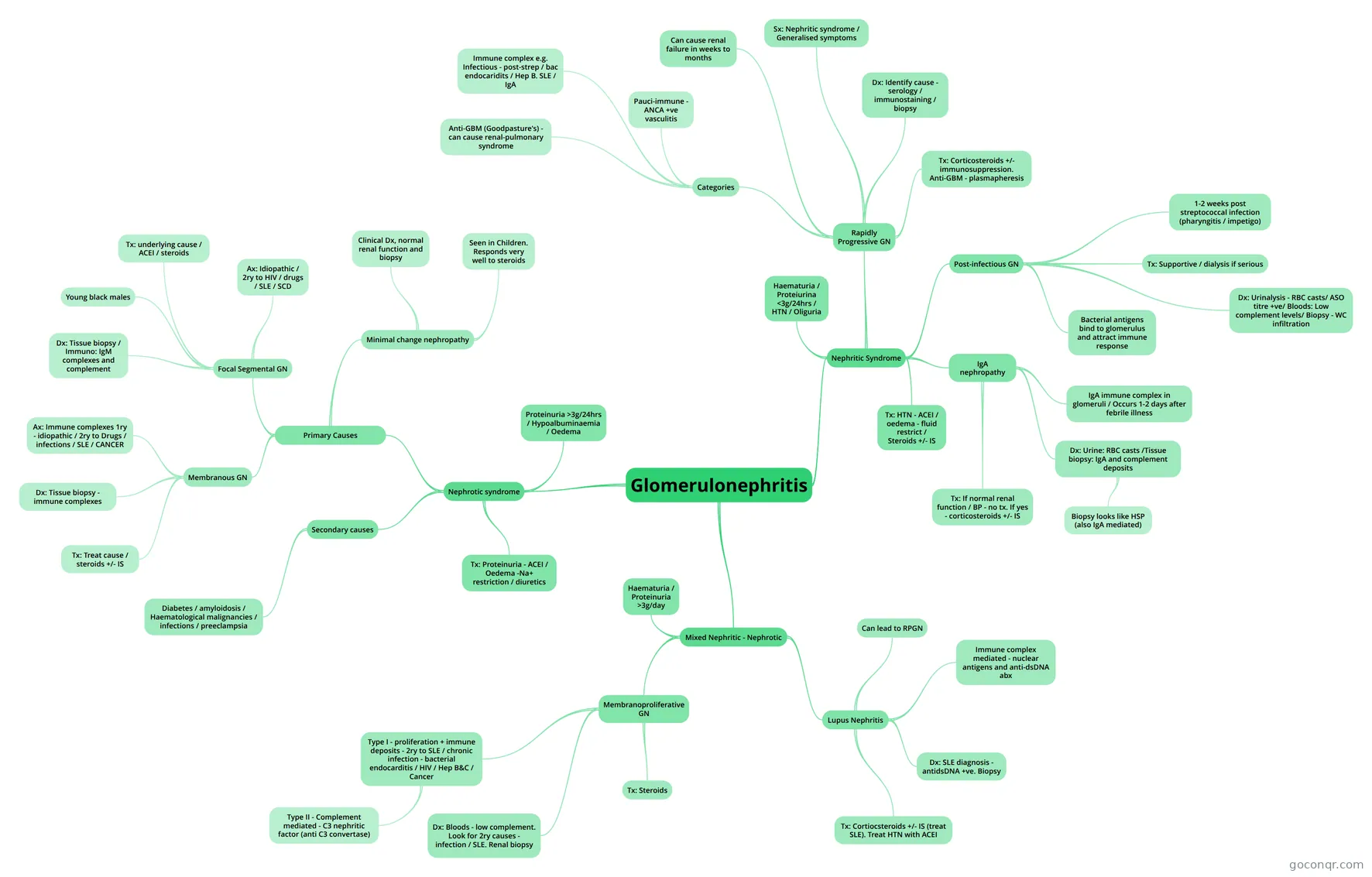
Flashcards
See all 197 flashcards-
26 cardsGlomerulonephritis Targets for injury in the nephron
-
142 cardsUrinalysis Unit 1 Review The total renal blood flow is approximately:
-
62 cardsRenal disease and its investigation I The renal medulla is highly vascularised which is useful for filtration. Which injury and clinical procedur...
-
23 cardsHistopathology of renal disease Diagnosis and clinical management of renal disease is often largely through biochemistry of blood and urine...
-
20 cardsGenetic Disease of the Kidneys congenital cystic diseases and age
-
46 cardsChapter 29 Alterations of Renal and Urinary Tract Function
-
7 cardsClinical Pathology Coloquim 1- Kidneys- 4th Year- PMU Clinical Pathology Coloquim 1- Kidneys- 4th Year- PMU
-
27 cardsRenal Path Type of Glomerular Pathology
Topics in Renal Disease
More Internal medicine, pathology and clinical semiology topics
About Renal Disease
GoConqr OriginalWhat this unit covers
The resources here follow the kidney from structure to failure. The mind map Diabetic nephropathy starts with the anatomy of the kidney, its blood supply and histology, then moves to glomerular filtration and clearance. Other maps cover acute kidney injury, including the RIFLE classification for staging, as well as chronic kidney disease, polycystic kidney disease, obstructive diseases, malignant tumours of the kidney and urinary symptoms such as oliguria.
Where to start
If the basics feel shaky, begin with a map. Diabetic nephropathy is a good first read because it builds the physiology that later topics rely on. Then open Glomerulonephritis, which separates nephritic from nephrotic syndrome and lists IgA nephropathy among its branches. After that, take on acute kidney injury and chronic kidney disease, which have many maps, decks and quizzes to choose from.
Using quizzes and maps together
Read a map first, then test yourself straight away. The Chronic Kidney Disease quiz asks about terms and the slow destruction of glomerular filtration, whatever the cause. The quiz Chapter 39: Alterations of Renal and Urinary Function asks how progressive nephron injury affects angiotensin II activity. Where an answer surprises you, go back to the matching map and read that branch again.
- Use the Glomerulonephritis flashcards for biopsy, subtypes and nephrotic features.
- Try the Nephrology Quiz for a longer case about a patient in intensive care.
- Look at UWorld Renal and Nephrology Board Review -- NephKAP if you are working towards USMLE-style questions.
Where it fits
This unit sits within the strand Renal, Endocrine, Metabolic and Reproductive Medicine, in the subject Internal medicine, pathology and clinical semiology. Most of the material is aimed at university level, with a small share for professional candidates. Teachers can pick out maps and quizzes to share with a class.
Ready to begin? Open a map that matches your next lecture, then try a quiz on the same topic and see what you remember.
Frequently asked questions
Which resource should I open first?
Start with the mind map Diabetic nephropathy. It moves from kidney anatomy, blood supply and histology to glomerular filtration and clearance, so it gives you a base for later topics. After that, try the Glomerulonephritis mind map and then the Chronic Kidney Disease quiz.
What do the mind maps cover?
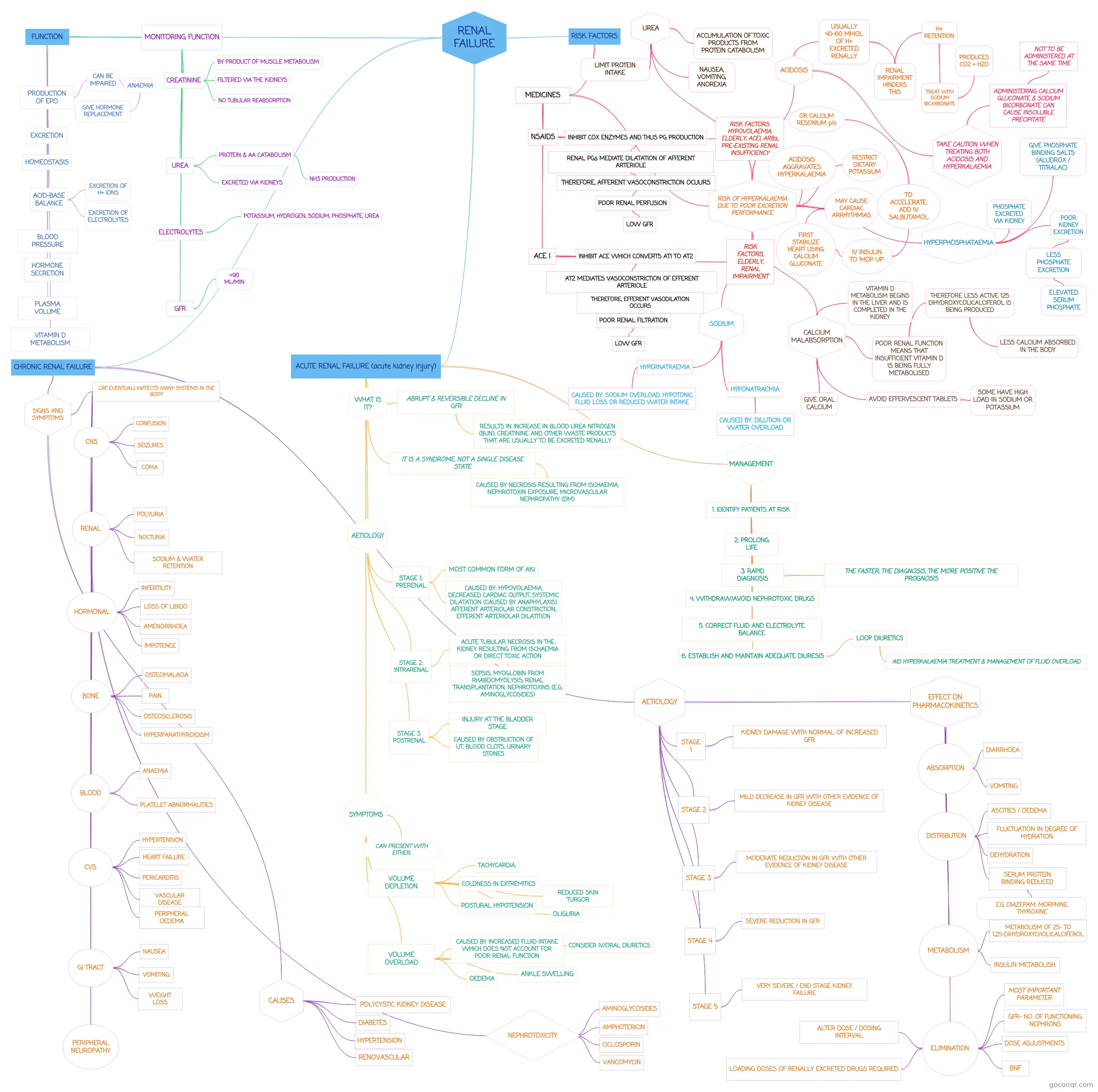
They range across acute kidney injury, chronic kidney disease, glomerulonephritis, nephritic syndrome, IgA nephropathy, polycystic kidney disease, urinary tract infections, obstructive diseases and malignant tumours of the kidney. There are also maps on laboratory tests of renal function, oliguria and proteinuria.
Are the resources free to use?
Yes. Every resource listed here is free to open, study and take, with no account needed. They were made by GoConqr users, not by GoConqr itself. If you create a free account, your quiz scores are saved and you can build your own quizzes, maps, flashcards and notes.
Which levels and exams do these suit?
Most of the resources are at university level, with a small share for professional candidates. One exam is mentioned in the listed material: USMLE. Decks such as UWorld Renal suit that style of question practice, though you should check each resource against your own course.
Is there anything for quick revision?
Yes. The flashcard decks cover short topics such as AKI, Hematuria, Renal Replacement Therapy and Tubulointerstitial Disease. Quizzes such as CKD staging and Nephrotic and Nephritic Syndromes are also useful for a quick check of what you remember.
What if my topic seems to be missing?
Look under a nearby heading first, as renal topics often appear inside broader maps or decks. Systemic Disease and the Kidney is one example. If you still cannot find it, you can make your own notes, map or flashcards on it.