
Mapa mental
MOTIVATION AND EMOTION
Conteúdo do mapa
MOTIVATION AND EMOTION
a valenced response to an external/internal stimulus
- Basic vs Emotional schemas
- Innate/evolutionary, automatic process, universal. Fear, anger, sadness, joy, surprise, disgust
- learned, developed, more complex. shame, jealousy
- Basic vs Emotional schemas
Energization of behaviour that gives direction (approach and avoidance) initiates, maintains, directs and finalizes an action
- Types of motivation
- Homeostasis: basic motivation to reach a stable physiological state, given a set point,
- settling point: equilibrium between opposite forces, affected by external elements (hunger vs satiety depending on availability of resources)
- extrinsic: external, linked to reward and punishment . leads to negative affect and undermines performance.
- intrinsic: internal, personal gain, needs, goal . leads to positive affect and greater performance
- Over-justification effect: reduction of intrinsic motivation by extrinsic reward
- Homeostasis: basic motivation to reach a stable physiological state, given a set point,
- NEEDS: satisfaction of a need is necessary for an organism to live a healthy life.
- psychological needs
- Deci & Ryan, Self-detemrination theory. basic needs: competence, autonomy, relatedness, people want to feel affective in their activities so they feel they are self chosen and to feel closeness to others.
- Epstein.basic needs: self esteem, relatedness (affection) and self consistency (safety) and pleasure
- American Dream: happinesss results when individuals acquire popularity, influence and money luxuries.
- Swann: need self enhancement and self consistency.
- Terror Management theory: individuals have desire to live. we are aware of our own death, therefore 2 defence mechanims: self-esteem, safety. less important: self-expansive.
- Deci & Ryan, Self-detemrination theory. basic needs: competence, autonomy, relatedness, people want to feel affective in their activities so they feel they are self chosen and to feel closeness to others.
- psychological and physiological
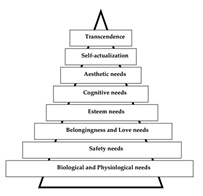
- MASLOW:
- CRITICISMS, developmental stages of affection. self-actualisation isnt functional under an evolutionary POV. developmental priorities may not be related to current priorities
- OTHER TYPES
- KENRIK, pyramid with evolutionary functions at top (mate acquisition, parenting, mate retention)
- Sheldon: converged theories. four fundamental are enhancement needs. competence, autonomy, belongingness and self-esteem. siggetsed 10 needs however other 6 changed across cultures
- MASLOW
- MASLOW:
- psychological needs
- DRIVES: acts of motivation that have primarily biological purposes
- Types of motivation
LINK : emotional schema can be temperamental or motivational. emotion modulates motivation to reach a goal.
NEURAL CORRELATES
- APPROACHES TO EMOTIONAL BRAIN
- LIMBIC SYSTEM THEORY. (MacLean). 1 system for all emotions,
- BASIC EMOTION THEORY. 6 basic emotions, each emotion has a different system.
- LEDOUX: one emotion processed at a time. how brain learns about, detects and responds to events/stimuli
- low road directly from thalamus to amygdala -> triggers/primes automatic responses. high road: thalamus -> sensory cortex (for analysis) -> amygdala (slower process)
- AMYGDALA: to give valence/relative value to a sensory input, mediates avoidance/approach.
- CENTRAL (innate responses, outputs)
- output to orbital & medial prefrontal cortex. leads to conscious experience of reward, planning to obtain reward and avoid punishment
- hypothalamus & brain stem: autonomic, endocrine and behavoural responses
- LATERAL (inputs)
- TRIGGER CELLS & STORAGE CELLS: associative learning and unconscious emotional memory (vs hippocampal conscious memory of emotion)
- FEAR & REWARD
- CENTRAL (innate responses, outputs)
- DOPAMINE:
- Ventral Tegmental Area (VTA - regulates) -> prefrontal & insular cortex/nucleus accumbens & limbic structures
- REWARD PREDICTION ERROR (Schultz): dopamine signal = actual reward - expected reward. +ve = activation, -ve = depression, 0 = no response
- increases effect of positive/negative motivators
- NUCLEUS ACCUMBENS (linked to reward, addiction and emotional stimuli)
- dopamine release occurs in anticipation of reward, so is motivational
- INPUTS: prefrontal association cortex, amygdala, dopaminergic cells of VTA
- OUTPUTS: basal ganglia-> thalamus -> prefrontal cortex. this leads to awareness.
- APPROACHES TO EMOTIONAL BRAIN
IMPULSIVITY: Acting suddenly, and without plan to satisfy immediate desire. Inability to inhibit inappropriate actions and insensitivity to consequences. (Moallem & Papachristou)
- Sensitivity to Reward: predisposition to detect and pursue rewarding stimuli
- Nucleus Accumbens: high activity shows more sensitivity to rewards -> more impulsive
- Demos: heightened activity to appetitive cues can predict future behaviors. eg. higher activity to a beer bottle stimulus predicts future alcohol intake
- Delay reward discounting: focus on ST reward compared to LT greater reward. Measured with IOWA gambling task
- Somatic Marker hypothesis: people have somatic markers that regulate decision making, more impulsive -> markers unable to be read and therefore not used as well -> worse decisions
- Risky decision making. Balloon Analog Risk Task
- Neural circuits
- +ve correlations to impulsivity
- ventral amygdala
- -ve correlations to impulsivity
- dorsal amygdala.
- +ve correlations to impulsivity
- Behaviorual Activation System: regulates appetitive and reward seeking behaviour, increases motor output. Behavioural Inhibition System: passive avoidance of punishment and non-reward, decreases motor output
- Nucleus Accumbens: high activity shows more sensitivity to rewards -> more impulsive
- Response Inhibition: ability to inhibit thoughts or behaviour. measured with Go-nogo tasks (stop-signal task)
- poor response inhibition, -> risk factor as makes more vulnerable to contextual cues -> more impulsivity.
- Neural Circuits
- +ve correlation to impulsivity
- Bilateral Caudale
- Dorsal anterior cingulate gyrus.
- -ve correlation to impulsivity
- vPFC
- +ve correlation to impulsivity
- Measurement as a personality trait: Barratt Impulsiveness Scale
- Sensitivity to Reward: predisposition to detect and pursue rewarding stimuli
Imagens e arquivos do mapa
Informações
- Descrição
- Mapa Mental sobre MOTIVATION AND EMOTION, criado por dockergirl94 em 30-04-2014.
- Criado por
- dockergirl94
- Visualizações
- 108
- Avaliação