
Mapa mental
Religious Experiences
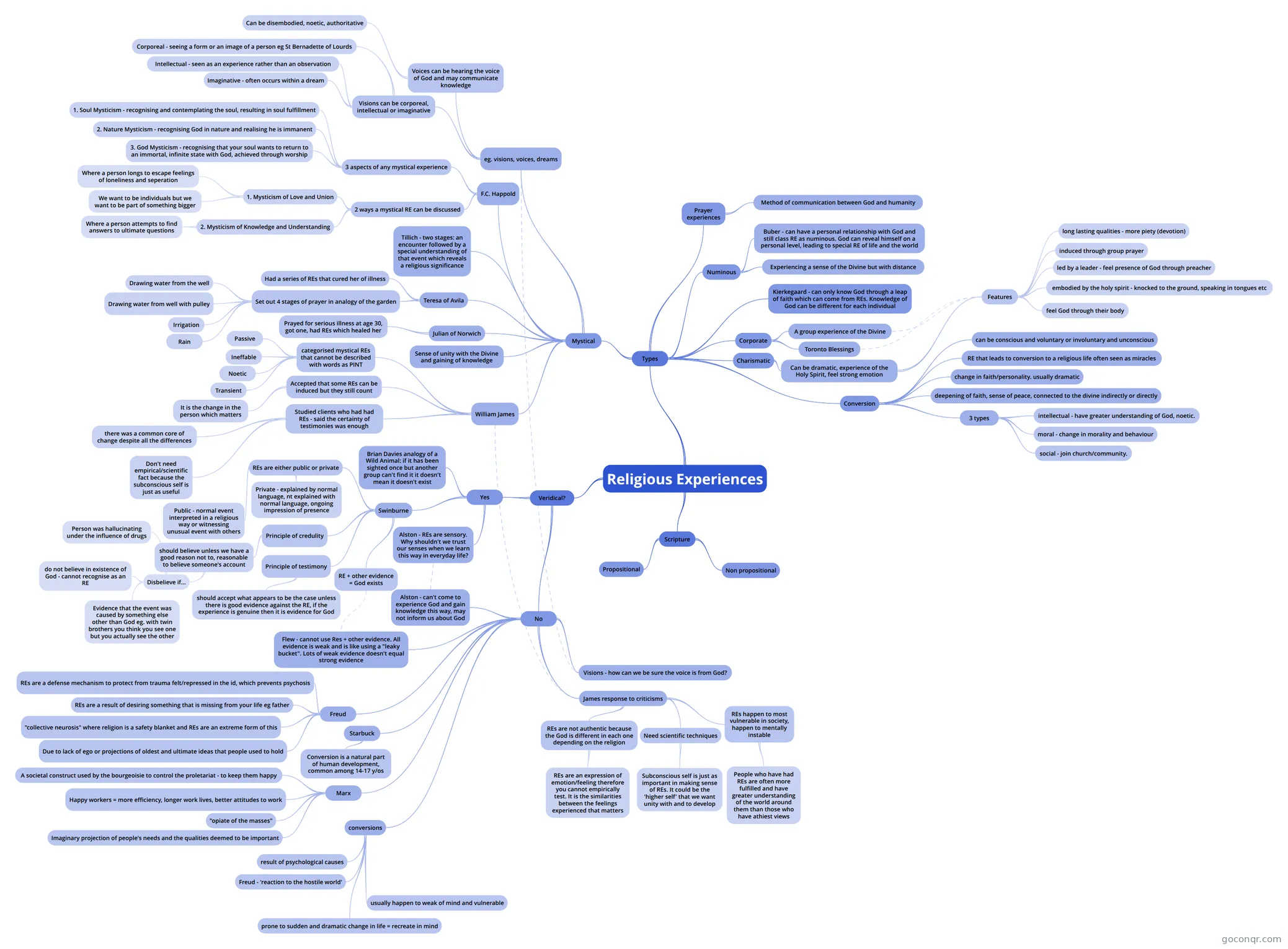
Mind map: religious experiences
Conteúdo do mapa
Religious Experiences
Types
- Mystical
- William James
- categorised mystical REs that cannot be described with words as PINT
- Passive
- Noetic
- Ineffable
- Transient
- Accepted that some REs can be induced but they still count
- It is the change in the person which matters
- Studied clients who had had REs - said the certainty of testimonies was enough
- there was a common core of change despite all the differences
- Don't need empirical/scientific fact because the subconscious self is just as useful
- categorised mystical REs that cannot be described with words as PINT
- Teresa of Avila
- Had a series of REs that cured her of illness
- Set out 4 stages of prayer in analogy of the garden
- Drawing water from the well
- Drawing water from well with pulley
- Irrigation
- Rain
- Julian of Norwich
- Prayed for serious illness at age 30, got one, had REs which healed her
- Sense of unity with the Divine and gaining of knowledge
- eg. visions, voices, dreams
- Visions can be corporeal, intellectual or imaginative
- Corporeal - seeing a form or an image of a person eg St Bernadette of Lourds
- Intellectual - seen as an experience rather than an observation
- Imaginative - often occurs within a dream
- Voices can be hearing the voice of God and may communicate knowledge
- Can be disembodied, noetic, authoritative
- Visions can be corporeal, intellectual or imaginative
- Tillich - two stages: an encounter followed by a special understanding of that event which reveals a religious significance
- F.C. Happold
- 2 ways a mystical RE can be discussed
- 1. Mysticism of Love and Union
- Where a person longs to escape feelings of loneliness and seperation
- We want to be individuals but we want to be part of something bigger
- 2. Mysticism of Knowledge and Understanding
- Where a person attempts to find answers to ultimate questions
- 1. Mysticism of Love and Union
- 3 aspects of any mystical experience
- 1. Soul Mysticism - recognising and contemplating the soul, resulting in soul fulfillment
- 2. Nature Mysticism - recognising God in nature and realising he is immanent
- 3. God Mysticism - recognising that your soul wants to return to an immortal, infinite state with God, achieved through worship
- 2 ways a mystical RE can be discussed
- William James
- Numinous
- Experiencing a sense of the Divine but with distance
- Buber - can have a personal relationship with God and still class RE as numinous. God can reveal himself on a personal level, leading to special RE of life and the world
- Corporate
- A group experience of the Divine
- Toronto Blessings
- Charismatic
- Can be dramatic, experience of the Holy Spirit, feel strong emotion
- Features
- induced through group prayer
- led by a leader - feel presence of God through preacher
- embodied by the holy spirit - knocked to the ground, speaking in tongues etc
- feel God through their body
- long lasting qualities - more piety (devotion)
- Features
- Can be dramatic, experience of the Holy Spirit, feel strong emotion
- Conversion
- RE that leads to conversion to a religious life often seen as miracles
- change in faith/personality. usually dramatic
- deepening of faith, sense of peace, connected to the divine indirectly or directly
- 3 types
- intellectual - have greater understanding of God, noetic.
- moral - change in morality and behaviour
- social - join church/community.
- can be conscious and voluntary or involuntary and unconscious
- Prayer experiences
- Method of communication between God and humanity
- Kierkegaard - can only know God through a leap of faith which can come from REs. Knowledge of God can be different for each individual
- Mystical
Scripture
- Propositional
- Non propositional
Veridical?
- Yes
- Swinburne
- REs are either public or private
- Public - normal event interpreted in a religious way or witnessing unusual event with others
- Private - explained by normal language, nt explained with normal language, ongoing impression of presence
- Principle of credulity
- should believe unless we have a good reason not to, reasonable to believe someone's account
- Disbelieve if...
- Person was hallucinating under the influence of drugs
- do not believe in existence of God - cannot recognise as an RE
- Evidence that the event was caused by something else other than God eg. with twin brothers you think you see one but you actually see the other
- Disbelieve if...
- should believe unless we have a good reason not to, reasonable to believe someone's account
- Principle of testimony
- should accept what appears to be the case unless there is good evidence against the RE, if the experience is genuine then it is evidence for God
- RE + other evidence = God exists
- REs are either public or private
- Brian Davies analogy of a Wild Animal: if it has been sighted once but another group can't find it it doesn't mean it doesn't exist
- Alston - REs are sensory. Why shouldn't we trust our senses when we learn this way in everyday life?
- Swinburne
- No
- Flew - cannot use Res + other evidence. All evidence is weak and is like using a "leaky bucket". Lots of weak evidence doesn't equal strong evidence
- Alston - can't come to experience God and gain knowledge this way, may not inform us about God
- Freud
- REs are a defense mechanism to protect from trauma felt/repressed in the id, which prevents psychosis
- REs are a result of desiring something that is missing from your life eg father
- "collective neurosis" where religion is a safety blanket and REs are an extreme form of this
- Due to lack of ego or projections of oldest and ultimate ideas that people used to hold
- Marx
- A societal construct used by the bourgeoisie to control the proletariat - to keep them happy
- Happy workers = more efficiency, longer work lives, better attitudes to work
- "opiate of the masses"
- Imaginary projection of people's needs and the qualities deemed to be important
- James response to criticisms
- REs are not authentic because the God is different in each one depending on the religion
- REs are an expression of emotion/feeling therefore you cannot empirically test. It is the similarities between the feelings experienced that matters
- Need scientific techniques
- Subconscious self is just as important in making sense of REs. It could be the 'higher self' that we want unity with and to develop
- REs happen to most vulnerable in society, happen to mentally instable
- People who have had REs are often more fulfilled and have greater understanding of the world around them than those who have athiest views
- REs are not authentic because the God is different in each one depending on the religion
- Visions - how can we be sure the voice is from God?
- Starbuck
- Conversion is a natural part of human development, common among 14-17 y/os
- conversions
- result of psychological causes
- Freud - 'reaction to the hostile world'
- prone to sudden and dramatic change in life = recreate in mind
- usually happen to weak of mind and vulnerable
- Yes
Informações
- Descrição
- AS - Level Philosophy and Ethics (Religious Experiences) Mapa Mental sobre Religious Experiences, criado por Alice Storr em 21-03-2017.
- Criado por
- Alice Storr
- Visualizações
- 48
- Tags
- Avaliação