
Mapa mental
Situation ethics
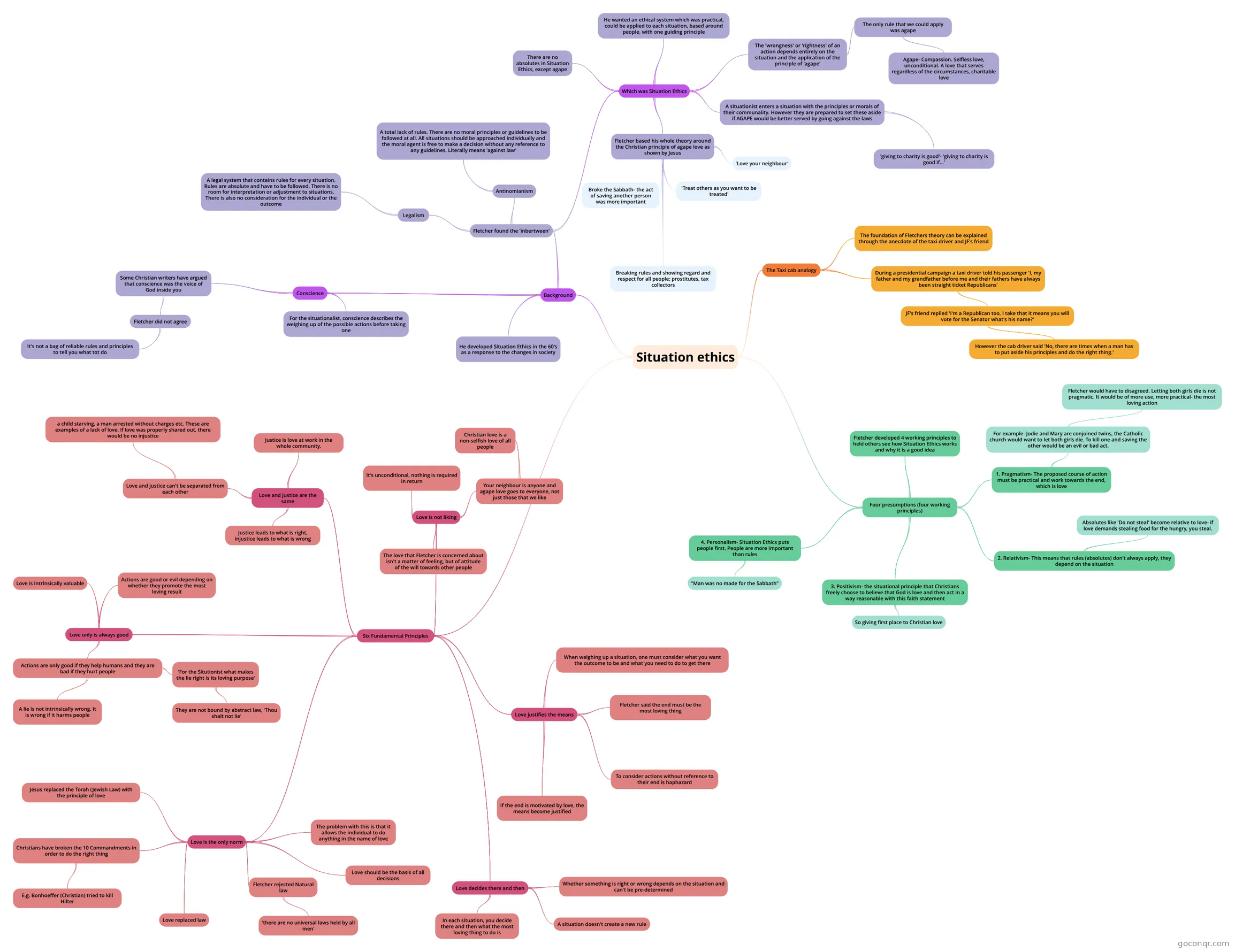
Mind map: Situation ethics
Conteúdo do mapa
Situation ethics
Background
- Fletcher found the 'inbertween'
- Legalism
- A legal system that contains rules for every situation. Rules are absolute and have to be followed. There is no room for interpretation or adjustment to situations. There is also no consideration for the individual or the outcome
- Antinomianism
- A total lack of rules. There are no moral principles or guidelines to be followed at all. All situations should be approached individually and the moral agent is free to make a decision without any reference to any guidelines. Literally means 'against law'
- Which was Situation Ethics
- He wanted an ethical system which was practical, could be applied to each situation, based around people, with one guiding principle
- The 'wrongness' or 'rightness' of an action depends entirely on the situation and the application of the principle of 'agape'
- The only rule that we could apply was agape
- Agape- Compassion. Selfless love, unconditional. A love that serves regardless of the circumstances, charitable love
- The only rule that we could apply was agape
- A situationist enters a situation with the principles or morals of their communality. However they are prepared to set these aside if AGAPE would be better served by going against the laws
- 'giving to charity is good'- 'giving to charity is good if...'
- There are no absolutes in Situation Ethics, except agape
- Fletcher based his whole theory around the Christian principle of agape love as shown by Jesus
- 'Love your neighbour'
- 'Treat others as you want to be treated'
- Breaking rules and showing regard and respect for all people; prostitutes, tax collectors
- Broke the Sabbath- the act of saving another person was more important
- Legalism
- He developed Situation Ethics in the 60's as a response to the changes in society
- Conscience
- Some Christian writers have argued that conscience was the voice of God inside you
- Fletcher did not agree
- It's not a bag of reliable rules and principles to tell you what tot do
- Fletcher did not agree
- For the situationalist, conscience describes the weighing up of the possible actions before taking one
- Some Christian writers have argued that conscience was the voice of God inside you
- Fletcher found the 'inbertween'
The Taxi cab analogy
- The foundation of Fletchers theory can be explained through the anecdote of the taxi driver and JF's friend
- During a presidential campaign a taxi driver told his passenger 'I, my father and my grandfather before me and their fathers have always been straight ticket Republicans'
- JF's friend replied 'I'm a Republican too, I take that it means you will vote for the Senator what's his name?'
- However the cab driver said 'No, there are times when a man has to put aside his principles and do the right thing.'
- JF's friend replied 'I'm a Republican too, I take that it means you will vote for the Senator what's his name?'
Four presumptions (four working principles)
- Fletcher developed 4 working principles to held others see how Situation Ethics works and why it is a good idea
- 1. Pragmatism- The proposed course of action must be practical and work towards the end, which is love
- For example- Jodie and Mary are conjoined twins, the Catholic church would want to let both girls die. To kill one and saving the other would be an evil or bad act.
- Fletcher would have to disagreed. Letting both girls die is not pragmatic. It would be of more use, more practical- the most loving action
- For example- Jodie and Mary are conjoined twins, the Catholic church would want to let both girls die. To kill one and saving the other would be an evil or bad act.
- 2. Relativism- This means that rules (absolutes) don't always apply, they depend on the situation
- Absolutes like 'Do not steal' become relative to love- if love demands stealing food for the hungry, you steal.
- 3. Positivism- the situational principle that Christians freely choose to believe that God is love and then act in a way reasonable with this faith statement
- So giving first place to Christian love
- 4. Personalism- Situation Ethics puts people first. People are more important than rules
- "Man was no made for the Sabbath"
Six Fundamental Principles
- Love only is always good
- Love is intrinsically valuable
- Actions are only good if they help humans and they are bad if they hurt people
- A lie is not intrinsically wrong. It is wrong if it harms people
- 'For the Situtionist what makes the lie right is its loving purpose'
- They are not bound by abstract law, 'Thou shalt not lie'
- Actions are good or evil depending on whether they promote the most loving result
- Love is the only norm
- Jesus replaced the Torah (Jewish Law) with the principle of love
- Christians have broken the 10 Commandments in order to do the right thing
- E.g. Bonhoeffer (Christian) tried to kill Hilter
- Love replaced law
- Fletcher rejected Natural law
- 'there are no universal laws held by all men'
- The problem with this is that it allows the individual to do anything in the name of love
- Love should be the basis of all decisions
- Love and justice are the same
- Love and justice can't be separated from each other
- a child starving, a man arrested without charges etc. These are examples of a lack of love. If love was properly shared out, there would be no injustice
- Justice is love at work in the whole community.
- Justice leads to what is right, injustice leads to what is wrong
- Love and justice can't be separated from each other
- Love is not liking
- Your neighbour is anyone and agape love goes to everyone, not just those that we like
- Christian love is a non-selfish love of all people
- It's unconditional, nothing is required in return
- The love that Fletcher is concerned about isn't a matter of feeling, but of attitude of the will towards other people
- Your neighbour is anyone and agape love goes to everyone, not just those that we like
- Love justifies the means
- When weighing up a situation, one must consider what you want the outcome to be and what you need to do to get there
- Fletcher said the end must be the most loving thing
- To consider actions without reference to their end is haphazard
- If the end is motivated by love, the means become justified
- Love decides there and then
- Whether something is right or wrong depends on the situation and can't be pre-determined
- A situation doesn't create a new rule
- In each situation, you decide there and then what the most loving thing to do is
- Love only is always good
Informações
- Descrição
- AS level Philosophy, theology and ethics Mapa Mental sobre Situation ethics, criado por Leah Holland em 11-05-2017.
- Criado por
- Leah Holland
- Visualizações
- 0
- Histórico
-
- Criado por Jodie Bell · 13 mar 2017
- Copiado por Leah Holland · 11 mai 2017
- Avaliação