
Mapa mental
A2 Philosophy - Key Words
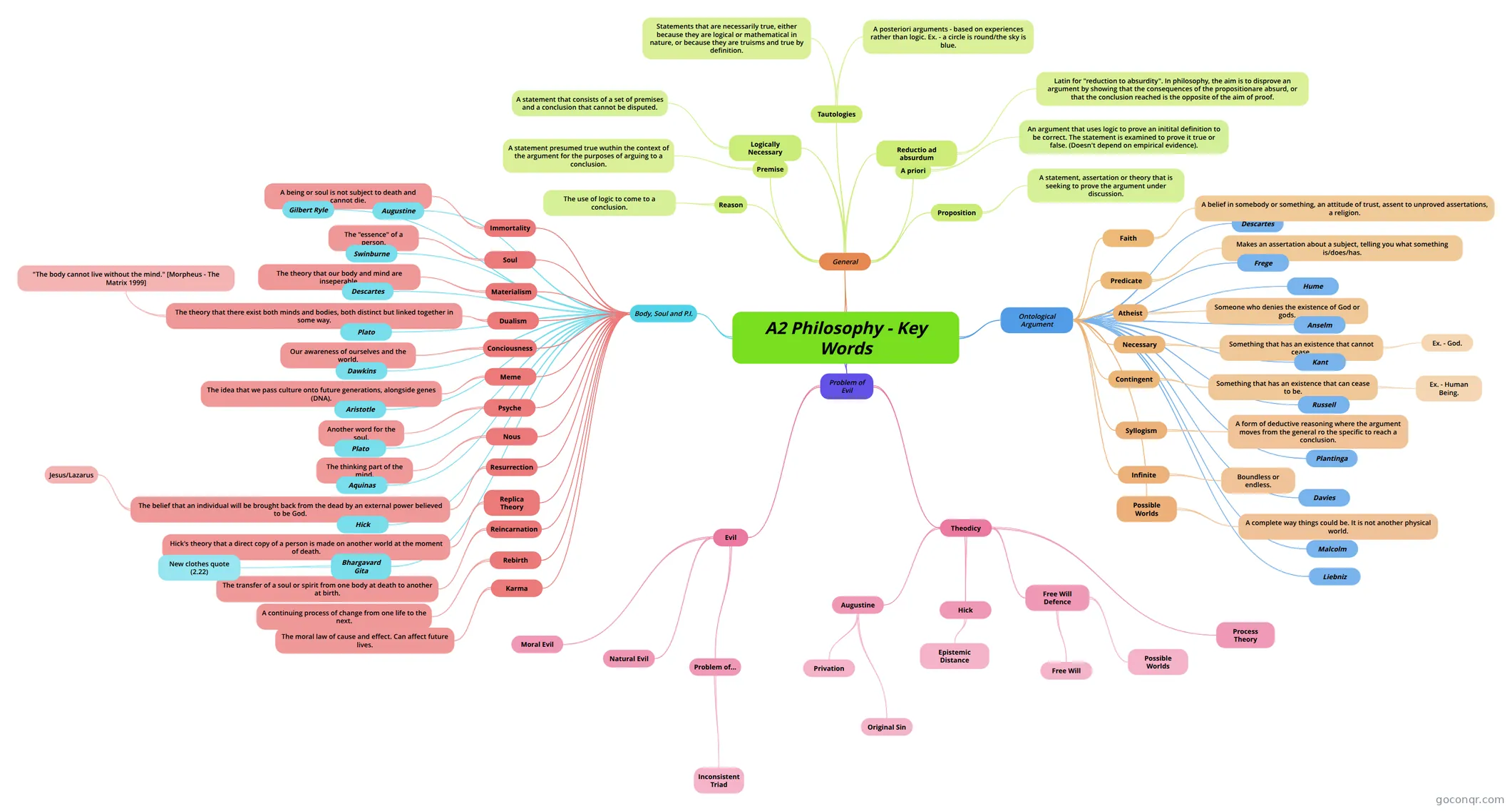
Mind map: A2 philosophy key words
Conteúdo do mapa
A2 Philosophy - Key Words
Ontological Argument
- Atheist
- Someone who denies the existence of God or gods.
- Necessary
- Something that has an existence that cannot cease.
- Ex. - God.
- Something that has an existence that cannot cease.
- Contingent
- Something that has an existence that can cease to be.
- Ex. - Human Being.
- Something that has an existence that can cease to be.
- Syllogism
- A form of deductive reasoning where the argument moves from the general ro the specific to reach a conclusion.
- Possible Worlds
- A complete way things could be. It is not another physical world.
- Infinite
- Boundless or endless.
- Predicate
- Makes an assertation about a subject, telling you what something is/does/has.
- Faith
- A belief in somebody or something, an attitude of trust, assent to unproved assertations, a religion.
- Descartes
- Anselm
- Kant
- Hume
- Russell
- Plantinga
- Davies
- Malcolm
- Frege
- Liebniz
- Atheist
General
- Reason
- The use of logic to come to a conclusion.
- Proposition
- A statement, assertation or theory that is seeking to prove the argument under discussion.
- Premise
- A statement presumed true wuthin the context of the argument for the purposes of arguing to a conclusion.
- A priori
- An argument that uses logic to prove an initital definition to be correct. The statement is examined to prove it true or false. (Doesn't depend on empirical evidence).
- Logically Necessary
- A statement that consists of a set of premises and a conclusion that cannot be disputed.
- Tautologies
- Statements that are necessarily true, either because they are logical or mathematical in nature, or because they are truisms and true by definition.
- A posteriori arguments - based on experiences rather than logic. Ex. - a circle is round/the sky is blue.
- Reductio ad absurdum
- Latin for "reduction to absurdity". In philosophy, the aim is to disprove an argument by showing that the consequences of the propositionare absurd, or that the conclusion reached is the opposite of the aim of proof.
- Reason
Problem of Evil
- Evil
- Moral Evil
- Natural Evil
- Problem of...
- Inconsistent Triad
- Theodicy
- Augustine
- Privation
- Original Sin
- Hick
- Epistemic Distance
- Free Will Defence
- Free Will
- Possible Worlds
- Process Theory
- Augustine
- Evil
Body, Soul and P.I.
- Immortality
- A being or soul is not subject to death and cannot die.
- Soul
- The "essence" of a person.
- Materialism
- The theory that our body and mind are inseperable.
- Dualism
- The theory that there exist both minds and bodies, both distinct but linked together in some way.
- "The body cannot live without the mind." [Morpheus - The Matrix 1999]
- The theory that there exist both minds and bodies, both distinct but linked together in some way.
- Conciousness
- Our awareness of ourselves and the world.
- Meme
- The idea that we pass culture onto future generations, alongside genes (DNA).
- Psyche
- Another word for the soul.
- Nous
- The thinking part of the mind.
- Resurrection
- The belief that an individual will be brought back from the dead by an external power believed to be God.
- Jesus/Lazarus
- The belief that an individual will be brought back from the dead by an external power believed to be God.
- Replica Theory
- Hick's theory that a direct copy of a person is made on another world at the moment of death.
- Reincarnation
- The transfer of a soul or spirit from one body at death to another at birth.
- Rebirth
- A continuing process of change from one life to the next.
- Karma
- The moral law of cause and effect. Can affect future lives.
- Augustine
- Descartes
- Swinburne
- Plato
- Gilbert Ryle
- Dawkins
- Aristotle
- Plato
- Aquinas
- Hick
- Bhargavard Gita
- New clothes quote (2.22)
- Immortality
Informações
- Descrição
- Philosophy Mapa Mental sobre A2 Philosophy - Key Words, criado por jessica.kenmore em 20-05-2014.
- Criado por
- jessica.kenmore
- Visualizações
- 216
- Tags
- Avaliação