
Mapa mental
Physics EOY Revision
Conteúdo do mapa
Physics EOY Revision
Sound
- Waves and Speed of Sound
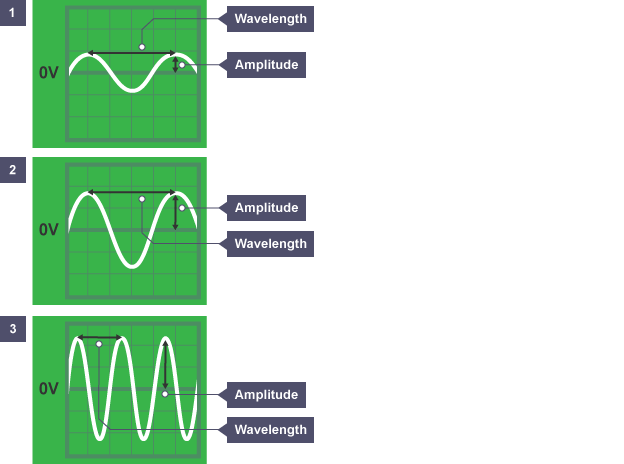
- The amplitude is the maximum height of the wave from its resting position – the greater the amplitude, the louder the sound. The wavelength is the distance between the crests (tops) of two waves next to each other (or any other two identical point on waves next to each other). The frequency is the number of waves per second – the higher the frequency, the closer together the waves are and the higher the pitch.
- The speed of sound is the distance travelled per unit time by a sound wave as it propagates through an elastic medium. In dry air at 20 °C, the speed of sound is 343 metres per second, or a kilometre in 2.91 s or a mile in 4.69 s.
- The amplitude is the maximum height of the wave from its resting position – the greater the amplitude, the louder the sound. The wavelength is the distance between the crests (tops) of two waves next to each other (or any other two identical point on waves next to each other). The frequency is the number of waves per second – the higher the frequency, the closer together the waves are and the higher the pitch.
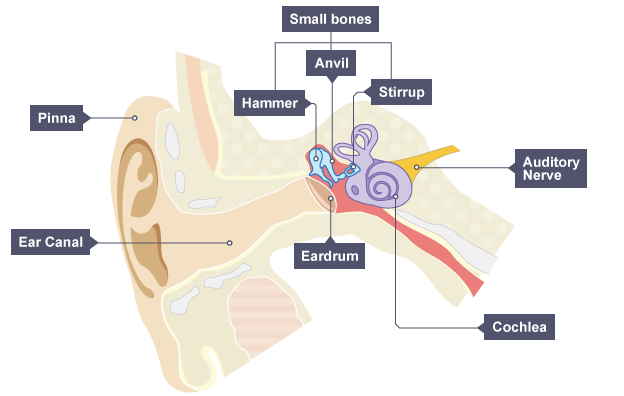
- The Ear
- What is Sound
- Sound is the energy things produce when they vibrate (move back and forth quickly). If you bang a drum, you make the tight skin vibrate at very high speed (it's so fast that you can't usually see it), forcing the air all around it to vibrate as well. As the air moves, it carries energy out from the drum in all directions. Eventually, even the air inside your ears starts vibrating—and that's when you begin to perceive the vibrating drum as a sound. In short, there are two different aspects to sound: there's a physical process that produces sound energy to start with and sends it shooting through the air, and there's a separate psychological process that happens inside our ears and brains, which convert the incoming sound energy into sensations we interpret as noises, speech, and music. We're just going to concentrate on the physical aspects of sound in this article. Sound is like light in some ways: it travels out from a definite source (such as an instrument or a noisy machine).
- How Sound travels
- Sound is transmitted by particles (atoms or molecules) in a solid, liquid or gas colliding with each other. It is a wave which is created by vibrating objects and propagated through a medium (solid, liquid or gas) from one location to another. A vibrating source can be sound coming from a drum, speaker of a radio, the mouth of a person (vocal chord), a car engine, a plane above the sky and so on. Although sound is commonly associated in air, sound will readily travel through many materials that are solid, liquid and gas.
- Waves and Speed of Sound
Light
- Reflection, Refraction and Diffraction.
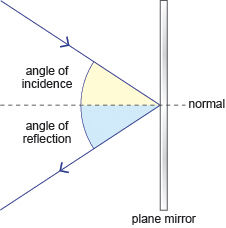
- Reflection. Light waves reflect from surfaces. When waves reflect, they obey the law of reflection: the angle of incidence equals the angle of reflection. The normal is a line drawn at right angles to the reflector. The angle of incidence is between the incident (incoming) ray and the normal. The angle of reflection is between the reflected ray and the normal.
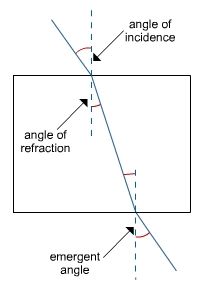
- Refraction. Light waves change speed when they pass across the boundary between two substances with different densities, such as air and glass. This causes them to change direction and this effect is called refraction. There is one special case you need to know. Refraction doesn't happen if they cross the boundary at an angle of 90° (called the normal) - in that case they carry straight on. The refraction follows a regular pattern.
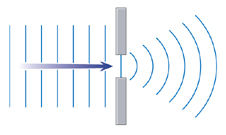
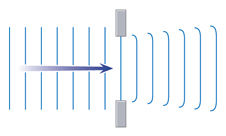
- Diffraction. When waves meet a gap in a barrier, they carry on through the gap. However, the waves spread out to some extent into the area beyond the gap. This is diffraction. The extent of the spreading depends on how the width of the gap compares to the wavelength of the waves. Significant diffraction only happens when the wavelength is of the same order of magnitude as the gap. For example: a gap much larger than the wavelength causes little spreading and a sharp shadow eg light through a doorway a gap similar to the wavelength causes a lot of spreading with no sharp shadow eg sound through a doorway
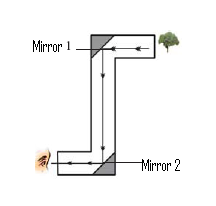
- Periscope Ray Diagram
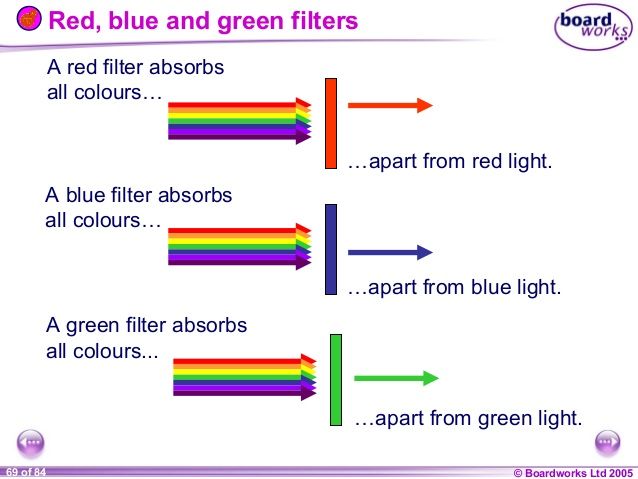
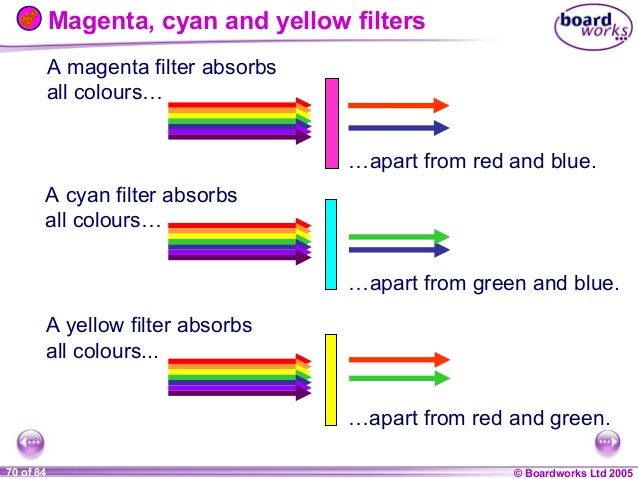
- Light Colours filters
- Reflection, Refraction and Diffraction.
Pressure and Moments
- pressure = force ÷ area
- Weight is not the same as mass. Mass is a measure of how much stuff is in an object. Weight is a force acting on that stuff. Weight is the result of gravity. The Earth's gravity attracts objects towards the centre of the Earth and you feel forces like this as weight. Here is the equation that links weight, mass and gravitational field strength weight = mass × gravitational field strength Weight is measured in newtons, N Mass is measured in kilograms, kg The gravitational field strength is measured in newtons per kilogram, N/kg For example, the gravitational field strength is: 10 N/kg on Earth 1.6 N/kg on the Moon You would weigh less on the Moon because the gravitational field strength of the Moon is about one-sixth of that of the Earth. But note that your mass would stay the same. For example, what is the weight of an 80 kg person on Earth and on the Moon? On Earth, weight = 80 × 10 = 800 N On the Moon, weight = 80 × 1.6 = 128 N
- A moment is the turning effect of a force around a fixed point called a pivot. For example, this could be a door opening around a fixed hinge or a spanner turning around a fixed nut. The size of a moment depends on two factors: the size of the force applied the perpendicular distance from the pivot to the line of action of the force This explains why less force is needed to open a door by pushing at the side furthest from the hinge than at the side closest to the hinge. To push at the hinge side of the door requires more force to be exerted because the distance is smaller. A moment can be calculated using this equation: M = F × d
- An equation triangle showing moments: M over F and d. Where: M = the moment of the force in newton-metres Nm, F = the force in newtons, N d = the perpendicular distance from the line of action of the force to the pivot in metres, M.
Magnetism
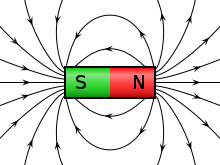
- Magnetic Fields (with compasses)
- Magnetic Materials
- Iron, Cobalt, Nickel, Aluminium, Magnetite and Manganeese
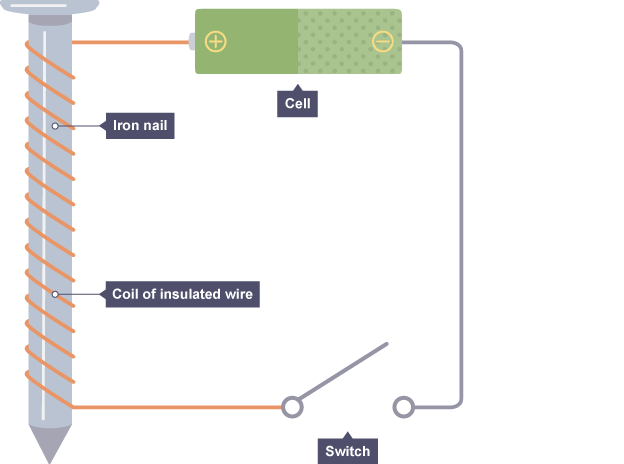
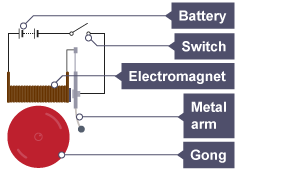
- Electromagnet and Electric Bell
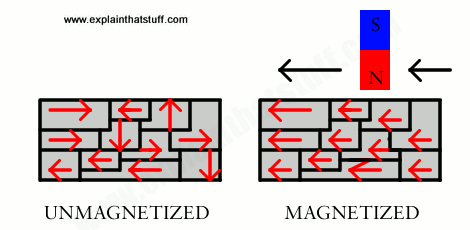
- Magnet Domains
- Magnetic Fields (with compasses)
Imagens e arquivos do mapa
Informações
- Descrição
- Year 8 Physics Mapa Mental sobre Physics EOY Revision, criado por Anonymous Guy em 08-06-2017.
- Criado por
- Anonymous Guy
- Visualizações
- 2
- Avaliação