
Mapa mental
Students Assessments

Conteúdo do mapa
Students Assessments
diagnostic
- Definition: A diagnostic assessment is used to determine what a student knows before teaching a lesson, in order to inform how the lesson will be taught. It is also used after a lesson to determine how much of a lesson was learned by student(s). Purpose: It is used to determine what the level of understanding is, in order to inform the next step in the learning process. Advantages: It can help teacher devise a plan for a lesson, and influence differentiation strategies. Disadvantages: The results can be difficult to interpret, and therefore misleading. Of learning or For learning: For learning. 4th Grade Example: Before lesson on poetry, teacher can give a quiz on vocabulary of structural elements and examples of poems to get an idea of how to start the lesson and where to go with it.
peer assessment
- Definition: Students work together to understand concept and give each other feedback on each other's work Purpose: To create a deeper understanding of content. To learn from each other's successes and mistakes. Students more fully absorb the assessment criteria that is used in the lesson if they have to apply it to their peer in assessment. Advantages: Good for class cohesion. Frees up teacher to give help where it is needed. Disadvantages: The teacher does not know if all of the students are helping each other or not. Of learning or For learning: For learning 4th Grade Example: Evaluating poem written by peer that is supposed to contain specific structural elements. Peer says what he/she liked about poem, asks writer to point out structural elements, gives writer suggestions.
formative
- Definition: Assessments that are part of the instruction process, designed to influence the teaching and learning of a lesson or concept. Purpose: To assess how on task students are and to assess how well a concept or lesson is being understood while the lesson is being learned. Advantages: Teacher is able to alter lesson accordingly for the class and/or the student. Can relieve test anxiety for students with low pressure assessments throughout lesson/unit. Disadvantages: Can be time consuming for the teacher. Of learning or For learning: Formative assessments are pretty much the definition of "For learning" -- used as a part of the learning and instructional process throughout the lesson/unit. 4th Grade Example: Students hand in journals with language arts project outlines for teacher assessment. Exit tickets can be used as quick measure of how many students understand vocabulary words.
summative
- Definition: Summative assessments are designed to measure how much of a lesson/concept has been learned after the lesson/unit has been completed. Purpose: To assess how much of a lesson/unit has been learned by student(s) after the lesson/unit has been taught. There are many levels of summative assessment, from high stakes to end of unit tests. Advantages: Gives students something to strive for, often with grading rubrics included as students work toward final summative assessment. Can be combined with formative assessments so progress can be monitored and lesson can be modified to get student in better place to do well on summative assessment. Disadvantages: Puts pressure on one test to judge student grasp of information. Teachers may teach toward the final test as opposed to differentiating and checking in with progress along the way. Of learning or For learning: Summative is "Of learning" because it measures grasp of subject matter after unit/lesson is complete, with no further revisitation of unit/lesson. If student is allowed to retake test, it becomes formative, or "For learning". 4th Grade Example: Final Performance of drama containing specific language arts structural elements. Another form would be a high-stake test like the California Achievement Tests
high-stakes
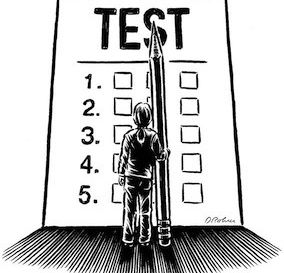
- Definition: High-stakes assessment is when test results are used to make important decisions about students, educators, or schools. Purpose: Can be used to decide whether a student graduates or passes a grade. Can be used in teacher evaluation, including tenure, pay rate, and hiring. Can be used in school evaluation, which may include state and federal funding, school categorizing and/or closing. Advantages: Gives students, teachers and schools a goal to work toward. It is a consistent measure. Disadvantages: Teachers teach toward test and not toward learning. Of learning or For learning: Of learning, because it is used at the end of an educational period to judge level of success. 4th Grade Example: California Achievement Tests
performance-based
- Definition: Performance-based assessment measures students ability to apply a concept(s) or unit lesson(s) in a high level, real world manner. They are often open-ended, student-oriented, and time-based. Purpose: To measure how well students can apply a concept or lesson in a complex, real application. Advantages: Personalizes the lesson, leaving room for student to make it his/her own, while meeting the objectives of lesson and internalizing the information by applying it directly to the final product. It offers students many different perspectives based on the same concept. Disadvantages: Time consuming, must be designed well and periodically assessed to ensure that the main objective is being learned. Grading can be more subjective. Of learning or For learning: For learning, because assessments are embedded throughout the project. 4th Grade Example: Students working in small groups to develop an example of drama that will be performed and will include five basic structural elements of drama to be discussed.
portfolio
- Definition: Portfolio assessment involves periodic evaluations with students' ongoing collection of assignments that have a common or related goal. Purpose: To be able to trace progress over a period of time. Can be helpful in showing parents a cohesive body of work and focus on any patterns of understanding or struggling with material. Advantages: Provides many opportunities for formative assessment as projects continue. Disadvantages: It is a subjective form of assessment and students may be held to different standards Of learning or For learning: For learning, as it is very process-oriented. 4th Grade Example: Writing journals for creative writing unit on poems, drama, and prose. Useful for drafts, and other quick exercises that can be easily turned in to teacher and returned.
authentic
- Definition: Authentic assessment deals with assessing how a skill or lesson has been learned in a way that establishes grasp of real world application. Purpose: Deeper learning of concept because it recognizes the process of learning and incorporating the material in a higher level of applied learning. Advantages: This student-oriented assessment can allow the student to decide a self-motivated and self-satisfying direction to take the concept or lesson in, creating a deeper understanding for the student, and letting the teacher know how high of a level of understanding the student has. Disadvantages: Can be difficult to quantify, recognize, and measure the skills that make up the objective. Of learning or For learning: Of learning ultimately, but for project-based activities, there are plenty of opportunities for the "for learning" assessing, as it celebrate the process as much as the end content. 4th Grade Example: Have students write poem in any style, and be able to point out and define 5 structural elements. This gives students opportunity to use the structural element knowledge to create a real life example of applied language arts.
self-assessment
- Definition: Self-assessment is a measure of a student's grasp of a lesson or concept that is directed by that student, using a predetermined rubric or learning plan to guide his/her assessment. Purpose: To involve the student in the learning process from the inside out. Instead of learning for the teacher's opinion/assessment, the student is more in control of knowing how he/she is doing, because he/she has a guide to follow, and theoretically will be more inclined to check all of the boxes that need checking when completing the assignment. Advantages: Internalizes the learning and gives student a sense of control and self-satisfaction. Disadvantages: Can be time consuming to explain the rubric/grading plan to students. English language learners may have extra hurdles to clear with using rubric. Students may be doubtful of how exactly to fulfill the objectives. Of learning or For learning: It is "For learning" because it helps student understand lesson while lesson is being completed. Teacher is also an ongoing part of the assessment process, guiding student in the skill of self-assessment. 4th Grade Example: Student assesses the poem he wrote to find out if it contains five of the specific structural elements that the lesson called for. If not, he can alter it to ensure that he has satisfied the assignment, and understands the function of the structural elements.
References
- Diagnostic and Formative Assessment. (April 7, 2017). Retrieved from http://serc.carleton.edu/introgeo/assessment/formative.html High Stakes Test (Aug. 18, 2014). Retrieved from http://edglossary.org/high-stakes-testing/ McDonald, E. (2011). Student Portfolios as an Assessment Tool. Retrieved from http://www.educationworld.com/a_curr/columnists/mcdonald/mcdonald025.shtml What is Authentic Assessment? (1997). Retrieved from https://www.eduplace.com/rdg/res/litass/auth.html Why should I use peer assessment? (N.D.). Retrieved from: https://www.reading.ac.uk/engageinassessment/peer-and-self-assessment/peer-assessment/eia-why-use-peer-assessment.aspx IMAGES: TAG image. Retrieved from http://3.bp.blogspot.com/-1iJGYbwHKiU/TzBwx376g1I/AAAAAAAAADs/ozvmAWrKnSw/s320/tag2.jpg High Stakes image. Retrieved from https://www.edulastic.com/blog/wp-content/uploads/2015/05/High-Stakes-Testing.jpg
Imagens e arquivos do mapa
Informações
- Descrição
- Mapa Mental sobre Students Assessments, criado por falcatross falcatross em 21-07-2017.
- Criado por
- falcatross falcatross
- Visualizações
- 11
- Avaliação