
Notas
Science 9: Unit 4 - Electricity
Conteúdo das notas (8)
Página 1
Science 9: Unit 4 - Electricity
Topic 1.1 - Introduction and Static Electricity
Positive Charge: Not enough electrons compared to protons
Negative Charge: Too many electrons compared to protons
Neutral Charge: Balance of electrons and protons
Conductors: Have freely moving electrons, can hold an electric current
- Superconductor: Has no resistance
- Semiconductor: Conductivity depends on temperature, light, etc.
Insulators: Electrons cannot move freely, can have static discharges
Resistors: Allows current to flow, but adds resistance Eg. The filament in lightbulb gets very hot
Law of Electrical Charges:
- Opposite Charges Attract
- Like Charges Repel
- Neutral Objects are Attracted to Charged
Charge Separation: A charged object can approach a neutral object and create a concentration of like charges
Static Electricity: A build-up of electrons on insulators. There is a temporary imbalance of protons and electrons, only changing with a discharge.
Página 2
Science 9: Unit 4 - Electricity
Topic 1.2 - Current Electricity
Current Electricity: A constant flow of electrons through a conductor. Flows from negative to positive. It flows as long as there's:
- There's an energy source
- There's a complete path
Electrical Circuit: A pathway that allows electricity to flow
- Source: A battery
- Conductor: A wire(allows electrons to flow)
- Load: A lightbulb, heater, fan, etc. (a device that converts energy to different forms)
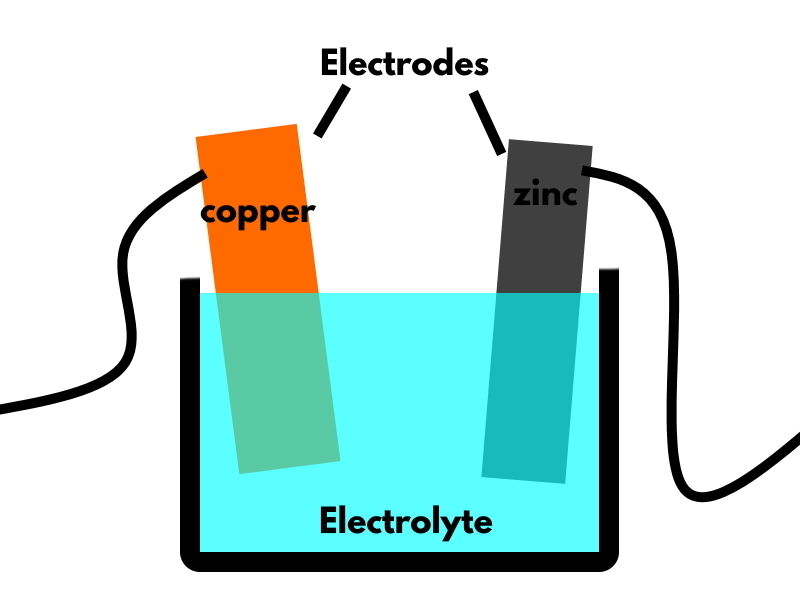
Electrolyte: Liquid or paste conductor
Electrode: Gets eaten up by the electrolyte. Has the charged ions.
Dry Cells: Use a paste electrolyte. A chemical reaction happens where free electrons are released. These electrons travel from one end of the battery, go through a wire, and then end up on the other side. This process eats up the electrodes, which is why batteries can run out of power. Used in flashlights and remotes.
Wet Cells: Use liquid electrolyte. Used in car batteries.
(See Diagram Below)
Primary Cells: Only used once
Secondary Cells: Chemical reaction can be reversed(rechargeable)
Direct Current: Current moves in one direction Eg. Use in phones and computers
Alternating Current: Current moves back and forth Eg. Used in TVs and toasters
- An AC(Alternating Current) Adapter changes AC coming from an outlet to DC for our phones and computers
Página 3
Science 9: Unit 4 - Electricity
Topic 1.3 - Measuring Electric Current
Current: A measure of how many electrons pass a certain point per second.
- Measured in Amperes, used the symbol "I".
- Measured using an ammeter and small amounts are measured using a galvanometer
Voltage: The amount of energy supplied to a current.
- Measured in volts, uses the symbol "V".
- Measured using a voltmeter
Potential Difference: Measuring the potential energy between two points on a circuit
Resistance: The measure of how difficult is it for electrons to flow through a substance
- Measured in ohms
Factors:
- Longer wire = More resistance
- Thinner wire = More resistance
- Hotter = More resistance
- Certain materials have different levels of resistance
Página 4
Science 9: Unit 4 - Electricity
Topic 2.1 - Parts of a Circuit
Circuit: A path that allows electrons to flow and convert energy
Open: Not a full path
Closed: Full path, current flows
Source: A battery (source of current)
Conductor: A wire (carries the current)
Load: A lightbulb, motor(a device that consumes electricity)
Switch: Controls the flow of electrons but closing and opening the circuit Eg. Lightswitch
- Off = Open
- On = Closed
Rheostat(Variable Resistor): Adjusts the resistance (difficulty to flow)of a circuit Eg. Dimmer switch
- More resistance = Less power = Dimmer lights
Series Circuit: A circuit with all of its components in a row
- More devices = More resistance
Parallel Circuit: A circuit that has many paths for each component
- More devices = Less resistance
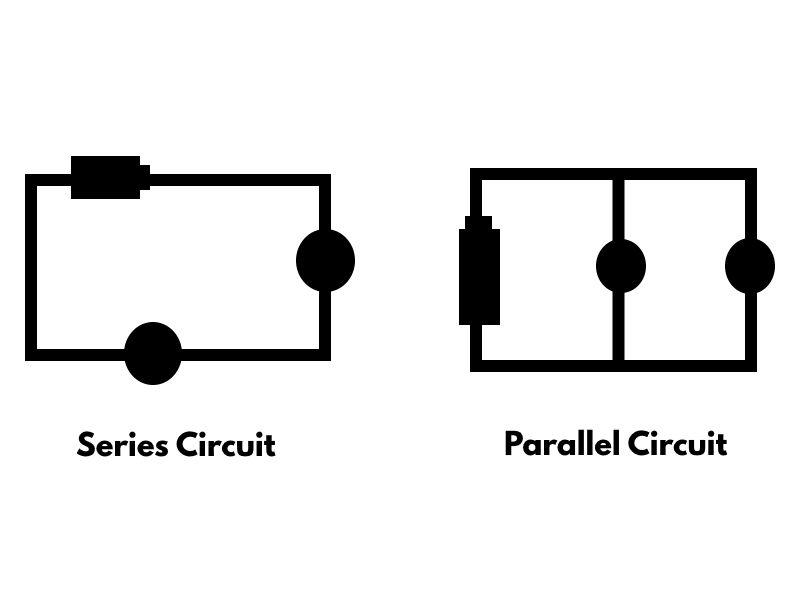
We use Schematic Diagrams to illustrate circuits:
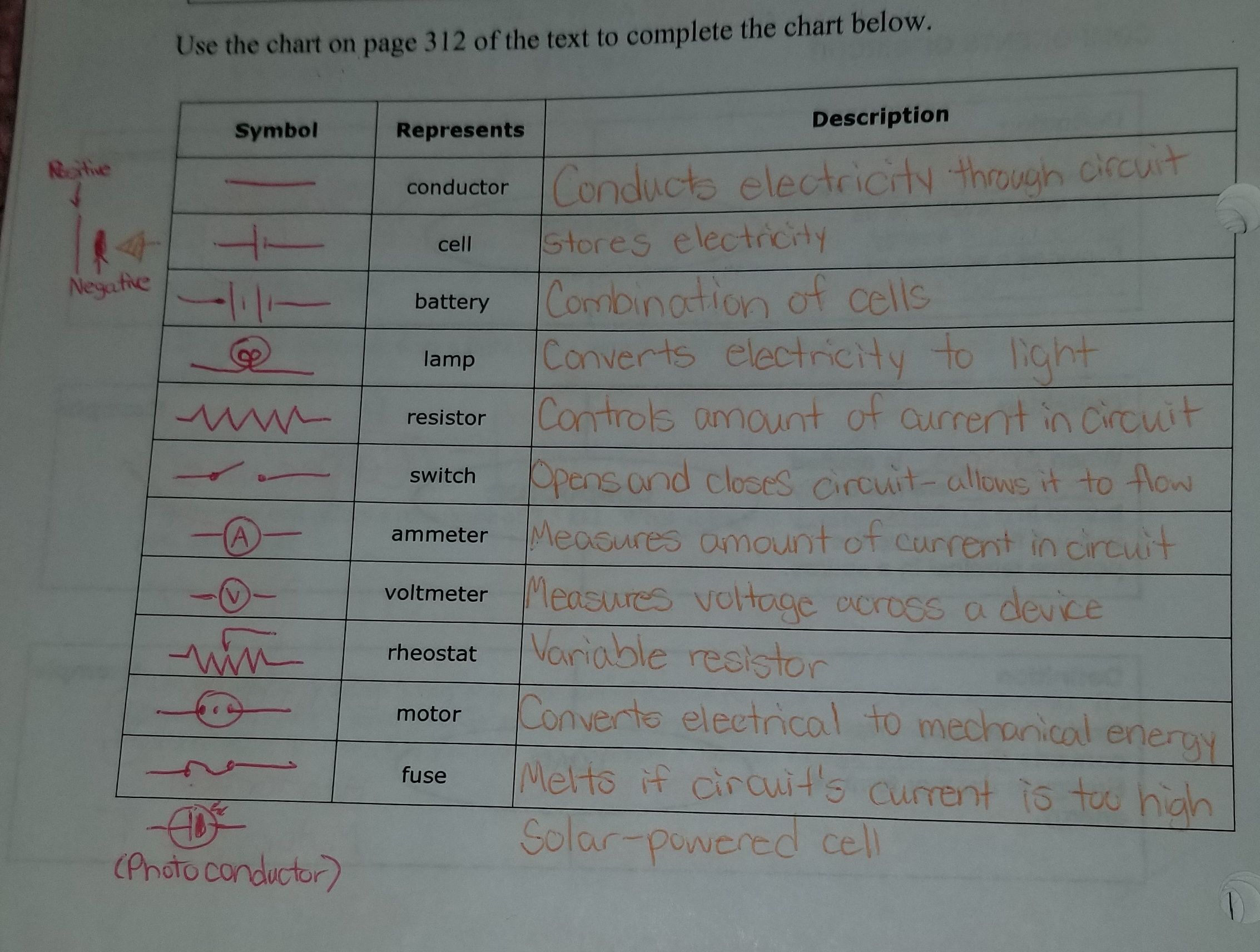
Microcircuits: Tiny circuits, use transistors instead of switches.
Página 5
Science 9: Unit 4 - Electricity
Topic 2.2 - Ohms Law
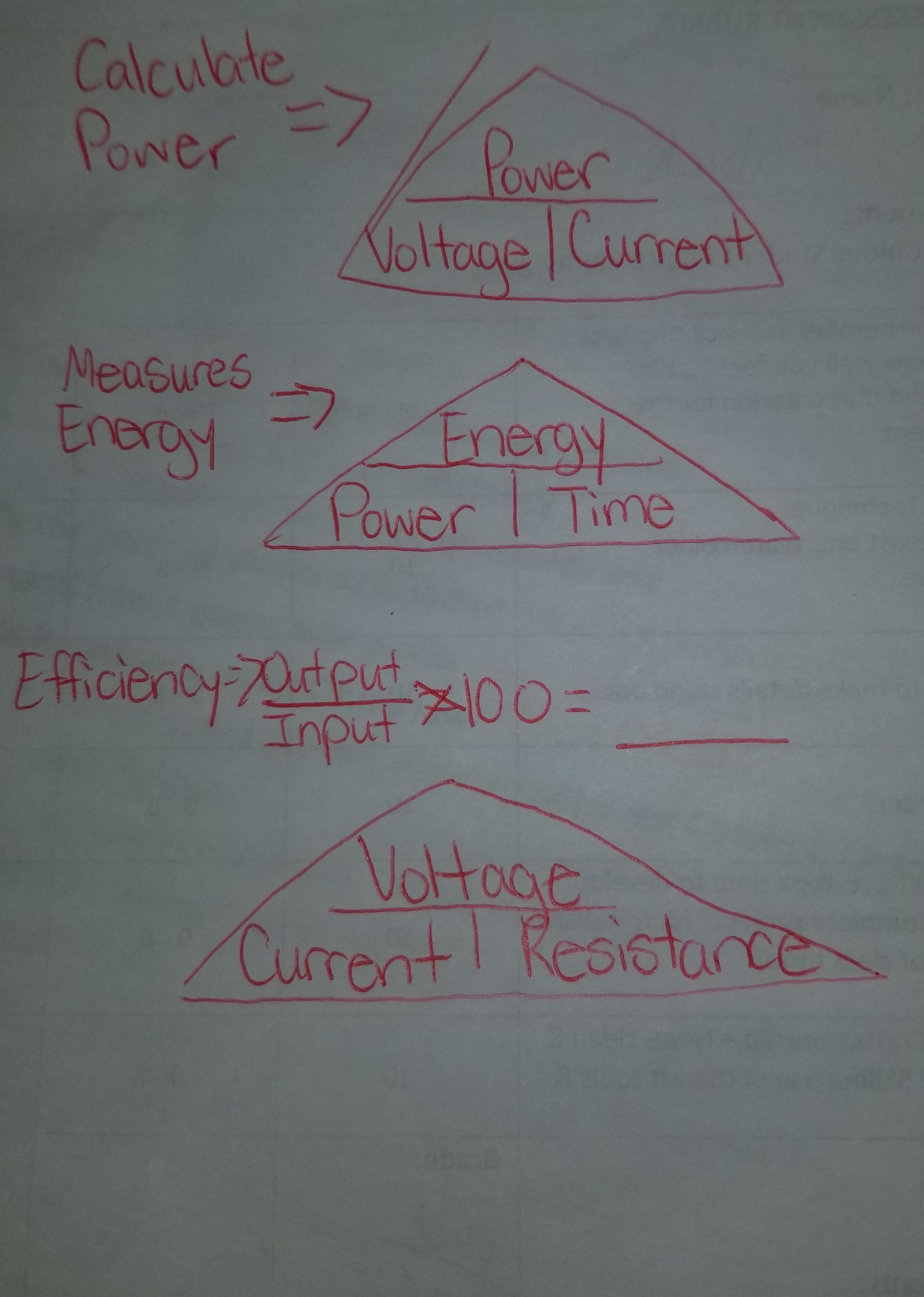
Ohms Law: As long as the temperature stays the same, the resistance is constant, and the current and voltage are proportional.
- Current and Voltage go up = Resistance goes down
To Solve a Word Problem:
1. Identify variables (current, voltage and resistance)
2. Make sure all numbers are equivalent (kA, kV, etc.), convert if needed
3. Identify variables (they will be labelled on test)
4. Plug in numbers and solve
Know These Formulas:
Página 6
Science 9: Unit 4 -Electricity
Topic 2.3 - Energy Conversions
Electric devices are all about converting energy into different forms(such as light, mechanical, etc.)
- Potential Energy: Energy being stored
- Kinetic Energy: Energy in motion
Electric Conversions in a Device:
Toaster: Electric -> Thermal -> Light
Car: Chemical -> Electric -> Mechanical
Electromagnet: A wire wrapped around an iron core. It creates a temporary magnet.
- The direction of current(counter, clock) = Polarity(North or South)
- Amperage in the wire/ Amount of coils = Strength of the magnet
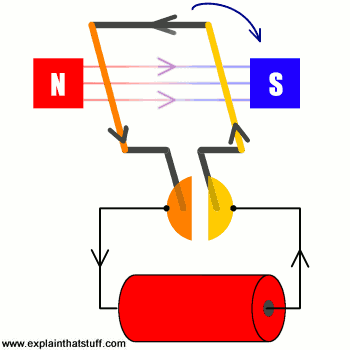
Electric Motor: Converts electrical energy into mechanical energy. Has an electromagnet(coil and iron core) rotating on an armature around permanent magnets. Every time the electromagnet rotates, a communitator switches the direction of the current, making the magnets continuously spin.
(See Diagram Below)
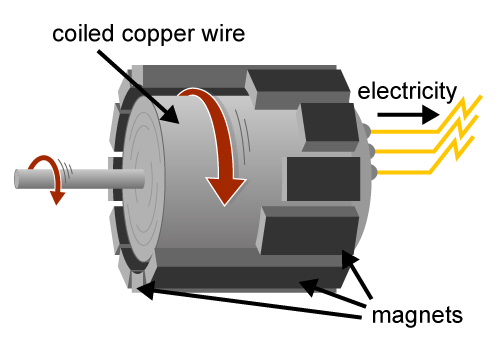
Electromagnetic Induction: Converts mechanical energy to electrical energy. The electromagnet is rotated by mechanical means with magnets surrounding it.
(See diagram below)
Converting Energy on a Greater Scale:
Dam: Using water to turn a turbine. Expensive, high energy output.
Coal: Uses steam to turn a turbine. Polluting, high energy output.
Nuclear: Splitting an atom to create electricity. Destructive, high energy output.
Solar: Converts sunlight to electricity. Takes up space, medium energy output.
Wind: Uses wind to turn a turbine. Takes up space, high energy output.
Página 7
Science 9: Unit 4 - Electricity
Topic 2.4 - Law of Conservation of Energy
Law of Conservation of Energy: Energy cannot be created or destroyed, it is only converted. So no matter what, an electrical device's output energy is the same as the input because some is released as heat or light, etc.
- Efficiency is how much energy can be used for its intended use and not lost in other forms
Energy is our home is measured in kilowatts per hour, instead of joules per second.
Página 8
Science 9: Unit 4 - Electricity
Topic 3.1 - Electric Safety
0.1 amps can kill you. Electricity is dangerous.
Safety Pointers:
- Never use electric devices near water
- Don't use a power cord that is damaged
- Unplug electrical devices when examining them
- Only put proper plugs in outlets
- Don't overload outlets
- Stay away from power lines
Ground Prong: The third prong on a plugin takes the charge to the ground if it overloads
Fuse: A piece of metal designed to melt if a circuit overloads
Circuit Breaker: A spring mechanism is tripped when the circuit overloads Eg. Breaker box in a house
Informações
- Descrição
- Use this to study for tests.
- Criado por
- Riley Babuik · jan 2020
- Atualizado
- 27 jan 2020
- Visualizações
- 139
- Tags
- Avaliação