
Notas
Time Sequence of Multiple interrupts
Conteúdo das notas (1)
Página 1
Time Sequence of Multiple interrupts
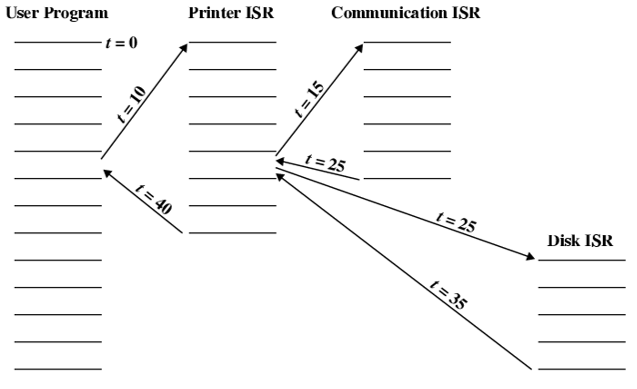
As an example of this second approach, consider a
system with three I/O devices: a printer, a disk, and a communications line, with
increasing priorities of 2, 4, and 5, respectively. Figure 3.14 illustrates a possible
sequence. A user program begins at t = 0. At t = 10, a printer interrupt occurs; user
information is placed on the system stack and execution continues at the printer
interrupt service routine (ISR). While this routine is still executing, at t = 15, a
communications interrupt occurs. Because the communications line has higher
priority than the printer, the interrupt is honored. The printer ISR is interrupted,
its state is pushed onto the stack, and execution
continues at the communications ISR. While this routine is executing, a disk interrupt occurs (t = 20). Because this interrupt is of lower priority, it is simply held, and the communications ISR runs
to completion.
When the communications ISR is complete (t = 25), the previous processor
state is restored, which is the execution of the printer ISR. However, before even a
single instruction in that routine can be executed, the processor honors the higher priority
disk interrupt and control transfers to the disk ISR. Only when that routine
is complete
(t = 35) is the printer ISR resumed. When that routine completes (t = 40),
control finally returns to the user program.
Informações
- Descrição
- Notas sobre Time Sequence of Multiple interrupts, criado por Matthew Swart em 20-11-2018.
- Criado por
- Matthew Swart
- Visualizações
- 0
- Avaliação