
Notas
Soils Lecture 2
Conteúdo das notas (2)
Página 1
Soil Dispersion
Dispersive soils will form crusts, and are highly susceptible to erosion.
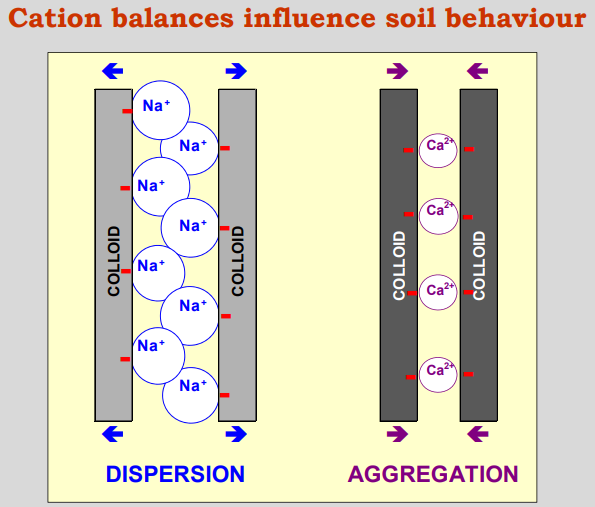
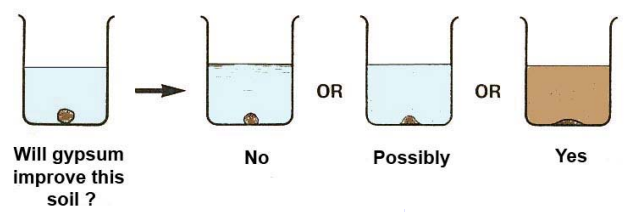
Dispersion (clod produces cloudy, turbid water): is caused largely by high levels of exchangeable sodium in the soil and excessive mechanical disturbance, especially if the soil is wet.
Slaking (clod produces fine ‘sawdust’ in water): is caused by soil sodicity OR by a lack of organic matter in the soil. It results in the loss of large pores (macropores) and the development of crusting and/or hardsetting characteristics.
Add energy to the soil: The micro-instability of some soils may only become evident after some extra energy has been put into the system by re-moulding the soil.
Exchangeable Sodium Percentage (ESP): measures the sodicity of the soil. ESP = 100 x Exch. Na / Σ (Exch. Ca+Mg+K+Na) where the cation contents are in cmol / kg soil.
Soil Sodicity Classes: Non-sodic: ESP < 6 %, Sodic: ESP between 6 and 15 %, Strongly sodic: ESP > 15 %
Sodic soils occupy: almost 30% of the Australian landmass; and 80% of the irrigated agricultural area in Australia
Infiltrating rainwater cannot easily infiltrate into sodic subsoils. The water accumulates in the topsoil; iron and organic matter are reduced chemically, and bleached A2 horizons develop. The saturated topsoil loses its strength and becomes mushy.
The surfaces of dispersive soils lack strongly connected macropores through which water can infiltrate and drain away. Such soils, particularly those with heavy (clayey) textures, become sticky and boggy after only light rains. They usually dry out to form a surface seal or crust
Surface seals form where fine colloidal particles, dispersed by rainfall impacts, clog the pores of the surface soil and form a thin crust of fine, structureless material. Require chemical amelioration.
Rill and gully erosion that give the soil a finely fretted (wavey/ridgy) appearance, very high soil pH (> 8.5), and dispersive clods usually indicate the occurrence of sodic soils.
Página 2
The attraction of cations to a colloid surface: H+ > Al3+ > Ba2+ > Ca2+ > Mg2+ > K + = NH 4 + > Na +
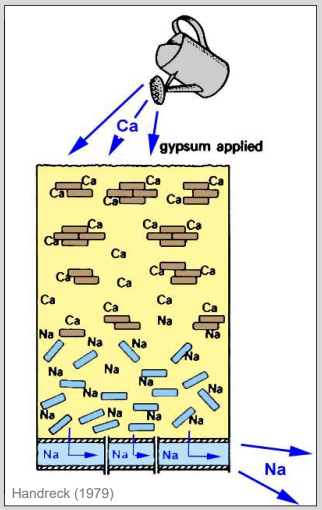
Gypsum treatments will improve the structure of: hardsetting or crusted sodic topsoils, and almost impervious sodic subsoils
The practical outcomes are:
improved soil tilth
reduced crust strength
increased water infiltration and storage
increased drainage and leaching
reduced runoff
better plant growth
reduced soil erosion
Class 1 aggregates: soils with high rill and tunnel erosion susceptibility; detection may be difficult in acidic soils; excellent dam sealants.
Class 2 aggregates: some aggregate instability; soil with some rill and tunnel erosion susceptibility; desirable materials for sealing water storage structures.
Class 3 aggregates: generally stable materials; soils suitable for soil conservation earthworks; dam leaks can be sealed when wet by roller or stock trampling.
Classes 4 – 6 aggregates: soil not susceptible to dispersion, piping, or tunnel erosion.
Informações
- Descrição
- TV1002 Notas sobre Soils Lecture 2, criado por Erika Cobb em 08-08-2019.
- Criado por
- Erika Cobb
- Visualizações
- 0
- Avaliação