
Notas
OCR Physics P1a-h
Conteúdo das notas (8)
Página 1
P1a - Heating houses
Temperature = a measure of how hot something is (chosen scale e.g. degrees Celsius)
Heat = a measure of energy (absolute scale e.g. joules)
The amount of energy needed to raise the temperature of an object depends on:
the mass of the object
the change in temp required
material it's made from
Total energy supplied = energy supplied per second x number of seconds
SPECIFIC HEAT CAPACITY:
The amount of energy required to change the temperature of 1kg of material by 1 degree Celsius
Energy (J) = Mass (kg) x Specific heat capacity (J/kg degrees Celsius) x Temp change (degrees Celsius)
SPECIFIC LATENT HEAT:
The amount of energy required to change the state of 1kg of material without changing it's temperature
Energy(J) = Mass (kg) x Specific latent heat (J/kg)
During melting/boiling of water, the energy supplied is used to break intermolecular forces as the water changes state, this explains why the temperature doesn't change
Página 2
P1b - Keeping homes warm
Materials that allow energy to flow through them quickly are called conductors e.g. metal is a good conductor
Materials that allow energy to flow through them slowly are called insulators e.g. most non-metals are good insulators
Air is a good insulator because the particles are far apart
Types of insulation:
Fibreglass roof insulation - reduces conduction and convection by trapping layers of air between fibres
Reflective foil on walls - reduces radiation by reflecting heat energy back into the room
Foam cavity wall insulation- reduces conduction and convection by trapping air in the foam
Double glazing - reduces conduction and convection by trapping air between panes of glass
Draught excluder - reduces conduction and convection by keeping as much warm air inside the house as possible
Payback time (years) = cost of installing
annual saving
Cavity wall insulation is made up of an inner and outer wall separated by a space full of air. The heat energy passes through the wall by conduction, heating the air in the cavity. The heat is then carried away from the wall by convection. This heat loss can be reduced by filling the cavity with foam (a good insulator).
Efficiency = useful output energy (J) x 100
total input energy (J)
Conduction = transfer of heat energy through a substance from a hotter region to a cooler region without any movement of the substance
Convection = transfer of heat energy from hotter regions to cooler regions by the movement of particles
Radiation:
Hot objects emit mainly infra-red radiation. Dark matt surfaces emit more radiation than light shiny surfaces at the same temp, because dark matt surfaces are better absorbers.
Página 3
P1c - A spectrum of waves
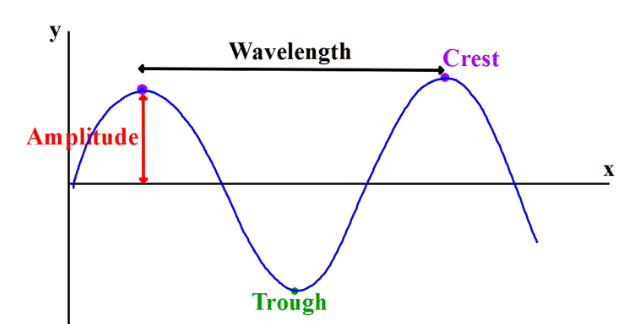
Transverse wave has the following features:
Amplitude - maximum disturbance caused by the wave
Wavelength - distance between 2 corresponding points (from one crest to another)
Frequency - number of oscillations per second
The electromagnetic spectrum:
Radio waves
Microwaves
Infra-red
Visible light
UV
X-rays
Gamma
The wave equation:
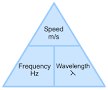
Wave speed = Wave length x Frequency
Reflection = when light bounces of a surface
Refraction = when light goes from air to a more dense substance, it slows down and changes direction
Diffraction = when waves pass through a gap and spread out, maximum diffraction occurs when wavelength is same as width of gap
Página 4
P1d - Light and lasers
1) If angle of incidence is below critical angle, light is refracted
2) If angle of incidence is above critical angle, light is totally internally reflected
3) If angle of incidence is equal to critical angle, light travels along glass-air boundary
Optical fibres are long, flexible and transparent. In an optical fibre pulse of light are totally internally reflected. They are used to carry binary code.
Advantages of Wireless signals: (e.g. radios, mobile phones and laptops)
Signals available 24 hours a day
No wiring needed
Items can be portable
Various signals:
Light - travels very fast, small loss of signal - cant be used for wireless signalling as it doesn't diffract well
Electrical - Can be sent along wires - signal deteriorates
Radio waves - Can be used for wireless signalling as the waves can diffract - diffraction leads to signal loss
Morse code is a digital signal as the light is either on or off
Lasers produce a a narrow beam of monochromatic light (one colour)
All their light waves:
have the same frequency
are in phase with each other
have low divergence
Página 5
P1e - Cooking and communicating using waves
The amount of radiation that is absorbed or emitted from a surface depends on:
surface temp
colour
texture
Microwaves are used to heat materials, for satellite communications, mobile phones and radar. They:
are absorbed by water and fat molecules which cause them to heat up
can penetrate about 1cm into food
can cause burns when absorbed by body tissue
can travel through glass and plastic
are reflected by shiny metal surfaces
Infra-red rays are used to heat material and in remote controls. They are:
used to heat the surface of the food in surface
reflected off shiny surfaces
absorbed by black objects
Microwaves are absorbed by water and fat molecules in outside layers of food, increasing kinetic energy of the particles. Energy is then transferred to the centre of food by conduction or convection. Infra-red is absorbed by all the particles on the surface of food, increasing their kinetic energy. Energy is then transferred to the centre of food by conduction or convection.
Microwave signals can be lost or affected by:
large obstacles
poor weather conditions
large areas of surface water
the curvature of the earth
interference between signals
Some of the problems can be reduced by:
limiting distance between transmitters
positioning masts on top of hills or tall builidings
Página 6
P1f - Data transmission
Infra-red is used in many commonplace devices, for example:
remote controls
automatic doors
short-distance wireless data links for computers or mobile phones
burglar alarms
security lights
Analogue signals = used to transmit data. They very continuously in amplitude.
Analogue signals can have any value within a fixed range of values and are very similar to the sound waves of speech or music
Digital signals = used to transmit data as a series of pulses. They don't vary in amplitude.
They only have two states (on and off), there are no values in-between.
Two or more digital signals can be sent down the same optical fibre at the same time - MULTIPLEXING
Analogue signal - poor signal quality due to interference
Digital signal - high signal quality as interference is easily removed
Página 7
P1g - Wireless signals
Advantages of wireless communication:
No connection to a land-line required
Portable, convenient
Disadvantages of wireless communication:
Aerial is needed to pick up the signal
Satellites can be used for global communication:
A signal is sent from a ground station transmitter dish to a satellite receiver dish
A return signal is then sent by the satellite transmitter to a ground receiver dish
The ionosphere is an electrically charged layer in the earth's upper atmosphere. Longer wavelength radio waves are reflected by the ionosphere, enabling radio and television programmes to be transmitted between different places.
DAB Radio = Digital Audio Broadcasting
Advantages:
More stations are available
Less interference with broadcasts from other stations
Disadvantages:
Audio quality is not as good as FM broadcasts
Some areas cannot receive DAB
Página 8
P1h - Stable earth
Earthquakes produce shock waves, which can travel inside the earth (seismic waves)
P-waves:
Primary waves
Longitudinal
Travel through solids and liquids
S-waves:
Secondary waves (slower)
Transverse
Travel through solids but not liquids
Seismic waves are detected by seismometers
Factors the contribute to global warming:
Increased energy use in homes and industry
Increased carbon dioxide emissions from fossil fuels
Deforestation
Weather patterns are affected by human activity for example:
Dust from volcanoes reflects radiation from the sun back to space causing cooling
Dust from factories reflects radiation from cities back towards earth causing warming
The sun produces electromagnetic waves, including UV radiation
Prolonged exposure can cause:
sun tan
sun burn
cataracts
premature ageing
skin cancer
People with darker skin tones have a reduced chance of developing breast cancer, as they have an increased amount of melanin in the skin. The melanin absorbed the UV rays and protects the delicate tissues.
To reduce the risk of sunburn or developing skin cancer we can:
stay out of the midday sun
keep skin covered
reduce or avoid use of sunbeds
always use sunscreen
The Ozone layer is a layer of Ozone gas found naturally up high in the earth's atmosphere, which prevents too many harmful UV rays reaching the earth.
The discovery of the hole in the ozone layer had an impact globally:
Legislation was passed in many countries to ban the use of CFCs in fridges
Old fridges and fridge freezers containing CFCs must be disposed of
CFCs are no longer used in aerosol cans
Informações
- Descrição
- GCSE Physics (P1) Notas sobre OCR Physics P1a-h, criado por Beth Cuff em 01-05-2016.
- Criado por
- Beth Cuff
- Visualizações
- 1
- Avaliação