
Notas
DNA sample prep - created from Mind Map
Conteúdo das notas (1)
Página 1
Isolate and Purify DNA from biological evidence<br><br><ul><li>• Different biological starting materials have different biological properties » Require different DNA extraction protocols and conditions • Purity refers to quality of cleanliness such that subsequent analytical techniques can be carried out effectively • Variants of several generic methods » Usually aim to overcome, remove or dilute PCR inhibitors </li></ul>
Quantify DNA obtained (post-extraction)<br><br><ul><li>• Spectrophotometric absorption • Incorporation of fluorescent dyes
• Real-Time PCR </li></ul>
Extracting DNA from the sample<br><br><ul><li>Release biological fluid from substrate (usually by dissolving into solution</li><li>Release cells and cell contents from biological fluid (cell lysis) </li><li>Isolate DNA and purify it by separating it from unwanted material (e.g. protein, fats &amp; carbohydrates, inhibitory dyes, chemical denaturants)</li></ul>
essential components<br><br><ul><li>1. Maximize DNA recovery
2. Remove inhibitors of PCR (polymerase chain reaction)
3. Remove or inhibit nucleases 4. Maximize the quality of DNA </li></ul>
Lyse cells<br><br><ul><li>Detergents (e.g. SDS – sodium dodecyl sulphate )
Lipid-solubilising organics (e.g. chloroform)
Chaotropic agents Heat </li></ul>
Separation<br><br><ul><li>Bind DNA to a substrate – remove everything else Separate layers (organic / water) </li></ul>
Generic extraction methods<br><br><ul><li>Summarise generic methods for DNA extraction then specify peculiarities for various templates</li></ul>
blood
Saliva
semen
bones
teeth
hair and nails
post mortem tissue
trace DNA
general principle<br><br><ul><li>Break open (lyse) the cells Separate (either physically or chemically) nucleic acids from all the other stuff: • Proteins • Carbohydrates • Lipids • Exogenous contaminants Clean the DNA to remove unwanted salts, reagents etc. Quantify and store DNA for further use. </li></ul>
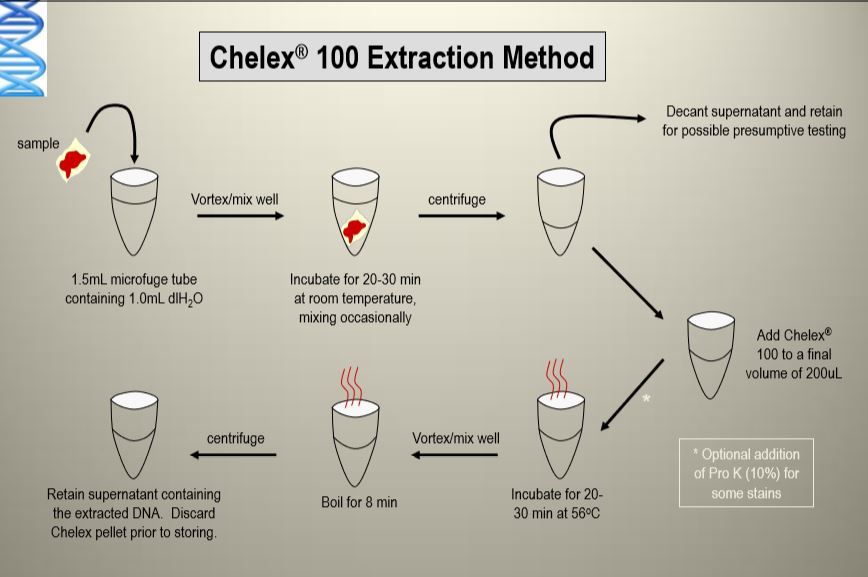
Chelex<br><br><ul><li> • Resin is made of styrene divinylbenzene copolymers containing paired iminodiacetate ions – these act as chelating agents
• In the form of small beads
• High binding affinity for polyvalent metal ions (such as Mg2+)
• Removing Mg2+ inactivates nucleases
• Usually 5% w/v concentration (can use 20% for soiled stains)
• Usually soak in dH2O to remove possible contaminants and inhibitors such as haem and other proteins </li></ul>
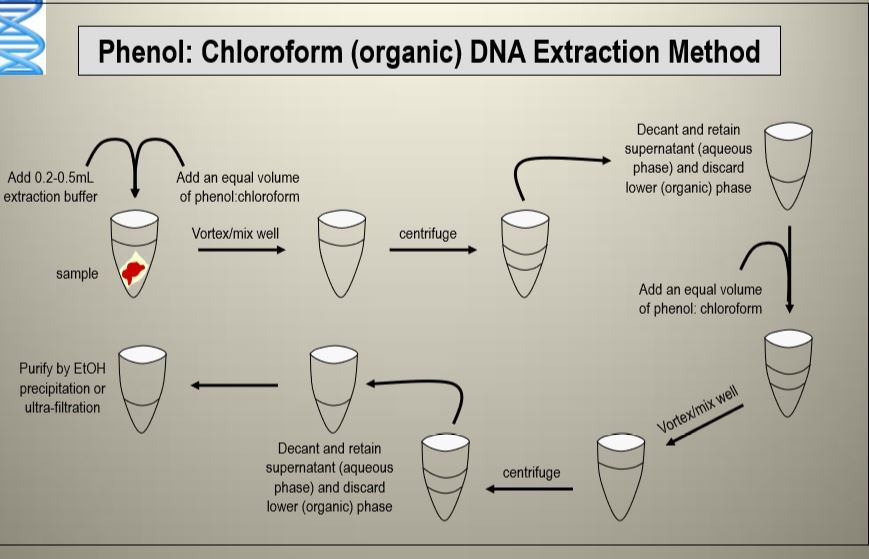
Organic DNA extraction<br><br><ul><li>Preliminary steps involve addition of SDS and Proteinase K • Disrupt cell walls, breakdown proteins that protect DNA in the chromosomes Phenol:chloroform mixture is added • Phenol is an organic solvent and also an acid. • It is only slightly miscible/soluble with water • Buffered in solution at a relatively high pH, phenol is not acidic enough to denature DNA however it can denature protein • Destroying the 1o structure of the protein makes it insoluble and it is precipitated out in the organic phase • The DNA is left to be purified and analysed further • Fats and carbohydrates dissolve in the chloroform, which also helps to separate the aqueous and phenolic phases </li></ul>
FTA paper<br><br><ul><li>Designed in South Australia as a means to store DNA, FTA™ Paper is an absorbent cellulose-based paper • Contains chemicals to » Lyse the cells » protect the DNA from nuclease degradation » preserve the paper from bacterial growth • DNA on FTA™ Paper is stable at room temp for several years • Cells are lysed on contact with the paper • DNA is immobilised within the matrix of the paper • Haem and other compounds removed through washing • DNA released during initial PCR incubation </li></ul>
silica based<br><br><ul><li> At low pH, and in the presence of chaotropic agents, DNA (&amp; RNA) binds reversibly to silica (e.g. glass).
“A chaotropic agent is a substance which disrupts the structure of, and denatures, macromolecules such as proteins and nucleic acids (e.g. DNA and RNA).” </li><li> Remove the chaotropic agent, then raise the pH 8.0 and the DNA is released from the silica. </li><li>DNA binds to silica membrane and contaminants pass through • Washes remove divalent cations and protein (PCR inhibitors) • Carrier RNA (or other polymers) can be added to the lysed sample to facilitate membrane binding » Recommended for forensic samples » Care must be taken with downstream quantitation methods (DNA specific) </li></ul>
DNA IQ<br><br><ul><li> Magnetic silica resin-based purification method • Designed specifically for low-level templates (10-100ng) » Loses efficiency as the amount of template increases • Sample is lysed with chaotropic agent, then DNA bound to the resin • Resin is separated by magnetic attraction to a purpose-made stand • DNA is eluted from the resin by elution buffer (pH 8.0) and heat (65 C) </li></ul>
heat shock<br><br><ul><li>• Lyse cells allowing them to release DNA (56°) • Proteinase K digests much of the proteins in the cells • Denature cell proteins (100°) (including the proteinase K) • Remnants are pulled to the bottom of the tube with the Chelex® beads during centrifugation leaving DNA free in solution • Divalent cations (Mg++ , Ca++, Fe++ ) become attached to the beads </li></ul>
common contaminants<br><br><ul><li>humic acids</li></ul>
pros<br><br><ul><li>• Cheap, rapid, single-tube reaction • Simple protocol • Nucleases are denatured (by heat and removal of divalent cations) </li></ul>
cons<br><br><ul><li>“Quick and dirty” – many contaminants remain in tube – these may either interfere with subsequent reactions, or break down the DNA ( e.g. Fe++ ). </li></ul>
pros<br><br><ul><li>Efficient recovery of high purity DNA </li></ul>
cons<br><br><ul><li> Time consuming, hazardous chemicals, many tube transfers • Carry-over phenol will interfere with downstream processing further cleanup steps are often necessary to remove residual phenol &amp; chloroform </li></ul>
pros<br><br><ul><li>Simple, reliable, flexible, two-tube technique </li></ul>
cons<br><br><ul><li> Expensive, non-differential extraction of semen stains, can be high losses of DNA</li></ul>
pros<br><br><ul><li> Isolates and quantifies in the same reaction (hence IQ), sensitive, accurate, designed for compromised forensic samples • Readily automated </li></ul>
cons<br><br><ul><li>Expensive (requires purpose designed stand)</li></ul>
possible sources<br><br><ul><li> Whole blood sample (2-10 L) – venous, finger-prick
Buffy coat layer Bloodstain </li></ul>
methods commonly applied<br><br><ul><li> Chelex 100™, FTA™ method, Phenol: chloroform method, Silica column, DNA IQ magnetic silica beads Purification may be required for soiled or degraded stains</li></ul>
micro-analytical process<br><br><ul><li> Tissue – N/A (may require removal from physical substrate such as blood card) Cell &amp; Nucleus – white blood cell-membrane and nuclear membrane lysis Remove or destroy inhibitory agents (proteins esp. heme, nucleases, dyes, etc.) </li></ul>
casework
creating doubt<br><br><ul><li>R v Lisoff (NSW CCA, 22nd November 1999, unreported) – “planted”, post-transfusion blood </li></ul>
transfused blood<br><br><ul><li>Research findings » Eight post-transfusion individuals, 10 PCR loci » No cases where post-transfusion profile differed from pre-transfusion [Brauner et al, J. Forensic Sci. 1997; 42(6): 1154-56] </li></ul>
chimerism<br><br><ul><li> in DNA from allogenic hematopoietic stem cell transplantations. » Berger, B et al., (2013) Int J Legal Medicine 127: 49-54 </li></ul>
possible sources<br><br><ul><li>Buccal swab (reference) Saliva stain, whole saliva sample (spit) </li></ul>
micro-analytical process<br><br><ul><li>Tissue – N/A (may require removal from physical substrate such as swab or FTA™ card) Cell &amp; Nucleus – epithelial cell-membrane (oral cavity lining) and nuclear membrane lysis Remove or destroy inhibitory agents (proteins and nucleases) </li></ul>
methods commonly applied<br><br><ul><li>Chelex 100™, FTA™ method, Silica column, DNA IQ magnetic beads Bio-screening via Phadebas® reaction may be required to locate stains </li></ul>
retreiving from drinking ocntainers<br><br><ul><li> Variables… » Significant person-to-person variation, reduced yield from alcoholic vessels, reduced yield from bottles compared to cans, no effect of time from period measured (24-48 hrs) [Abaz et al. Forensic Sci. Int. 2002; 126: 233-40] </li></ul>
lipstick
possible sources<br><br><ul><li>Medical Examination samples (♂ or ♀) – typically swabs; other samples include slides, clothing etc. Semen stain, whole semen sample, condoms </li></ul>
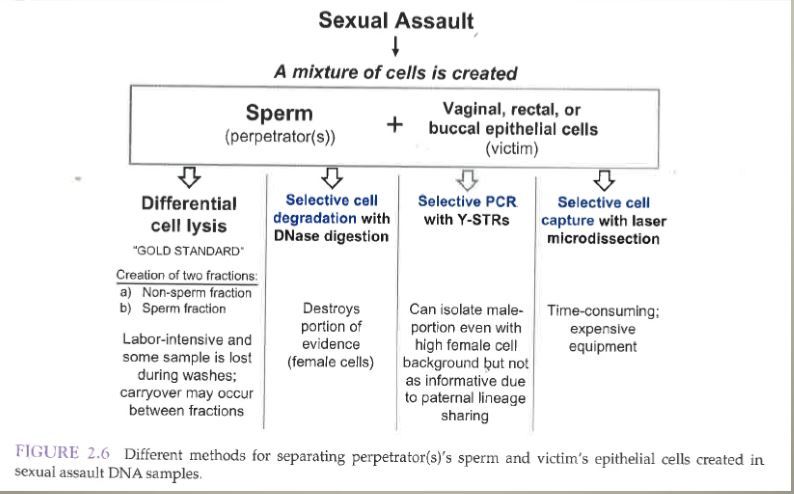
micro-analytical process<br><br><ul><li>may require removal from physical substrate such as clothing or swab Cell &amp; Nucleus – epithelial cell-membrane lysis (♂ and ♀) achieved with Proteinase K. Sperm cell membrane lysis (♂ only) requires reducing agent such as DTT Results in separation of different cellular components into sperm and epithelial fractions </li></ul>
methods commonly applied<br><br><ul><li> Chelex, phenol:chloroform method, magnetic bead separation (e.g.Differex™ differential separation) Bio-screening for seminal fluid – acid phosphatase, microscopy. </li></ul>
differential extraction<br><br><ul><li> The procedure involves preferentially breaking open the female epithelial cells with an incubation in a SDS/Proteinase K mixture.
Sperm heads remain intact during this incubation.
The sperm heads are pelleted and the supernatant containing the female fraction is collected and saved.
The sperm pellet is washed several times to remove any residual DNA from the victim.</li><li>The sperm are subsequently lysed by treatment with a SDS/proteinase K/ dithiothreitol (DTT) mixture. The DTT is required to breakdown (reduce) the protein disulfide bridges that make up the sperm head. The sperm are impervious to lysis without the addition of the DTT.
Both the male fraction and the female fraction are then extracted with phenol-chloroform (or silica-based methods), and the DNA precipitated with ethanol</li></ul>
analytical process<br><br><ul><li>Tissue – destruction of compact bone matrix through cryogenic crushing (freezer mill) or drilling, and dissolution of mineral content of bone through chemical decalcification. Can use bone marrow – very rich in DNA due to regenerative and immune system function. Remove or destroy inhibitory agents (EDTA from decalcification, soil, humic acids) </li></ul>
possible sources<br><br><ul><li> Post mortem reference sample (fire victims, decomposed corpses, DVI, etc.) Exhumations or random discoveries </li></ul>
common methods used<br><br><ul><li>Phenol: chloroform method, Silica column method Extensive cleaning and decontamination of external bone surface is also required. See for example: </li></ul>
possible sources<br><br><ul><li>Post mortem reference sample (fire victims, decomposed corpses, DVI, etc.) Exhumations or random discoveries </li></ul>
micro analytical<br><br><ul><li> Tissue – bypassing or eliminating enamel matrix through cryogenic crushing (freezer mill) or drilling and dissolution of mineral content by chemical decalcification. Seeking dentine or dental pulp from core of tooth at cemento-enamel junction. Cell &amp; Nucleus – lysis occurs via specific buffers </li></ul>
methods<br><br><ul><li> Phenol: chloroform, silica column or magnetic beads Purification by ethanol precipitation or ultracentrifugation Extensive cleaning and decontamination of external enamel surface is also required. </li></ul>
ppssible sources<br><br><ul><li>Hair - plucked reference sample. Combed or trace evidence sample </li></ul>
micro analytical<br><br><ul><li>Tissue – some disruption of keratinous outer layer may be needed to access hair bulb cells. Cell &amp; Nucleus – Hair root sheath cell membrane and nuclear membrane lysis (lengthy incubation with Proteinase K) plus DTT for keratinocyte membrane lysis in hairs. </li></ul>
methods<br><br><ul><li> Modified Chelex 100™, silica column or magnetic beads. Hair examination must be undertaken prior to DNA extraction as the digestion process can dissolve hair entirely. Thorough washing should precede nail and hair DNA tissue extraction. </li></ul>
dermal papilla<br><br><ul><li>controls hair growth cycle</li></ul>
root<br><br><ul><li>source of germinative cells</li></ul>
keratinising zone<br><br><ul><li>cuticle cortex </li></ul>
hair sheath<br><br><ul><li>inner physical support for forming hair and outer protencts IRS</li></ul>
pssible<br><br><ul><li>Post mortem reference sample (usually muscle, sometimes organ – liver, spleen) Archived pathological sample (formaldehyde fixed and mounted blocks or biopsies)</li></ul>
micro analytical<br><br><ul><li>Tissue – must break down fixation (xylene treatment) and tissue integrity (physical disruption by homogenisation or cutting) Cell &amp; Nucleus – muscle cell and nuclear membrane can be lysed by standard digest buffer Remove or destroy inhibitory agents (proteins, dyes, etc.) </li></ul>
methods<br><br><ul><li> Phenol: chloroform, silica column or magnetic beads Purification post-extraction is required to remove residual solvents or formaldehyde Pre-extraction treatment to remove fixation is also required.
April </li></ul>
prossible<br><br><ul><li>You name it!!! Touched or handled objects or sources (steering wheels of SMVs, door handles at B&amp;Es, weapon handles, discarded masks/clothing, etc.) </li></ul>
micro analytical<br><br><ul><li>Cell &amp; Nucleus – epithelial cell-membrane and nuclear membrane lysed by standard digest buffer </li></ul>
methods<br><br><ul><li> Chelex 100™, silica column, magnetic beads Great care must be taken to avoid contamination (separate laboratory, equipment, etc.) especially when using ultra-trace PCR-based methods such as low copy number (LCN) analysis </li></ul>
Informações
- Descrição
- Finals DNA Profile Notas sobre DNA sample prep - created from Mind Map, criado por madelene.smith em 21-06-2016.
- Criado por
- madelene.smith
- Visualizações
- 1
- Histórico
-
- Criado por madelene.smith · 21 jun 2016
- Copiado para Nota por madelene.smith · 21 jun 2016
- Avaliação