
Forensic Science and Crime Scene Investigation
268 resources created by 203 users
This Forensic Science and Crime Scene Investigation page on GoConqr gathers community-made quizzes, mind maps, flashcards, flowcharts and notes, from processing a crime scene and blood spatter to fingerprints, ballistics and DNA. It's built for school students revising a topic, university students filling gaps, and teachers after ready-made material. There are over 260 resources here, including more than 40 quizzes, over 120 mind maps and more than 60 flashcard decks. Pick a topic, try a quiz to find your gaps, then make your own revision sets.
Select topic
- History and Branches of Forensic Science7
- Observation and Eyewitness Testimony7
- Crime Scene Processing51
- Physical Evidence and Collection13
- Forensic Evidence in Court5
- Forensic Laboratories and Testing5
- Blood Analysis and Serology38
- Bloodstain Pattern Analysis19
- Forensic DNA Analysis23
- Fingerprints and Impression Evidence15
- Trace Evidence: Hair, Fibres and Glass9
- Firearms, Ballistics and Tool Marks8
- Forensic Drug Analysis5
- Death Investigation8
Top Forensic Science and Crime Scene Investigation resources
-
61 questionsForensic Science Chapter 2 After providing or obtaining medical assistance for the injured and effecting an arrest of suspects (if pos...
-
64 cardsForensic Science - Chapter 1 Forensic science owes its origins to which individuals........
-
39 questionsForensics Test Chp.1 Who established the comparison microscope as the indispensable tool of the modern firearms examiner?
-
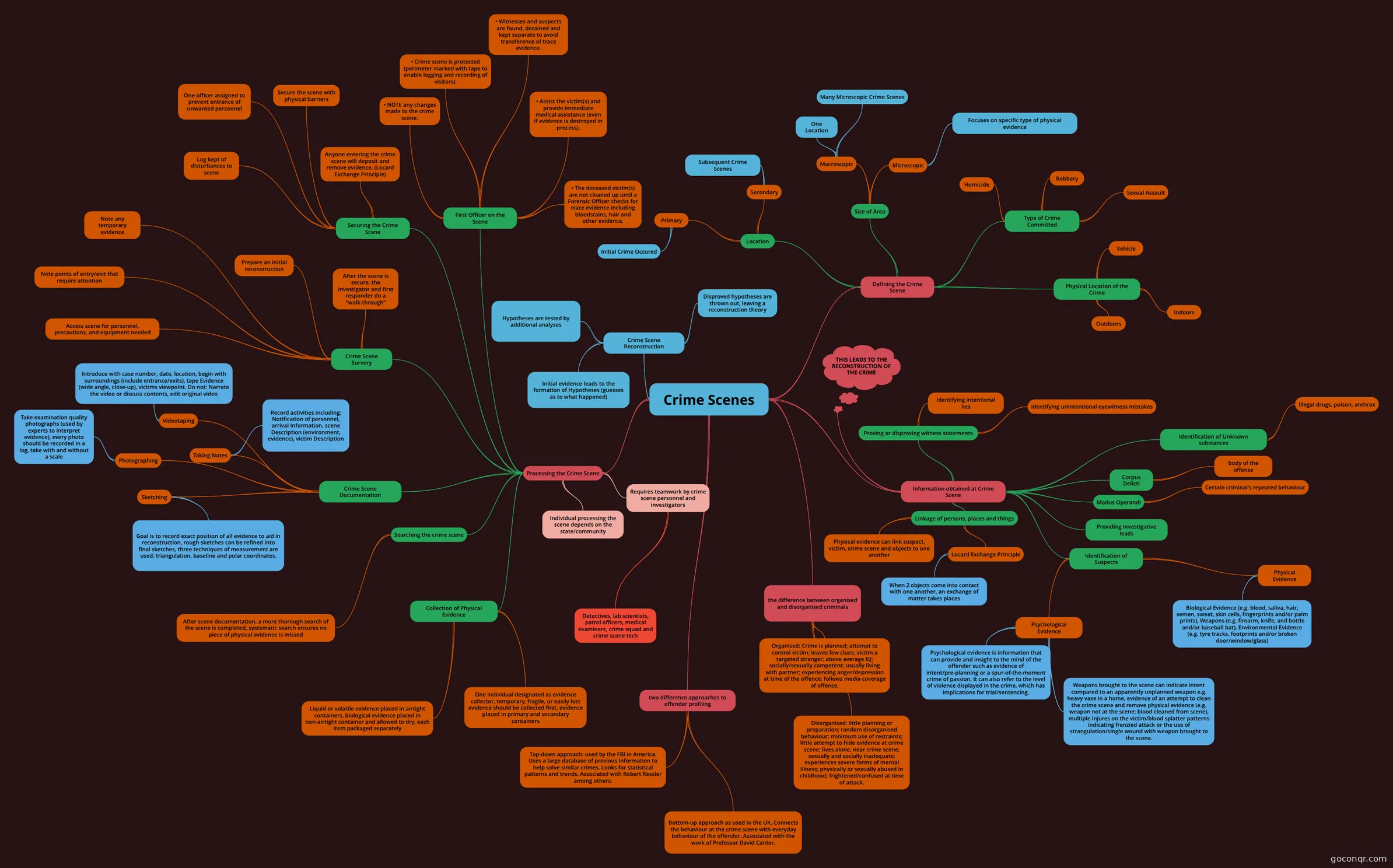 Mind map Crime Scenes Crime Scene NC - Revision Mindmap
-
30 questionsForensic Science Unit 1 This person popularized physical detection methods in a crime scene and developed the character Sherlock Ho...
-
17 questionsForensics Chp 4 Forensic Science mid term chp 4 study
-
11 questions1. Fingerprint Matching- training Fingerprint Analysis Study Burden of Proof Forensics Class By taking this quiz you agree that you understan...
-
36 questionsForensic Science Chapter 8 The barrel of a shotgun:
Quizzes
See all 45 quizzes-
61 questionsForensic Science Chapter 2 After providing or obtaining medical assistance for the injured and effecting an arrest of suspects (if pos...
-
39 questionsForensics Test Chp.1 Who established the comparison microscope as the indispensable tool of the modern firearms examiner?
-
30 questionsForensic Science Unit 1 This person popularized physical detection methods in a crime scene and developed the character Sherlock Ho...
-
17 questionsForensics Chp 4 Forensic Science mid term chp 4 study
-
11 questions1. Fingerprint Matching- training Fingerprint Analysis Study Burden of Proof Forensics Class By taking this quiz you agree that you understan...
-
36 questionsForensic Science Chapter 8 The barrel of a shotgun:
-
42 questionsForensic Science Chapter 7 compound microscope is equipped with two objective lenses (10x and 45x) and has a 10x ocular lens. The high...
-
100 questionsMASTERY QUIZ (FS5& FS6) This is used primarily in determining the bore diameter of firearms
Mind maps
See all 122 mind mapsFlashcards
See all 70 flashcards-
64 cardsForensic Science - Chapter 1 Forensic science owes its origins to which individuals........
-
90 cardsFSC239 Midterm What is forensic science?
-
53 cardsForensic Geoscience what is Forensic Geoscience
-
81 cardsIntroduction to Forensic Science Why the fundamental principles of crime scene management and investigation essential?
-
66 cardsBloodstain Pattern Analysis Bloodstain Pattern Analysis (BPA) why is it important?
-
55 cardsFootwear evidence Shoe mark impressions at crime scenes Why is it important – well…
-
41 cardsintro - glass
-
70 cardsFundamentals of Forensic Science
Flowcharts
See all 24 flowchartsNotes
-
Locating and Recovering Evidence - created from Mind Map
-
DNA sample prep - created from Mind Map
-
Anomalies, Trace DNA and LCN - created from Mind Map
-
Non-autosomal markers - created from Mind Map
-
Forensic DNA Procedures Kinship/Paternity/Familial analysis - created from Mind Map
-
Stats - created from Mind Map
-
For2601 definitions FORENSICLatin Forensis: forum or court Forensic: for judicial or court purposes/ suitable for courtForensic investigation: purpose of ending up in courtForensic investigator: take the matter to court, where guilt will...
Topics in Forensic Science and Crime Scene Investigation
More Criminology topics
About Forensic Science and Crime Scene Investigation
GoConqr OriginalWhat the resources cover
The material runs from the origins of the field to specialist evidence types. Early quizzes such as Forensic Science Unit 1 and Forensics Test Chp.1 ask who popularised physical detection methods, who Edmond Locard and Mathieu Orfila were, and what forensic science actually is. The flashcard deck Forensic Science - Chapter 1 adds the CSI Effect and its problems.
Later items move into evidence. Forensics Chp 4 looks at blood spatter on hard and soft surfaces, Forensic Science Chapter 7 covers microscopes, and Forensic Science Chapter 8 covers firearms, rifling and bullet comparison. There are also resources on hair, fibres, glass, footwear, toxicology, drugs, entomology and anthropology.
Where to start
- Open the Crime Scenes mind map to see how a scene is defined and processed.
- Take Forensic Science Chapter 2, which asks what the first officer at a scene should do.
- Move to the fingerprint quizzes, then blood, then firearms.
- Finish with a longer paper such as Forensic Science Midterm Exam.
Using quizzes and maps together
Read a mind map first to get the shape of a topic. Then take a quiz on the same topic and note every question you miss. Go back to the map for those branches, and use flashcards for names, terms and definitions. The many flowcharts on processing a crime scene are handy for checking the order of steps.
The DNA notes, such as the one on locating and recovering evidence, suit university students who want more detail. Teachers can pick a quiz or deck and use it as ready-made classroom material.
Where it sits
This unit belongs to the Forensics and Criminal Investigation strand of Criminology. Everything here was made by GoConqr users, so styles and depth vary. Choose a resource that matches your course and see how far it takes you.
Frequently asked questions
Which quiz should I try first?
Forensic Science Unit 1 and Forensics Test Chp.1 are good openers, as they cover the basics: what forensic science is and who shaped it. After that, Forensic Science Chapter 2 moves on to what happens first at a crime scene.
What do the mind maps cover?
There are well over 100 mind maps. Many deal with blood and blood pattern analysis, others with crime scenes, time of death, drug analysis, questioned documents, trace evidence, entomology, anthropology and DNA evidence. They work well as a quick overview before a quiz.
Are the resources free to use?
Yes. Every resource listed here is free to open, study and take, with no account needed. A free account also saves your quiz scores and lets you create your own quizzes, mind maps, flashcards and notes.
Who made these resources?
They were made by GoConqr users, not by GoConqr itself. That means you will find a mix of styles, from chapter-by-chapter quizzes to short flashcard decks, so it is worth opening a few to find ones that suit your course.
Which levels do they suit?
Most are aimed at school students, with a good share for university students and a few at professional level. Teachers can use the quizzes and decks as ready-made material. Check the title and excerpt to see whether the depth matches you.
What if the topic I need is missing?
Try a nearby topic first, as blood, fingerprints, firearms, hair, fibres and DNA each appear in several formats. If you still cannot find it, you can build your own mind map, flashcards or quiz on the subject.