
Notas
IXL Notes
Conteúdo das notas (9)
Página 1
Assignment: "SENTENCE, FRAGMENT, AND RUN-ON: COPY THE FOLLOWING NOTES AND COMPLETE IXL J-p.1, J-p.2, and J-p.3 before turning your notes in." Ty Hayes
Created Jan 3Jan 3
DONE
SENTENCE, FRAGMENT, AND RUN-ON: COPY THE FOLLOWING NOTES AND COMPLETE IXL J-p.1, J-p.2, and J-p.3 before turning your notes in.SENTENCE, FRAGMENT, AND RUN-ON NOTES
A sentence is a group of words that forms a complete thought. It has both a subject and a verb.
EX: My friends walk along the path.
A sentence fragment is a group of words that does not express a complete thought. It is usually missing a subject, a verb, or a helping verb.
EX: Knows the answer.--This is a sentence fragment. It is missing a subject.
EX: The bright red car.--This is a sentence fragment. It is missing a verb.
EX: We skiing next week.--This is a sentence fragment. It is missing a helping verb.
A sentence is a group of words that forms a complete thought. It has both a subject and a verb.
EX: My friends walk along the path.
A run-on sentence is made up of two independent clauses that are joined without end punctuation or with just a comma.
EX: I knocked on the door it opened.
EX: It started raining, we ran inside.
To fix a run-on sentence, separate it into two sentences. Add end punctuation after the first sentence, and capitalize the second sentence.
EX: I knocked on the door. It opened.
EX: It started raining. We ran inside.
You can also fix a run-on sentence by rewriting it as a compound sentence. A compound sentence is made up of two independent clauses joined by a comma and a coordinating conjunction such as and, but, or, or so.
EX: I knocked on the door, and it opened.
EX: It started raining, so we ran inside.
OPEN
Página 2
First, copy the notes. Second, Complete IXL level J sections I.1, I.2, and I.3 with at least 80. Third, Turn in your notes.
In a title, capitalize the first word, the last word, and every important word in between.
The Wind in the Willows
James and the Giant Peach
These words are not important in titles:
Articles, a, an, the
Short prepositions, such as at, by, for, in, of, on, to, up
Coordinating conjunctions, such as and, but, or
The title of a book, movie, play, TV show, magazine, or newspaper should be underlined(for typing or writing) or in italics (slanted for typing only).
The title of a poem, song, article, or short story should be in quotation marks.
"You Are My Sunshine".
Página 3
An adjective is a word that tells you about a noun.
Some adjectives answer the question what kind?
The small baby smiled.
She carried heavy books.
Some adjectives answer the question how many?
One baby smiled.
She carried some books.
Often, more than one adjective is used to describe the same noun.
She gave me long red silk roses.
The adjectives long, red, and silk all describe the noun roses.
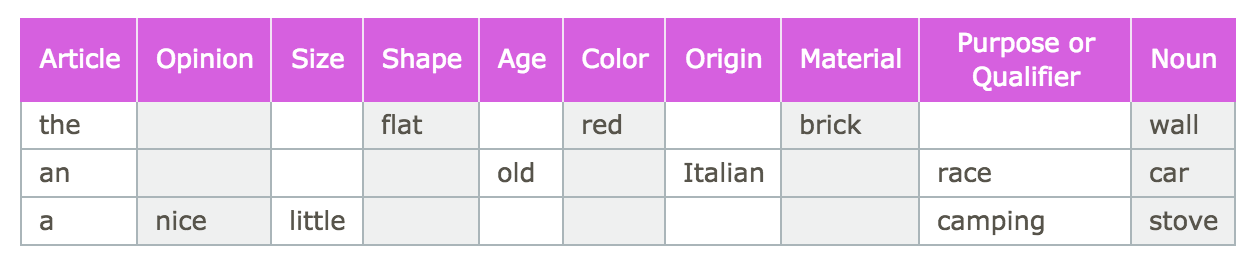
When more than one adjective is used, the adjectives usually go in a certain order. This table shows that order.
Article-Opinion-Size-Shape-Age-Color-Origin-Material-Purpose or Qualifier-Noun
the-----------------------------flat-------------red-----------------brick-------------------------------------wall
an----------------------------------------old-------------Italian-------------------------race----------------car
a------------nice----little-------------------------------------------------------------camping------------stove
A purpose or qualifier is often considered part of the noun. When you put a purpose or qualifier with a noun, the result is similar to a compound word.
race car
camping stove
Página 4
A possessive noun shows who or what owns something or has something.
When a noun is singular, add an apostrophe and -s ('s) to form the singular possessive noun.
Matt → Matt's glove
the bird → the bird's wings
When a noun is plural and ends in -s, just add an apostrophe (') to form the plural possessive noun.
the boys → the boys' camp
the schools → the schools' teams
When a noun is plural and does not end in -s, add an apostrophe and -s ('s) to form the plural possessive noun.
the children → the children's toys
the mice → the mice's tails
Página 5
Paper and pencil (or pen) required
Copy the rules and examples for apostrophes in possessives, contractions, and plurals. Complete part A and B in Practice and Apply (You don't need to copy the passages, just the correct answers.) Check your work with the answers posted under the rotation schedule. Turn your work into your odd period tray. After you turn it in, work on IXL J-d.1 and Jd.2.
Notes
OPEN
Página 6
IXL
PUNCTUATION CHALLENGE
Level J
a.1 through g.1
You can (and should) work on these both at school and at home
Contest ends 10/14.
(It's also a composition grade)
Página 7
Pronouns: Vague refernces and Inappropriate ShiftsIXL J-u.1 J-v.1 J-v.2
IXL
OPEN
Página 8
NounsIXL level F (e1,e2, e3, and e4)
OPEN
Página 9
independent clause: Contains a subject and a verb and can stand on its own as a sentence
I run slowly.
dependent clause: contains a subject and a verb but CAN'T be a sentence on its own
because I run slowly
simple sentence: Contains one independent clause and no dependent clauses
I run slowly.
compound sentence: contains at least two independent clauses and no dependent clauses
I run slowly, but I am always first in line at the buffet.
complex sentence: contains only one independent clause and at least one dependent clause
Because I run slowly, I like to get a head start.
compound-complex sentence: contains at least two independent clause and at least one dependent clause.
Because I run slowly, I like to get a head start, but my coach calls that cheating.