
Grammar Foundations and Sentence Structure
137 resources created by 128 users
This Grammar Foundations and Sentence Structure page on GoConqr gathers community-made quizzes, mind maps, flashcards, notes and flowcharts, from nouns and gender to reflexive verbs, compound sentences and identifying subject and object complements. It's built for school students revising grammar and teachers after ready-made material. There are over 100 resources here, including more than 30 quizzes, more than 30 mind maps and more than 30 flashcard decks, made by over 100 contributors. Pick a topic, try a quiz to find your gaps, then make your own study set.
Select topic
- Parts of Speech14
- Nouns, Gender and Articles9
- Adjectives and Agreement7
- Pronouns and Demonstratives8
- Verb Conjugation and Tenses9
- Reflexive Verbs7
- Ser, Estar and Gustar5
- Sentence Parts and Complements21
- Phrases, Clauses and Sentence Types13
- Sentence Errors and Parallel Structure5
- Punctuation and Capitalization6
Top Grammar Foundations and Sentence Structure resources
-
6 questionsFel Intro Quiz According to the definition, the fel is :
-
7 questionsSpanish 2 Unit 1 Lesson 1 Adjectives and Nouns in Spanish must agree in what?
-
Mind map NOUNS & GENDER
-
113 questionsAP Final Exam "We missed the first two or three shots and they made (theirs; their's; theirs'; they'res). That put us on ...
-
24 cardsEnglish devices
-
5 questions[E-A1] Muy y mucho (ejercicios estructurales)
-
24 cardsFeatures of Language _1 List of three
-
30 questionsSpanish Chp 6 Como se dice "this" and "these"
Quizzes
See all 36 quizzes-
6 questionsFel Intro Quiz According to the definition, the fel is :
-
7 questionsSpanish 2 Unit 1 Lesson 1 Adjectives and Nouns in Spanish must agree in what?
-
113 questionsAP Final Exam "We missed the first two or three shots and they made (theirs; their's; theirs'; they'res). That put us on ...
-
5 questions[E-A1] Muy y mucho (ejercicios estructurales)
-
30 questionsSpanish Chp 6 Como se dice "this" and "these"
-
10 questionsUntitled What is a sentence?
-
11 questionsDirect Objects Find the direct object in each sentence
-
7 questionsSpanish 1 Unit 7 Lesson 6 When do we use a reflexive verb in Spanish?
Mind maps
See all 34 mind maps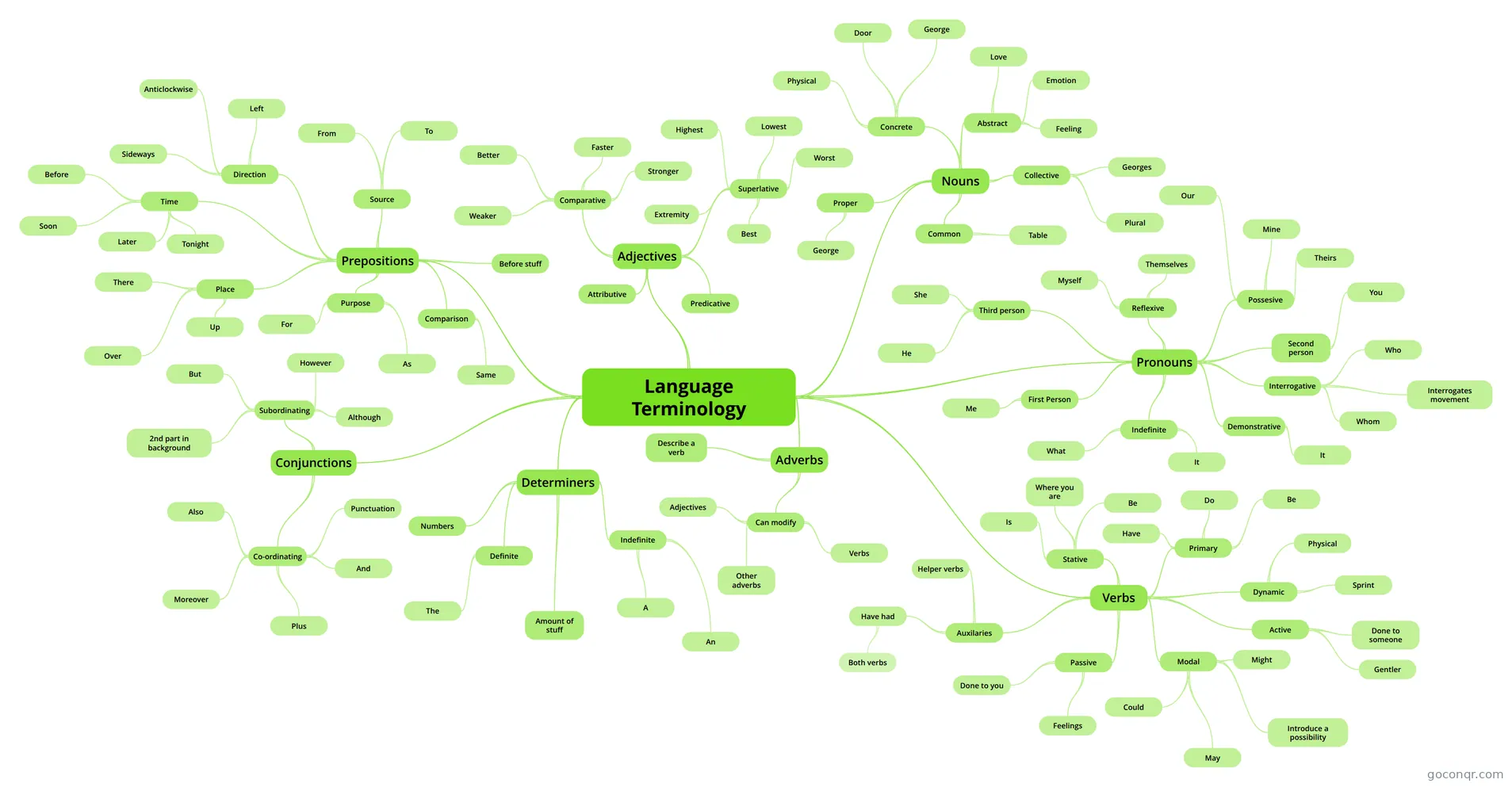
Flashcards
See all 34 flashcardsFlowcharts
See all 15 flowcharts-
Untitled
-
Spanish Small Plate Presentation
-
Identifying Subjects and Object Complements
-
Identifying Subjects and Object Complements
-
Identifying Subject and Object Complements - Andrew S.
-
Identifying Subjects and Object Complements
-
Identifying Subjects and Object Complements by the one and only Patty Ice
-
Identifying Subjects and Object Complements
Notes
See all 12 notes-
IXL Notes Assignment: "SENTENCE, FRAGMENT, AND RUN-ON: COPY THE FOLLOWING NOTES AND COMPLETE IXL J-p.1, J-p.2, and J-p.3 before turning your notes in." Ty Hayes Created Jan 3Jan 3 DONE SENTENCE, FRAGMENT, AND RUN-ON: COPY THE F...
-
Spanish 2 SER and ESTAR SER and ESTAR -------------------------------- SER: You can use the acronym DOCTOR. D- Description O- Occupation C- Characteristics T- Time and Date O...
-
SPANISH NOTES Put simply, subject pronouns are the words we use to tell who is completing an action in a sentence. The dog likes to run. We always go fishing on Saturdays. Turkey is delicious on Thanksgivin...
-
English - Word Classes. Nouns:Common: Refers to people or things in general ~ boy, country, bridge and desk.Proper: A name of a person, place or thing ~ New Zealand, Jake and Orange.Compound: Connecting two words to make one ~ pea+nut=peanut...
-
Language Arts Exam Grammar Gerunds- verbs used as nounsParticiples-verbs used as adjectivesInfinitive Phrase- a phrase that consist of a noun and a verb and everything else that goes with itCompound Sentence- a sentence that consists of...
-
Nouns & Definite Articles Notes In Spanish there a 4 definite articles (all meaning "the.") This is different from English which has the used for both female, male, plural, and singular words: la → feminine (singular) el → masculine ...
-
General notes Donde vives? vivo en Maidenhead, esta en el sureste de Inglaterra.Vocal: El/la = the un/una = a (or an) CognatesCognates are words that are very similar in spelling in two languages and they have the same meaning...
-
September 30th-Sentences:Modifiers and Stuff MODIFIERS:-Adjectival ModifiersWords, phrases, etc. that modify either a noun or noun phrase-Adverbial ModifiersModify verbs, adverbs, etc...answer how when why-Overlapping modifiersDo not have to be in a linear forma...
Slides
Topics in Grammar Foundations and Sentence Structure
More Spanish language (as a school subject) topics
About Grammar Foundations and Sentence Structure
GoConqr OriginalWhat this unit covers
The page mixes Spanish grammar with general sentence work. On the Spanish side, you will find the mind map NOUNS & GENDER, which explains that Spanish nouns have gender, but this does not always mean male or female. There are also resources on plurals, adjectives, articles, reflexive verbs, prepositions, negation and indirect objects. A slide set on Superlatives & comparatives covers irregular forms, such as using joven in a comparison.
Sentence structure and terms
Other resources step back to the metalanguage. The Parts of Speech mind map gives simple tests, such as putting the in front of a noun or to in front of a verb. Language Terminology covers word classes and comparative and superlative forms. You will also find mind maps on sentence types, compound sentences and punctuation, and analysing sentences, plus a long run of flowcharts on identifying subjects and object complements.
Where to start
- Open Parts of Speech to get the labels straight.
- Move to NOUNS & GENDER for agreement and plurals.
- Try the quiz Spanish 2 Unit 1 Lesson 1, which asks what adjectives and nouns must agree in and how plurals are formed.
- Look at the sentence maps, then check yourself with Sentence Structure.
Using quizzes and maps together
Read a map first, then take a quiz on the same topic. Where you slip, go back to the branch that explains it. Flashcard decks such as Spanish Prepositions and Spanish Negation are handy for short, repeated practice. Teachers can set a map as reading and a quiz as a quick check. A GCSE Spanish speaking and writing prompt map is also listed for those working at that level.
Where it fits
This unit sits in the Grammar strand of Spanish language as a school subject. Choose one topic that feels shaky, work through it, and then build your own flashcards from what you found.
Frequently asked questions
Which resource should I open first?
Start with the Parts of Speech mind map if the grammar labels feel unfamiliar. It gives quick tests for nouns and verbs. If you already know the terms, go straight to the quiz Spanish 2 Unit 1 Lesson 1, which checks agreement and plurals.
What do the mind maps cover?
They cover nouns and gender, parts of speech, language terminology, reflexive verbs, adjectives, sentence types, compound sentences and punctuation, and analysing sentences. Some are Spanish-specific, while others deal with general sentence structure and grammar terms.
Are the resources free to use?
Yes. Every resource listed here is free to open, study and take, with no account needed. They were made by GoConqr users rather than by GoConqr itself, so styles and depth vary from one resource to the next.
Which levels and exams do they suit?
Most resources are aimed at secondary school students, with a few at other levels. One mind map is a GCSE speaking and writing prompt with examples, and GCSE Spanish is the exam the listed resources mention.
What are the flowcharts about?
There is a long run of flowcharts on identifying subjects and object complements. Each takes you step by step through deciding which part of a sentence is which. They are useful once you are comfortable with basic parts of speech.
What if I can't find my exact topic?
Try a nearby resource, such as a general grammar mind map or flashcard deck, then make your own. A free account lets you save quiz scores and create your own quizzes, mind maps, flashcards and notes.