
Notas
Working Memory - created from Mind Map
Conteúdo das notas (1)
Página 1
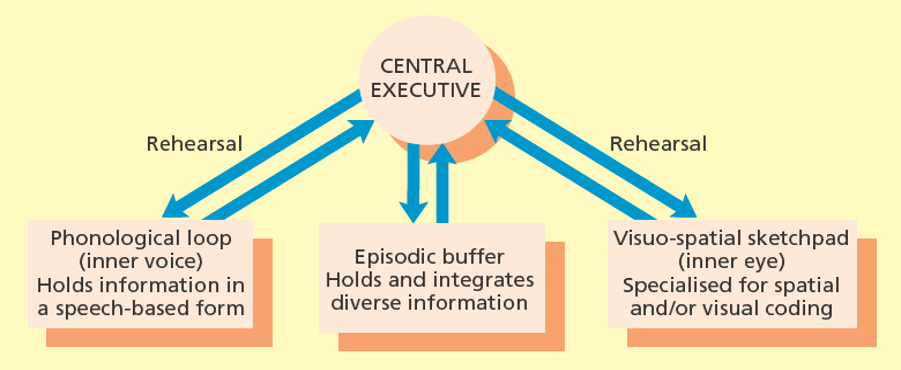
CE: is involved in problem solving/decision-making. It also controls attention and plays a major role in planning and synthesizing information, not only from the subsidiary systems but also from LTM. It is flexible and can process information from any modality, although it does have a limited storage capacity and so can attend to a limited number if things at one time.
PL: it stores a limited number of speech-based sounds for brief periods. It is thought to consist of two components - the phonological store (inner ear) that allows acoustically coded items to be stored for a brief period and the articulatory control process (the inner voice) that allows sub-vocal repetition of the items stored in the phonological store.
VSS:it stores visual and spatial information and can be thought of as an inner eye. It is responsible for setting up and manipulating mental images. Like the phonological loop, it has limited capacity but the limits of the two systems are independent. In other words, it is possible, for example, to rehearse a set of digits in the phonological loop while simultaneously making decisions about the spatial layout of a set of letters in the visual spatial scratchpad.
EB 200- It is responsible for integrating & manipulating material; it has limited capacity and depends heavily on executive processing. It binds together information from different sources into chunks or episodes, hence the term ‘episodic’. One of its important functions is to recall material from LTM & integrate it into STM when working memory requires it (e.g. imagining an elephant ice-skating).
The model has subsequently proved both useful and resilient, but has had to be supplemented by a fourth component, the episodic buffer (Figure 2). This is episodic in that it is capable of holding multidimensional episodes or chunks, which may combine visual and auditory information possibly also with smell and taste. It is a buffer in that it provides a temporary store in which the various components of working memory, each based on a different coding system, can interact through participation in a multidimensional code, and can interface with information from perception and long-term memory. The episodic buffer is assumed to have a limited capacity of about four chunks or episodes, and to be accessible through conscious awareness [7]. In its initial form, the buffer was assumed to play an active and attentionally-demanding role in binding together information from different sources, but further investigation suggests that it serves as a passive store rather than an active processor [8].
Phonological Similarity Effect (1966), which found that when given a list of words, people found it more difficult to remember words that sound similar to each other than those that sound different. It was also shown that semantic similarity had little effect on how easy words are to remember, which suggests that words are encoded phonologically rather than semantically in working memory
Larsey et al 2000 Recall 25% worse with a phonologically similar list, compared to a dissimilar list Suggests that we use speech-based rehearsal processes within the phonological loop
Bishop and Robson (1989) reported that children who have been unable to speak from birth (congenitalanarthrics) nevertheless show word length effects in serial verbal recall tasks. This kind of evidence points to the idea that rehearsal can be phonologically based and that word length effects can arise from the use of phonological coding
Baddeley (1973) gave participants a simple tracking task that involved holding a pointer in contact with a moving light. Whilst this was taking place, participants were asked to imagine a block capital letter F, and, starting from the bottom of the left hand corner of the letter, had to classify each angle as a 'yes' if it included the bottom or top line of the letter, and as a 'no' if it did not. The participants found it very difficult to perform both tasks at the same time, which suggests that the tracking and imagery task were both competing for the limited resources that the visuospatial sketchpad has.
Farrah et al (1988) LH better on spatial processing than visual imagery
Informações
- Descrição
- Notas sobre Working Memory - created from Mind Map, criado por Harpal smith em 15-04-2018.
- Criado por
- Harpal smith
- Visualizações
- 1
- Histórico
-
- Criado por Harpal smith · 15 abr 2018
- Copiado para Nota por Harpal smith · 15 abr 2018
- Avaliação