
Notas
Differentiation notes
Conteúdo das notas (17)
Página 1
Limits
A function is said to have a limit if it approaches the same value from below as from above. limits let us look at what's happening without being able to see it by instead looking around it.
Página 2
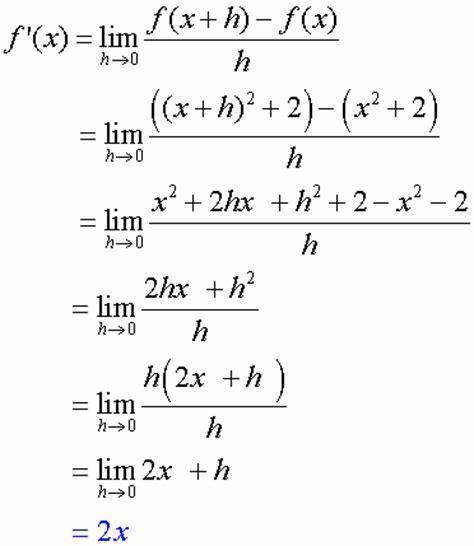
Differentiation by first principles
Página 3
Graph features
a function is said to be continuous if you can trace it without lifting your pen.
if a function is discontinuous then it is not differentiable at that point.
However, a graph can still be continuous and not differentiable at sharp changes in a gradient such as points where there is a cusp or undefined gradient.
a domain is the set of all possible x values which produce a valid output from a particular function.
a range is the set of all possible y values which produce a valid output from a particular function.
Página 4
Differentiation
An equation can be called a function if it satisfies the vertical line test. That is, a vertical line will only cut the equation in one place. Therefore each value in the domain (set of x values) will have only one corresponding value in the range (set of y values).
Differentiating a function, f(x) gives a gradient function, f'(x)
power function- when f(x) = x^n, the derivative will be f'(x) =nx^n-1, and the second derivative will be f''(x) = n(n-1)x^(n-1)-1
Chain rule
The chain rule is used to differentiate a composite function, which is a function inside another function.
the function is differentiated by first differentiating only the outer function, then multiplying this by the differential of the inner function.
when [f[g(x)]]^n the chain rule is used to give the following differentiation f'[g(x)]. g'(x), where f(x) is the outer function and g(x) is the inner function.
Exponential function- Is the only function where the y value is also equal to the gradient at that point.
So when f(x) = e^x the derivative will be f'(x) = e^x
for composite exponential functions where f(x) = e^nx, is a composite functions where e is the outer function, and ^(nx) is the inner function.
Natural log functions- when y=ln|x| (the |x| bars indicate that the x value is an absolute value and so must be positive), the derivative will be dy/dx = 1/x.
for composite natural log functions where y = ln |x^n|, is a composite function where ln |x| is the outer function and (x^n) is the inner function.
Trigonometric function- when y = sin(x), the derivative will be dy/dx= cos(x) where the derivatives of these functions can be found from a table in the resource booklet.
for composite trig functions such as f(x)= sin (x^n) the outer function is sin(x) and the inner function is (x^n)
for composite trig functions such as f(x) = cos^n(x) this is the same as (cos(x))^n where ^n is the outer function and cos(x) is the inner function where there can sometimes be a second inner function of (x).
Página 5
Product rule
A product consists of one function being multiplied by a second function.
when differentiating using the product rule (f.g)'=f'.g+f.g'
after substituting in the two functions into this equation which is found in the resource booklet this equation will require simplifying
Página 6
Quotient rule
A quotient consists of one function being divided by a second function.
When differentiating using the quotient rule (f/g)' = f'.g-f.g'/(g)^2
after substituting in the two functions into this equation which is found in the resource booklet this equation will require simplifying
Página 7
Second derivative
the 2nd derivative gives information on how the gradient is changing.
When f''(x) >0 the gradient at that point is positive (increasing), and the function is decreasing. For a turning point, it is a minimum or concave up.
When f''(x) =0 this is a point of inflection for some graphs.
When f''(x) <0 the gradient that point is negative (decreasing), and the function is increasing. For a turning point, it is a maximum or concave down.
Página 8
gradient at a point
Method-
differentiate
substitute x variable at that point
solve
coordinates for a given gradient
Method-
differentiate
f'(x)=gradient
solve for x
when solving for x when an equation contains a natural log or exponential.
remember that ln is a log with a base of e.
the logarithm loge(x)=y can be changed to exponential form where e^y=x
and the reverse of this can be applied to solve for the power of e when in exponential form by changing into log form.
Página 9
Tangent gradient
a tangent is a straight line that touches a curve at a point
Method-
differentiate
substitute in x variable for that point
solve for the gradient of the curve at the point where the line touches it, as it also gives the gradient of the tangent
use gradient and coordinates of the point to write an equation for the tangent.
normal gradient
the normal is a straight line that is perpendicular to the tangent
the same method is followed however the gradient of the normal is given by the inverse of the gradient of the tangent m(of normal)=-1/m(of tangent).
Página 10
stationary points
Method-
Differentiate the function
the gradient function, f'(x)= 0 at stationary points. therefore substitute so that the differentiated equation equals zero.
solve for X
when the question asks for stationary points substitute X value at that point into the function equation and solve for y.
a Turning point is where a function turns it's gradient from negative to positive or from positive to negative. At these points, the gradient function equals zero. These points are a type of stationary point.
a maxima is a maximum turning point that has a concave down shape. At this point f''(x) > 0
A minima is a minimum turning point that has a concave up shape. at this point f''(x) < 0
Página 11
decreasing/increasing function
when f'(x) is less than 0 (negative) this means that the gradients along these values of x of that function are decreasing
when f'(x) is greater than 0 (positive) this means that the gradients along these values of x of that function are increasing
between where the graph increases and decreases the gradient, f'(x)=0 this is called a turning point
the gradient will also equal zero at stationary points however only these stationary points are turning points.
method-
Differentiate f(x)
to find where the values of x for the function is increasing make f'(x)>0
or to find where the values of x for the function is decreasing make f'(x)<0
solve for x. It's important to remember the rules for solving inequalities; division or multiplication by a negative number reverses the inequality symbol.
Página 12
Parametric differentiation
A parametric equation is where the X and y variables are defined in terms of another parameter (a 3rd variable such as time, t). This lets each variable be defined in terms of its own equation.
Method-
Differentiate both functions in terms of the 3rd variable
fit both gradient functions into formula where dy/dx= dy/dt.dt/dx (formula found on reasorce sheet).
multiply gradient functions together.
simplify
Página 13
Optimisation
Variables of a function are optimized at the maximum or minimum points of a gradient function.
Method-
form an equation for the function which shows the relationship between the variables that result in the aspect that needs to be optimized
differentiate
make the gradient function equal zero
solve for x
find y when optimized
Página 14
optimisation of shape under function
method-
label side of the shape which can then be used as a coordinate of the function above (like the height of a triangle)
when the area is to be maximized or minimized find the general equation for the area of the shape.
use the labeled sides and known coordinates of the graph to give base and height for this area equation.
differentiate equation
equate gradient function to zero (as an optimization)
solve for x (lable given to unknown side)
sub into original area equation to find the optimized area
ensure that all parts of the question are completed
if the question asks for proof of maximum or minimum value you then need to calculate the second derivative then sub in found x value
remember that when f''(x)>0 the x value is for a local maximum point or when f''(x)<0 the x value for a local minimum point.
Página 15
rates of change
Differential equations express situations of related rates of change.
Formation of differential equations-
a differential equation can be set up from a situation when the rate of change is linked to some other quantity
when change is proportional to X
dy/dx= Kx
when change is inversely proportional to X
dy/dx = k/x
when the change of an amount is proportional to the amount itself
dy/dx = ky
Example-
water is flowing out of a lake at 400 liters per second. Express this using a differential equation.
Answer-
The rate of change of the volume of water (v) is -400 L/s. It is negative because the volume is decreasing.
dv/dt =-400
Página 16
Related rates of change
these questions use rates of change and parametric functions so
that the rates of change involve a third variable that relates two variables.
Página 17
Implicit differentiation
In explicit differentiation, y is expressed in terms of x (y=3x+1). Whereas for implicit differentiation y^2 is expressed in terms of (x^2 +y^2=9)
Method-
differentiate in terms of x
differentiate in terms of y^2 where y is the inner function and differentiates to dy/dx.
combine both differentials into the equation
rearrange to make dy/dx the subject
Informações
- Descrição
- NCEA Level 3 Mathematics Differenation (MD) Notas sobre Differentiation notes , criado por Shannon Ruscoe em 25-09-2018.
- Criado por
- Shannon Ruscoe
- Visualizações
- 2
- Avaliação