
Differentiation and Derivatives
62 resources created by 48 users
This Differentiation and Derivatives page on GoConqr gathers community-made quizzes, mind maps, flashcards, notes and slides, from first principles and basic rules to the chain rule, related rates and maxima and minima. It's built for university students and professional candidates, school students, and teachers after ready-made material. There are over 280 resources here, including more than 10 quizzes, over 130 mind maps and over 100 flashcard sets. Pick a topic, try a quiz to find your gaps, then make your own revision set.
Top Differentiation and Derivatives resources
-
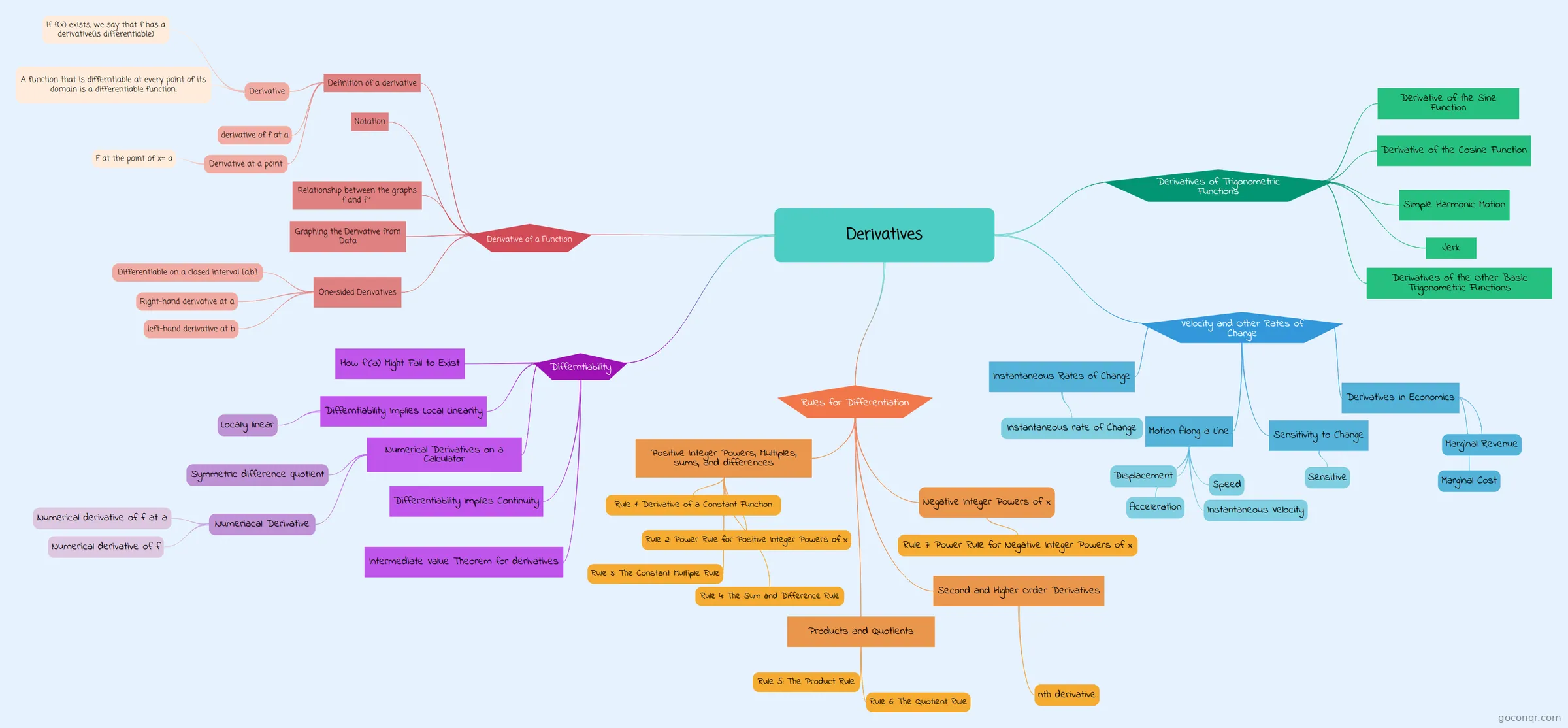 Mind map Derivatives
-
Mind map Differentiation My first mind map. Identifies key concepts of derivatives
-
3 cardsMAXIMUM AND MINIMUM 1. Compare the graphics of the following functions, then prove the resulted inequality. a) f (x) = ln (x + ...
-
19 cardsBasic Derivative Rules Basic Derivative Rules
-
10 cards2.7-2.10 AP Calculus-AB d/dx (sin x) = ?
-
22 cardsC3 Differentiation y = lnx
-
13 cardsNature of the Derivative This graph is for next flashcards so look at it.....
-
9 cardsIncreasing and Decreasing functions Where dy/dx is positive, the graph is.....
Quizzes
Mind maps
See all 11 mind maps-
Derivatives
-
Differentiation My first mind map. Identifies key concepts of derivatives
-
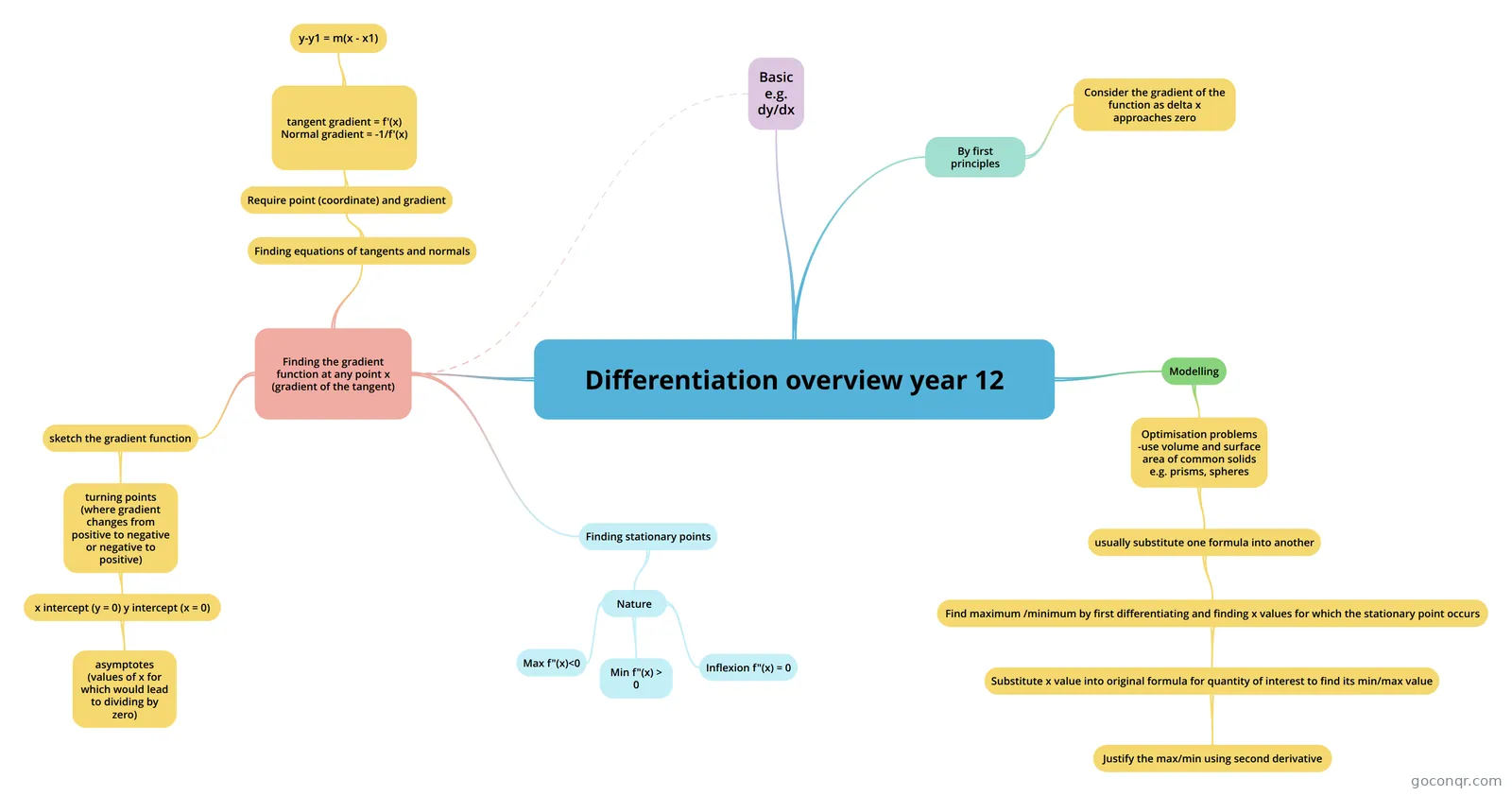 Differentiation overview year 12
-
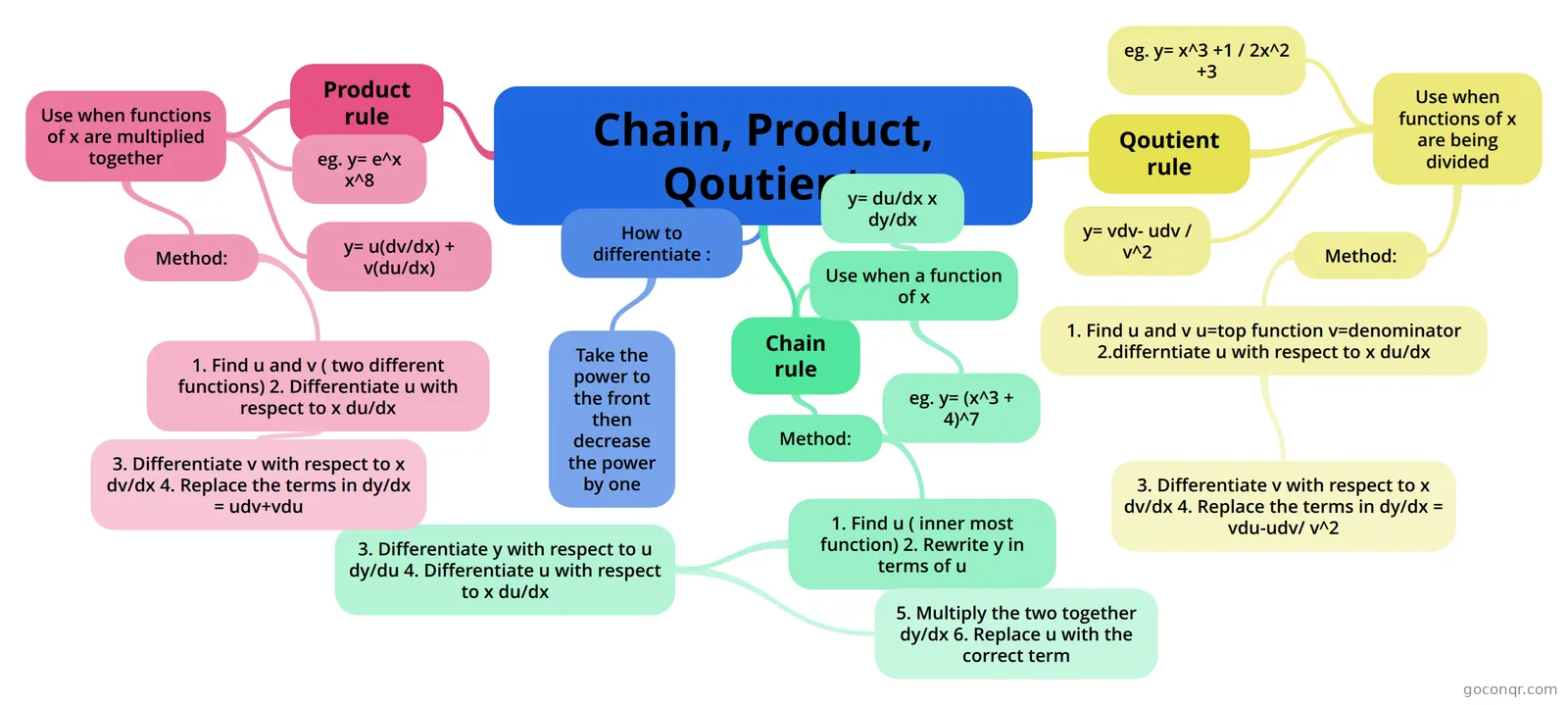 Chain, Product, Qoutient
-
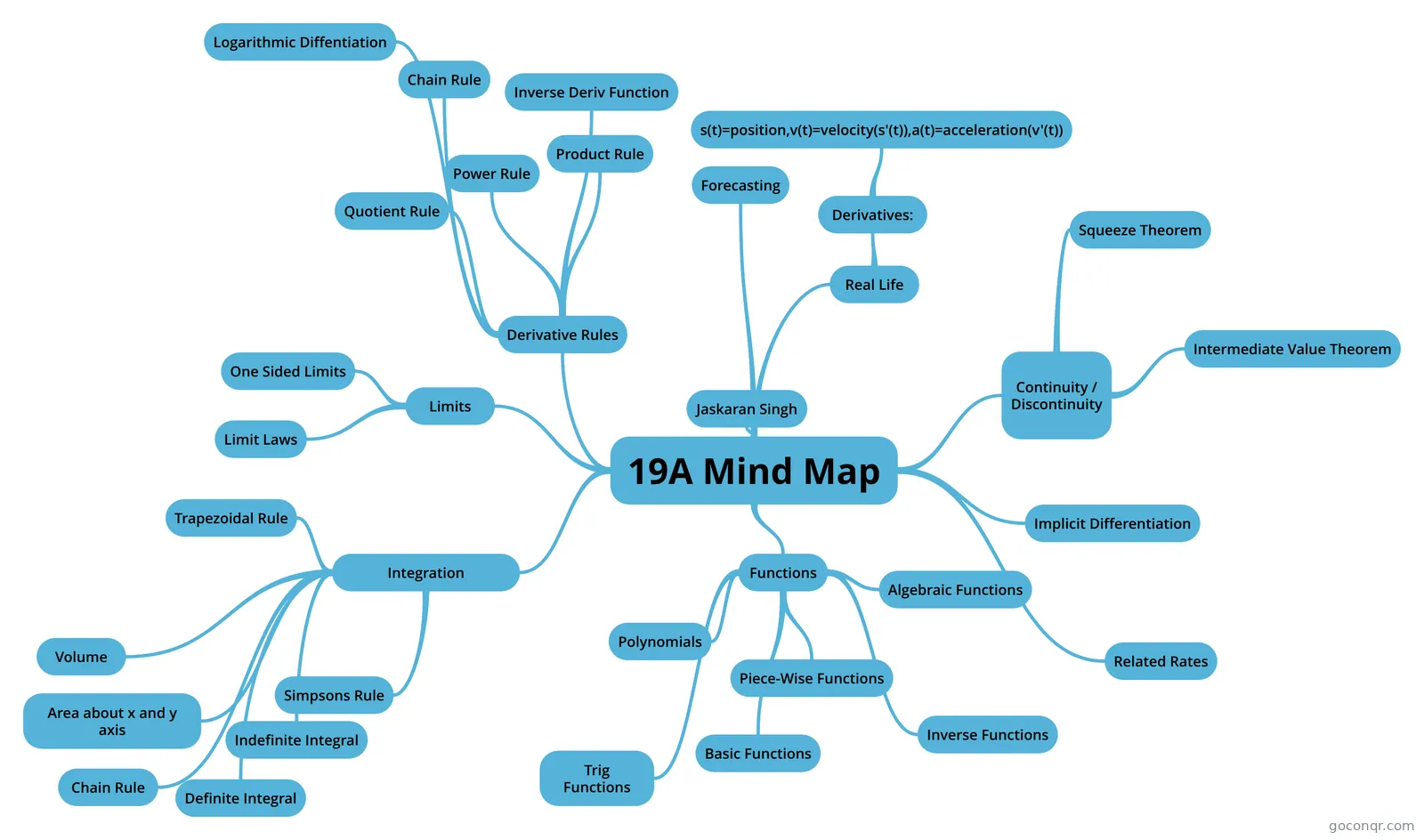 19A Mind Map Mind map for calc 19a
-
Derivatives of the addition or subtraction of functions. ,ingles
-
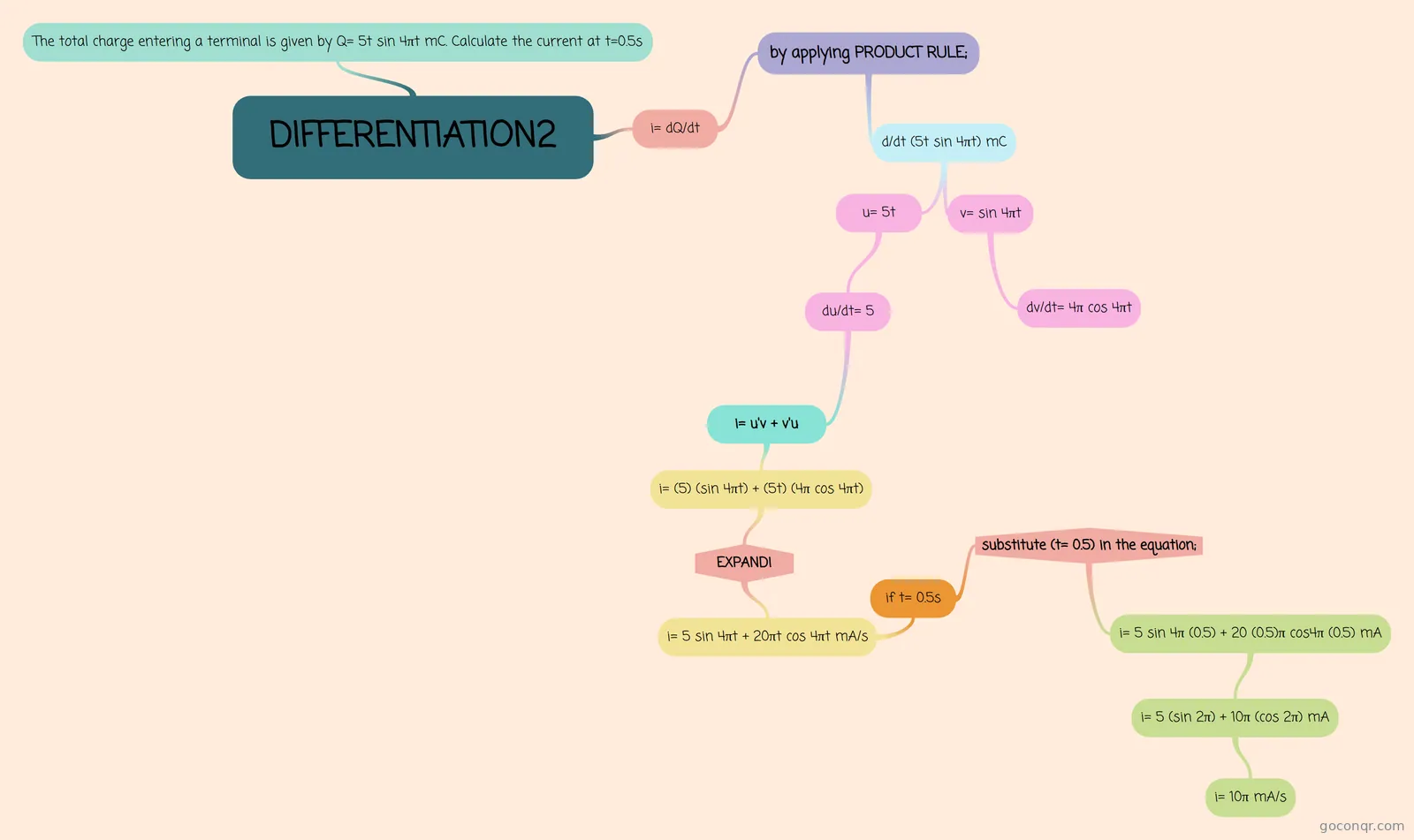 DIFFERENTIATION2
-
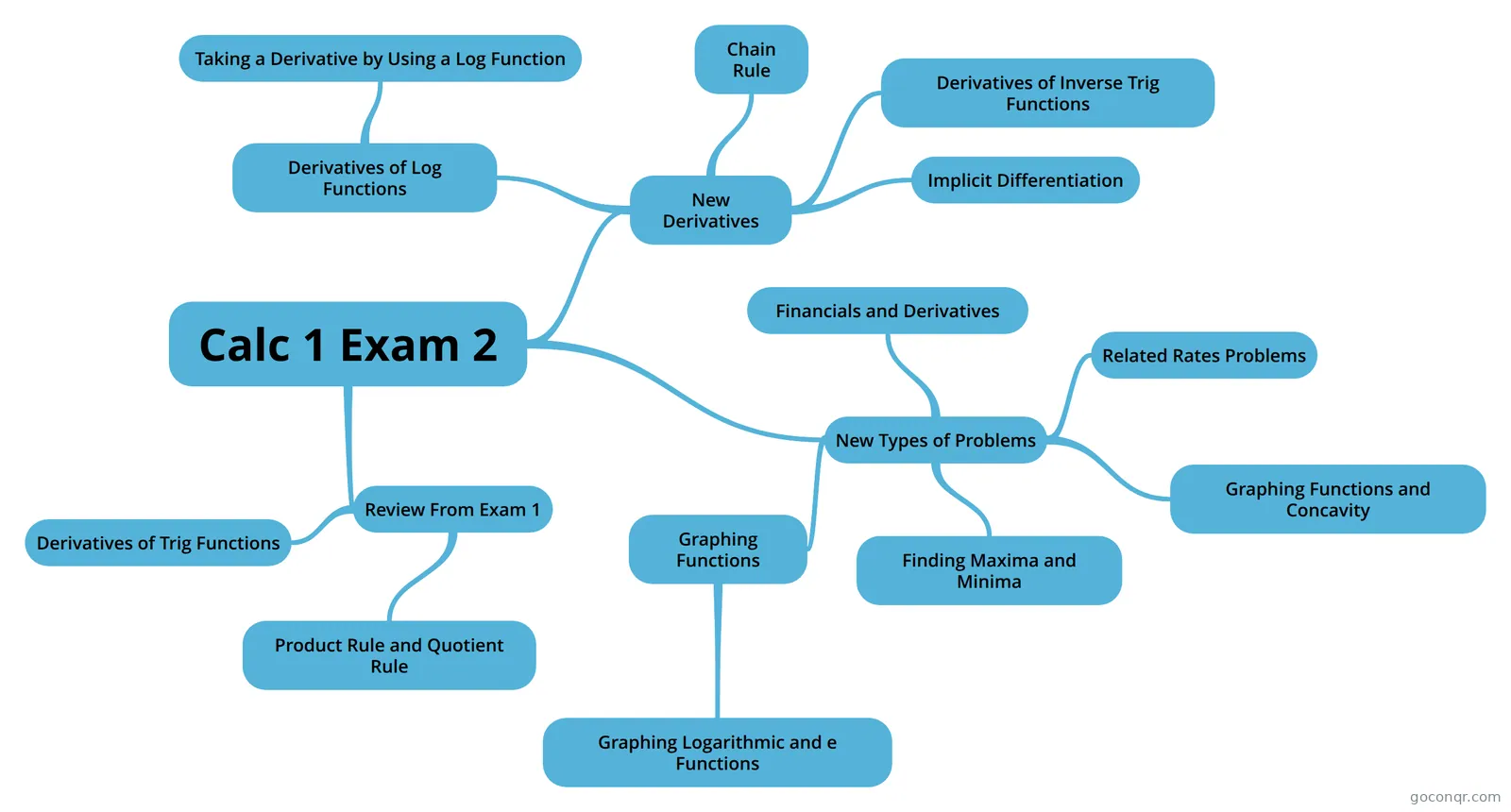 Calc 1 Exam 2 Mind map for the second exam of Calc 1
Flashcards
See all 37 flashcards-
3 cardsMAXIMUM AND MINIMUM 1. Compare the graphics of the following functions, then prove the resulted inequality. a) f (x) = ln (x + ...
-
19 cardsBasic Derivative Rules Basic Derivative Rules
-
10 cards2.7-2.10 AP Calculus-AB d/dx (sin x) = ?
-
22 cardsC3 Differentiation y = lnx
-
13 cardsNature of the Derivative This graph is for next flashcards so look at it.....
-
9 cardsIncreasing and Decreasing functions Where dy/dx is positive, the graph is.....
-
14 cardsDifferentiation How do you differentiate?
-
21 cardsCalculus Differentiation, integration
Notes
-
Graphical Representations of Differentiation Gradients and Tangents The derivative of a function can be interpreted as the gradient of a function at that point. This means that if we were to graph the function, we could use the derivative to find its slope...
-
Second Order Derivatives
-
What is Differentiation? What is 'Differentiation by first principles'? Differentiation by first principles means using the idea that the deriviative represents the gradient of the curve, rather than rules and tricks, to calculating the...
-
MEI OCR: Core 3 Maths
-
Differentiation year 1 and 2 GRADIENTS OF A CURVE What is a gradient? A gradient is the measure of how steep a line is (Can be positive if increase or negative if decreasing), it does this by measuring how much you increase in Y by every 1 x you ...
-
Mathematics B
-
An Introduction
-
Calculus Section 4.1 - Rates of Change To solve related rates problems: 1. Identify given information 2. Identify the unknown 3. Introduce suggestive notation KEY - Remember that rates of change = derivatives
Slides
More Mathematics topics
About Differentiation and Derivatives
GoConqr OriginalWhat this unit covers
The resources here follow differentiation from its meaning to its uses. The notes titled What is Differentiation? introduce the derivative as the gradient of a function and explain differentiation by first principles. Graphical Representations of Differentiation covers gradients, tangents, normals and stationary points. Second Order Derivatives links the derivative of the derivative to displacement, velocity and acceleration.
Where to start
If the idea is new, begin with the mind map Differentiation. It asks why we differentiate and ties the derivative to the gradient of a tangent. Then read the notes on first principles and the definition of the derivative.
Next, move to the rules. The flashcard deck Basic Derivative Rules covers the constant, constant multiple, power, sum and difference, product and quotient rules. The deck Differentiation formulae adds the chain rule and the derivatives of exponential, logarithmic and trigonometric functions.
Building up to applications
- Learn the trigonometric and exponential results with the AP Calculus-AB deck, which asks for the derivatives of sin x, cos x, tan x, eˣ and ln(x).
- Practise the product, quotient and chain rules with the slide sets and the mind map Chain, Product, Qoutient.
- Turn to Related Rates and the maximum and minimum material, including the flashcard deck on maximum and minimum and the Class XII maxima and minima quiz.
Using quizzes and maps together
Read a mind map first to see the whole topic on one screen. Then take a quiz such as Differential Calculus to see which rules you still mix up. Go back to the matching flashcards for those gaps. Exam-minded learners will find material mentioning A-level Maths, AP Calculus and GCSE Maths, plus past paper question slides.
Where it fits
This unit sits in the Calculus strand of Mathematics. Everything here was made by GoConqr users, so styles and notation vary. That is useful: if one explanation does not click, another might. Open a resource that matches where you are, and see how far a short session takes you.
Frequently asked questions
Which resource should I open first?
Start with the mind map called Differentiation. It explains why we differentiate and connects the derivative to the gradient of a tangent. After that, the notes What is Differentiation? walk through first principles with worked examples, and Basic Derivative Rules gives you the core rules to memorise.
What do the mind maps cover?
The over 130 mind maps range from overviews of derivatives and differentiability to rule summaries, such as Chain, Product, Qoutient, and applications like how to graph a function. Some follow specific courses, including C3 and C4 maps, so you can pick one that matches what you are studying.
Which exams and levels do these resources suit?
The listed resources mention A-level Maths, A-level Mathematics, AP Calculus and GCSE Maths. Most are aimed at university students and professional candidates, with a substantial share for school students. Teachers can use the slide sets, quizzes and notes as ready-made classroom material.
Are the resources free to use?
Yes. Every resource listed here is free to open, study and take, with no account needed. A free account also saves your quiz scores and lets you make your own quizzes, mind maps, flashcards and notes.
Who made these resources?
They were made by GoConqr users, not by GoConqr itself. Over 220 contributors have added material to this page, which is why you will see different styles, notations and course references, from university calculus courses to A-level modules.
Is there anything on maxima and minima?
Yes. You will find a flashcard deck called MAXIMUM AND MINIMUM, notes on maxima and minima, a quiz on absolute maximum and minimum, and a Class XII maxima and minima quiz. The notes on graphical representations also cover stationary points.