
Notas
Waves past exams modelling
Conteúdo das notas (13)
Página 1
Resource booklet

Other needed equations include:
beat frequency=f1-f2 (the difference in frequencies)
Página 2
2017 question one
scenario:
In 1845, Dutch physicist Buys Ballot demonstrated the Doppler effect by listening to musicians playing their instruments on a train as it passed by him. One musician played a note on a clarinet with all the finger holes closed. A clarinet can be modeled as a pipe that is open at one end and closed at the other. The length of the clarinet is 0.613 m. The speed of sound is 341 ms–1.
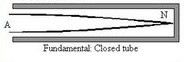
(a) On the diagram below, draw the 1st harmonic (fundamental) standing wave, AND label the nodes and antinodes.
Achievement question
for the diagram to be correct the wave must continue to the end of the pipe and not be straight.
Nodes always at a closed end of a pipe and the fixed end of a string
Antinodes always at open ends of a pipe
(b) The clarinet produces the fundamental frequency and several harmonics. Explain why the clarinet does not produce any even harmonics
merit question
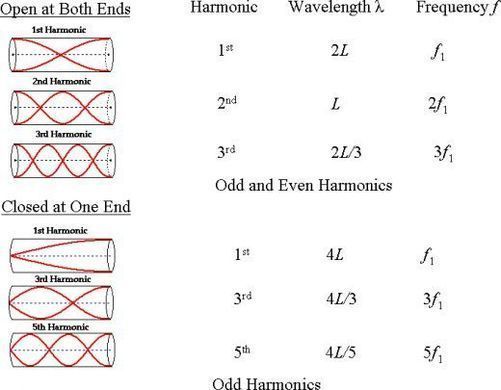
the closed end of the pipe must be at the node
the open end of the pipe must be at the antinode
The fundamental has a pipe length of a 1/4 wavelength
so the pipe length for an even harmonic would require an even number of 1/4 wavelengths.
because of this even harmonics cannot be produced as that would require both ends of the standing wave to be at antinodes or both at nodes.
(c) When the train was approaching Ballot at a speed of 5.00 ms–1, he heard a frequency of 139 Hz from the clarinet. Show that the frequency of the sound heard by the clarinet player would have been 137 Hz
Merit question
f' = f. vw / vw ± vs
f'=139 Hz
vw= 341 ms–1.
vs=5.00 ms–1
f=137 Hz
139 = f .341 /341− 5
f = 139.341/336 = 137 Hz
(d) A second clarinet player was standing beside Ballot as the train approached. She produced the same frequency (137 Hz) as the clarinet player on the train, causing Ballot to hear beats. Explain why the sound wave reaching Ballot from the clarinet on the train did not have a frequency of 137 Hz, AND explain why Ballot heard beats, AND calculate the beat frequency
Excellence question
The clarinet on the train is moving towards the waves that it has already produced
This causes the wavelength to decrease and the frequency of the wave to increase (the wave speed is constant)
This is called the Doppler effect and is why the sound waves from the clarinet on the train reach Ballot with an increased frequency of 139 Hz instead of 137 Hz.
Beats are caused when the two waves of slightly different frequencies to arrive at Ballot with slightly different frequencies.
they sometimes arrive in phase interfering constructively causing a loud sound to be heard
when they arrive 180' out of phase they interfere deconstructively causing a quite sound to be heard
The beat frequency is the difference between the two frequencies, so the beat frequency is f1-f2=139-137= 2 Hz
Página 3
2017 question two
scenario:
Mike and Kate are on a tramping trip and are crossing a suspension bridge. They realize that by jumping up and down in a particular way, they can set up a standing wave in the bridge. The bridge is 24.0 m long.
(b) A bridge can oscillate at many harmonics. Show that the frequency of the 3rd harmonic mode is: f = 3v/2L, where L is the length of the bridge.
Merit question
f= v /λ
for 3rd harmonic, L = 3/ 2.λ→λ = 2L /3
f = v /2L/ 3
f= 3v / 2L
(c) The bridge oscillates at the fundamental frequency mode with a period of 1.80 s. Calculate the speed of the waves in the bridge.
Merit question
f=1/T
T=1.80 s
f=1/1.8=0.56 Hz(don't round answer until the end)
v=f λ
L=1/2. λ
λ=2L=2.24.0=48m
v=0.56*48=26.7m/s
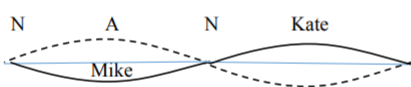
(d) Mike is 6 m from one end and Kate is 6 m from the other end. Give a comprehensive explanation of how it is possible for Mike and Kate to cause the bridge to oscillate in the 2nd harmonic mode. In your explanation, you should:
draw a labeled diagram of the bridge oscillating in the 2nd harmonic mode
explain how they set up a standing wave
explain why they choose to stand in the positions stated
explain the phase relationship between their oscillations
Excellence question
By jumping up and down they send transverse waves along the bridge
these waves hit a fixed end and reflect inverted
the two sets of waves interfere and set up a standing wave
they must stand at the 1/4 and 3/4 positions because this is where the antinodes are for the second harmonic.
they must jump up and down 180' out of phase because adjacent antinodes are out of phase.
f=2v/2L=26.7/24=1.11 Hz
mike and kate must jump at the correct frequency f=1.11 Hz
Página 4
2017 question three
Página 5
2017 summary
(a) Describe one difference between a standing wave and a traveling wave
Merit question
Standing waves have nodes and antinodes but traveling waves do not
standing waves require interference but traveling waves do not.
Traveling waves transfer energy, standing waves don’t.
Traveling waves have one source but a standing wave requires 2 sources.
Página 6
2016 question one
Página 7
2016 question two
Página 8
2016 question three
Página 9
2016 summary
Página 10
2015 question one
Página 11
2015 question two
Página 12
2015 question three
Página 13
2015 summary
Informações
- Descrição
- NCEA Level 3 Physics exam Notas sobre Waves past exams modelling, criado por Shannon Ruscoe em 08-10-2018.
- Criado por
- Shannon Ruscoe · out 2018
- Atualizado
- 9 out 2018
- Visualizações
- 124
- Avaliação