
Notas
Science 9: Unit 3 - Environmental Chemistry
Conteúdo das notas (11)
Página 1
Science 9: Unit 3 - Environmental Chemistry
Topic 1.1 - Chemicals in the Environment
The three cycles we learned about in this unit are the Water Cycle, Carbon Cycle, and the Nitrogen Cycle.
The Water Cycle:
Water starts as a liquid in surface water or as water in leaves. Then the water transpires from the leaves and vaporizes from the surface water, becoming water vapour in the atmosphere. Then it condenses into clouds, and water keeps filling up in clouds. Once the clouds are over-filled, water falls in liquid form, called precipitation. The water then drains into surface and groundwater, ready to be evaporated again.
The Carbon Cycle:
Carbon is given off by factories and dead and alive organisms, usually in the form of carbon dioxide. Then the carbon dioxide is absorbed by plants or goes into the soil and slowly forms coal. Then the plant dies and creates more carbon dioxide, ready to be absorbed again.

The Nitrogen Cycle:
Nitrogen gets into the soil through decay and animal waste and then gets rid of bacteria in the roots of plants. It mixes with ammonium and oxygen in the soil. Then it separates and goes back into the atmosphere. To make nitrogen useful, it must be combined with something else, called "Nitrogen Fixation". Nitrogen then goes back into the soil, ready to be used again.
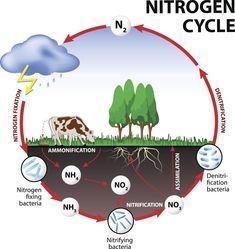
Nitrogen Fixation: Changing free nitrogen so that the atoms can combine with other elements that organisms can use. This happens with lightning.
Página 2
Science 9: Unit 3 - Environmental Chemistry
Topic 1.2 - Human Activities and Their Impact
AGRICULTURAL:
Fertilizer: A substance that enriches the soil, allowing plants to grow better. Made up of nitrogen, phosphorus and potassium
Positives:
- Encourages growth
Negatives:
- Too much can damage soil
- Gets into water and damages ecosystems
Pesticides: A chemical used to kill pests(pests harm people, crops, or structures).
Insecticide = Bugs
Herbicides = plants and weeds
Fungicide = Fungus
Positives:
- Kills pests
Negatives:
- Pests can build immunities to overused pesticides
- Cause cancer, poisonous to many other organisms
HUMAN WASTE DISPOSAL
Solid Waste: Garbage taken from anywhere humans are. Some are recycled while most are sent to landfills. In landfills, the waste is burned and then buried into the ground. Sanitary landfills have a clay lining that tops damaging chemicals getting into the soil
Positives:
- Get rid of our waste
Negatives:
- Take up space
- Dangerous chemicals can leak into the soil
- Incinerators cause air pollution
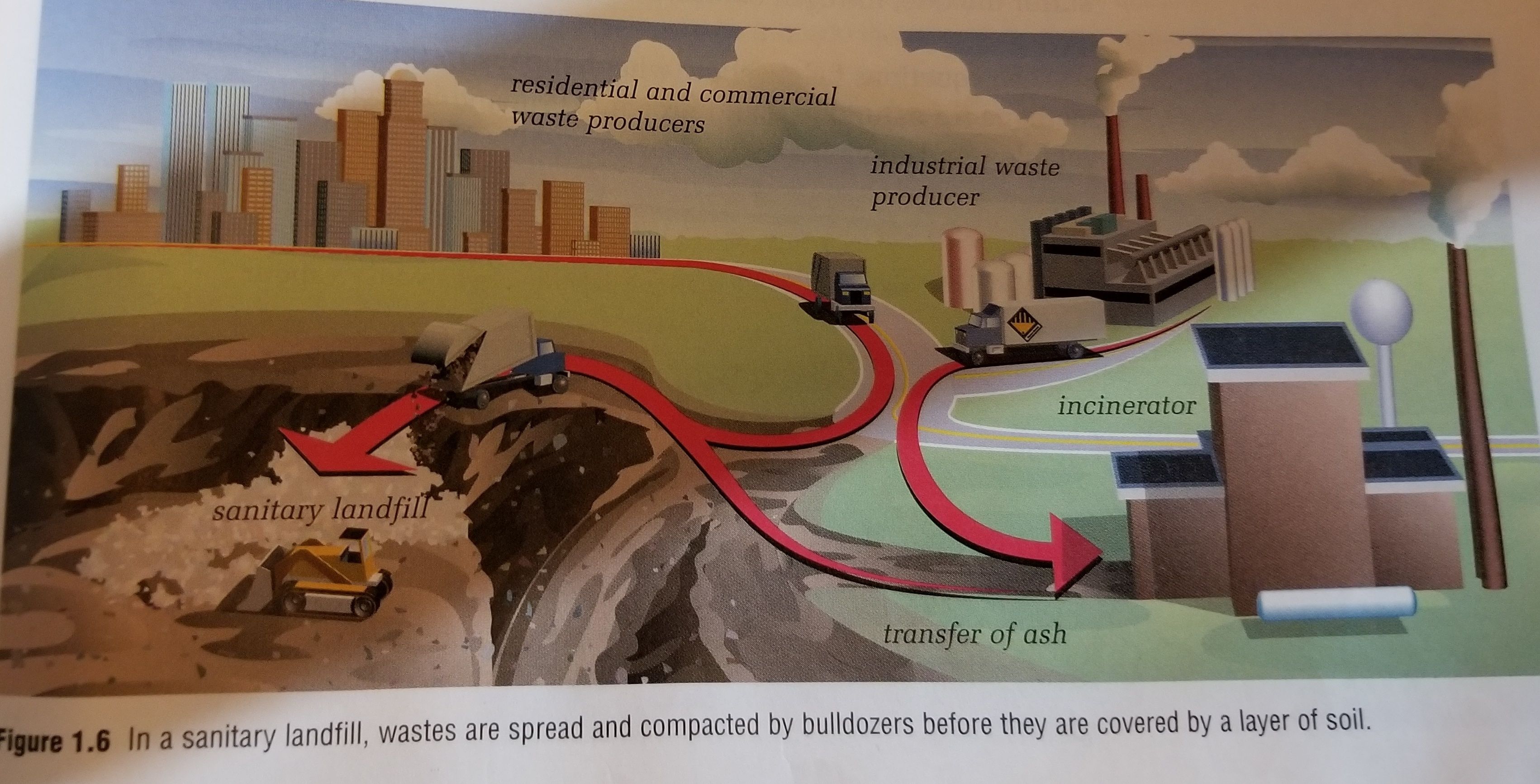
Waste Water: Water that is taken from human places. It can be dangerous if not cleaned. In a rural area, it is taken to a septic tank. In an urban area, it is taken to a sewage treatment plant. Storm sewers take excess rainwater that rolls down the streets can carry dangerous chemicals. Effluent is treated wastewater.
Stages of Cleaning:
Physical - Large material removed
Biological - Bacteria removes smaller material
Chemical - Chemical cleaners are added
Positives:
- Clean water is safe!
Negatives:
- Uncleaned water can pollute the environment, magnifies down the food chain

Fuel Combustion and Industrial Processes: Involve gases reacting to aid us mechanically. Combustion reactions are used to get lots of energy Eg. Gasoline and factories
Positives:
- Transportation, heating and using power are easier
Negatives:
- Lots of CO2 is released
- Causes air pollution
- Acid rain
- Global warming
Página 3
Science 9: Unit 3 - Environmental Chemistry
Topic 1.3 - Common Substances Essential to Living Things
Organic Substances: Contain the element carbon, there are more of these. CO2 and CO aren't organic
Inorganic Substances: Do not contain the element carbon
Nutrients are things that we need to live!
Macronutrients: Are needed in large amounts(made of oxygen, carbon, nitrogen and hydrogen)
- Carbohydrates: Provide energy(C, H, O)
- Proteins: Helps us grow and repair(C, H, O, N)
- Lipids: Store energy(C, H, O)
- Nucleic Acids: Found in nucleus
Micronutrients: Are needed in small amounts
- Iron
- Copper
- Many other metals
Nitrogen: Growth and repair in humans and plants
Phosphorus: Growth, bones and photosynthesis
Potassium: Early growth in both, muscles in humans
Magnesium: Photosynthesis, bone composition
Calcium: Muscles and bones, cell wall
Sulfur: Proteins, fruit production
Página 4
Science 9: Unit 3 - Environmental Chemistry
Topic 1.4 - The Intake of Substances
Intake In Plants:
Diffusion: Molecules move from high concentration to low concentration in the plant roots
Osmosis: Molecules moving through water through a semi-permeable membrane(high concentration to low concentration)
Active Transport: Movement from low concentration to high concentration using energy
Intake in Animals:
Ingestion: Taking food into the body
Hydrolysis: Using water to break down food(saliva)
Animals can access nutrients on a substrate:
Substrate: The material a substance lives or moves on
Examples:
Algae growing on water(water gives algae nutrients)
- Mold growing on bread
Página 5
Science 9: Unit 3 - Environmental Chemistry
Topic 2.1 - Acids and Bases
Acidity: The measure of how many hydrogen ions are in a substance(more ions = more acidic)
pH: On a scale from 0 -14. 0 = acid, 7 = neutral, 14 = base. Use a base-10 system
Acids: Have a pH lower than 7 Eg. Tomatoes, vinegar, battery acid
- Taste sour
- Conducts electricity
Bases: Have a pH higher than 7 Eg. Ammonia, baking soda, shampoo
- Tastes bitter
- Conducts electricity
- Corrodes
Neutralization: Acids and bases will react with each other to form a salt, water and gas Eg. Antacid, vinegar
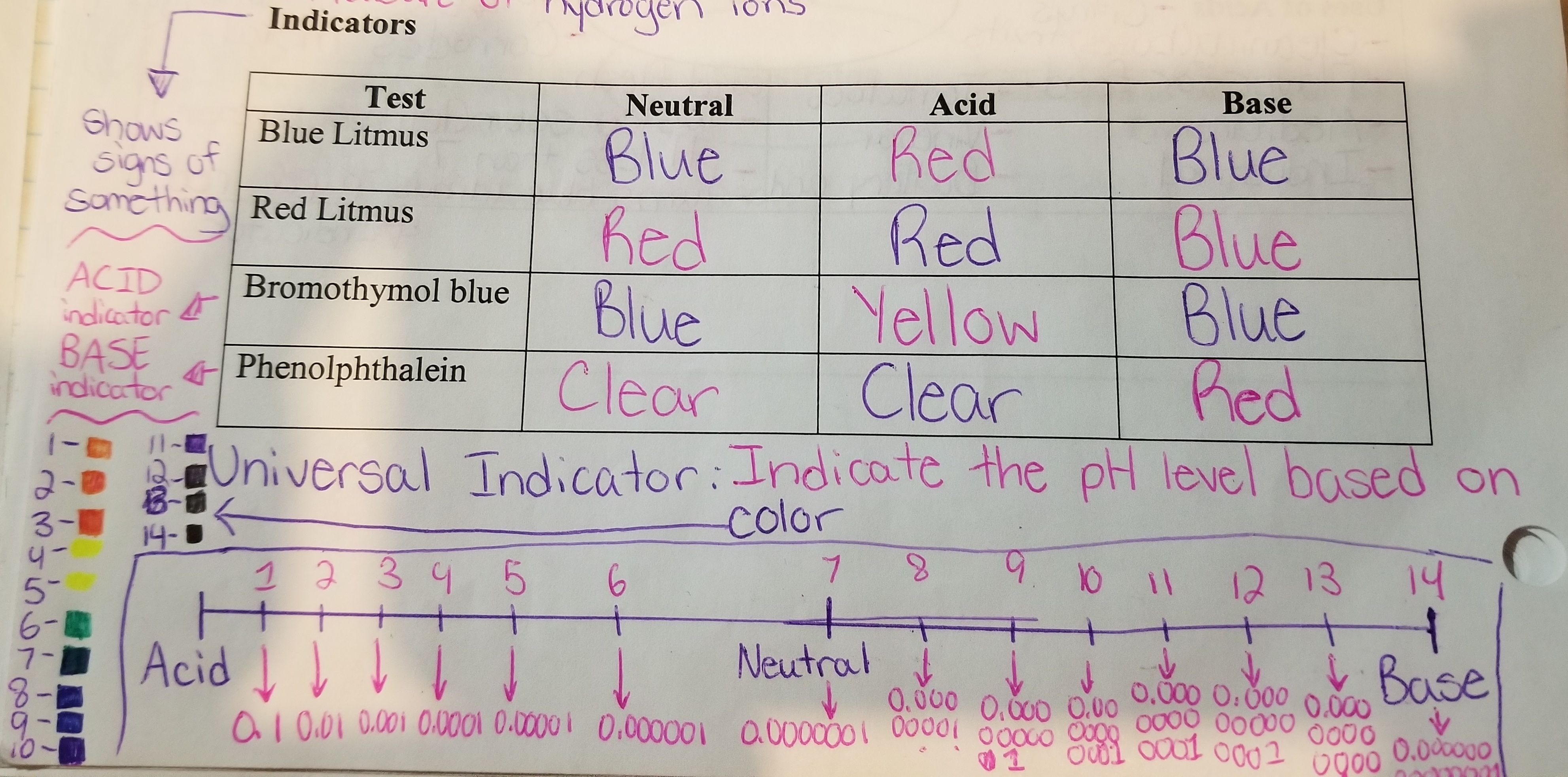
Acid Indicators: Express the pH of a substance
- Blue Litmus Paper: Turns red when there's an acid
- Red Litmus Paper: Turns blue when there's a base
- Bromothymol Blue: Turns yellow when there's an acid
- Phenolphthalein: Turns red when there's a base
- Universal Indicator: Color = acidity
Effects on the Environment:
Acid Rain: Rain with a pH lower than 5.3. Caused by factory emissions.
- Stops fish eggs
- Slow plant growth
Acid Spring Shock: Acidification of runoff
- Stops fish spawning
Página 6
Science 9: Unit 3 - Environmental Chemistry
Topic 3.1 - Monitoring Water Quality
Water quality is determined by what it's used for.
- Human Drinking
- Recreation
- Livestock Drinking
- Irrigation
- Aquatic Life Protection
Biological Indicators: Organisms that live in water and allow us to determine the water quality(some organisms can survive in tougher conditions)
Lots of pollution = Dragonflies, beetles
Little pollution = Mayflies, stoneflies
Inorganic Chemical Factors:
- Dissolved Oxygen: Amount of oxygen in water, more is better
- Temperature
- Turbulence
- Photosynthesis
- # of Organisms
- Acidity: Level of pH
- Heavy Metals: Metals denser than 5g/cm3 are dangerous
- Plant Nutrients: Amount of phosphorus and nitrogen(excess can cause sewage outfalls and fertilizer run-off)
- Nitrates are bad, result from excess fertilizer, etc. Can cause health problems to both humans and aquatic animal diversity
- Excess phosphorus comes from too many algae. It also lowers oxygen levels and sunlight for other plants
- Toxicity: Can cause health problems to organisms
River Diagrams:
Headwaters: Where it starts
Floodplain: Where it overflows too
Mouth: Where it ends
Página 7
Science 9: Unit 3 - Environmental Chemistry
Topic 3.2 - Measuring Chemicals in the Environment
LD50: A certain amount of a substance that has a 50% chance of killing you(depends on mass)
Eg, A 2000g rat eats 1500g of LD50, it dies
Examples:
- Caffeine
- Table salt
Parts Per Million: The concentration of chemicals. A ppm(part per million) is a millionth of a substance.
- Part per Billion
- Part per Trillion
Formula: Mass of solute(g, kg)/ total volume of solution(mL, L) x 1,000,000 for ppm(1 B for ppb and 1 T for ppt)
*If poison does damage at ppt, it is very powerful.
Example Problem: Pool has 2,500,000 L of water. 6.75 g of salt is dissolved, what is its ppm?
1. Make sure the units are equivalent(l = kg, mL = g, etc.) They aren't, so convert L to mL: 2,500,000 x 1000 = 2,500,000,000 mL
2. Divide! 6.75 g/ 2,500,000,000 mL = 0.0000000027
3. Multiply! 0.000000027 x 1,000,000 = 0.0027 ppm
Answer: 0.0027 ppm!
Página 8
Science 9: Unit 3 - Environmental Chemistry
Topic 3.3 - Monitoring Air and Atmosphere Quality
Air Pollutants:
Sulfur Dioxide: Comes from oil and gas burning, forms acid and causes lung problems
Nitrogen Oxides: Comes from electric utilities, forms acid rain
Carbon Monoxide: Comes from burning carbon, kills organisms
Ground Level Ozone: Comes from overheated ozone layer, causes lung problems
Chlorofluorocarbons: Comes from fridges and aerosal cans, breaks down ozone layer
Atmosphere Quality:
Important Greenhouse Gases:
- Water vapour (H2O)
- Carbon dioxide (CO2)
- Nitrogen oxides (N2O)
- Methane (CH4)
Greenhouse Effect: A naturally occurring event, resulting in greenhouse gases being trapped, making our planet warm and habitable
Enhanced Greenhouse Effect: Higher global temperatures caused by an excess of greenhouse gases
Global Warming: Heat from the sun is trapped by greenhouse gases, caused by human activities. Results in unpredictable climate and ice caps melting. Political opinions on it are that we must charge people on their carbon usage to get them to reduce it.
Technologies to Reduce Impact:
- Scrubbers
- Catalytic converters in cars
- Planting vegetation
Página 9
Science 9: Unit 3 - Environmental Chemistry
Topic 4.1 - Transportation of Chemicals Throughout the Environment
Stages to Chemical Movement:
Point Source: Chemical comes from one specific spot
Non-point Source: Chemical comes from a large area
Release: Where the chemicals originate Eg. Littering
Dispersion: Chemicals are spreading out Eg. Wind moving chemicals
Deposition: Where the chemicals end up Eg. Water, Air, or Soil
Transportation of Chemicals in the Air: Chemicals can get anywhere if they can move through the air
Factors:
- Wind speed
- Wind direction
- Mass of chemical
- Weather(rain or snow)
Transportation of Chemicals in Water: Chemicals can move long distances in surface water. Chemicals can increase in concentration in groundwater.
Factors:
- Movement of water
- Temperature of water
- The shape of the waterway(straighter = faster)
- Chemical mass and composition
- Amount of pores
Run-off: Excess water that flows over land surfaces, picking up chemicals as it goes
Transportation of Chemicals in Soil: Chemicals can increase in concentration as they move downwards
Factors:
- Amount of pores
- Composition of soil
- Chemical composition
Biomagnification: The increase in the concentration of a pollutant through the movement of the food chain
Página 10
Science 9: Unit 3 - Environmental Chemistry
Topic 4.2 - Reducing the Harmful Chemicals in the Environment
Dilution: Mixing the chemical with lots of air or water to reduce the concentration
Biodegradation: Living things that actively break down waste Eg. Composting
- Temperature
- Soil Moisture
- pH levels (6.5 - 8)
- Oxygen Levels
- Nutrient Availability
Four R's: Reuse, Reduce Recycle, Recover
Phytoremediation: Plants that absorb harmful chemicals
Photolysis: Breaking down compounds using sunlight
Properly cleaning and taking care of chemicals also helps the environment!
Página 11
Science 9: Unit 3 - Environmental Chemistry
Topic 4.3 - Viewpoints of Human Activities
Ethical: Is it right to destroy the environment for our needs?
Political: Who has to clean up messes? Will this help the country?
Economic: Is it financially viable to continue supporting the environment?
Environmental: How have our actions changed the environment? Is it all negative?
Informações
- Descrição
- Use this to study for tests.
- Criado por
- Riley Babuik · jan 2020
- Atualizado
- 21 jan 2020
- Visualizações
- 102
- Tags
- Avaliação