
Notas
C.2 Economics, Skill #4- Notes
Conteúdo das notas (6)
Página 1
C.2 Economics, Skill #4- Notes
Analyze how macroeconomic factors (e.g., national income, employment, price stability) influence the performance of economic systems.
Página 2
Macroeconomics
study of the economy as a whole
focuses on
national output which is measured by the Gross Domestic Product (GDP)
the role of inflation
unemployment
Página 3
National Output (GDP)
GDP
most important indicator of the health of the economy and a country's income
total money value of final goods/ srvcs. that a country produces over a given period of time
Expenditures Approach
looks at the amount of new goods and services purchased in a country for a given year
what each sector in the country spends is equal to what they earn producing it
GDP = C + I + G + NX
C= Consumption (total amount of goods and services in one year)
I = Investment (total amount of investment items bought by business and individuals)
G= Goods (amount of new goods and services bought by the government)
NX= Net Exports (the difference between the goods bought by people outside of the country and the goods people in the country bought from outside of the country
When an economy is doing well, the aggregate supply is equal to the aggregate demand; however, economies have different cycles and fluctuations of aggregate economic activity
aggregate supply: amount of national output purchased
aggregate demand: amount of national output purchased
Four phases of the economic cycle
Boom: expansion of the economy that brings prosperity
Recession: a contraction of the economy with a decline in GDP and a rise in unemployment
Trough: a turning point in an economic cycle, a period in which there is a slide from the mean to the lowest point in a recession
Recovery: a period in which there is a rise from the trough back to the mean and during which there is lessening unemployment and rising prices
Página 4
Unemployment and Inflation
Indicates economy's instability that result when there is an inequality between aggregate demand and aggregate supply
Unemployment
surplus (sellers make too many goods and there aren't enough buyers) results in unemployment because sellers have to lower their production by laying off workers
governmental action is required when there is not enough spending in an economy, production slows, and unemployment rises
three types of unemployment:
frictional
occurs when workers voluntarily move from one job to another job with time in-between
examples: students entering the workforce, stay-at-home parents returning to work, people who move to new location
cyclical
economy falls as the result of a recession and businesses need to survive by laying off workers rather than cutting salaries or prices
functional
more workers than available jobs
worker skills are either not in demand or do not match industry needs
results from seasonal work
Inflation
a period in which the prices rise too quickly because a monetary unit's value has decreased and the purchasing power of that monetary unit has lessened
government intervention should try to slow the economy and encourage less spending
results from too much spending in an economy
buyers want to buy more than sellers can produce and buyers rise prices
inflation rate
the rate at which prices rise
used to determine whether economy is growing at healthy rate
Página 5
Governmental Economic Stabilization Tools
Fiscal Policy
expansionary fiscal policy
raises government spending/ decreases taxes in order to increase spending
contractionary fiscal policy
decreases government spending and increases taxes in order to decrease spending in the economy
Monetary Policy
bonds
a way for government and business to borrow money
each bond has a par value (stated/ face value; represents principal of the loan), a date to maturity (ranges from 90 days - 30yrs), a coupon (a promise to pay a certain amount of money each year to the bondholder until maturity; represents interest), and a promise to repay the par value (principal) on the maturity date
issuing government/ business sells the bonds in the bond market for a price determined by supply and demand
money received from the sale represents the principal of the loan, the annual coupon pa
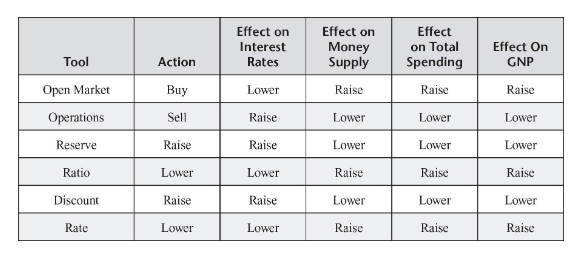
in the US, the Federal Reserve System (Fed) implements monetary policy by changing the level of money in the banking system using:
open-market operations
Fed's buying/ selling of US Gov. bonds in the open market to influence the amount of reserves in the banking system and the banking system's ability to extend credit and create money
to expand the economy, Fed would buy bonds
to contract economy, Fed would sell bonds
reserve ratio
Fed can set legal reserve ratio for both member/ non-member banks to influence the level of excess reserves in the banking system and consequently the banking system's ability to extend credit and create money
to expand the economy, the Fed would reduce the reserve requirement
to contract the economy, the Fed would raise the reserve requirement
discount rate
Fed acts as a "lender of the last resort" to banks
banks needing reserves can borrow from the Fed and the interest rate that the Fed charges on these loans is called the discount rate
to expand the economy, the fed would lower the discount rate which would make it less "painful" for member banks to borrow from the Fed lead to lower interest rates/ credit requirements, a higher money supply, and greater spending
to contract economy, the Fed would raise the discount rate
Página 6
Monetary Policy Summary Table
Informações
- Descrição
- O usuário eliminou as informações de disciplina Notas sobre C.2 Economics, Skill #4- Notes, criado por Usuário eliminado em 16-03-2021.
- Criado por
- Usuário eliminado · mar 2021
- Atualizado
- 16 mar 2021
- Visualizações
- 11
- Tags
- Histórico
-
- Criado por Jasmine M. · 16 mar 2021
- Copiado por Jasmine M. · 16 mar 2021
- Avaliação