
Flashcards
BISC 100 - Lecture 16, 17, & 18 - cellular Respiration
Flashcards do conjunto (35)
- 1StromaFluid within the chloroplast
- 2How many membranes enclose the mitochondrion?two:
1. Outer smooth membrane
2. Inner membrane, which has cristae and the matrix - 3Describe the endosymbiotic hypothesis on the origin of Chloroplasts and Mitochondriax
- 4Chloroplasts are divided into three major compartments by internal membranes:1. the space between the two outermost
membranes
2. the stroma, a thick fluid within the chloroplast,
and
3. the space within grana, membrane-enclosed
discs and tubes. - 5What is central to the processes that make energy available to the cellEnzymes and membranes are central
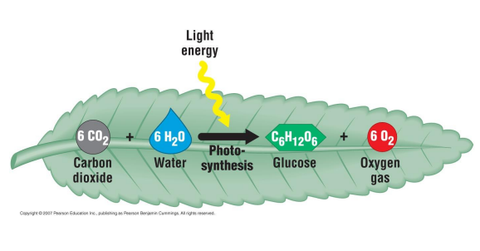
Chloroplasts carry out photosynthesis, using solar
energy to produce glucose and oxygen from
carbon dioxide and water
Mitochondria consume oxygen in cellular
respiration, using the energy stored in glucose to
make ATP (chemical energy).
Water is a byproduct in these reactions.
Note: They are opposite processes! - 6Endosymbiotic hypothesisEndosymbiont: An organelle considered to be a prokaryote engulfed by
an Eukaryote (nucleus already present)
-Mitochondria and chloroplasts in eukaryotic cells originated through
symbiosis between multiple organisms, where one organism ‘engulfed’
free-living prokaryotes - 7Evidence for endosymbiosiscontain their own DNA, which encodes some of their
proteins
- small size, similar to the size of a prokaryote
- have at least two membranes: inner and outer
membranes
- are not synthesized in the cell like ribosomes and
lysosomes - 8The ingredients for photosynthesis are• The ingredients for photosynthesis are
carbon dioxide and water
• CO2
is obtained from the air by a plant’s leaves (organs).
- H2O is obtained from the damp soil by a plant’s roots (organs).
• Chloroplasts rearrange the atoms of these ingredients to produce
sugars (glucose) and other organic molecules.
• Oxygen gas is a by-product of photosynthesis. - 9Cellular RespirationAerobic Harvest of Food Energy
– Is the main way that chemical energy is
harvested from food (produced by plants
originally) and converted to chemical
energy in ATP (usable form)
-REQUIRES oxygen - 10The Relationship between Cellular Respiration and Breathing• Cellular respiration and breathing are closely
related.
– Cellular respiration requires a cell to exchange
gases with its surroundings.
– Breathing exchanges these gases between the
blood and outside air. - 11Where does cellular respiration occur?Cellular respiration occurs in mitochondria.
– Cellular respiration is a chemical process that
harvests energy from organic molecules.
• The waste products of
cellular respiration,
CO2
and H2O,
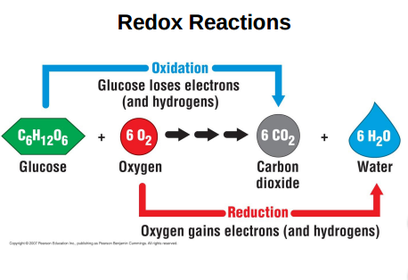
are used in photosynthesis. - 12Equation for cellular respirationC6H12O6 + 6O2 -> 6CO2 + 6H2O + ATP
- 13Redox Reactions (Oxydation Reduction Reactions)Chemical reactions that transfer electrons from one
substance to another are called
oxidation-reduction reactions or in short:
REDOX reactions
:REDOX REACTIONS:
Definition – Loss of electron(s) from donor and gain of
electron(s) by a receiver. - 14Redox reaction
- 15Why does electron transfer to oxygen release energy?– When electrons move from glucose to
oxygen, it is as though they were falling (high
E to low E)
– This “fall” of electrons releases energy
during cellular respiration.
– However, this fall is NOT due to gravitational
pull but rather due to the FORCE (pull) of
attraction by oxygen since it is the most
electronegative atom found among biological
molecules - 16Metabolism has two parts:Anabolism: Synthesis
Catabolism: Breaking - 173 stages of cellular respirationGlycolysis (breakdown of Glucose)
How to generate some ATP and reducing power
TCA cycle (Tri Carboxylic Acid cycle, Kreb cycle)
How to generate more ATP, generate a variety
of C skeletons and more reducing power
ETC (Electron Transport Chain)
Way more ATP, Water as a by product,
regeneration of NAD+ - 18NADH and Electron Transport Chains (ETC)The path that electrons take on their way down
from glucose to oxygen involves many steps. - 19Stage 1: GlycolysisOne molecule of glucose (6C) is split into two
molecules of pyruvic acid (3C).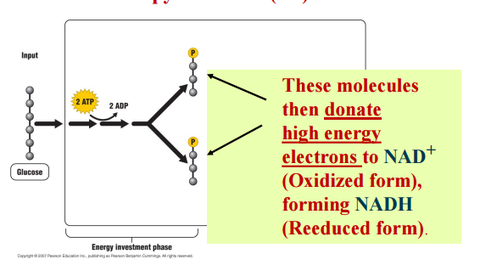
- 20—Describe in detail
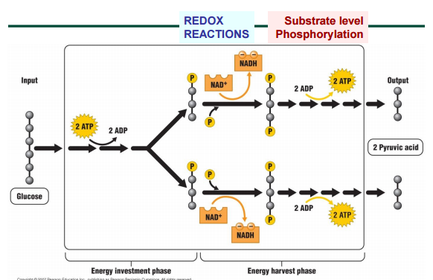
- 21Glycolysis makes some ATP directly when ....enzymes transfer phosphate groups from fuel
molecules to ADP. This process is called,
Substrate level phosphorylation - 22What are the net molecular products of Glycolysis, for each glucose molecule used?•2 of ATP
•2 of NADH
•2 of Pyruvic acid
• 2 H20 (waste) - 23Glycolysis Summary• Is a metabolic pathway each step catalyzed by an enzyme
and takes place in the cytoplasmic fluid of the cell
• Harvests chemical energy by OXIDIZING 1 glucose (6C)
molecule to form 2 pyruvate (3C) molecules.
• Glucose is first energized by using ATP
• Substratelevel Phospholylation makes ATP: an enzyme
transfers phosphate group from a substrate molecule to
2 ADP to form 2 ATP (about 6% of energy of a glucose
molecule)
• Another source of energy, reducing power, NADH is also
produced (provides another 16% of energy of glucose
molecule, depending on the availability of O2
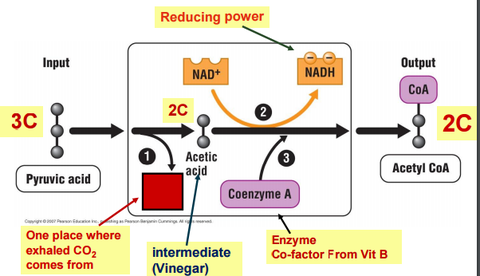
• Pyruvate is OXIDIZED prior entering the TCA cycle - 24Stage 2: The Citric Acid Cycle (TCA cycle or Kreb Cycle , Hans Krebs: 1930)takes place in the Mitochondrial Matrix.
• completes the breakdown of Glucose generating many
of the two cofactors, NADH and FADH2
• In the citric acid cycle, pyruvic acid from glycolysis is
first “groomed” into a usable form:
a 2C Acetyl CoA (Acetyl coenzyme A)
• “grooming” (oxidizing) also produces 1 NADH
molecule per pyruate molecule
(i.e. 2 NADH for a glucose molecule) - 25Grooming of Pyruvic Acid to Enter Mitochondria
- 26Stage 3: Electron Transport Chain (ETC) Oxidative Phosphorylation• Electron transport releases most of the energy your
cells need to make most of their ATP.
• The molecules of electron transport chains (ETC)
are built into the inner membranes of mitochondria.
– The chain functions as a chemical machine that uses
energy released by the “fall” of electrons to pump
hydrogen ions across the inner mitochondrial
membrane.
– These ions (H+
) store potential energy
(as electrochemical potential gradient) - 27Mitochondrial Electron Transport Chain Oxidative Phosphorylation
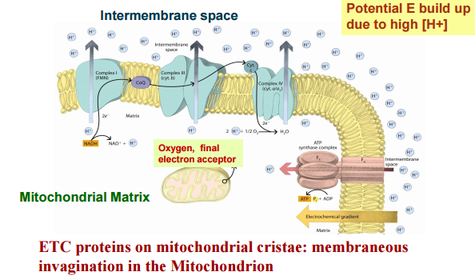
- 28When the hydrogen ions flow back by facillitated diffusion through the membrane, they releaseenergy.
– The ions flow through a membrane bound
enzyme (protein) called ATP synthase.
– ATP synthase takes the energy released from
this flow (kinetic energy) and synthesizes
ATP (potential energy) .
– This process is called Chemiosmosis
(Peter Mitchel in 1953 received the Nobel prize
for discovering this process) - 29Cellular respiration can “burn” other kinds of molecules besides glucose:Diverse types of carbohydrates
– Fats
– Proteins - 30Fermentation:Some of your cells can actually work for short
periods without oxygen.
• Fermentation
– Is the anaerobic harvest of food energy.
• After functioning anaerobically for about
15 seconds,
– Muscle cells will begin to generate ATP by the
process of fermentation. - 31Evolution Connection: The Oxygen RevolutionThe atmospheric oxygen we breathe is a by-product of
photosynthesis.
• Cyanobacteria were the first organisms to carry out
photosynthesis.
• The production of oxygen changed the Earth forever.
– The “oxygen revolution” was a major episode in
the history of life on Earth. - 32Almost all plants are photosynthetic autotrophs, as are some bacteria and protists (algae)They generate their own organic matter through
photosynthesis - 33Chloroplasts: Sites of PhotosynthesisPhotosynthesis
– Occurs in chloroplasts.
• Chloroplasts
– Are found in the interior cells of leaves.
– Contain stroma, a thick fluid.
– Contain thylakoids, membranous sacs - 34The Overall Equation for Photosynthesis
- 35Photosynthesis is composed of two processes:The light reactions convert solar energy to
chemical energy. Water molecules are used
as electron donors at this stage
– The Calvin cycle (“dark reaction”) makes
sugar (Glucose) from carbon dioxide using
the chemical energy the light reactio
Informações
- Descrição
- O usuário eliminou as informações de disciplina FlashCards sobre BISC 100 - Lecture 16, 17, & 18 - cellular Respiration , criado por Usuário eliminado em 10-08-2016.
- Criado por
- Usuário eliminado · ago 2016
- Atualizado
- 18 jan 2017
- Visualizações
- 511
- Tags
- Histórico
-
- Criado por Chelsi Souch · 10 ago 2016
- Copiado por Chelsi Souch · 10 ago 2016
- Avaliação