
Historical Context of The Handmaid's Tale
Slides do conjunto (14)
-
- The Handmaid's Tale by Margaret Atwood is a dystopian (or anti-utopian) novel, because it presents the reader with a dysfunctional future society.
- Often texts that are set in an imaginary future are actually used to criticise real aspects of the author's own society, and it is possible to read The Handmaid's Tale as a warning.
- George Orwell's Nineteen Eighty-Four and Aldous Huxley's Brave New World are other examples of dystopian novels, and there can be useful comparisons made with The Handmaid's Tale.]
- One of the reasons why Atwood's novel is so disturbing is that there are numerous historical parallels for the way Gilead is organised and its citizens controlled.
- In an interview, Atwood explained that these parallels were intentional:
- "One of the tasks I set myself when writing the novel was to avoid including any practices that had not already happened somewhere, at some time. One of the functions of the afterword is to indicate the origins of some of the practices described in the novel. But it is vital to understand that every single one of the practices described in the novel is drawn from historical record."
-
- Concentration
- camps under the Nazi Germany regime had similar regulations about uniform as
- Gilead.
- “On
- arrival at concentration camps prisoners had their clothing taken away, often
- to be replaced by a striped uniform (now known as striped pyjamas). Men would
- wear a vest, trousers, hat and coat. Women would be supplied a smock type
- dress.” Read more
- Likewise, all people in the Handmaid’s
- Tale (Handmaids, Commanders, Commanders Wives, Ecnowives, Marthas, and
- Guardians) wear a uniform. Their clothes from the time before are disallowed.
- “Prisoners were identified by a number printed on
- their clothing and also an inverted triangle with lettering to signify the
- reason for imprisonment. Criminals were marked with a green triangle, political
- prisoners with red, homosexuals with pink, whilst Jehovah’s
- Witnesses wore a purple
- triangle and asocials (including Roma) wore a black triangle.” Read more
- Interestingly, these are all people who Gilead punishes - or just executes. The various reasons for executions are clearly displayed on the bodies hanging on the Wall, like the markings on the concentration camp uniforms.
- Atwood also uses colour to
- distinguish between the different roles in Gilead; Handmaids have red dresses,
- Commanders’ Wives have blue, Marthas wear green dresses, Ecnowives wear dresses
- with red, green and blue stripes. The Commanders are issued black uniforms. The characters in Gilead are all similarly trapped or imprisoned, with their uniform displaying why they are there. The Guardians and Angels in Gilead, also have to wear uniforms, like the SS men in concentration camps.
- “Clothes would be changed approximately every six
- weeks. As prisoners would have to work and sleep in the same clothes, they
- would be very dirty.” Read more
- Although Gilead encourages more
- hygiene than Nazi concentration camps, the principle that clean clothes are
- only issued at a set time remain the same. Atwood describes how Offred is
- allowed to wear her summer dresses around July time, and her winter dresses are
- put back into storage.
- Additionally, nuns also cover their hair like the Handmaid's in order to de-sexualise their appearance.
-
- In
- chapter 42, the women in Gilead attend a Salvaging, where two Handmaids and a
- Commander’s Wife are publicly hanged.
- “Under
- the rule of the Qajar dynasty (1785–1925), forms of public execution included
- hanging, throwing the condemned from the city walls, tying them to the mouth of
- a cannon and blowing them apart, suffocating them in a carpet, or re-enacting
- the crime on the criminal. There was also Sham'i ajjin, which entailed making
- multiple incisions in the body and then lighting candles in the cuts until the
- person died. Before being brought
- onto the public scaffold, the condemned was paraded through the bazaar. By
- 1890, public hanging replaced more exotic forms of execution.” Read more
- Women can be sent to die in the Colonies if they are not fertile. King Henry VIII divorced and beheaded his first two wives who failed to give him a male heir. Gilead desires fertile women.
-
- Throughout
- the novel, denominations of Christianity are mentioned with disdain, as they
- are rebelling against the regime. Catholic priests, Jews and Jehovah’s
- Witnesses are mentioned to have been hung on the Wall. Ofglen talks about the
- progress of the conflict between the denomination of the regime and all other
- denominations. Similarly, the French Wars of Religion featured the killing of
- different denominations and sects.
- “The St. Bartholomew's Day massacre (Massacre
- de la Saint-Barthélemy in French) in 1572 was a targeted group of assassinations and a wave of Catholic mob
- violence, directed against the Huguenots (French Calvinist Protestants) during the French
- Wars of Religion.” Read more
- Furthermore, during the Crusades, Christians and Muslims went to war to get each other to convert, and killed any enemies who refused.
- The seemingly 'holy' reason for war was warped for gaining power, just as the Bible's meanings are warped and twisted in The Handmaid's Tale to get people to obey the regime.
-
- The
- Handmaid’s Tale features reference to information being censored and the use of
- propaganda.
- For example, Ofglen tells Offred news of the war, and Offred
- remarks that it may not be true, but she was desperate for any kind of news,
- true or not. This suggests she isn’t
- allowed to know the progress of the war.
- Also, before the ceremony takes place,
- in Chapter 15, Serena Joy switches on the television and watches the news.
- Offred remarks how the Jewish people in the boat shown could be actors and that
- they looked stereotypically and almost comically Jewish. This introduces the
- idea that the authorities aren’t being truthful to people and are using
- distorted information to control them.
- This is like the Defense of the Realm Act (DORA) passed in 1914 which disallowed any negative ideas of the war, even in private letters!
- Similarly, the story of Jacob,
- Rachel and Bilah in the Old Testament of the Bible has also been used for
- propaganda. Like the poster promotes war against Germany, the Bible verses
- present the idea that the ceremony practice is good and what God intended.
- North Korean censorship of the internet
- Similarly, Chinese, Russian and North Korean society have also been controlled in this way.
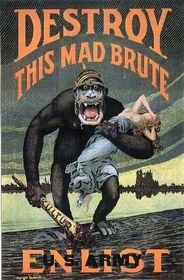
- Legenda: This poster is a sample of propaganda the US Government issued during the First World War. The gorilla represents Germany as dangerous. The presence of the woman also would move men to enlist as they want to defend who they considered to be vulnerable.
-
- Oflgen
- is part of an underground resistance movement. This is hinted at in the novel,
- but more widely explored in the Historical Notes that follow Offred’s
- narrative. It was unclear to Offred, and therefore to us, what the resistance
- movement actually did to rebel against the regime they were in, however, by
- looking at resistance movements under other regimes throughout history may
- provide us with more information.
- For example, in Nazi Germany, there were small
- resistance campaigns consisting of a few individuals. The small groups had no
- means of uniting publicly, therefore their impact was restricted somewhat. This
- is similar to the resistance in The Handmaid’s Tale as the nature of the regime
- is restrictive towards travelling and meetings. Also, resistors to the regime
- of Gilead are subject to execution as political prisoners, which is similar to
- the Gestapo’s responsibility.
- “The White Rose was a non-violent, intellectual resistance group in Nazi Germany, consisting of students
- from the University of Munich and
- their philosophy professor. The group became known for an anonymous leaflet and
- graffiti campaign, lasting from June 1942 until February 1943, that called for
- active opposition to dictator Adolf
- Hitler's regime.” Read more
- The tapes that are described in the Historical Notes
- can be considered to be like the leaflets produced by the White Rose, as they
- exposed the horrors of being a Handmaid without censorship.
-
- An underground railroad – Within the
- novel, there are references to an underground railroad, nicknamed, ‘the
- underground femaleroad.’ Presumably it is used to help Handmaids and other
- oppressed women escape the regime in Gilead. This is similar to 19th
- Century America;
- “The Underground Railroad was
- a network of secret routes and safe houses used by
- 19th-century enslaved
- people of African
- descent in the United States in efforts to escape to free states and Canada with the aid of abolitionists and allies who were sympathetic to their cause. The term
- is also applied to the abolitionists, both black and white, free and enslaved,
- who aided the fugitives. Various other routes led to Mexico or overseas. An "Underground Railroad" running
- south toward Florida, then a Spanish possession, existed from the late 17th century until
- shortly after the American
- Revolution.” Read more
-
- At the very start of
- the novel, Offred describes her experiences of what she calls the Red Centre.
- This is where the various Aunts train the Handmaids for their role. They
- re-educate them to believe in the regime. Aunt Lydia is a key figure in this
- process, as Offred mentions what she says throughout the novel.
- “During the Zamosc expulsions the Germans seized many
- children from their parents to be racially screened for possible adoption by
- German parents in the SS Lebensborn
- ("Fount of Life") program. As many as 4,454 children chosen for
- Germanization were given German names, forbidden to speak Polish, and
- re-educated in SS or other Nazi institutions, where many died of hunger or
- disease. Few ever saw their parents again.” Read more
- Similar to the Polish children during the Nazi
- Germany occupation, the Handmaids were forcibly taken into the system to be
- re-educated with the values of the regime, so they might live a life under the
- regime. Also, the Handmaids cannot see their families ever again, which is
- another similarity to the Polish children.
- Interestingly, Jim Jones' cult, the People's Temple was run quite similarly to Gilead.
-
- At
- the women’s Salvaging, later on in the novel, the women being hanged were most
- likely to have been accused by other women. Offred makes references to the
- amount pressure to appear inconspicuous when she is talking to Ofglen, which
- creates the impression that they were being watched and could be accused and
- punished for conspiracy against the regime. Similarly, older women in Salem,
- Massachusetts, were also afraid of being accused of witchcraft;
- “The infamous Salem witch trials began during
- the spring of 1692, after a group of young girls in Salem Village,
- Massachusetts, claimed to be possessed by the devil and accused several local
- women of witchcraft. As a wave of hysteria spread throughout colonial
- Massachusetts, a special court convened in Salem to hear the cases; the first
- convicted witch, Bridget Bishop, was hanged that June. Eighteen others followed
- Bishop to Salem’s Gallows Hill, while some 150 more men, women and children
- were accused over the next several months. By September 1692, the hysteria had
- begun to abate and public opinion turned against the trials.” Read more
- Like the accused witches, the accused conspirators in Gilead
- were often noticed because they were socially isolated. Offred and Ofglen make
- conscious efforts throughout the novel to appear like the rest of the
- Handmaids.
- Similar to Janine's 'confession' of being gang-raped at the age of 14, these testified statements and accusations aren't necessarily true. It's just that with the hysteria and threat of punishment (or death) people will say anything to save themselves.
-
- This
- refers to people being forced to return to their own country or place of
- origin. There are mentions in the novel and an explanation in the historical
- notes that the Jewish population were being deported from America if they chose
- not to convert.
- “The
- term repatriation was often used by Communist
- governments to describe the large-scale state-sponsored ethnic
- cleansing actions and expulsion of national groups. Poles born in territories that were annexed by the
- Soviet Union, although deported to the State of Poland, were settled in the
- annexed former German territories.” Read more
- In a similar way, the Jewish people in the novel are
- part of ethnic cleansing in Gileadan America. The regime in Gilead called for a
- specific religious denomination, and Jewish culture and beliefs were not
- acceptable. The Jews were probably treated with more kindness as they are
- described as God’s people in the Bible, therefore they were given more
- comfortable choices compared to the rest of the population.
- Additionally, Mexican people were forced to return to Mexico from America in the 1930s.
-
- As
- detailed previously, Gilead called for a specific religious belief. There are
- references to Catholic priests, Protestants, and other Christian denominations,
- such as Quakers, either being executed for their refusal to convert or their
- rebellion and hiding from authority.
- “Religious persecution took place by the Portuguese in Goa, India from 16th to
- the 17th century. The natives of Goa, most of them Hindus were subjected to severe torture and oppression by the zealous Portuguese rulers and missionaries and forcibly
- converted to Christianity… All the persons above 15 years of age were compelled
- to listen to Christian preaching, failing which they were punished.” Read more
- The people of Gilead also are forced to
- convert to the belief system of the regime. If they do not, there they will
- face capital punishment, as seen by the hanging of Catholic priests and
- Jehovah’s Witnesses on the Wall. There is also references to priests having to teach
- in secret, as their beliefs were no longer allowed to be expressed or
- practised.
- The people of Gilead have to listen to
- Bible readings in the regime, like the oppressed Hindus in Goa, India. The
- story of Jacob is read out before the Ceremony, and at women’s Prayvaganzas,
- there is also Scripture read aloud for the group marriages of the daughters.
- This also links with the enforcement of Islam in Iran.
-
- At
- the end of the Salvagings in chapter 42, chapter 43 features a political
- prisoner being savagely beaten by the Handmaids because of his crime. The
- Handmaids are told he used to be a Guardian and raped two Handmaids at
- gunpoint, one of which was pregnant. Supposedly, the rape resulted in
- miscarriage for the pregnant Handmaid.
- Similarly, in an all-female Nazi
- Germany concentration camp, Ravensbrück;
- “Helm writes about one woman, Katharina Waitz, who
- escaped the camp by scaling a 15ft wall topped with barbed wire and fleeing
- into the forest. She was caught three days later. But for the period she was
- missing, the prisoners she'd left behind were forced to stand completely still,
- day and night, without food. On the fourth day, when she was brought back, she
- was put into the punishment block, where those same prisoners were told, by the
- Germans, "do what you want with her". They clubbed her to death.” Read more
-
Parallels between Iran and Gilead
- “Following the 1979 revolution, Iran became a
- theocratic republic under Ayatollah Ruhollah Khomeini. Newspapers and magazines
- opposing his rule were shut down (as happens in Gilead). Women were denied
- equal rights. Although university enrolment among women went up following the
- revolution, the marriage age for girls was lowered to 13; once married, they
- were forbidden to continue their education.
- Women protested from the start, and in the 30 years since the Revolution
- many of the original policies have been suspended. However, segregation is
- still rigorously enforced and women caught by officials in mixed-sexed
- situations – however innocuous – can be forced into virginity tests. For
- pre-marital sex, the death penalty may be enforced.” Read more
- Newspapers and magazines were also
- banned in Gilead, as all of them were thought to undermine the authority and
- importance of following the regime.
- Offred describes how women were made
- financially dependent on men, as they could no longer pay for things, which is
- similar to the denial of equal gender rights in Iran.
- University enrolment is not even an
- option for women in Gilead. Offred mentions early on whilst describing the
- ‘Faith’ cushion, that ‘it is the only thing they’ve given me to read’. The
- picture signs above shops also help to create the impression that women are not
- allowed to be educated.
- The marriage age in Gilead is also
- similar to Iran; the girls being married at the women’s Prayvaganza were just
- 14.
- The segregation of men and women is
- another similarity with Iran. Handmaids especially are disallowed sexual
- freedom – they are only allowed to have sex with their Commanders only, on
- Ceremony nights.
-
- Food and clothes are rationed, like in World War II.
- There is a hierarchy of power, like in Nazi Germany. These men in the German High Command are almost like Commanders - they have power over citizens (and women!) below them.
Informações
- Descrição
- A-Level (Year 1) (Year 1) English Language and Literature (The Handmaid's Tale by Margaret Atwood) Slides sobre Historical Context of The Handmaid's Tale, criado por Summer Pearce em 11-08-2016.
- Criado por
- Summer Pearce · ago 2016
- Atualizado
- 4 nov 2019
- Visualizações
- 5.631
- Avaliação