
Notas
Chapter 9 Notes (Week 6)
Conteúdo das notas (2)
Página 1
Learning Objectives, Key Words, and Summary
LOs:
The major variables that are used to segment target audiences for media planning purposes
The meaning of reach, frequency, gross rating points (GRP), target audience rating points (TARP), effective rating points (ERP), and other media concepts.
The logic of the three-exposure hypothesis and its role in media and vehicle selection.
The use of the efficiency index procedure for media selection
The differences between the three forms of advertising allocation: continuous, pulsed, and flighting schedules.
The principle of recency, or 'shelf-space', model and its implications for allocating advertising expenditures over time
How to calculate cost-per-thousand statistic (CPM) or (CPM-TM for target market)
Key Words:
Media planning
Reach
Frequency
TARPs
Recency planning
CPM (cost per thousand)
Summary:
Four steps to media planning: (1) Selecting the target audience, (2) Specifying media objectives, (3) Selecting general media categories and specific vehicles within each medium, (4) Buying media based on optimisation criteria [like maximising reach 1+, effective reach 3+, and frequency or TARPs.]
Media and vehicle selection influenced by target audience, cost, and creative considerations
Media vehicles within the same medium are compared using the CPM criterion
It identifies strategies that will reach the target audience;
Satisfy budgetary constraints; and
Be compatible with and enhance the advertiser's creative message
Media planners generally used pulsed or flighting scheduling for their media insertions
Recency ('shelf-space' model) says fuck this -- weekly reach is much better, ensures advertising runs at the time when the consumer is making brand selection decisions
Página 2
Definitions & Notes
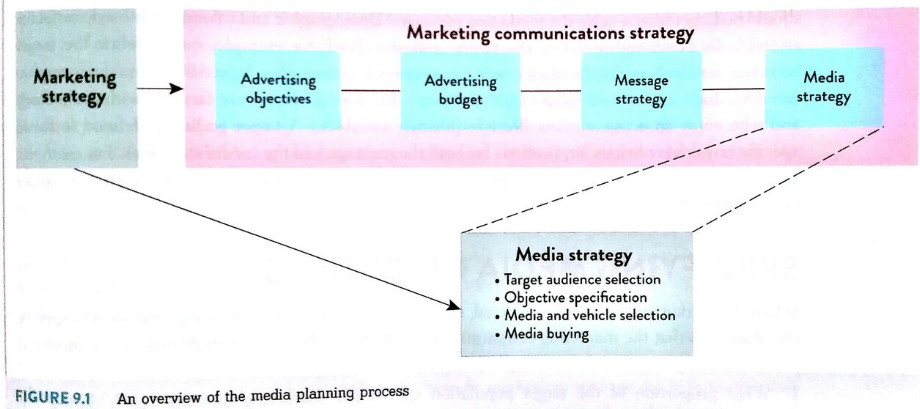
Media Planning: the process of devising a marketing communications strategy that quantifies how investments in money and time will contribute to achieving an organisation's marketing objectives. [see 9.1 picture below]
Coordination of 3 levels of strategy formulations:
Marketing strategy, marketing communications strategy, and media strategy (which is part of MCS)
Marketing strategy; profiling target market, selecting marketing mix --> influences direction of the next two...
MCS; objectives, budget, message, media
Develop a Media Strategy? (1) Select target audience, (2) Specify media objectives, (3) Select media categories and vehicles, (4) Cost considerations
To select a target audience, you need:
Buyer behaviour --> generally provides most meaningful info
Demographics --> typically used to define the audience
Consumer Values and Lifestyles
Issues when setting Objectives:
What proportion of the TM should the marketing message reach during the specified promotional period? (Reach)
How frequently do members of the TM need to be exposed to the marketing communications method during that period? (Frequency)
How much exposure to the marketing message is necessary to accomplish the reach and frequency objectives?
How should the marketing communications budget be allocated over time?
How close to the time of purchase should the target audience be exposed to the marketing message?
What is the most cost-effective way to accomplish the other marketing objectives?
Reach: the % of TM who are exposed to the vehicles that carry the marketing message, at least once during the time period.
Also represents those who have an opportunity to be exposed; or
Opportunity to See (OTS)
AKA '1+', 'net coverage', 'unduplicated audience', or 'cumulative audience'
More TM are reached when using multiple media
Can be influenced by the number of different media vehicles and channels
Exposure to a specific vehicle does not guarantee the TM will see the marketing message
Frequency: the average no. of times (during the planning period) that members of the TM will be exposed to the vehicles that carry the marketing message.
Can also represent media schedule average frequency (continuous, pulse, flighting)
Multiply this by Reach (1 + exposures) to get GRPs
Weight: the third objective of media plans, how much is needed to accomplish the objectives? Three metrics can be used to calculate..
Gross Rating Points (GRPs) - reflect the gross weight that a schedule has delivered to a duplicated audience [Reach x Frequency]
Target Audience Rating Points (TARPs) - expressed as a % of the potential audience, the TM, since not all viewers of vehicles may be part of the selection
Effective Rating Points (ERPs) - AKA Effective Reach based on idea that an ad schedule is effective only if it does NOT reach members of the TM too few or too many times (this depends)
-->High levels of exposure may be unproductive for loyalty and level off brand awareness, while distinctive ads require less exposure
*Ratings - based on estimated audience that is tuned into a channel at a certain time, with a rating point = 1%
Three-Exposure Hypothesis: the minimum no. of exposures needed to achieve ad objectives [Krugman], (3+)
Used to figure out how many exposures are needed to the MESSAGE (not the vehicle, and OTS is different)
(1) What is it? (2) What of it? (3) Reinforcing information gained from previous steps
The no. of people exposed to the message is less than the no. of people exposed to the vehicle that carries it
Tends to lead to multiple media/vehicles
Generally seen as <3 is ineffective, >10 is excessive
**BEST FOR new brands or established brands releasing something 'new and improved', or detailed messages that require multiple exposures (frequency) in order to 'TEACH'
"It depends!", there is no right minimum exposure no.
Efficiency Index: select the media schedule that generates the most exposure value per GRP, an alternative to the 3+ hypothesis
Exposure Utility - the value of each additional opportunity for audience members to see an ad for a brand during a planning period
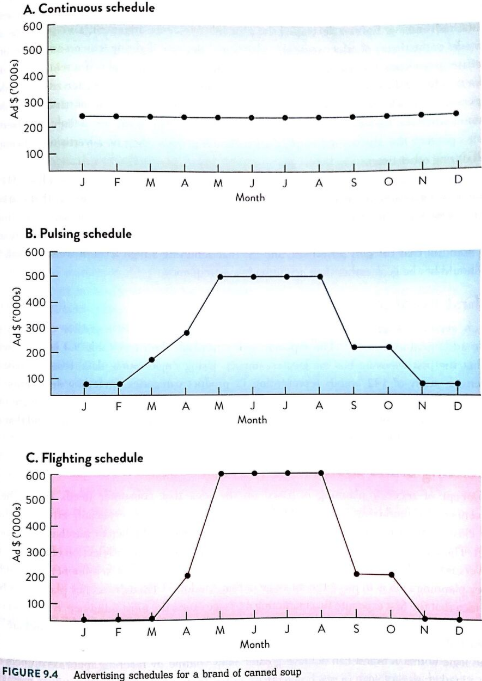
Continuity: how advertising is allocated during the course of an advertising campaign.
But how should the media budget be spread?
Concentrated or even?
Few advertisers can afford to continue an expensive schedule for long; advertise where greatest chance of communicating effectively
(1) Continuous - relatively equal amount of ad spending invested throughout, makes sense when P&S consumed evenly throughout year
(2) Pulsing - some advertising used during every period of the year, but amount varies in each period
(3) Flighting - differential levels, but here, some advertising takes place during some periods but not in others
Pulsing and Flighting consistent with 3+ Hypothesis; there will be sufficient frequency to justify ad efforts
Recency Planning: supports continuous scheduling, says brand unlikely to experience any sales if they don't do any advertising (the concept of an 'empty shelf'), [Ephron], and is built on 3 ideas...
(1) First exposure has a greater effect on sales, each additional exposure adds very little influence
(2) Influencing brand choice is the primary role of advertising to those in the market for the P&S at a time the brand advertises;
Says that a brand can get greater sales volume by reaching more consumers ONCE (Reach) than reaching fewer consumers more often (Frequency)
It invests less weight (GRPs/TARPs) over smaller periods (maybe one week instead of four)
(3) Optimising a high weekly reach in order to influence the consumer at the time of purchase, messages most effective here
This is not about 'teaching' (3+) but about reminding people about the brand
The schedule should reach more consumers more often throughout the year
**BEST FOR established brands that already have recall and familiarity and serve to 'REMIND' (as oppose to teach)
Cost Per Thousand (CPM): the cost of reaching 1000 people, or CPM-TM as the cost of reaching 1000 people in the target market, excluding those who fall outside of it.
Cost of ad / Number of total contacts (in thousands) [similar for TM]
Online Cost Per Thousand - considers Click-Through Rate (CTR), Cost-Per-Click (CPC), and Cost-Per-Acquisition (CPA)
CTR - % of users who click an ad after viewing a web page, a measure of how successful an ad is at capturing attention
CPC - fixed cost charged every time a person clicks an ad and is redirected
CPA - fixed cost charged every time a person clicks an ad, then completes a transaction
Limitations: useful for comparing cost-efficiency of different vehicles (not ad effectiveness), lacks comparability across media, misused unless vehicles compared on same basis
Trade-Offs:
Cannot optimise multiple objectives at the same time
A fixed budget means either reach or frequency
Is frequency more important (3+) or reach (recency)?
Informações
- Descrição
- Universität MKTG 306 (Media Analysis (Week 6)) Notas sobre Chapter 9 Notes (Week 6), criado por T L em 22-08-2016.
- Criado por
- T L · ago 2016
- Atualizado
- 3 fev 2018
- Visualizações
- 2
- Avaliação