
Flashcards
Sociology
Flashcards do conjunto (288)
- 1sociologyAuguste Comet
systematic study of human society and social interaction.
helps consider the complex connections in personal life and larger world - 2sociological imaginationc. Wright Mills
helps us understand the connection between personal experience and larger society - 3Harriet Martineauperspective involving social progress towards gender and social equality
- 4Emile Durkheimsocieties are built on social facts, that rapidly change produces strain on society, anomie
- 5Anoimeloss of shared values and propose lead to loss of or ineffective use of social control
- 6Karl Marxcontinuous clash between owners of means of production and the workers-who must sell their labor to survive
- 7Max Webernecessary for individuals to acknowledge own actions
- 8functionalist P.society is stable,orderly system.
societal consensus
criticism=overlooking the importance of change, out-dated - 9Conflict P.Continuous power struggle among competing groups: class, race, ethnicity, gender
Critic=minimizes the importance of social stability and shared values in society - 10Feminist P.focus on the significance of gender in understanding an explaining the inequalities between men and women at home, work, politics, laws, culture
- 11Symbolic Interactionist Phow people make sense of everyday social interaction through mutually understand symbols.
Focuses on Microlevel
Critics= Ignores Macrolevel - 12Postmodern theorists PThe need for new ways to view society instead of functionalist, conflict, interactionist P.
- 13societya large social grouping that shares the same geographical territory and is subject to the same political authority and dominant cultural expectations
- 14global interdependencea relationship in which that lives of all people are closely intertwined and any one nation's problems are part of a larger global problem
- 15Commonsense knowledgeguides ordinary conduct in everyday life.
Equal to a Myth-false notion to perpetuate a belief or theory on inclusive evidence - 16high-income countriesnations with highly industrialized economies; technologically advanced industry, administrative, and service occupations; relatively high national and personal incomes
- 17middle-income countriesnations with industrializing economies, urban areas, moderate levels of national and personal incomes
- 18low-income countriesprimarily agrarian, with little industrialization, low levels of nation and personal income
- 19Industrializationprocess by which societies are transformed from dependence on agriculture and handmade produce to manufacturing and related industries
- 20Urbanizationincreasing proportions of a population lives in cities rather than rural areas
- 21PositivismAugust Comte
a belief that the world can be understood through the use of scientific inquiry - 22law of three stages1) the theological = religious + supernatural
2) metaphysical =abstract philosophical speculation
3) scientific/positive =systematic, history observation, experiment, comparison - 23Social DarwinismHerbert Spencer
belief that those species of animals best adapted to their environment survive ad prosper, or die
idea of progress adaption - 24Social FactsEmile Durkheim
patterned ways of acting, thinking, and feeling - 25alienation Class Conflict-a feeling of powerlessness and estrangement from other people and oneself
-struggle between capitalist class and working class - 26Who said Sociology should be Value free?Max Weber
- 27dyad triad formal sociologyGeorg Simmel
a group of two; a group of three
-an approach that focuses attention on the universal, recurring social forms of the social interaction and the content of social interaction in different contexts - 28theory perspective-a set of logically interrelated statements that attempts to describe, explain, and predict
-an overall approach to or viewpoint on some subject - 29societal consensusfunctionalist P
-majority of the members share a common set of values, beliefs, and behavioral expectations. - 30instrumentalist tasks expressive tasks Who believed that societies must make provisions for the social needs in order to survive?-leadership, decision making, employment=father or husband
-housework, support child and emotional family needs=mother/wife
Talcott parsons - 31Manifest functions Latent Functions-intended and/overtly recognized by the participants in a social unit
-unintended functions that are hidden and remain unacknowledged by participants - 32social solidaritystate of having shared beliefs, values among members of a social group, along with intense and frequent interaction among group members
- 33macrolevel analysis microlevel analysis-examines whole societies, large scale social structures, and social systems
-focuses on small groups rather than large-scale social structures - 34Which postmodernist believed in the dissolution of TV into life?Jean Baurillard
- 35altruismbehavior intended to help others and done without expectation of personal benefit
- 36the 5 ways in knowing the worldPersonal experience
Tradition
Authority
Religion
Science - 37Empirical Approach: 1)Descriptive Studies 2)Explanatory Studiesanswers questions through a direct, systematic collection and analysis of data
1)describe social reality
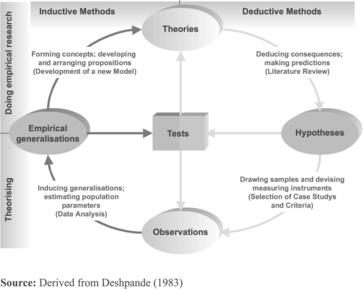
2)explain relationships, and why events occur - 38Inductive Approach Deductive Approach-researcher collects and analyzes data and then generates a theory based on analysis
-researcher begins with a theory and then collects and analyzes research to test it - 39Quantitative research Process1) select and define research problems
2)review previous research
3)formulate hypothesis, construct variables
4)developing the research design
5) collect and analyze data
6)draw conclusions and report findings - 40hypothesistentative statements of the relationship between two or more concepts or variables
- 41objectivescientists try to ensure their biases and values do not affect their research
- 42deductive approach vs inductive approach
- 43reliabilityextend to which a study or research instrument yields consistent results
- 44validityextent to which a study or research instrument accurately measures what it is measuring
- 45replicationrepetition of a study = the same results
- 46research methodsspecific strategies or techniques for conducting reseach
- 47experimentalways has an experimental group and control group
-lab, natural, field experiements - 48Reactivitytendency of participants to change their behavior in response to the fact that they know they are being studied
- 49Survey respondents-identical questions asked through interviews or questionnaires
-provide data for analysis in interviews or questionnaires - 50field research:case studies - indepth study of single event, person, or social grouping
ethnography - study of life and activities of people by researchers who may live with that group over years - 51field research: unstructured interviewsopen-ended interaction between an interviewer and an interviewee
- 52secondary analysisexisting material and analyze of data originally collected by others
- 53content analysis Cultural artifacts-systematic examination of cultural artifacts or various forms of communication to extract thematic data for conclusions about social life
-products of individual, social organizations, tech., cultural patterns - 54Triangulation-using more than one means of research, data, perspectives in a study
- 55material culture non material culturephysical, tangible creations that member of a society make, use, and share
abstract, intangible human creations of society that influence people's behaviors - 56technology-knowledge, techniques, tools that make it possible for people to transform resources into usable forms
- 57cultural universalscustoms and practices that occur across all societies
ex-appearances, activities, intuitions, customs - 58languagea set of symbols that expresses ideas and enables people to think and communicate with one another
- 59Sapir-Whorf-hypothesislanguage shapes views of reality of its speakers
- 60languages effects-2 thingsgender role/identity, race/ethnicity,
- 61valuescollective ideas about what is right or wrong, good or bad, and desirable or undesirable in a particular culture
- 62value contradictionsvalues that conflict with one another or are mutually exclusive
- 63ideal culture real culture-the values and standards of behavior that people in society profess to hold
-the values and standards of behavior that people do follow. - 64norms: prescriptive norms proscriptive norms-established rules of behaviors or standards of conduct
1)appropriate, acceptable
2)inappropriate, unacceptable - 65formal norms informal norms Sanctions-written down punishments for violators
-unwritten standards of behavior understood by common identity
-rewards or punishments for appropriate/inappropriate behaviors - 66Folkways Mores-informal norms or everyday customs that may be violated without serious consequences within a particular culture
-strongly held norms with moral and ethical connotations that may not be violated without serious consequences - 67taboosmores so strong that their violation is considered to be extremely offensive and unmentionable
- 68laws-2 typesformal, standardized norms that have been enacted by legislatures and are enforced by formal sanctions
Civil, Criminal - 69cultural lag discovery Invention-a gap between the technical development and its moral and legal intuitions
-learning about something previously unknown or unrecognized
-reshaping existing cultural items into a new form - 70diffusiontransmission of cultural items or social practices from one group or society to another
- 71subculturea group of people who share a distinctive set of cultural beliefs and behaviours that differ in some way from larger society
- 72counterculture culture shock-a group that strongly rejects dominant societal values and norms ad seeks alternative lifestyles
-disorientation that people feel when encounter cultures radically different from their own - 73cultural relativismbelief that the behaviors and customs of any culture must be viewed and analyzed by the culture's own standards
- 74Cultural Capital theory high culture culturePierre Boudieu
-high culture as a device used by the dominant class to exclude the subordinate classes
-classical music, opera, live theater, the elite
-rock concerts, sports, movies,TV, comedys - 75cultural imperialismextensive infusion of one nation's culture into other nations
- 76what is Culture?-knowledge, language, values, and customs passed from one generation to the next
-essential for individual survival
-can be a stabilizing or conflicting source withing the society
-material and non material culture - 77Socializationlifelong process of social interaction through which individuals acquire a self-identity and the physical, mental, and social skills needed for survival in society.
-humans need it to learn in the early years from social groups and environment - 78degree of physical and human characteristics based on heredity/environment?-humans are born with unique characteristics
or gained through socialization
1)heredity = nature, physical makeup
2)social environment = nurture, how we develop and behave - 79Sociobiology Social isolation/contactsystematic study of how biology affects social behavior
-social contact needed to develop the self/self-concept - 80agents of socialization 4 typespersons,groups, or institutions that teach us what we need to know in order to participate in society
family, schools, peer group, mass media - 81peer groupa group of people who are linked by common interests, equal social position, and similar age
- 82self-concept 4 components-totality of our beliefs and feelings about ourselves
1) physical self = i am tall
2) active self = i am good at soccer
3)social self = I am nice to others
4)psychological self = i believe in... - 83self-identityour perception of what kind of person we are
gain this info through language, symbols, and interactions with others
-we are active agents developing plans to use in society - 84looking-glass selfCharles Horton Cooley
way in which a person's sense of self is derived from the perception of others.
-how families perceive and treat us - 85families-transmit cultural and social values
1)procreating and socializing children
2)provide emotional support
3)assigning position - 86the school-teach knowledge and skills; influence self-image, beliefs, values
- 87Peer groups-sense of belonging and self-worth; reinforce cultural norms and acceptable behaviors
- 88Mass Media1) inform us about world events
2)introduce us to a wide variety of people
3)provide and opportunity to live through characters on TV - 89Role-takingGeorge Herbert Mead
-the process by which a person mentally assumes the role of another person in order to understand the world from another's point of view
-I=spontaneous/unique, Me=internalized attitudes and demands of society - 903 stages of self-developmentMead
1)preparatory
2)play
3) game - 91Cognitive DevelopmentJean Piaget
1)sensorimotor + object permanence
2)Preoperational
3)Concrete operational
4)Formal operational stage - 92Moral Stages of DevelopmentLawerence Kohlberg
Pre,Post - - Conventional - 93gender socializationaspect of socialization that contains specific messages and practices concerning the nature of being female and male in a specific group/ society
- 94When does socialization end?-on going throughout the life time of the individual
- 95social devaluation resocialization-a person or a group is considered to have less social value than another
-process of learning a new/different set of attitudes, behaviours - 96total institutiona place where people are isolated from the rest of society for a set period of time and come under the control of officials who run the institution
- 97social interactionprocess by which people act toward or respond to other people and is the foundation for all relationships/groups
- 98social structurea stable pattern of social relationships that exists within a particular group or society
- 99relative homelessness social marginality-being housed in a dwelling that fails to meet basic living standards
-state of being part insider and outsider in the social structure - 100stigma-an physical or social attribute or sign that so devalues a person's social identity that it disqualifies that person from full social acceptance
- 101status status set-a socially defined position in a group or society characterized by certain expectations, rights, duties
-made up of all the statuses that a person occupies at a given time - 102ascribed status achieved status master status-conferred at birth or involuntarily
-person assumes voluntarily: personal choice, merit, or direct effort
-most important status a person occupies - 103role role expectation role performance-a set of behavioral expectations associated with a given status
-a group/society's defined way to perform a specific role
-how a person plays the role - 104role conflict role strain-incompatible role demands placed on a person by two or more statues at a time
-incompatible demands are built into a single status that a person occupies - 105-role exit-when people disengage from social roles that have been central to their self-identity
- 106Social Groupsconsists of 2-more people who interact frequently and share common identity and feeling of interdependence
- 107primary group secondary group-a small less specialized group in which members engage in face-face, emotion based interactions
-larger, more specialized group in which members engage in more impersonal, goal-oriented relationships for a limited time - 108social networka series of social relationships that link an individual to others
- 109formal organization-highly structured group for the purpose of completing certain tasks or achieving specific goals
- 110social institutiona set of organized beliefs and riles that establish how a society will strive to meet its basic social needs
- 111social institutions: 5 essential tasks1)Replacing Members
2)teaching new members
3)Producing, distributing, and consuming goods and services
4)Preserving Order
5)Providing and maintaining a sense of purpose - 112Mechanical SolidarityEmile Durkheim
social cohesion in pre-industrail societies, in which there is minimal division of labour and people feel united by shared values and common social bonds - 113Organic SolidarityEmile Durkheim
social cohesion in industrial societies, in which people perform specialized tasked and feel united by their mutual dependence - 114Gemeinschaft GesellschaftFerdinand Tonnies
-a traditional society: social relationships are based on personal bonds of friends and kin, stability
-large, urban society: social bonds are based on impersonal and specialized rela. with little long term commitment to group or values - 115GoffmanCivil Inattention and interaction order
- 116social constructionprocess of our perception of reality is shaped by the subjective meaning that we give an experience
- 117self-fulfilling prophecya false belief or prediction that produces a behaviors that makes the originally false belief come-true
- 118Ethnomethodologystudy of the commonsense knowledge that people use to understand the situations in which they find themselves
- 119background expectancy breaching experimentsHarold Garfinkel
-shared interpretation of objects and events as resulting actions
-different activities to his students to see how breaking the unspoken rules of behaviours created confusion - 120Dramaturgical Analysis Impression managementGoffman
-study of social interaction that compares everyday life to theatrical presentation
-peoples efforts to present themselves to others in ways that are most favorable to their own interests - 121Feelings RuleArlie Hochschild
-shape the appropriate emotions for a given role or specific situation - 122non-verbal communication personal space-transfer of information between persons without the use of speech
-immediate area surrounding a person that the person claims as private - 123social controlsystematic practices developed by social groups to encourage conformity and to discourage deviance
- 124devianceany behaviour, belief, or condition that violates cultural norms in the society or group in which it occurs
- 125crimean act that violates criminal law and is punishable with fines, jail terms and other sanctions
- 126strain theoryRobert Merton
people feel strain when they are exposed to cultural goals that they are unable to obtain because they do not have access to culturally approved means of achieving those goals - 127illegitimate opportunity structuresRichard Cloward and Lloyd Ohlin
circumstances that provide an opportunity for people to acquire through illegitimate activities what they cannot get through legitimate channels - 128social bonding theoryTravis Hirschi
-holds that probability of deviant behavior increase when a person's ties to society are weakened or broken
1)attachment to other ppl
2) commitment to conventional lines of behavior
3)involvement in conventional activities
4)belief in legitimacy of conventional values and norms - 129differential association TheoryEdwin Sutherland
-individuals have a greater tendency to deviate from societal norms when they frequently associate w/ persons who favour deviance over conformity - 130Labelling Theorywilliam chambliss
-deviants are those people who have been successfully labelled as such by others
primary deviance(initial act)-> stigmatization -> Deviant self image -> Secondary Deviance (accepts new self, continuing deviance) - 131moral entrepreneurs moral crusaders-persons who use their own views of right and wrong to establish rules and label others as deviant
-public and media awareness campaigns that help generate public and political support for their causes - 132Indictable offenses Summary conviction offenses-homicide, sexual assault, robbery, B&E
-minor offenses: fraudulently obtaining food, causing a disturbance - 1334 types of crime1) street - violent, property, moral
2)occupational/white-collar/corporate - in course of employment, or financial affairs
3)organized - business operation that supplies goods and services for profit
4)political - unethical acts involving misuse of power by gov. officials, or from an outside group to undermine or overthrow - 134Major types of crime reports? CUCR victimization surveys-Canadian Uniform Crime Reporting: lists police reports
-VS = determine crimes not in police reports
ex spousal abuse - 135property violence peaks at ages15-18 years
- 136Men make up ___% of violence committed in Canada80
- 137policeopen 24 hours, in service to the people
authority - intervene in situations where something must be done
non-negotiable force - use force to arrest - 138punishment RSRDany action designed to deprive a person of things of value
1)Retribution
2) Social Protection
3) Rehabilitation
4) Deterrence - 139Restorative Justice-seek to return focus of justice to repairing harm to victim and community
ex - victim-offender reconciliation and family gathering conferencing - 140community corrections-programs, community probation, community service orders, intensive probation supervision, bail supervision
Perks = cheaper, humanitarian, maintaining family/community ties - 141persons under the age of ___ have the highest likelihood to commit a crime25 years
- 142Social Stratificationhierarchical arrangement of large groups based on their control over basic resources
- 143Max Weber - life chancesextent to which individuals have access to important societal resources = food, clothing, shelter, education, health care
- 144open system closed system- the boundaries between levels in the hierarchies are more flexible and influenced by achieved status
-boundaries between levels are rigid, people's positions are set - 145Social Mobilitymovement of people from one level in stratification to another
- 146Intergenerational mobility intragenerational mobility-social movement experienced by one generation to the next
-social movement of individuals within their own lifetime - 147Slaveryextreme stratification - owning another person
- 148caste system Apartheid Endogamous-social system of inequality, peoples status is ascribed at birth based on parents
-separation of race
-only allowed to marry within own group - 149class system horizontal mobility vertical mobility-stratification based on the ownership and control of resources and work
-loss or gain without change
-movement up or down in class structure - 150Income Wealth-economic gain through wage, salaries, government aid, ownership of property
-property, bank accounts, stocks,bonds, insurance - 151prestige powermax weber
-the respect with which a person/ status is regarded by other
-ability of ppl or groups to achieve their goals despite opposition from others - 152Max webers classes of stratification1) Rentiers -wealthy individuals who live off investments and don't work
2)Entrepreneurs - wealthy bankers, ship owners, professionals , merchants
3)Middle class
4)skilled labour
5)semi-skilled labour
6)unskilled labour - 153Max Webers - SESSocioeconomic Status
-combined measures that attempt to classify individuals, families, households, in terms of income, occupation, edcuation = class location - 154pink collar occupationsrelatively low paying, nonmanual job, semiskilled
-often held by women - 155Erik Olin Wright's Class Model1) Capitalist class
2)Managerial class
3) small business class
4)working class - 156Consequences of inequality-difference in income, wealth
-access to goods and services
-opportunity and life chances
- health and nutrition
-type of crime commited - 157low-income cutoffincome level which a family may be in straitened circumstances to spend considerably more on basic needs then average
- 158Absolute poverty relative poverty-people do not have the means to secure the most basic necessities of life
-people may be able to afford necessities but still are unable to maintain an average standard of living - 159feminization of povertytrend in women who are disproportionately represented among individuals living in poverty
-single mother, earns less, part time jobs - 160event driven poverty reshuffled poverty multiple jeopardies- divorce, separation, widowhood
-deprivation that follows them regardless of martial status
-greater risk of poverty: immigrants, visible minority, disabilities - 161job deskillinga reduction in proficiency needed to perform a specific job that leads to a corresponding reduction in the wages for that job
- 162meritocracy David-Moore thesis-hierarchy in which all positions are rewarded based on people's ability and credentials
1)Important tasks to be filled
2) some positions are more important
3)Qualification must be met
4)talent is scarce, extensive training
5)highly rewarded positions to Quality - 163racecategory of people who have been singled out as inferior or superior, basis of real or alleged physical characteristics
- 164ethnic group 5 groupingscollection of ppl distinguished, by others or by themselves, on basis of cultural or nationality characteristics
1)unique cultural traits
2)a sense of community
3)feeling of ethnocentrism
4)ascribed membership from birth
5)territoriality, distinct geographic location - 165majority/dominant group minority group-one that is advantaged, has superior resources and rights
-members whose physical and cultural traits are disadvantaged and subjected to unequal treatment = objects of collective discrimination - 166visible minorityofficial governments category of nonwhite/Caucasian individuals
- 167prejudice racial prejudice-a negative attitude based on preconceived notions about a select group
-involves beliefs about certain racial groups making them inferior with negative traits - 168stereotypesover generalizations about the appearance, behavior, characteristics of members of particular group
- 169scapegoata person or group that is incapable of offering resistance to hostility/aggression of others
- 170authoritarian personalityexcessive conformity, submissiveness to authority, intolerance, insecurity, high level of superstition, rigid, stereotype thinking
- 171social distanceextent to which a people are willing to interact and establish relationship with members of racial/ethnic groups other than their own
- 172discriminationactions or practices of dominant group members that have a harmful impact on members of subordinate group
- 1732 types of discrimination de jure de facto-a legal discrimination, encoded by law
-informal discrimination entrenched in customs and institutions - 174Robert Mertons 4 combinations of attitudes and responses1)Unprejudiced nondiscriminators - equality for all
2)Unprejudiced disciminattors- no personal prejudices, but engages in discrimination
3)Prejudiced nondisriminators- personal prejudices but do not discriminate
4)prejudiced disciminators- personal prejudices and discriminate - 175Racisma set of ideas implying superiority of one social group over another on the basis of biological or cultural characteristics, together with power to put beliefs into practice to deny or exclude
- 176Overt racism polite racism-take form of public statements about inferiority of a racial/ethnic group
-an attempt to disguise a dislike of others through behaviors outwardly nonprejudicial - 177subliminal racism institutionalized racism-a form of subconscious racism occurring when there is a conflict of values
-made up of rules, procedures, and practices which may directly or indirectly promote, sustain, entrench differential advantage or privilege to dominant ppl - 178assimilationa process in which members of subordinate racial and ethnic groups become absorbed into dominant culture
- 179ethnic pluralismco-existence of a variety of distinct racial and ethnic groups within one society Canadian Multiculuralism Act 1988
- 180Segregationspatial and social separation of categories of ppl by race, ethnicity, class, gender, or religon
-de facto or de jure (Jim Crow Laws) - 181internal colonialisma situation in which members of a racial or ethnic group are conquered or colonized and forcibly placed under economic and political control
- 182split-market theorydivision of economy into two areas:
1)primary sector-upper tier/higher paid jobs
2)secondary sector-lower paid, little security - 183discourceMichael Foucault
-different ways of structuring knowledge and social practice - 184deconstructinganalyzing the assumption and meanings embedded in scientific works
- 185Royal Proclamation of 1763 Constitution Act 1867 Indian Act 1876-divided up territory, forbidden outside treaty
-gave jurisdiction over Indians and land to federal gov.
-every aspect of life controlled by gov., promote assimilation, took children away - 186British North America Act 1867 quiet revolution (1960-66) Bill 101-acknowledge rights and privileges of french
-Quebec nationalism grew, catholic church no longer control over education
-french as sole language rejected - 187Immigration Act of 1869-excluded diseased, criminals, Japanese, Chinese, east Asians
- 188anti-Chinese bill 1885 1907 Asiatic Exclusion Act-limit Chinese immigration, removed during Immigration act 1960s
-restricting admissions to Japanese, and sikhs - 189Continuous passage rule 1908-South Asians had to make one trip no stops, strait to canada
-repealed after WWII - 190Immigration Act 1962 1967 2002 Immigration and Refugee Act- opened the doors in nonracial basis
-points system to enter was introduced: job training, skills, education, language, job offer
-3 classes of families:economic, family, refugee - 191sexbiological and anatomical differences between females and males.
- 192hermaphrodite transsexual transvestite-sexual differentiation is ambiguous/incomplete
-a person who believes that he or she was born with body of wrong sex
-a male who lives as a women, or female who lives as a man but does not alter genitalia - 193sexual orientation homosexuality heterosexuality bisexuality-individuals preference for emotional-sexual relationships with of a species
-same sex
-opposite sex
BOTH! woohoo - 1943 criteria for homosexual or bisexual1) sexual attraction to persons of one's own gender
2) sexual involvement with one's own gender
3) self-identification - 195transgender- a person whose appearance, behavior, self-identification to common social rules of gender
- 196genderculturally and socially constructed differences between females and males found in meanings, beliefs, practices - femininity and masculinity
- 197gender roleattitudes, behaviors, activities that are socially defined as appropriate for sex and learned through socialization
- 198gender identity body consciousness-a person's perception of self as female or male
-how a person perceives and feels about his or her body, also includes an awareness of social conditions in society that contribute to this self-knowledge - 199sexismsubordination of one sex, usually female, based on assumed superiority of other sex
1) negative attitude
2)stereotypical beliefs reinforce prejudice
3)discrimination - an act - 200causes of gender inequality?economic, political, education discrimination against women
-workplace, specific jobs, cut pay, division of labour
-declined since 1970 - 201gender biasconsists of showing favouritism toward on gender over the over
- 202wage gap-disparity between men and women
-70 cents / 1 dollar - 203pay equity employment equity-wages ought to reflect the worth of work, not gender, race
-a strategy to eliminate the effects of discrimination and fully open competition for job opportunities to those who have been excluded historically - 204Economysocial institution that ensures the maintenance of society through production, distribution, and consumption of goods and services
- 205primary sectorextraction of raw material and natural resources from the environment
- 206secondary sectorprocessing of raw material into finished goods
- 207post-industrial economybased on the provision of services rather than goods
1)info displaces property
2)workplace shifts from factories to diversification, cut-backs, lay offs
3)traditional boundaries between work and home are being set aside - 208Capitalisman economic system characterized by private ownership of means of productions, from which personal profits can be derived through market competition and without gov, interference
- 2094 Qualities of Ideal Capitalism1) private ownership of the means of production
2)pursuit of profit
3)competition
4)lack of gov. intervention - 210stapleslumber, wheat, primary industries, minerals.
- 211commercial capitalismmerchants controlled the trade in raw materials
- 212industrial capitalisminventions of steam engine, spinning jenny - led to a change in society
- 213corporationslarge-scale organization that have legal powers, such as to enter a contract and buy and sell property, separate from individual power
- 214multinational corporationslarge companies that are headquartered in one country and have subsidiaries or branches in other countries
- 215oligopolyseveral companies overwhelmingly control an entire industry
ex Nestle - 216laissez-faire market economy/free enterpriseAdam Smith - no gov. intervention 1776
-free market competition set prices not gov. - 217Gov. intervention in Canadabusiness aid
- 218socialismeconomic system characterized by public ownership of means of production, pursuit of collective goals, centralized decision making
-a route to communism (Marx) - 219The communist manifesto-working class would rebel from impoverished and alienated states
-workers become aware of their own class interests, revolt against capitalists, overthrow system - 220Ideal Socialism1)public ownership of means of production
2)pursuit of collective goals
3)centralized decision making - 221Mixed Economycombines elements of market economy(capitalism) with elements of command economy (socialism)
- 222democratic socialisman economic political system that combines private ownership of some of the means of production, governmental distribution of some essential goods and services
- 223expansion inflation recession-economy thrives, building, increased production, upward social mobility
-a sustained and continuous increase in prices
-decline in an economy total production lasts no longer than 6 months - 224The End of WorkJeremy Rifkin
-working less, people gain freedom - 225Relationship between gender and work.Amy Wharton
1) characteristic of housework=women's
2)economic inequality between men and women
3)structural and institutional bases of gender in workplace - 226the tipping point Rosabeth Kanter-gender or race in the minority in workplace = excluded, lacked support,
-15-20%=the tipping point - 227Occupationscategories of jobs that involve similar activities at different work sites
- 228Professions-high-status, knowledge-based occupations
1. Abstract-Specialized Knowledge
2)Autonomy -rely on own judgement
3)Self-regulation-regulate members
4)Authority - expect compliance
5)Altruism -self sacrifice for patients - 229Scientific management time-motion studiesFrederick Winslow Taylor
-an effort to increase productivity of factories
-studied workers he found efficient
- taught to perform work in concise steps = deskilling - 230Henry Ford technical control assembly line-control due to machines
-workers perform a specialized operation on an unfinished production as it is moved by a conveyor belt - 231Marginal Jobsdiffer from the employment norms of the society in which they are located
-more likely to a women - 232contingent work-part-time, temporary work
- 233unemployment ratepercentage of unemployed persons in the labour force actively seeking jobs
- 234labour unionsa group of employees who join together to bargain with an employer or a group of employers over wages, benefits, working conditions
- 235how has globalization effected workers-competitive = employment of low wage countries
-closing of high-wage factories/countries
-increased trade - 236families we choose- social arrangements that include intimate relationships between couples and close familial relationships with other couples and with other adults and children
- 237familiesrelationship, in which people live together with commitment, economic unit, children, identity attachment
- 238kinshipsocial network of people based on common ancestry, marriage, or adoption
- 239family of orientation family of procreation-family born into, taking you through early socialization process
-person forms a family by having or adopting a child - 240extended familya family unit composed of relatives in addition to parents and children who live in same household
- 241nuclear familya family composed of one or two parents and their dependent children, all of whom live apart from other relatives
- 242Marriagelegally recognized/socially approved arrangement b/w two individuals carry rights and obligations, involving sex
- 243patrilineal descenta system of tracing descent through the fathers side of family
pre-industrail - 244matrilineal descenta system tracing descent through eh mother's side of the family
- 245bilateral descenta system of tracing descent through both the mother's and father's sides of the family
- 246patriarchy family matriarchal family-eldest male has authority
-eldest female has authority - 247egalitarian familypower is shared by the both partners equally
-increased with legal status and education of women
-gender role in children is linked to EF - 248sociology of familysubdiscipline of sociology that attempts to describe and explain patterns if family life and variations in family structure
- 249Emile Durkheim and Talcott Parsons Divisions of Labour- 41)Sexual Regulation
2)Socialization
3)Economic and psychological support
4)Provision of social status - 250shared reality in marital partnersBerger and Kellner
- 251women and men experience "his" and "her" realities, separationJessie Bernard
- 252Socialization of passive females and aggressive males Lenore Walker1)low self esteem on both people involved
2)a limited range of behaviour: possessive and dominant or dependent and eager
3)stereotype beliefs in gender roles - 253Permeable David Elkindcapable of being diffused or invaded in such a manner that an entity;s original purpose is modified or changed
- 254Cohabitationcouple's living together without being legally married
- 255Margaret Mead two stage marriageindividual marriage-serious commitment without children
parental marriage-a couple decides to have children and share responsibility - 256Homogamypattern of individuals marrying those who have similar characteristics, such as race/ethnicity, religious background, age, education, social class
- 257dual-earner families second shift-both partners are in labour force
-domestic work that employed women perform at home after there labour job - 258Infertility-inability to conceive after one year of unprotected sexual relations
females -30-40% of the time
males 40%
20% is unknown - 259intrauterine insemination test-tube baby In vitro fertilization-sperm goes in uterus during ovulation
-conception, gestation, birth outside body
-ovulation, removing egg from women, implant sperm in dish, back intro women - 260traditional surrogacy gestational surrogacy-surrogate is inseminated with fathers sperm, women's infertility
-egg and sperm from parents go to a surrogate with technology - 261family violence - 2 typesSpousal Abuse-women being mistreated by man, physical, emotional, economic abuse
Child abuse-physical or sexual, neglect - 262divorce: causes - 2 effects 3-dissolving of marriage
1) social institutions (macrolevel)
2)age, resources, religion, parental maternal happiness(microlevel)
-increase in blended families, step families, binuclear families - 263heterosexismattitude in which heterosexuality is considered the only valid form of sexual behaviour, everything else inferior
- 264Demographysubfield of sociology that examines population size, composite, distribution
- 2653 processes of population1)fertility-level of childbearing for an individual or population
2)mortality-incidence of death in a pop.
3)migration - movement of ppl into a geographic area to take up residence - 266crude birth rate crude death rate infant mortality rate-# of live births/1000 ppl in a pop./year
-# of live deaths/1000 ppl in a pop/year
-# of deaths of infants under 1/1000 live births/ year - 267Immigration Emigration-movement of people into a geographic area to take up residency
-movement of people out of geographic region to take up residency - 268Pull factors Push Factors-democratic gov, religious freedom, employment, climate,
-political unrest, war, famine, natural disasters, oppression - 269population compositionbiological and social characteristics of population
- 270sex ratio- # of males for every hundred females
- 271population pyramida graphic representation of distribution of pop. by sex and age
-Canada=rectangle/diamond, low birth rate and increase in old ppl
-Mexico, pyramid-high fertility and mortality rate
-Russia=odd shape catastrophic events, wars, famine, WWII - 272baby boom baby bust-dramatic increase in births, after WWII
-low levels of birth that remain today,1966 - 273baby boom echo-the children of baby boomers, fewer children, age 29, university enrollment
- 274Malthusian perspective thomas malthus doubling effect positive checks preventive checks-population would grow at geometric progression (2,4,8,16...)food grows at arithmetical progression (1,2,3,4,...)
-scarcity of food/lack of supply
-morality risks, famine and disease
-limits on fertility - 275Marx and Engel food supply-food shortage is not caused by overpopulation but instead surplus of workers to create suppression from capitalists
- 276Neo-Malthusiansdangers of overpopulation: too little food and degradation of environment
- 277Demographic Transition Theoryprocess by which some societies has moved from high birth+death rates to relatively low birth and death rates = technological advancement
- 278Stages of Demographic Transition Theory -41)Pre-industrial - little pop growth, high mortality in children, 30years
2)Early industrialization-pop growth, high birth, lower death rates, improvements on health, Africa, Asia, Latin America
3)Advanced industrialization and urbanization-little pop growth, low death and birth, children consume
4)Post-industrialization-decline in birth rates, women employed, children=consume$$$ - 279urban sociologya subfield of sociology that examines social relationships and political and economic structures in the city
- 280metropolisone or more central cities and their surrounding suburbs that dominate the economic and cultural life of a region.
- 281central city-a densely populated centre of a metropolis
- 282Concentric Zone model Ernest Burgesscircular areas or zones, different type of land used to develop from central core
- 283Invasionprocess in which a new category of ppl or type of land use arrives in an area previously occupied by another group or land use
- 284Successiona new category of people or type of land use gradually predominates in an area formerly dominated by another group or activity
- 285Gentrificationprocess by which members of middle and upper-middle class move into the central city and renovate existing properties
- 286the sector Model Hoytsignificance of terrain and importance of transportation routes in the layout of cities
- 287Multiple nuclei model Harris and Ullman Toronto, NewYork,Edmontoncities do not have one centre from all growth radiates, specific numerous centres of development based on needs ad activities
- 288difference between Canda and US cities1.C=greater density and less urban sprawl, cheaper services
2)C=core is healthier
US=donut cities, crime=, poverty
3)C=public transit more than US
Informações
- Descrição
- From the fifth edition of "Sociology in our times" --- study guide that will help you through chapters 1,2,3,4,5,7,8,10,11,13,15,19
- Criado por
- Usuário eliminado · set 2016
- Atualizado
- 29 set 2016
- Visualizações
- 49
- Histórico
-
- Criado por shattering.illus · 3 dez 2013
- Copiado por Lukey Carey · 28 set 2016
- Avaliação