
Quiz
Part3 US History EOC
Perguntas do quiz (38)
1In the late 19th century, the major argument
used by labor union leaders against immigrants was
that immigrants- Atook jobs from United States citizens
- Bcontributed little to enrich American life
- Cplaced financial drains on social services
- Drefused to assimilate into American culture
2 Mark Twain labeled the late 1800s in the United States the “Gilded Age” to describe the
- Aend of the practice of slavery
- Babsence of international conflicts
- Cextremes of wealth and poverty
- Dachievements of the labor movement
3 In the late 1800s, supporters of laissez-faire capitalism claimed that government regulation of business would be
- Aessential to protect the rights of consumers
- Bnecessary to provide jobs for the unemployed
- Cuseful in competing with foreign nations
- Dharmful to economic growth
4In the 19th century, protective tariffs, subsidies for railroads, and open immigration showed that the federal government followed a policy of
- Asupport for economic development
- Bnoninterference in the free-market system
- Cregulation of unfair business practices
- Dsupport for organized labor
5In the late 19th century, Congress tried to limit the power of monopolies by
- Acreating the Federal Trade Commission
- Bstrengthening the Supreme Court
- Cadopting Granger laws
- Dpassing the Sherman Antitrust Act
6Which reform idea was a common goal of the Populists and the Progressives?
- Arestoration of the nation’s cities
- Bexpansion of opportunities for immigrants
- Cimprovement in the status of African Americans
- Dgreater control of government by the people
7 The success of the Populist Party of the 1890s can best be measured by which development?
- AThe party replaced one of the two major parties.
- BThe party gained support among business leaders.
- CTwo of the party’s candidates were elected to the presidency.
- DSeveral of the party’s proposed reforms were made into laws.
8 Between the 1890s and the start of World War I, the United States expanded its access to overseas markets and raw materials through the policy of
- Acontainment
- Bimperialism
- Cisolationism
- Dneutrality
9Base your answer to the question on the quotation below and on your knowledge of social studies.
“. . . Whether they will or no, Americans must now begin to look outward. The growing production of the country demands it. An increasing volume of public sentiment demands it. . . .”
— Alfred T. Mahan, The Atlantic Monthly, December 1890
This statement encouraged popular support among Americans for- Aisolationism
- Bprotectionism
- Cneutrality
- Dimperialism
10Base your answer to the question on the quotation below and on your knowledge of social studies.
“. . . Whether they will or no, Americans must now begin to look outward. The growing production of the country demands it. An increasing volume of public sentiment demands it. . . .”
— Alfred T. Mahan, The Atlantic Monthly, December 1890
Supporters of Mahan’s ideas most likely favored a foreign policy that would- Alimit the military arms race
- Bacquire foreign markets
- Cabandon the Monroe Doctrine
- Destablish an international peace organization
11 During the 1890s, Joseph Pulitzer and William Randolph Hearst used yellow journalism to generate public support for the
- Aelection of Populist Party candidates
- Bpresidential candidacy of William McKinley
- Cgoals of workers in the Pullman strike
- DSpanish-American War
12 An important result of the Spanish-American War of 1898 was that the United States
- Aacquired territories in Africa
- Bbecame a world power with an overseas empire
- Cimproved its relations with Germany
- Dlost interest in Latin American affairs
13Which United States policy is most closely associated with the annexation of Hawaii and the Philippines?
- Aneutrality
- Bisolationism
- Cimperialism
- Dinternational cooperation
14 Why was there increased interest in building a canal across Central America in the late 1800s?
- AThe United States had acquired colonies in the Pacific region.
- BTariffs on Chinese and Japanese products had ended.
- CThe main source of immigration had shifted from northern Europe to southern Europe.
- DTranscontinental railroads had not yet been completed.
15By proclaiming the Open Door policy in 1899, the United States was attempting to
- Akeep Japan from attacking and colonizing China
- Bincrease trade between Russia and the United States
- Censure equal trading opportunities in China
- Dprevent European countries from colonizing the Western Hemisphere
16 A goal of President Theodore Roosevelt’s Big Stick policy and President William Howard Taft’s Dollar Diplomacy policy toward Latin America was to
- Ajoin Western Hemisphere nations in a military alliance
- Bprotect American economic and political interests
- Cencourage foreign nations to establish colonies
- Draise Latin America’s standard of living
17 Which heading best completes the partial outline below? (6.03)
I. ____________________________________
-Sea power is the key to national greatness.
-United States missionaries spread Christian principles.
-The Anglo-Saxon civilization is the best in the world.
-Sugar plantations in Hawaii were developed by Americans- AReasons to Declare War on Spain
- BJustification for American Imperialism
- CTheodore Roosevelt’s Political Platform
- DYellow Journalism in Newspapers
18Base your answer to the question on the chart to the left and on your knowledge of social studies.
Which generalization about population growth is supported by the information in this chart?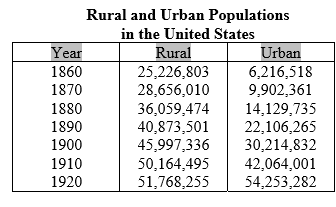
- AFor every census listed, rural population exceeded urban population.
- BBy 1920, more people lived in cities than in rural areas.
- CThe Civil War significantly slowed the rate of population growth.
- DMost urban population growth was due to people migrating from rural area
19 What was a result of the growth of big business in the late 1800s
- Aa reduction in child labor
- Bthe elimination of the middle class
- Cthe widening of the economic gap between rich and poor
- Da shift in transportation investment from railroads to canals
20 During the late 1800s and early 1900s, where did most of the immigrants to the United States settle?
- Aurban centers of the Northeast
- Bplantations of the New South
- Cmining areas of the Far West
- Dfarming regions of the Great Plains
21Base your answer to the question on the cartoon to the left and your knowledge of social studies.
What is the main idea of the cartoon?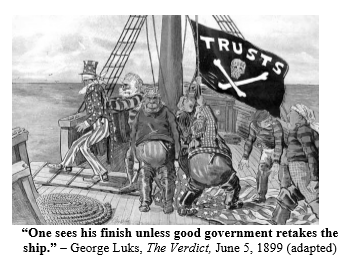
- AGovernment policies have created a recession.
- BAmericans support the activities of the trusts.
- CGood government has saved the country from trusts.
- DTrusts are a threat to the nation.
22 Between 1880 and 1900, why did most immigrants coming to the United States settle in the cities along the east coast?
- Amany factory jobs were available in the East
- Blittle farmland remained to be settled in the Midwest
- Cmost immigrants came from the cities of Europe
- Dcity laws afforded special rights and protections for immigrants
23 In 1906, what did the publication of The Jungle, written by Upton Sinclair, lead Congress to do?
- Aenact stronger prohibition laws
- Bsupport the national conservation movement
- Cestablish a system for meat inspection
- Dlegalize strikes and boycotts by labor unions
24The photographs of Jacob Riis are most closely associated with the
- Abattlefields of the Civil War
- Bliving conditions of the urban poor
- Cplight of sharecroppers in the South
- Dvictims of the Dust Bowl on the Great Plains
25 During the Progressive Era, why did muckrakers publish articles and novels?
- Ato advance their own political careers
- Bto make Americans aware of problems in society
- Cto help the federal government become more efficient
- Dto provide entertainment for readers
26 What did the tragedy of the Triangle Shirtwaist Company fire of 1911 draw national attention to the need to do?
- Arestrict immigration from southern Europe
- Bestablish full-time fire departments
- Cprotect the safety of workers
- Dimprove conditions for tenement dwellers
27How did muckrakers contribute to the rise of Progressivism in the early years of the 20th century?
- Achallenging big government and urging a return to past conditions
- Bexposing widespread corruption in business and government
- Cwriting favorable biographies about wealthy Americans
- Daligning themselves with the women’s suffrage movement
28 What was a goal of the Progressive movement?
- Areduce the government’s involvement in social issues
- Bcorrect the problems caused by industrialization
- Cpromote laissez-faire policies
- Dpromote settlement of land west of the Mississippi River
29During the Progressive Era, Jane Addams responded to urban conditions by working to establish
- Asettlement houses that provided assistance to the poor
- Bnewspapers that helped inform American about slum conditions
- Claws that restricted certain immigrant groups
- Dfree public schools located in inner-city neighborhoods
30What was a goal of Progressive Era reforms such as the initiative, referendum, and recall?
- Aincrease the power of citizens in state and local government
- Breestablish the system of checks and balances
- Cprovide low-interest loans to farmers
- Dexpand voting rights to Native Americans
31 Which president was known as a trustbuster?
- AGeorge Washington
- BCalvin Coolidge
- CTheodore Roosevelt
- DDwight Eisenhower
32Base your answer to the question on the table to the left and on your knowledge of social studies.
What was the common purpose of these legislative acts?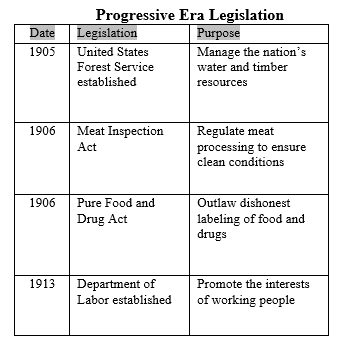
- Aprotect the nation’s natural resources
- Bimprove conditions for recent immigrants to the United States
- Cadvance the growth of big business
- Dpromote the general welfare of the American public
33Why was the Federal Reserve System created?
- Ato maintain a national petroleum supply
- Bto provide military support for the armed forces
- Cprotect consumers from fraud
- Dmanage the nation’s supply of currency and interest rates
34The Sherman Antitrust Act and the Clayton Antitrust Act were passed in an effort to
- Apromote the formation of new trusts
- Bmaintain competition in business
- Cincrease business investment
- Dlimit the activities of foreign corporation
35To improve distribution of money and guarantee an adequate money supply, what did President Woodrow Wilson ask Congress to do?
- Aeliminate the gold standard
- Blimit foreign investment
- Cprovide insurance for bank deposits
- Destablish the Federal Reserve System
36 In 1920, how did women gain the right to vote?
- Apresidential order
- BSupreme Court decision
- Cnational election
- Dconstitutional amendment
37“The right of citizens of the United States to vote shall not be denied or abridged by the United States or by any State on account of race, color, or previous condition of servitude. . . .”
-15th Amendment, Section 1, United States Constitution, 1870
Which actions did Southern States take to keep African Americans from exercising the rights guaranteed in this amendment?- Asuspending habeas corpus and denying women the right to vote
- Bcollecting poll taxes and requiring literacy tests
- Cestablishing religious and property-holding requirements for voting
- Dpassing Black Codes and establishing segregated schools
38In the South, the passage of Jim Crow laws in the 1870s and 1880s led directly to the
- Aracial integration of public schools
- Bdecline of the Democratic Party
- Corganization of the Ku Klux Klan
- Dsegregation of public facilities
Informações
- Descrição
- Part3 US History EOC
- Autor
- Usuário eliminado
- Idioma
- English
- Visualizações
- 100
- Histórico
- Criado em 6 out 2016 · atualizado em 29 nov 2016
- Etiquetas
- Avaliação
- Ainda sem avaliações Avalie este quiz