
Notas
E3: Greenhouse Gas Effects (UNMODIFIED)
Conteúdo das notas (1)
Página 1
Natural Greenhouse Gases: CO2, H2O Vapor, CH4
Temperatures at Sea Level:
With GHG: 16˚C
Without GHG: -18˚C
Process of Greenhouse Gas:
Solar Radiation (Short visible wavelengths and UV light) passes through atmosphere
Some solar radiation = reflected off clouds surface back into space
Some solar radiation = absorbed by Earth's surface + warms it
Energy radiated to Earth's Surface = Radiated back into atmosphere (as IR aka "heat")
Some IR = passed through space
Greenhouse gases in atmosphere absorbs IR Radiation, and then re-radiates back to Earth (therefore further heating Earth)
Process Name: GREENHOUSE EFFECT
Introduction:
Human activity = increased greenhouse gas in the atmosphere (dramatically since human industrialization era)
Greenhouse effects still active, but increase in re-radiation, therefore increasing global temperatures (global warming)
What is Greenhouse Gas?
A gaseous particle that has the ability to absorb and re-radiate IR Radiation
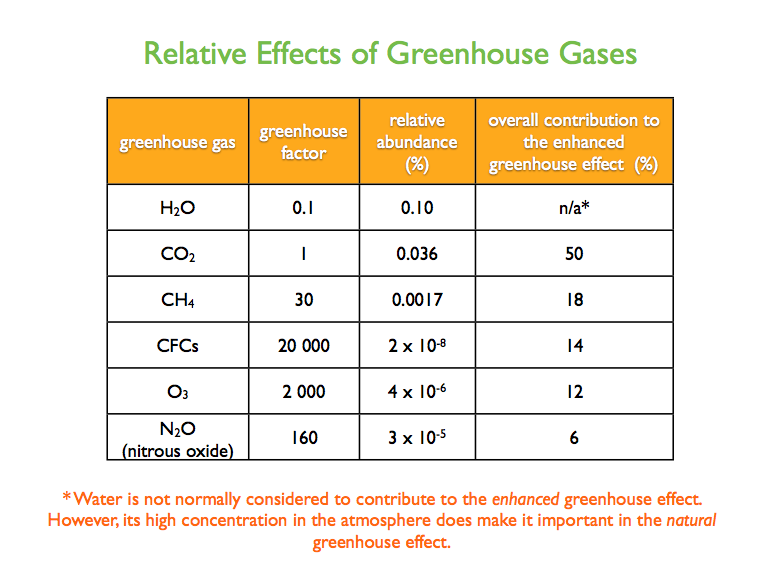
Main types: CO2, CH4, CFCs, O3, N2O
TO NOTE: H2O is not included in "enhanced GHG list" (Since it is naturally present in the atmosphere, and not anthropologically caused)
Sources:
H2O (Water from lakes and ocean)
CO2 (Combustion of fossil fuels, decomposition of organic matter, forest fires)
CH4 (Anaerobic Decomposition (e.g. in swamps), Intensive agriculture (e.g. rice paddies), oil and gas fields)
CFCs (Refrigerants, Solvents, Foaming Agents)
O3 (Photochemical Smog)
N2O (Use of Artificial Fertilizer)
Contributions of Greenhouse Effect depends on...
Ability to absorb IR
Greenhouse Factor:|| The ability of any particle to absorb IR radiation.||
Value = compared to CO2
Greenhouse Factor Values:
CO2 = 1
H2O (0.1)
e.g. "CFCs are 20 0000x more effective than CO2 to absorb IR Radiation"
Relative Abundance in Atmosphere
CO2 = more detrimental than CFCs (despite the greenhouse factor values) since it is the most abundant greenhouse gas in the atmosphere
Atmosphere
CO2 and CH4 Levels
Levels of CH4 and (esp.) CO2 have risen over the last 50 years
Increase of CO2 by 70ppm annually
Annual cycle = drop of CO2 during April - September, then peak of CO2 from October - March (due to plant growth in the Northern Hemisphere. Most likely vice versa for Southern Hemisphere)
Global Warming proportional to Global increase in CO2 (as seen through long term measurement of atmospheric CO2 and temperature anomalies)
Warming
Range of global warming = 1˚C - 4˚C (low CO2 growth VS high CO2 growth)
Despite small values, serious and deleterious consequences on other factors of the ecosystem
Habitat
Species will most likely redistribution / go extinct due to temperature deviations
Reason:
Desertification due to droughts
Warming of Cold Terrestrials/ Water Temperature
Loss of Ice
Agriculture
Agriculture
Agriculture
Agriculture
Crop yields will change (therefore, crop distribution will change as well)
Reason:
Will decrease due to desertification
Move to the northern regions (due to longer growing seasons)
Sea
Sea Levels:
Predicted to rise
Reason:
Thermal expansion of water (due to increased temperature)
Melting polar ice caps
Melting of glaciers
Outcome:
Coastal Communities = at risk (due to intensified flooding)
Large scale relocation of human population
Human Health
Expected to increase for certain types of diseases (e.g. malaria)
Reason:
Warmer temperature will increase geographical location of mosquitos
Life cycle of disease will change (and most likely extended season)
Natural GGE
Enhanced GGE Introduction
Effects of GHE
Influences of GHE
Informações
- Descrição
- IB Chemistry (E: Environmental Science (UNMODIFIED)) Notas sobre E3: Greenhouse Gas Effects (UNMODIFIED), criado por IBMichelle em 07-04-2014.
- Criado por
- IBMichelle · abr 2014
- Atualizado
- 18 nov 2016
- Visualizações
- 636
- Tags
- Avaliação