
Quiz
ANATOMY FINAL
Este quiz tem tipos de pergunta que abrem no player de sempre.
Perguntas do quiz (90)
1Neuromuscular Junction: Label it.

- APresynaptic terminal
- BSynaptic vessicle
- Cacetylcholine
- Dfolded sarcolemma
- Esynaptic cleft
- Fmotor end plate
2Parts of a sarcomere: label it!

- AZ-Line
- BM-Line
- CMyosin filament
- Dactin filament
- EA-Band
- FI-Band
3Label the muscles of the head and neck.

- AOccipitalis
- BMasseter
- CTrapezius
- DPlatysma
- Edepressor anguli oris
- FTemporalis
- Gfrontalis
- Horbicularis oculi
- IBuccinator
- Jzygomaticus minor
- Kzygomaticus major
4Label muscles seen at lateral view of thigh.

- Agluteus medius
- Bgluteus maximus
- Cbiceps femoris
- Drectus femoris
5Label the muscles of the posterior shoulder.

- ATrapezius
- BDeltoid
- CLatissimus dorsi
- DLevator scapulae
- ERhomboid major
6Label the parts of the anterior chest and abdomen.

- APectoralis major
- BDeltoid
- CExternal obliques
- Drectus abdominis
- Etrapezius
7Label!
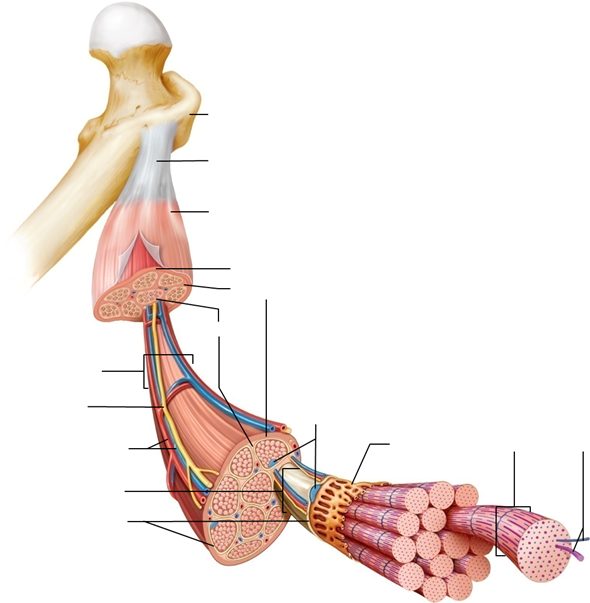
- ABone.
- BTendon
- Cmuscular fascia
- DEpimysium
- EPerimysium
- FEndomysium
- GFascicle
- HNerve
- IBlood vessels
- JMuscle fiber
- KNucleus
- Lsarcoplasmic reticulum
- MMyofibril
- NFilaments
- Osarcolemma
8Label the muscle fiber / muscle cell

- ASarcolemma
- Bsarcoplasm
- Cmyofibrils
- Dsarcoplasmic reticulum
- ENucleus
- Fsarcomere
- GM-Line
- HA-Band
- IH-Zone
- JZ-Line
- KI-Band
- LMyosin filaments
- Mactin filaments
9Label.

- AMyosin heads
- BTroponin
- CTropomyosin
- Dthin filament
10[blank_start]4[blank_end]. Impulse causes release of calcium - leads to muscle contraction.
[blank_start]2[blank_end]. ACh binds to ACh receptors on motor end plate.
[blank_start]1[blank_end]. Nerve impulse causes release ACh from synaptic vesicles.
[blank_start]3[blank_end]. ACh causes changes in permeability to Na+ and K+ ions, which generates a muscle impulse, aka action potiential.
- A4
- B2
- C1
- D3
11The outermost layer of connective tissue surrounding a skeletal muscle is the
- Aperimysium
- Bepimysium
- Cendomysium
- Dsarcomysium
12Myofibrils are composed primarily of:
- Aperimysium and endomysium
- Btroponin and tropomyosin
- Cfascia and tendons
- Dactin and myosin
13Muscle fibers are basically a collection of:
- Asarcomeres
- Bconnective tissue fibers
- Csynapses
- Dmuscles
14The functional unit of muscle contraction is:
- Athe muscle
- Bthe myosin cross-bridge
- Cthe sarcomere
- Dthe muscle fiber
15Binding sites on the surface of actin allow the formation of cross-bridges with molecules of
- AATP
- Bmyosin
- Ctropomyosin
- Dtroponin
16At a neuromuscular junction
- Atroponin and tropomyosin exchange places
- Bintercalated discs are synthesized
- Cactin and myosin filaments slide past one another
- Dneurotransmitters are released
17[blank_start]Endomysium[blank_end] surrounds whole muscle.
[blank_start]Perimysium[blank_end] surrounds fascicles within the muscle.
[blank_start]Endomysium[blank_end] surrounds muscle fibers within the fascicle.- AEndomysium
- BPerimysium
- CEndomysium
18[blank_start]Fascia[blank_end] - separates muscles from each other. Like deltoid from trapezius, etc.
[blank_start]Tendons[blank_end] - fascia connective tissue extends past ends of muscle tissue forming cord thing
[blank_start]Aponeurosis[blank_end] - broad fibrous sheets of connective tissue - like covering abs.- AFascia
- BTendons
- CAponeurosis
19[blank_start]2[blank_end]. Ca+2 binds to troponin & changes its shape
[blank_start]4[blank_end]. binding sites on actin are now exposed
[blank_start]3[blank_end]. Troponin's shape changing alters the position of tropomyosin
[blank_start]5[blank_end]. myosin head binds to actin binding site and forms cross bridges
[blank_start]1[blank_end]. Muscle impulse causes SR to release Ca+2 into the cytosol- A2
- B4
- C3
- D5
- E1
20Muscle Relaxation.
[blank_start]1[blank_end]. Acetylcholinerase - an enzyme quickly decomposes ACh remaining in synapse.
[blank_start]4[blank_end]. Troponin - Tropomyosin return to covering binding sites on actin - no more cross bridges - muscle relaxes.
[blank_start]3[blank_end]. Calcium pump rounds up all the Ca+2 and herds it back into SR.
[blank_start]2[blank_end]. Decomposed Ach = no more impulse.- A1
- B4
- C3
- D2
21The amount of oxygen liver cells require to support the conversion of lactic acid to produce glucose or glycogen is the
- Aoxygen debt
- Brefractory quantity
- Canaerobic concentration
- Daerobic conversion
22TYPES OF CONTRACTIONS
[blank_start]Isotonic[blank_end] - muscle contracts and changes length - equal force.
[blank_start]Isometric[blank_end] - muscle contracts but does not change length - change in force.- AIsotonic
- BIsometric
23Types of Contractions.
Shortening contraction - [blank_start]concentric[blank_end]
Lengthening contraction - [blank_start]eccentric[blank_end]- Aconcentric
- Beccentric
24The characteristic reddish brown color of skeletal muscle comes from which substance?
- AMyosin
- BCalcium
- CActin
- DMyoglobin
25Both acetylcholine and norepinephrine can affect
- Askeletal muscle contraction
- Bsmooth muscle contraction
- Csynthesis of actin and myosin
- Dexercise tolerance
26In ______ muscles, myofilaments are arranged into sarcomeres.
- Acardiac and skeletal
- Bvisceral smooth and cardiac
- Cskeletal and visceral smooth
27When a muscle undergoes atrophy in response to disuse
- Athere is a reduction in capillary networks
- Bthe size of actin and myosin filaments decreases
- Cthe muscle gets smaller
- Dall of the above
28The muscle that opposes a particular action is called the:
- Aantagonist
- Bprime mover
- Csynergist
- Dagonist
29The buccinator muscle is in the
- Achest
- Bbladder
- Ccheek
- Dbuttocks
30A muscle that assists the agonist is the
- Aantagonist
- Bprime mover
- Cmediator
- Dsynergist
31A muscle that causes an action is the
- Asynergist
- Bantagonist
- Cagonist
- Dmediator
32The more movable end of a muscle is its
- Aorigin
- Bfulcrum
- Csource
- Dinsertion
33A sign of aging of the muscular system is:
- Aexcess ATP
- Bdecreased supplies of myoglobin to muscles
- Cincreased creatine phosphate
- Dexpansion of muscle fiber diameters
34The lesser movable end of a muscle is its
- Aorigin
- Bfulcrum
- Cinsertion
- Dsource
35Label the glands.

- AThyroid
- BThymus
- CPancreas
- DAdrenal
- ETestis
- FOvary
- Gpituitary
- Hhypothalamus
- Ipineal
36Sits on top of a kidney: [blank_start]Adrenal gland[blank_end]
Found in the pelvis: [blank_start]Ovaries[blank_end]
Attached to the small intestines: [blank_start]Pancreas[blank_end]
Found in the neck: [blank_start]Thyroid gland[blank_end]
Found in the brain: [blank_start]Pituitary gland[blank_end]- APituitary gland
- BOvaries
- CPancreas
- DThyroid gland
- EAdrenal gland
- FPancreas
- GOvaries
- HAdrenal gland
- IThyroid gland
- JPituitary gland
- KThyroid gland
- LPituitary gland
- MPancreas
- NOvaries
- OAdrenal gland
- PThyroid gland
- QPituitary gland
- RPancreas
- SOvaries
- TAdrenal gland
- UPituitary gland
- VThyroid gland
- WAdrenal gland
- XOvaries
- YPancreas
37Graves disease, the most common form of hyperthyroidism, is caused by
- Aa lack of iodine
- Ban excess of iodine
- Can improper diet
- Dan autoimmune disorder
38The ____ secretes triiodothyronine.
- Aadrenal gland
- Bpancreas
- Cparathyroid gland
- Dthyroid gland
39Simple goiter is most prevalent where the soil lacks
- Aorganic matter
- Bvitamins
- Ciodine
- Dpotassium
40The hormone that stimulates calcium deposition into bone is
- Acalcitonin
- Bparathyroid hormone
- Cinsulin
- Dthyroxine
41Secretion of insulin causes
- Aa decrease in the concentration of blood glucose
- Ba decrease in the permeability of cell membranes to glucose
- Can increase in the breakdown of glycogen to release glucose
- Din increase in the concentration of blood glucose
42Secretion of glucagon causes
- Aan increase in the formation of fat
- Ban increase in the permeability of the cell membrane to glucose
- Can increase in the concentration of blood glucose
- Dan increase in glycogen
43The hormone that the pineal gland secretes is
- Amelanoma
- Bmelatonin
- Cmyostatin
- Dbeta endorphin
44Type 2 Diabetes mellitus results from
- Aa deficiency of insulin
- Binsensitivity of cells to insulin
- Ca deficiency of insulin and insensitivity of cells to insulin
- Dan infection
45The thyroid gland has the special ability to remove the element ___ from the blood.
- Aiodine
- Boxygen
- Cnitrogen
- Dpotassium
46The central region of the adrenal gland is the adrenal
- Acortex
- Bcore
- Ccenter
- Dmedulla
47A hormone is a ________, and the target cell is ______________.
- Aprotein that stimulates other cells; the source of hormone secretions
- Bregulatory molecule that controls secretions of other cells; a cell that synthesizes hormones
- Cmolecule that has a metabolic effect on another cell; a cell that has receptors for specific hormones
- Dmolecule; a cell that does not have receptors
48Nerve fibers in the posterior lobe of the pituitary gland secrete
- Athyroid-stimulating hormone
- Badrenocorticotropic hormone
- Cgrowth hormone
- Dantidiuretic hormone
49Which of the following hormones primarily affects the reproductive organs?
- Afollicle-stimulating hormone
- Badrenocorticotropic hormone
- Cprolactin-releasing factor
- Dgrowth hormone
50Another name for antidiuretic hormone is
- Aintermedin
- Boxytocin
- Cvasopressin
- Daldosterone
51Diabetes insipidus is caused by
- Ainsulin deficiency
- Bexcess insulin
- CADH (antidiuretic hormone) deficiency
- Dexcess ADH
52Oxytocin is administered to women following childbirth to stimulate
- Aless milk production
- Buterine contractions
- Cuterine relaxation
- DACTH production
53Which of the following has both endocrine and exocrine functions?
- APancreas
- BAnterior pituitary
- CLiver
- DThyroid gland
54Nonsteroid hormones include peptides, proteins, glycoproteins, and amines.
- AVerdadeiro
- BFalso
55Which of the following glands is found in the brain?
- Apancreas
- Bthyroid gland
- Cpituitary gland
- Dadrenal gland
56Increases size and division rate of body cells - [blank_start]Growth hormone[blank_end]
Sustains milk production after birth - [blank_start]Prolactin[blank_end]
Controls thyroid gland secretions - [blank_start]Thyroid-stimulating hormone[blank_end]
Controls adrenal cortex secretions - [blank_start]adrenocorticotropic hormone[blank_end]
stimulates development of eggs and sperm - [blank_start]follicle-stimulating hormone[blank_end]
Controls secretions from ovaries and testis - [blank_start]luteinizing hormone[blank_end]
affects muscle contraction of uterus and mammary glands - [blank_start]oxytocin[blank_end]- AProlactin
- BGrowth hormone
- CThyroid-stimulating hormone
- Dadrenocorticotropic hormone
- Eoxytocin
- Fluteinizing hormone
- Gfollicle-stimulating hormone
- HGrowth hormone
- IThyroid-stimulating hormone
- Jfollicle-stimulating hormone
- Kadrenocorticotropic hormone
- LLuteinizing hormone
- Moxytocin
- NProlactin
- OThyroid-stimulating hormone
- PFollicle-stimulating hormone
- QLuteinizing hormone
- Roxytocin
- Sadrenocorticotropic hormone
- Tprolactin
- Ugrowth hormone
- Vluteinizing hormone
- Woxytocin
- Xadrenocorticotropic hormone
- Yprolactin
- Zgrowth hormone
- AAfollicle-stimulating hormone
- ABthyroid-stimulating hormone
- ACfollicle-stimulating hormone
- ADluteinizing hormone
- AEgrowth hormone
- AFoxytocin
- AGprolactin
- AHthyroid-stimulating hormone
- AIadrenocorticotropic hormone
- AJluteinizing hormone
- AKGrowth hormone
- ALadrenocorticotropic hormone
- AMoxytocin
- ANfollicle-stimulating hormone
- AOthyroid-stimulating hormone
- APprolactin
- AQGrowth hormone
- ARProlactin
- ASThyroid-stimulating hormone
- ATadrenocorticotropic hormone
- AUfollicle-stimulating hormone
- AVluteinizing hormone
- AWoxytocin
57The anterior pituitary gland is responsible for all the -trophs:
Somatrophs ([blank_start]growth hormone[blank_end])(GH)
Mammotrophs ([blank_start]Prolactin)[blank_end](PRL)
Thyrotrophs ([blank_start]Thyroid-stimulating hormone[blank_end])(TSH)
Corticotrophs ([blank_start]Adrenocorticotropic hormone[blank_end])(ACTH)
Gonadotrophs (Follicle-stimulating hormone and [blank_start]Luteinizing hormone[blank_end])(FSH and LH)- Agrowth hormone
- BProlactin)
- CThyroid-stimulating hormone
- DAdrenocorticotropic hormone
- ELuteinizing hormone
58Label, please.

- ASynovial membrane
- BJoint cavity
- CHumerus
- Darticular cartilage
- EScapula
59Label, please.

- AFemur
- Bsynovial membrane
- Cpatella
- Darticular cartilage
- ETibia
60Cartilaginous joints are connected by
- Asynovial fluid
- Bfibrous connective tissue
- Chyaline cartilage or fibrocartilage
- Da joint capsule
61Ossification typically completes after age 40.
- AVerdadeiro
- BFalso
62Choose the joint characteristic that applies to all joints of the body.
- AAll joints are involved in elongation of long bones of the skeleton.
- BAll joints allow movement in response to muscle contraction.
- CAll joints are connections between neighboring bones
63What class of joint consists of bone ends held together by collagenous tissue?
- ACartilaginous
- BSynovial
- Cfibrous
64Joints in which the bone ends are bound together by hyaline cartilage or fibrocartilage are classified as:
- Afibrous joints
- Bcartilaginous joints
- Cimmovable joints
- Dsynovial joints
65What type of synovial joint involves a cylindrical shape for one bone end that rotates in a ring formed by another bone and a ligament?
- ASaddle (sellar) joint
- BBall-and-socket (spheroidal) joint
- CHinge joint
- DPlane joint
- EPivot (trochoid) joint
- FCondylar (ellipsoidal) joint
66What type of synovial joint involves one bone end with a globular head that fits into a cup-shaped cavity on the other bone end?
- ABall-and-socket (spheroidal) joint
- BCondylar (ellipsoidal) joint
- CPivot (trochoid) joint
- DHinge Joint
- EPlane joint
- FSaddle (sellar) joint
67What type of synovial joint involves two flat (or nearly flat) bone surfaces?
- APivot (trichoid) joint
- BPlane joint
- CSaddle (sellar) joint
- Dball-and-socket (spheroidal) joint
- ECondylar (ellipsoidal) joint
- FHinge joint
68Doing jumping jacks requires that you alternate between _______ and _______ your lower extremities.
- Aflexing; extending
- Brotate; circumduct
- Cabducting; adducting
- Dpronating; supinating
69[blank_start]Diarthrotic[blank_end] joints are freely movable.
[blank_start]Synarthrotic[blank_end] joints are immovable.
[blank_start]Amphiarthrotic[blank_end] joints are slightly movable.- AAmphiarthrotic
- BSynarthrotic
- CDiarthrotic
70Label.

- ACondylar joint
71Label.

- ACircumduction
- Bdorsiflexion
- Cplantar flexion
- DSupination
- EPronation
- FMedial rotation
- GLateral rotation
72Label.

- AFlexion
- BExtension
- CLateral Flexion
- DAdduction
- EAbduction
73Label the layers of skin.

- AEpidermis
- BDermis
- CSubcutaneous layer
74As a part of maintaining [blank_start]homeostasis[blank_end], body temperature is closely regulated. A change in body temperature is detected by receptors in the [blank_start]hypothalamus[blank_end] of the brain, which then sends signals to effectors in the skin.
- Ahomeostasis
- Bhypothalamus
75An increase in body temperature results in [blank_start]dilation[blank_end] of blood vessels in the dermis of the skin, allowing heat carried by the blood to dissipate.
- Adilation
76An increase in body temperature also causes the nervous system to stimulate [blank_start]merocrine[blank_end] [blank_start]sweat[blank_end] glands to increase their activity.
- Amerocrine
- Bsweat
77A drop in body temperature triggers [blank_start]vasoconstriction[blank_end], reducing blood flow and, therefore, heat loss from the skin.
- Avasoconstriction
78If a drop in body temperature is great enough, skeletal muscles are stimulated to begin [blank_start]shivering[blank_end], a mechanism that generates body heat.
- Ashivering
79Which of the following is NOT correct concerning the skin?
- AThe dermis is usually thicker than the epidermis
- BThe epidermis is composed of stratified squamous epithelium
- CThe subcuataneous layer is between the dermis and the epidermis
- DThe dermis contains smooth muscle and nervous tissue
80Label.

- Ahair shaft
- Bstratum corneum
- Cstratum basale
- DSebaceous gland
- EArrector pili muscle
- Fmerocrine sweat gland
- Ghair follicle
81Label.

- Ahair shaft
- BArrector pili muscle
- CSebaceous gland
- DHair root
- Ehair bulge
- Fhair follicle
- Ghair papilla
82Skin cells play an important role in producing
- AVitamin A
- BVitamin B
- CVitamin C
- DVitamin D
83A nail consists of
- Adense connective tissue
- Bbone
- CA nail bed and a nail plate
- DCollagen and elastin
84Shafts of hair are composed of
- Aliving dermal cells
- Bdead epidermal cells
- Cliving epidermal cells
- Ddead dermal cells
85Sweat cools the body by
- Aevaporation
- Bconvection
- Cconduction
- Dradiation
86Label.

- AMerocine sweat gland
- BApocrine sweat gland
87Cutaneous carcinomas are usually caused by regular exposure to
- AX-rays
- Bgamma radiation
- Cultraviolet light
- Dmutagenic chemicals
88Fever is
- Aa result of inflammation
- Bdue to exposure to heat
- Ca special case of hyperthermia in which body temperature rises in response to an elevated set point, typically in response to infection
- Da special case of hypothermia in which body temperature falls to protect the core from infection
89As cells are pushed from the deeper portion of the epidermis toward the surface
- Athey divide continually
- Btheir supply of nutrients improves
- Cthey die
- Dthey become dermal cells
901. Clot forms - consists of fibrin, blood cells and platelets 1. [blank_start]CLOT[blank_end]
2. Scab forms - consists of lot and dried tissue fluid 2. SCAB
3. Epithelial cells reproduce, fill in the wound 3. FILL IN WOUND WITH EPITHELIAL CELLS
4. Fibroblasts secrete collagen fibers to bind wound together 4. FIBROBLASSTS BIND WOUND TOGETHER WITH COLLAGEN
5. Growth factors stimulate new tissue formation 5. GROWTH FACTORS CAUSE NEW TISSUE TO GROW
6. Phagocytic cells remove dead cells and debris, scab sloughs off 6. PHAGOCYTES EAT LEFTOVERS, SCAB FALLS OFF
7. Excess collagenous fibers may form elevated mass called a scar 7. SCAR FROM EXCESS FIBERS- ACLOT
- BScab
Informações
- Descrição
- Quiz on ANATOMY FINAL , created by Keziah Gellis on 12/07/2017.
- Autor
- Keziah Gellis
- Idioma
- English
- Visualizações
- 89
- Etiquetas
- Avaliação
- Ainda sem avaliações Avalie este quiz