
Muscular System
1,036 resources created by 804 users
This Muscular System page on GoConqr gathers community-made quizzes, mind maps, flashcards, slide sets and notes, from muscle fibres and the sliding filament theory to back, trunk, limb and facial muscles. It's built for university students working through muscle identification and origins, insertions and actions, and for teachers after ready-made material. There are over 900 resources here, including more than 190 quizzes, over 130 mind maps and 600 flashcards. Try a quiz to find your gaps, then open a map to fill them.
Select topic
- Types of Muscle Tissue69
- Skeletal Muscle Structure53
- Muscle Contraction and Physiology10
- Muscle Origins and Insertions41
- Muscle Actions and Movement27
- Skeletal Muscle Identification147
- Head and Neck Muscles49
- Axial, Back and Trunk Muscles78
- Upper Limb and Shoulder Muscles45
- Lower Limb and Gluteal Muscles35
- Cat Muscle Anatomy6
Top Muscular System resources
-
36 cardsIntro to Myology: The Structural and Functional Organization of Muscles BIOL252.L Shemer Relevant to Labs 4, 5, & 6
-
192 cardsAnatomy and Physiology LAB exam III study guide Identify muscle #4
-
31 questionsAnatomy and Embryology of Skeletal Muscle Skeletal muscle cells fuse to form giant multinucleate cells with several nuclei located on the periphery t...
-
37 cardsLab Practical 2
-
31 questionsStudy Guide: Appendicular Muscles All of the following are rotator cuff muscles except
-
16 cardsMuscles and Actions Muscles of the Shoulder Girdle
-
34 cardsMuscles of the Scalp, Face, Decollete, and Arm What are the (4) muscles of the scalp?
-
4 questionsMuscle Blanks
Quizzes
See all 208 quizzes-
31 questionsAnatomy and Embryology of Skeletal Muscle Skeletal muscle cells fuse to form giant multinucleate cells with several nuclei located on the periphery t...
-
31 questionsStudy Guide: Appendicular Muscles All of the following are rotator cuff muscles except
-
4 questionsMuscle Blanks
-
33 questionsStudy Guide: Axial Muscles An entire skeletal muscle is covered by a coarse sheath called
-
16 questionsBC RMT Board Exam Review: Myology What muscles are innervated by the Axillary nerve?
-
41 questionsMuscle Origins and Insertions
-
6 questionsLabel These Muscles Name These Muscles
-
36 questionsCat Dissection Quiz Choose the answer that correctly labels muscle 1
Mind maps
See all 140 mind maps

Flashcards
See all 655 flashcards-
36 cardsIntro to Myology: The Structural and Functional Organization of Muscles BIOL252.L Shemer Relevant to Labs 4, 5, & 6
-
192 cardsAnatomy and Physiology LAB exam III study guide Identify muscle #4
-
37 cardsLab Practical 2
-
16 cardsMuscles and Actions Muscles of the Shoulder Girdle
-
34 cardsMuscles of the Scalp, Face, Decollete, and Arm What are the (4) muscles of the scalp?
-
87 cardsLab 6: Muscles of the Trunk and Lower Limb (ID Material) Shemer BIOL252L Midterm 2
-
28 cardsTrunk Muscles Trunk muscles with names, origins, insertions, and actions
-
39 cardsKin270 Lab Practical 2
Notes
See all 18 notesSlides
Topics in Muscular System
More Anatomy topics
About Muscular System
GoConqr OriginalWhat this page covers
The Muscular System unit sits in the Musculoskeletal System strand of Anatomy. It mixes the microscopic and the whole-body view. On the structure side, the flashcard deck Intro to Myology: The Structural and Functional Organization of Muscles opens with the kinds of muscular tissue and their shared purpose. The quiz Anatomy and Embryology of Skeletal Muscle looks at how muscle cells fuse into multinucleate cells.
On the whole-body side, you will find resources on the head, back, trunk, abdominal wall, shoulder, forearm, hand and lower limb.
Where to start
- Begin with the Intro to Myology flashcards to fix the vocabulary.
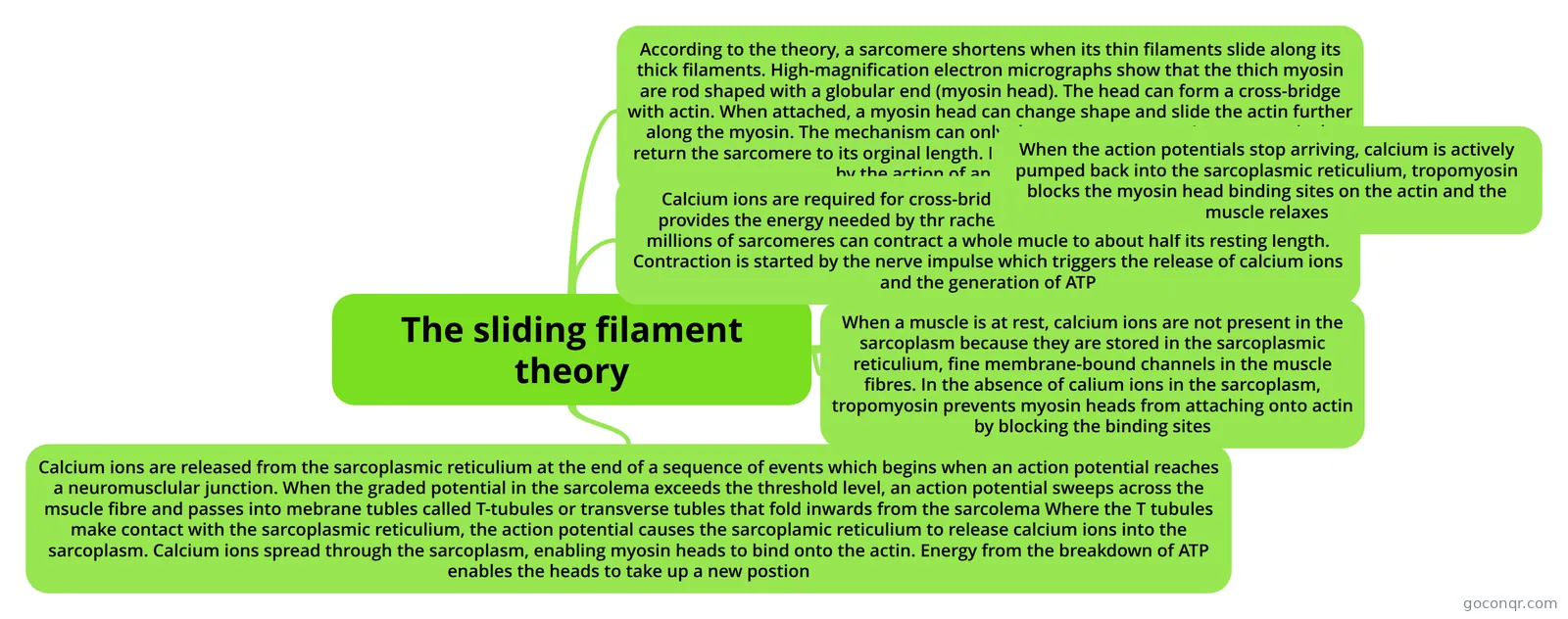
- Open the mind map The sliding filament theory, then Slow and fast skeletal muscle fibres, to see how a sarcomere shortens and why fibres differ.
- Take the quiz Study Guide: Axial Muscles, which asks about muscle sheaths, feather-like arrangements, aponeuroses and antagonists.
- Move on to Study Guide: Appendicular Muscles, which covers the rotator cuff, shrugging the shoulders and extending the forearm.
Learning origins, insertions and actions
Much of this page is about naming a muscle and saying where it attaches and what it does. The quiz Muscle Origins and Insertions works through facial muscles such as frontalis, orbicularis oculi and temporalis. The flashcards Muscular System - Muscle Identification Flashcards ask you to recognise muscles such as gracilis, masseter and rectus femoris. There are also separate sets for back, trunk and lower extremity muscles, plus slide sets for lab work.
Using quizzes and maps together
Maps give you the overview; quizzes show what you have not yet retained. Read a map on the back muscles, then take a quiz on the deep muscles of the back. Note what you missed, go back to the map, and test yourself again. Flashcards suit short, repeated sessions on attachments and actions.
Teachers can pick a quiz, slide set or map and use it as it stands in a lab or revision session.
Next step
Choose one region of the body, work through its map and quiz, and see which muscles still need another look.
Frequently asked questions
Which resource should I open first?
Start with the flashcard deck Intro to Myology: The Structural and Functional Organization of Muscles. It sets out the types of muscular tissue and what muscles are for. After that, the mind map The sliding filament theory is a clear next step before you move on to regional muscles.
What do the mind maps on this page cover?
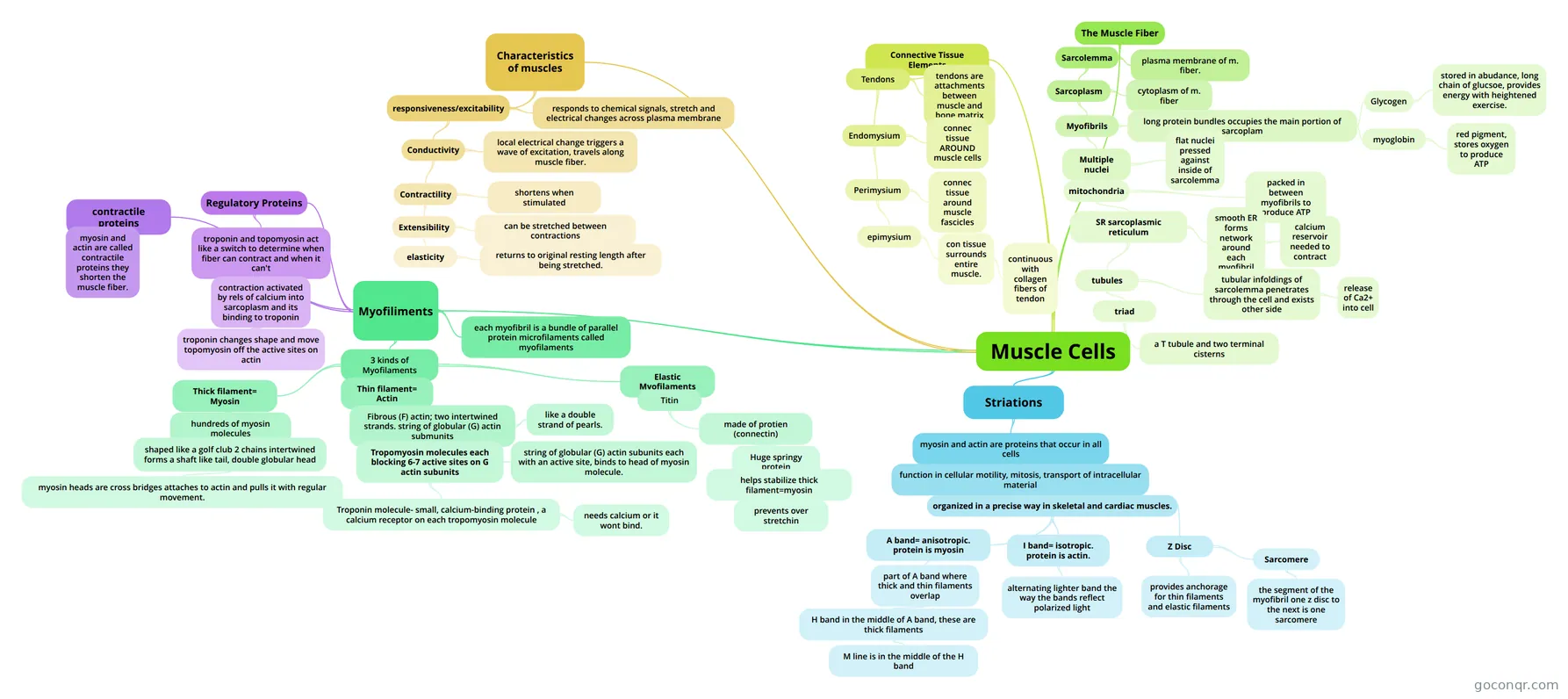
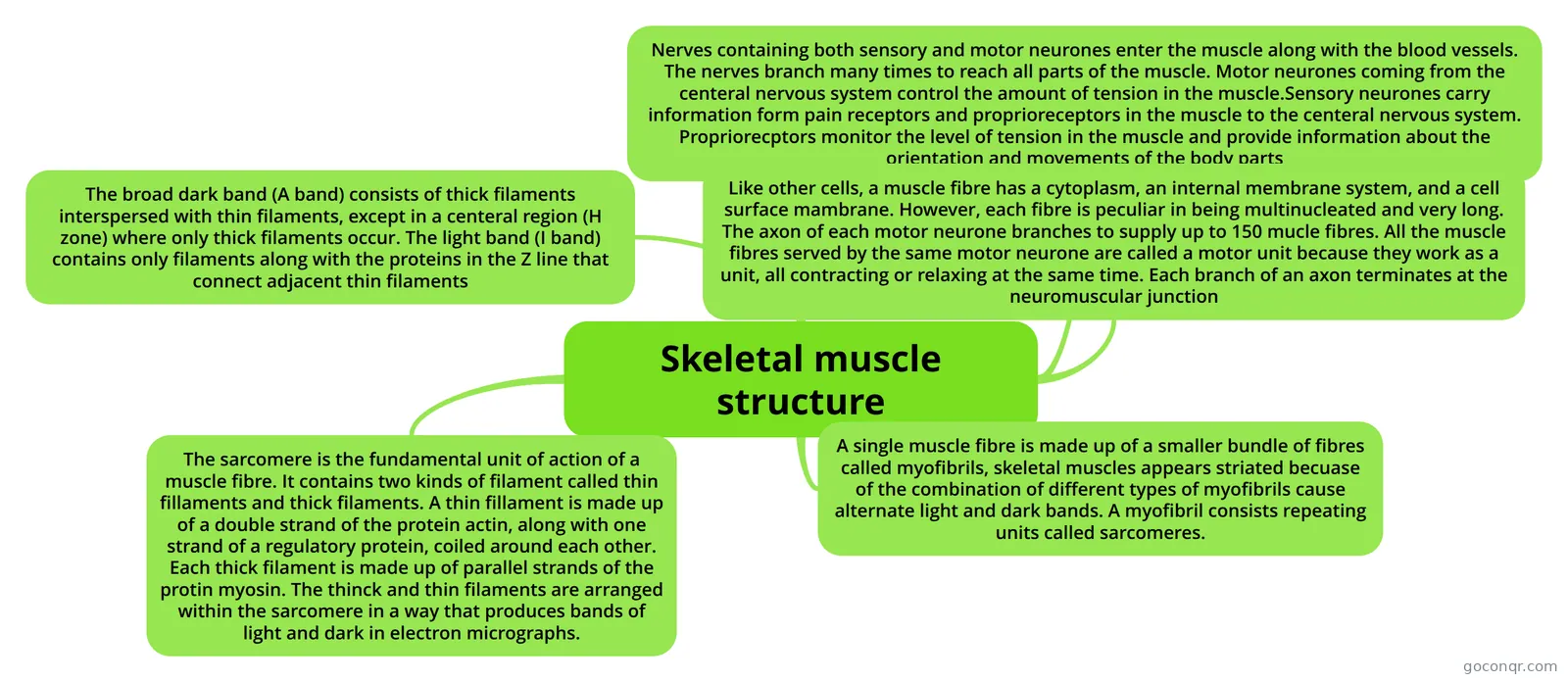
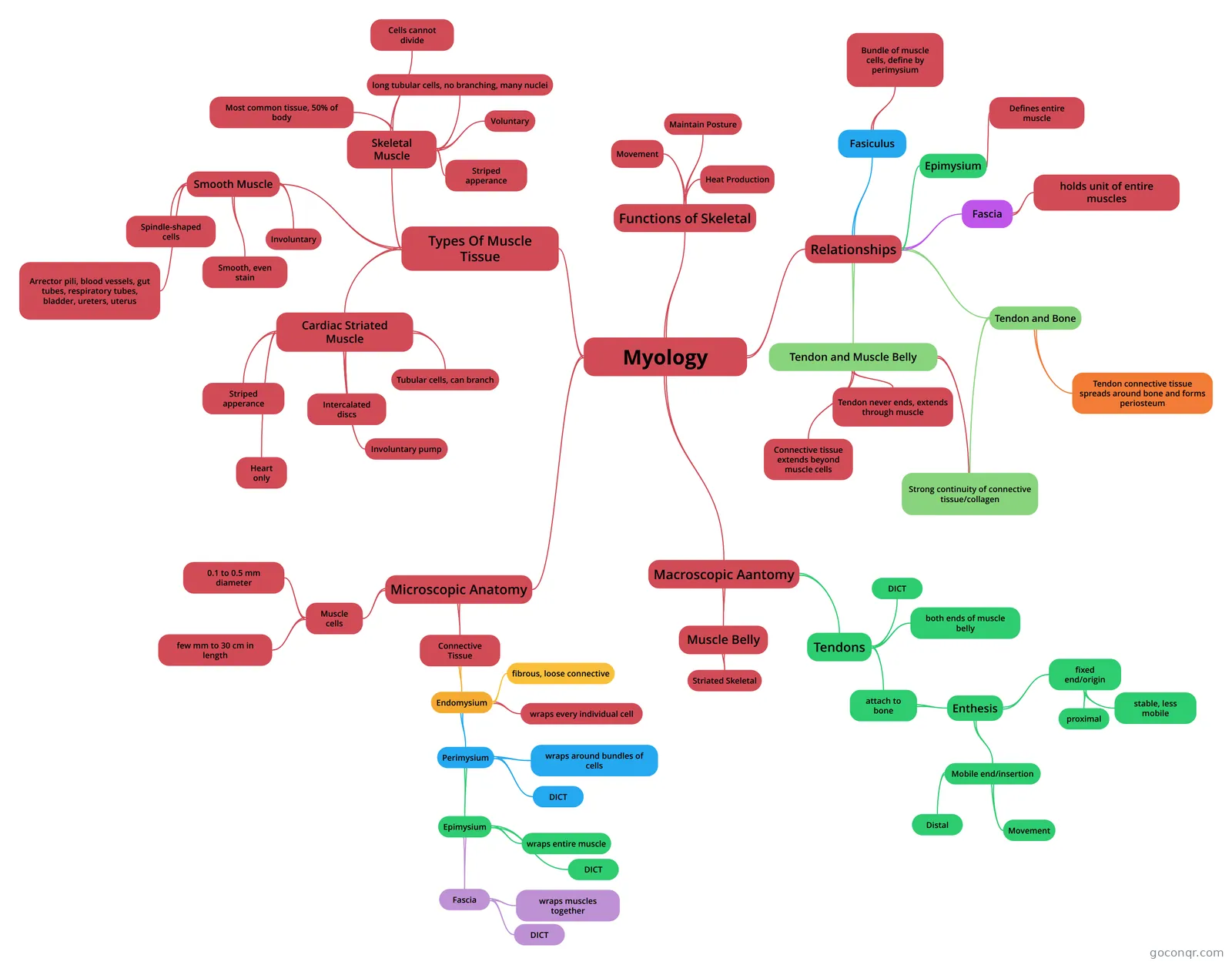
They range from cell-level topics, such as the sliding filament theory, slow and fast skeletal muscle fibres and muscle cells, to regional maps on the back, trunk, abdominal wall and shoulder girdle. There are also general maps on muscle types and muscle tissues, so you can pick the level you need.
Are there quizzes on origins, insertions and actions?
Yes. Muscle Origins and Insertions covers facial muscles such as frontalis and temporalis. Other quizzes cover the anterior muscles, the hand muscles and the lower limb. Flashcard decks on origin, insertion and action for the upper body and the axial muscles give you more to practise with.
Are the resources free, and who made them?
Every resource listed here is free to open, study and take, with no account needed. They were made by GoConqr users, not by GoConqr itself. A free account also saves your quiz scores and lets you make your own quizzes, mind maps, flashcards and notes.
Who is this unit for?
It is mainly for university students, who make up most of the resources, learning muscle structure, identification and actions for lectures and lab work. Teachers can also use the quizzes, slide sets and maps as ready-made material for their own classes.
What if the muscle I need is not listed?
Try the regional sets first, such as the back, trunk, forearm or lower limb, as a muscle is often covered inside a wider deck or map. If it still is not there, you can build your own flashcards or notes to fill the gap.