
Quiz
Physio Final
Este quiz tem tipos de pergunta que abrem no player de sempre.
Perguntas do quiz (124)
1What is triiodothyronine?
- AA catecholamine released from the adrenal cortex
- BA hormone released from the thymus
- CA catecholamine released from the anterior pituitary
- DA tropic hormone released from the anterior pituitary
- EA thyroid hormone secreted from the thyroid gland
2A person has a tumor in the hypothalamus causing excess TRH secretion. Which of the following correctly describes changes in plasma levels of hormones?
- AIncreased TRH, decreased TSH, and decreased thyroid hormones
- BDecreased TRH, decreased TSH, and decreased thyroid hormones
- CIncreased TRH, increased TSH, and decreased thyroid hormones
- DDecreased TRH, decreased TSH, and increased thyroid hormones
- EIncreased TRH, increased TSH, and increased thyroid hormones
3What is the primary hormone meditating the body’s stress response?
- AGrowth hormone
- Binsulin
- CCortisol
- DThyroid hormone
44. What layer of the adrenal cortex secretes mineralocorticoids?
- AZona glomerulosa only
- BZona fasciculata only
- CZona reticularis only
- DBoth zonae reticularis and fasciculata
- EBoth zonae reticularis and glomerulosa
5During the normal cardiac cycle, the bicuspid valve opens when
- AThe pressure in the right ventricle is greater than in the right atrium
- BThe pressure in the right atrium is greater than in the right ventricle
- CThe pressure in the left ventricle is greater than the left atrium
- DThe pressure in the left atrium is greater than in the left ventricle
- EThe pressure in the right ventricle is greater than in the pulmonary artery
6The spontaneous depolarization of autorhythmic cells (to reach threshold) begins with the opening of:
- AL-type calcium channels
- BFunny channels
- CPotassium channels
- DT-type calcium channels
- EChloride channels
7In the cardiac cycle, which event happens first?
- ABlood is ejected from the atrium
- BVentricular systole occurs
- CThe P wave develop
- DThe SA node fires
- EAtrial systole occurs
8Ejection of blood from the left ventricle will continue until:
- AThe pressure in the artery is less than the pressure in the left ventricle
- BThe pressure in the aorta is less than the pressure in the left ventricle
- CThe pressure in the pulmonary artery is greater than the pressure in the left ventricle
- DThe pressure in the aorta is greater than the pressure in the left ventricle
9Which of the following is directly affected by the parasympathetic nervous system?
- AStroke volume
- BTotal peripheral resistance
- CHeart rate
- DMore than one is correct
10A patient’s arterial blood pressure is 140/110. What’s the mean arterial pressure?
- A120 mm Hg
- B150 mm Hg
- C140 mm Hg
- D153 mm Hg
- E125 mm Hg
11Select the correct combination for a sympathetic increase in heart rate:
- AAcetylcholine- a receptors – increased potassium permeability
- BNorepinephrine and epinephrine – b2 receptors – increased permeability to sodium, potassium, and calcium
- CAcetylcholine – muscarinic receptors – increased potassium permeability
- DNorepinephrine and epinephrine – nicotinic receptors – increased permeability to calcium
- ENorepinephrine and epinephrine – B1 receptors – increased permeability to sodium and calcium
12Which of the following would cause localized arteriolar vasodilation?
- AIce pack
- BIncreased parasympathetic stimulation to the arteriole
- CIncrease in CO2
- DIncrease in O2
- EMore than one of the above is correct
13Receptors that detect changes in blood pressure are located in the:
- ASinoatrial node
- BSpinal cord
- CHypothalamus
- DMedulla
- ECarotid sinus
14If there is a loss of plasma proteins due to kidney disease (in other words, the plasma proteins go out in the urine), how will bulk flow in the systemic capillaries be affected?
- ABoth filtration and reabsorption will increase
- BBoth filtration and reabsorption will decrease
- CFiltration will increase, and reabsorption will decrease
- DFiltration will decrease, and reabsorption will increase
15Which of the following is NOT a function of the lymphatic system?
- ATo create pressure changes which affect respiratory rate and depth
- BReturning fluid from the interstitial spaces to the circulatory system
- CTo deliver fats from the small intestine to the circulatory system
- DTo help in defense against foreign invaders
- ENone of the above applies … they are all functions of the lymphatic system
16Which of the following does NOT increase venous return to the heart?
- AParasympathetic activity causing venous vasodilation
- BSympathetic nerve activity causing venous vasoconstriction
- CRespiratory pump providing a pressure gradient between the lower veins and the chest veins
- DSkeletal muscle pump squeezing blood through the veins
- EMore than one answer applies
17Which of the following is NOT a compensatory change, after hemorrhaging to restore MAP to normal?
- AIncreased synthesis of plasma proteins
- BIncreased filtration by capillaries
- CIncreased total peripheral resistance
- DIncreased venous return
- EIncreased stroke volume
18If the blood has no red blood cells but the lungs were functioning normally:
- AThe arterial Po2 would be normal
- BTotal oxygen content of arterial blood would be normal
- CBoth a) and b) are correct
- DNone of the above is correct
19Which muscles are involved in maximal inspiration?
- AThe abdominal muscles, internal intercostals and sternocleidomastoid
- BThe diaphragm, abdominal muscles, and external intercostals
- CThe abdominal muscles and internal intercostals
- DThe diaphragm, abdominal muscles, and internal intercostals
- EThe diaphragm, external intercostals, and sternocleidomastoid
20At the end of normal expiration, when outward air flow ceases:
- AIntra-alveolar pressure is less than atmospheric pressure
- BIntra-alveolar pressure is equal to atmospheric pressure
- CIntra-alveolar pressure is greater than atmospheric pressure
21Which of the following areas of the brain is believed to be the location of the “pacemaker” for breathing?
- ADRG
- BHypothalamus
- CPneumotaxic center
- DPons
- EMedulla
22Compare the changes in percent hemoglobin saturation that would occur in the two following situations:
The blood Po2 drops from 100mm Hg to 80mm Hg.
The blood Po2 drops from 40mm Hg to 20mm Hg.- AIn both situations, the percent hemoglobin saturation would decrease by 20%
- BThere would be a large reduction in percent hemoglobin saturation in situation I but a large reduction in situation II.
- CThere would be a very little reduction in percent hemoglobin saturation in saturation i but a large reduction in situation ii.
- DIn both situations, the percent hemoglovin saturation would increase
23Which of the following statements about hemoglobin is NOT true?
- AThe plateau portion of the oxygen-hemoglobin curve is in the blood Po2 range that exists in the lungs.
- BHemoglobin removes dissolved oxygen from the blood, thereby keeping Po2 low and allowing net diffusion of oxygen from the airways to continue until the hemoglobin is close to saturated*?
- CHemoglobin holds onto more O2 in the presence of carbon dioxide.
- DHemoglobin is found only in red blood cells.
24A person has a fever. How would % Hb saturation be affected?
- AThe O2-Hb curve would shift to the left, and there would be more unloading of oxygen.
- BThe O2-Hb curve would shift to the left, and there would be less unloading of oxygen.
- CThe O2-Hb curve would shift to the right and there would be more unloading of oxygen.
- DThe O2-Hb curve would shift to the right and there would be less unloading of oxygen.
25Which of the following is FALSE of carbonic anhydrase?
- AIt plays a role in how carbon dioxide is transported.
- BIt is found in red blood cells
- CIt is involved in the renal processing of sodium
- DIt is involved in how ventilation is controlled
- EMore than one of the above applies
26A rapid ascent to high altitude would lead to ventilation changes that initially cause:
- ARespiratory acidosis
- BRespiratory alkalosis
27Which of the following would decrease glomerular filtration rate?
- AA decrease in plasma protein concentration
- BA kidney stone in the renal tube which causes pressure in Bowman’s capsule to increase
- CAn increase in size of the pores in the glomerular capillary walls
- DMore than one answer is correct
28Juxtaglomerular cells in the nephron secrete:
- AAngiotensinogen
- BRenin
- CAngiotensin converting enzyme
- DAngiotensin I
29Where are the osmoreceptors which respond to plasma osmolarity?
- AJuxtaglomerular apparatus
- BHypothalamus
- CCarotid sinus
- DAfferent arteriole wall
- ERight atrium
30When a person has diarrhea, he or she loses exclusively salt and water from the body. This fluid loss results in sodium depletion and dehydration. As part of the body’s compensation mechanisms, for each factor, indicate it:
a) there is an increase
b) there is no change
c) there is a decrease
Sympathetic activity to the afferent arterioles of the nephrons- Athere is an increase
- Bthere is no change
- Cthere is a decrease
31When a person has diarrhea, he or she loses exclusively salt and water from the body. This fluid loss results in sodium depletion and dehydration. As part of the body’s compensation mechanisms, for each factor, indicate it:
a) there is an increase
b) there is no change
c) there is a decrease
Renin secretion- Athere is an increase
- Bthere is no change
- Cthere is a decrease
32When a person has diarrhea, he or she loses exclusively salt and water from the body. This fluid loss results in sodium depletion and dehydration. As part of the body’s compensation mechanisms, for each factor, indicate it:
a) there is an increase
b) there is no change
c) there is a decrease
Permeability of distal tubule and collecting duct to water- Athere is an increase
- Bthere is no change
- Cthere is a decrease
33A hormone called parathyroid hormone (PTH) acts to help raise the blood calcium concentration. According to the principles of negative feedback, high blood calcium would lead to:
- AAn increase in PTH
- BA decrease in PTH
34If a poison such as cyanide stopped the production of ATP, which of the following transport processes would stop almost immediately?
- AThe movement of K+ out of a cell
- BOsmosis
- CThe filtration of glucose in the glomerulus
- DThe movement of Na+ out of a cell
- EMore than one answer is correct
35When the ECF becomes hypotonic, fluid will:
- AShift from the ICF into the ECF
- BShift from the ECF into the ICF
- CNo shift between the ECF and the ICF
36Which of the following is FALSE about glucose reabsorption in the renal tubule?
- AGlucose moves out of the tubular cells by facilitated diffusion
- BBy using secondary active transport, rather than facilitated diffusion, more glucose is absorbed from the filtrate.
- CThe movement of glucose across the luminal membrane is accomplished by a co-transport carrier which relies on phosphorylation, in order to increase its affinity for glucose
- DThe sodium-potassium pump must be functioning for glucose reabsorption to occur.
- EGlucose reabsorption is linked to the reabsorption of sodium into the peritubular capillaries.
37A 0.1 M NaCl solution and a 0.2 M glucose solution are separated by a membrane that is impermeable to these solutes but is permeable to water. What will happen?
- AWater will go from the glucose to the saline solution
- BWater will go from the saline to the glucose solution
- CThere will be no net movement of water in either direction
38Assume that a membrane separates two NaCl solutions, and that the concentration of NaCl on side 1 is much highe than on side 2. Given that the membrane is permeable to Na+ but not to Cl-, what will occur?
- ANa+ will move until both sides have the same concentration of Na+
- BCl- will move from side 1 to side 2
- CA membrane potential will develop, where side 1 will become positive
- DA membrane potential will develop, where side 1 will become negative
- EMore than one answer is correct
39Which of the following describes ion channels which are coupled to membrane receptors, such that their gating (opening or closing) is altered by messenger binding?
- ALigand-gated channels
- BG-protein coupled channels
- CVoltage-gated channels
- DEnzyme-linked channels
- EPotential-gated channels
40The function of a second messenger system is to:
- ABuffer a cell’s response to a ligand
- BIsolate the response to the inside of a cell
- CAmplify the response of the first messenger
- DKeep calcium involved in the responses
- EFacilitate the process of covalent modification of a protein
41Once a steroid hormone is synthesized, it is:
- AStored in a unique protein structure that maintains steroids within a cell
- BStored in a vesicle until released
- CBound to albumin until released from a cell
- DImmediately capable of diffusing across the membrane
- EBound to the mitochondria until released
42What molecule, whose synthesis is catalyzed by phospholipase C, triggers the release of calcium from the endoplasmic reticulum?
- AcGMP
- BInositol triphosphate
- Cdiacylglycerol
- Dphosphatidylinositol bisphosphate
43a presynaptic neuron is stimulated and this leads to a slight hyperpolarization of the post synaptic cell membrane. What kind of synapse is between these two neurons?
- AInhibitory
- BExcitatory
- CNot enough info to determine
44Which of the following statements is NOT true?
- ASalutatory conduction occurs in myelinated nerve fibers
- BAlong any nerve cell membrane in between Schwann cells, action potentials are propagated by contiguous conduction
- CMyelin acts as an insulator to slow down the impulse
- DSalutatory conduction is faster than contiguous conduction
45Which of the following is NOT true of graded potentials?
- AThey can be produced in bot excitatory and inhibitory synapses
- BThey are caused by the opening of select voltage-gated ion channels
- CThey will lose strength as the current flows away from the initial site
- DThey vary in amplitude (size), depending on the strength of the stimulus
- EMore than one of the above is a false statement
46The neurotransmitter that is released by all preganglionic fibers in both the sympathetic and parasympathetic division is:
- ASerotonin
- BNorepinephrine
- CAcetylcholine
- DEpinephrine
47Nicotinic and muscarinic receptors bind:
- ANorepinephrine
- BEpinephrine
- CAcetylcholine
- DBoth epinephrine and norepinephrine
48The neuromuscular junction:
- AIs the junction between a motor neuron and a skeletal muscle fiber
- BContains muscarinic receptors
- CCan be either excitatory or inhibitory
- DMore than one answer is correct
49If you wanted to pick up something heavier than your pencil, you would need to have stronger muscle contraction. In what way does your body accomplish this?
- ADecrease the refractory period
- BStimulate more motor neurons
- CDecrease the frequency of stimulation to allow a more prolonger contraction to occur
- DBlock acetylcholinesterase at the neuromuscular junction to allow acetylcholine to function longer
- EMore than one of the above is correct
50Which part of the diagram refers to the threshold?
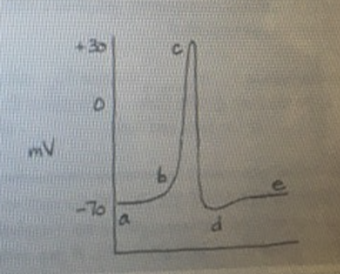
- AA
- BB
- CC
- DD
- EE
51Which part of the diagram best corresponds to the relative refractory period?
- AA
- BB
- CC
- DD
- EE
52Which of the following does NOT involve calcium?
- ARelease of neurotransmitters from a synapse
- BAn action potential in cardiac pacemaker cells
- CContraction of a skeletal muscle fiber
- DMovement of bicarbonate ion into the plasma from RBC’s
53During the contraction of a skeletal muscle:
- AThe “power stroke” is energized as the actin molecules cleave to ATP
- BThe myosin head is able to bind with an action molecule when the troponin-tropomyosin complex has moved
- CThe linkage between actin and myosin is broken when K+ binds to the myosin
- DMore than one answer is correct
54Binding of acetylcholine to the cholinergic receptor on skeletal muscle will lead to what type of movement across the cell membrane?
- ARapid influx of Na+ through a channel and slow outward flux of K+
- BRapid influx of K+ through a channel and no movement of Na+
- CRapid influx of Na+ through a channel and no movement of K+
- DSlow influx of Na+ through a channel and rapid outward flux of K+
- EFast influx of both Na+ and K+ through a channel
55The interaction between actin and myosin in smooth muscle requires:
- AThe interaction between calcium and troponin to expose the myosin binding site on the actin molecule
- BThe activation of troponin, which stimulates myosin light-chain kinase to phosphorylate myosin light chain, allowing myosin to bind with actin
- CThat the calcium-calmodulin complex activates the myosin light-chain kinase, which phosphorylates myosin light chain, thereby allowing myosin to bind with actin
- DThat the calcium-calmodulin complex directly phosphorylates the myosin head, allowing myosin to bind to actin
56This hormone is secreted from the liver in response to a tropic hormone from the anterior pituitary.
- AEpinephrine
- BGrowth hormone
- CInsulin-like growth factor
- DCortisol
- EThyroid hormone
57Which of the following would most likely NOT be affected by a tumor in the tissue of the anterior pituitary?
- AThe secretion of IGF-1
- BGrowth of bone at the epiphyseal plate
- CMilk let-down in mammary glands of a lactating human female
- DThe release of cortisol
58Systemic venous Po2 is ____ alveolar Po2, and systemic venous Pco2 is _______ alveolar Pco2
- AGreater than, greater than
- BGreater than, less than
- CEqual to, equal to
- DLess than, less than
- ELess than, greater than
59When a protein hormone is being synthesized in the rough endoplasmic reticulun, what is the initial polypeptide called?
- Aexon
- Bpeptide
- Cprohormone
- Dprehormone
- Epreprohormone
60What hormone released by the posterior pituitary functions in uterine contractions and milk letdown in the breast?
- Avasopressin
- Bprolactin
- Coxytocin
- DADH
- Ecalcitonin
61Which ofthe following is NOT a hormone released from lhe anterior pituitary?
- Aprolactin inhibiting hormone
- Badrenocorticotropic hormone
- Cluteinizing hormone
- Dgrowth hormone
- Efollicle stimulating hormone
62Which organ secretes insulin-like growth factors into the bloodstream?
- Apancreas
- Bliver
- Call organs
- Dadipose tissue
- Eskeletal muscle
63Which of the following is NOT one of the growth-supporting functions of growth hormone?
- Aincreased plasma glucose concentration
- Bincreased glucose uptake by muscles
- Cincreased fat breakdown
- Dincreased glucose production and output from the liver
- Eincreased protein synthesis
64Where are receptors for thyroid hormones located?
- Aon the plasma membrane of target cells
- Bin the cytosol of target cells
- Cin the nucleus of target cells
- Din the cytoplasm of all cells in the body
65Which ion is specifically required for the production of thyroid hormones?
- Acalcium
- Biron
- Cphosphorus
- Diodine
- Epotassium
66What is the primary hormone mediating the body's stress response?
- Agrowth hormone
- Binsulin
- Cglucagon
- Dthyroid hormone
- Ecortisol
67Acromegaly is associated with what endocrine malfunction?
- Adecrease in thyroid hormones
- Bdecrease in cortisol
- Cdecrease in epinephrine
- Dincrease in growth hormones in adults
- Eincrease in growth hormone in children
68Which of the following hormones is NOT released from the adrenal gland?
- Aadrenocorticotropic hormone
- Bcortisol
- Caldosterone
- Dsex hormones
- Eepinephrine
69What layer of the adrenal cortex secretes mineralocorticoids?
- Azona reticularis only
- Bzona fasciculata only
- Czona glomerulosa only
- Dboth zonae reticularis and fasciculata
- Eboth zonae reticularis and glomerulosa
70A person has a tumor in the anterior pituitary causing a decrease in ACTH secretion. Which of the following correctly describes subsequent changes in plasma levels of hormones?
- Aincreased CRH, increased ACTH, and increased cortisol
- Bdecreased CRH, decreased ACTH, and decreased cortisol
- Cincreased CRH, increased ACTH, and decreased cortisol
- Ddecreased CRH, decreased ACTH, and increased cortisol
- Eincreased CRH, decreased ACTH, and decreased cortisol
71Place these structures in the order that blood returning to the heart from the body would pass through them: right ventricle, left atrium, right atrium, pulmonary artery, left ventricle, pulmonary vein
- Aleft atrium, left ventricle, pulmonary artery, pulmonary vein, right atrium, right ventricle
- Bleft atrium, left ventricle, pulmonary vein, pulmonary artery, right atrium, right ventricle
- Cright atrium, right ventricle, pulmonary artery, pulmonary vein, left atrium, left ventricle
- Dright atrium, right ventricle, pulmonary vein, pulmonary artery, left atrium, left ventricle
- Eright atrium, left atrium, pulmonary artery, pulmonary vein, right ventricle, left ventricle
72Which of the following statements concerning action potentials in the heart is NOT true?
- AThe rising phase of the action potential in cardiac pacemaker cells is due to a rapid Ca2+ influx
- BThe plateau phase in cardiac contractile cell's action potential is due, in part, to a slow Ca2+ influx
- CThe spontaneous depolarization to threshold in cardiac pacemaker cells is due, in part, to a slow Ca2+ leak out of the cell
- DThe rising phase of the action potential in cardiac contractile cells is due to a rapid Na+ influx
73The part of the circulation pumping blood to and from the lungs is known as:
- Asystematic circulation
- Bcoronary circulation
- Crespiratory circulation
- Dhepatic circulation
- Epulmonary circulation
74Select the vessel carrying blood with a relatively high concentration of oxygen:
- Achordae tendinae
- Binferior vena cava
- Cpulmonary artery
- Dpulmonary vein
- Esuperior vena cava
75Cardiac muscle cells do not reach tetanus because:
- Athe supply of ATP is endless
- Bthe action potentials travel too slowly along the conducting tissues to re-stimulate the muscle
- Cthe J fibers provide a nodal delay
- Dthe action potential's long refractory period prevents the muscle from becoming re-stimulated while still contracting
- Emore than one answer applies
76Which of the following is FALSE about L-type calcium channels in cardiac muscle cells?
- Athey are open during the plateau phase of the action potential
- Bthey allow calcium entry that triggers calcium release from the sarcoplasmic reticulum
- Cthey are found in the sarcolemma of pacemaker cells
- Dthey open in response to depolarization of the membrane
- Ethey contribute to the spontaneous depolarization to threshold in autorhythmic cells
77During the normal cardiac cycle, the bicuspid valve opens when:
- Athe pressure in the right ventricle is greater than in the right atrium
- Bthe pressure in the right atrium is greater than in the right ventricle
- Cthe pressure in the left atrium is greater than in the left ventricle
- Dthe pressure in the aorta is greater than in the left ventricle
- Ethe pressure in the left ventricle is greater than in the left atrium
78The chordae tendineae:
- Akeep the AV valves from opening in the opposite direction during ventricular contraction
- Bkeep the semilunar valves from opening in the opposite direction during ventricular contraction
- Chold the right and left ventricles together
- Dare skeletal muscles which contract when the ventricles contract
- Emore than one answer is correct
79After the relaxation period, the final 20% of end-diastolic volume fills the ventricles during:
- Aatrial diastole
- Batrial systole
- Cventricular systole
- Dpassive filling
80The second heart sound ("dub") occurs when the semilunar valves close, and thus it marks:
- Athe end of the ventricular ejection period
- Bthe start of ventricular ejection
- Cthe start of ventricular systole
- Dthe start of isovolumetric ventricular contraction
81Ejection of blood from the right ventricle will continue until:
- Athe pressure in the pulmonary artery is less than the pressure in the right ventricle
- Bthe pressure in the aorta is greater than the pressure in the right ventricle
- Cthe pressure in the pulmonary artery is greater than the right pressure in right ventricle
- Dthe pressure in the aorta is less than the pressure in the right ventricle
82Which of the following is NOT affected by parasympathetic innervation of the circulatory system?
- Aheart rate
- Bcardiac output
- Cstroke volume
- Dmore than one is true
83[blank_start]A[blank_end]
[blank_start]B[blank_end]
[blank_start]C[blank_end]
[blank_start]D[blank_end]
[blank_start]E[blank_end]- AResting Membrane Potential
- BThreshold
- CAction Potential
- DRefractory Period
- EResting Membrane Potential
84Where are gap junction found?
- ABoth single-unit smooth muscle and cardiac muscle
- B???
85Which of the following does NOT describe a way by which the body regulates the release of hormones from endocrine gland?
- ANone of the above. (i.e they are all ways by which hormones release can be regulated
- B???
86The original polypeptide chain that is assembled on the ribosome in the peptide-hormone secreting cells is called
- APreprohormone
- B???
87Which of the following hormones would bind to receptors that are integral proteins in the cell membrane of target cells?
- AEpinephrine
- B???
88Which of the following would most likely NOT be affected by low circulating levels of LDL?
- AT3 and T4 synthesis by thyroid follicular cells
- B???
89Which of the following would most likely NOT be affected by a tumor in the anterior pituitary?
- Asmooth muscle contraction in mammary glands to allow for milk let-down
- B???
90Which of the following is NOT a tropic hormone?
- AProlactin
- B???
91Which ofthe following is a correct example of short loop negative feedback?
- ATSH inhibits the release of TRH
- B???
92Which ion is specifically required for the production of thyroid hormones?
- Aiodine
- B???
93In follicles, ____ is the protein from which the thyroid hormones are made and on which the thyroid hormones can be stored
- Athyroglobulin
- B???
94Which form of thyroid hormone has the greater activity at target cells
- AT3
- B???
95Which of the following is NOT one of the growth-supporting functions of growth hormone?
- Aincreased glucose uptake by muscles
- B???
96In response to GH, the lengthening of long bones is due to activity within the cartilaginous layer of bone known as the
- Aepiphyseal plate
- B???
97What is the primary hormone mediating the body's stress response?
- Acortisol
- B???
98Gigantism is associated with what endocrine malfunction?
- Aincrease in growth hormone in children
- B???
99Which of the following hormones is NOT released from the adrenal gland?
- Aadrenocorticotropic hormone
- B???
100What layer of the adrenal cortex secretes mineralocorticoids?
- Azona glomerulosa only
- B???
101Which of the following statements conceming action potentials in the heart is NOT true?
- AThe spontaneous depolarization to threshold in cardiac pacemaker cells is due in large part to K* channels opening
- B???
102Which of the following is FALSE about L-type calcium channels in cardiac muscle cells?
- AThey contribute to the spontaneous depolarization to threshold in autorhythmic cells.
- B???
103The part of the circulation pumping blood to and from the lungs is known as:
- Apulmonary circulation
- B???
104the vessel carrying blood with a relatively high concentration of oxygen
- Apulmonary vein
- B???
105During the normal cardiac cycle, the tricuspid valve opens when:
- Athe pressure in the right atrium is greater than in the right ventricle
- B???
106The chordae tendineae:
- Akeep the AV valves from opening in the opposite direction during ventricular contraction
- B???
107Which of the following is the proper sequence of cardiac excitation?
- ASA node - atrial myocardium - AV node - bundle of His - Purkinje fibers - ventricular myocardium
- B???
108Which of the following ECG waves represents ventricular repolarization?
- AT Wave
- B???
109A person with a heart rate of 30 beats/min has no P waves but normal QRS complexes and T
- ASA node is not working
- B???
110A certain drug decreases heart rate by producing hyperpolarization at the membrane of the autorhythmic cells ofthe heart. This drug probably is agonistic to:
- Amuscarinic receptors
- B???
111The final 30% of the blood that fills the ventricles occurs during:
- Aatrial systole
- B???
112The second heart sound ("dub") occurs when the semilunar valves close, and thus it marks:
- Athe end ofthe ventricular ejection period
- B???
113Ejection of blood from the left ventricle will continue until:
- Athe pressure in the aorta is greater than the pressure in the left ventricle
- B???
114Which of the following is NOT affected by parasympathetic innervation of the circulatory system?
- Astroke volume
- B???
115All peptide hormones are synthesized from the amino acid tyrosine
- ATrue
- BFalse
116What hormone released by the posterior pituitary, function in uniterine contraction and milf release in the breast?
- AOxycotin
- B???
117Which of the following is NOT a hormone released from the anterior pituitary?
- ASomatostatin
- B???
118Most hormones are regulated by negative feedback. Which of the following is contrlled by postive feedback?
- AOxycotin
- B???
119Which is the primary organ to secrete insulin-like growth factor into bloodstream?
- ALiver
- B???
120Which of the following is a correct example of short-loop negative feedback
- ATSH inhibits the release of TRH
- B???
121Where are receptors for thyroid hormones located?
- AInside the target cells
- B???
122Which of the following does NOT enhance the release of GH?
- AIncreased plasma glucose
- B???
123Which of the following hormones is NOT released from the adrenal Gland?
- AAdrenocorticotropic hormone
- B???
124An ECG reading shows P waves in a normal rhythm. However, the QRS and T waves occur regularly but at a significantly slower rate, independent of the P wave rhythm. WHat is the best explanation?
- AA problem with the internodal fibers
- B???
Informações
- Descrição
- Physiology Quiz sobre Physio Final, criado por Janell Garcia em 22-05-2018.
- Autor
- Janell Garcia
- Idioma
- English
- Visualizações
- 83
- Etiquetas
- Avaliação
- Ainda sem avaliações Avalie este quiz