
Quiz
Chapter 5
Este quiz tem tipos de pergunta que abrem no player de sempre.
Perguntas do quiz (104)
1Leviviruses infect [blank_start]gram - bacteria[blank_end].
- Agram - bacteria
2Leviviridae can infect E. coli.
- AVerdadeiro
- BFalso
3An example of a levivirus is [blank_start]MS2[blank_end]. An example of an allolevivirus is [blank_start]Q beta[blank_end].
- AMS2
- BQ beta
4MS2 is studied in terms of [blank_start]translational[blank_end] regulation, whereas Q beta is studied in terms of [blank_start]genome[blank_end] regulation.
- Atranslational
- Bgenome
5Levivirus have a genome of [blank_start]3500[blank_end] nt whereas allolevivirus has a geome of [blank_start]4200[blank_end] nt.
- A3500
- B4200
6There is a total of 4 proteins found in leviviruses.
1.) [blank_start]coat[blank_end] proteins
2.) [blank_start]maturation[blank_end] protein
3.) [blank_start]lysis[blank_end] protein
4.) [blank_start]replicase[blank_end]- Acoat
- Bmaturation
- Clysis
- Dreplicase
7coat protein = capsid protein?
- AVerdadeiro
- BFalso
8There is one copy of maturation protein per [blank_start]capsid[blank_end]
- Acapsid
9Maturation proteins act as the attachment proteins
- AVerdadeiro
- BFalso
10The maturation protein can bind to hosts via attachment to [blank_start]F-pili[blank_end]
- AF-pili
11After the maturation protein binds to the bacterial pili, it gets cleaved into [blank_start]2[blank_end] pieces
- A2
12Once the maturation protein gets cleaved into two pieces after binding to the bacterial pili,
- ARNA gets released from the virion
- Bthe cell lyses
- Cthe virion gets inside the cell
13Once the maturation protein binds to the pili, it gets pulled into the bacterial cell and the genome gets pulled into the cell as well
- AVerdadeiro
- BFalso
14The lysis proteins provide lysis of the [blank_start]cell wall[blank_end] in the bacteria
- Acell wall
15Leviviruses carry their own RdRp to convert their +ssRNA into -ssRNA.
- AVerdadeiro
- BFalso
16Maturation proteins only attach to the genome.
- AVerdadeiro
- BFalso
17Maturation proteins are located at the axis of the virus.
- AVerdadeiro
- BFalso
18Where are maturation proteins located?
[blank_start]in between 2 6 fold axises[blank_end]- Ain between 2 6 fold axises
19No lysis protein gene found in Q beta whereas it is found in MS2
- AVerdadeiro
- BFalso
20The maturation protein also functions as a lysis protein in MS2.
- AVerdadeiro
- BFalso
21The Q beta has a separate lysis protein.
- AVerdadeiro
- BFalso
22There is a readthrough of the coat protein found in Q beta but not in MS2.
- AVerdadeiro
- BFalso
23There is a readthrough of the [blank_start]coat[blank_end] protein in Q beta. Sometimes what happens is that the stop codon in readthrough, the tRNA charged with an amino acid binds, usually [blank_start]UGG[blank_end] and reads it as a [blank_start]sense[blank_end] codon instead.
- Acoat
- BUGG
- Csense
24When readthrough of the coat protein occurs, we get a coat protein with an extended [blank_start]C[blank_end] terminal domain.
- AC
25Some readthrough coat proteins get assembled into the virus
- AVerdadeiro
- BFalso
2696% of the time, readthrough of the coat protein occurs.
- AVerdadeiro
- BFalso
27What are the 3 RBS?
1.) [blank_start]AUG[blank_end]
2.) [blank_start]SD[blank_end]
3.) [blank_start]UP[blank_end]- AAUG
- BSD
- CUP
28What binds to the AUG RBS?
[blank_start]fMet-tRNA anticodon[blank_end]- AfMet-tRNA anticodon
29What binds the SD?
3' end of [blank_start]16S rRNA[blank_end]- A16S rRNA
30What binds the UP?
[blank_start]S1 r-protein[blank_end]- AS1 r-protein
31Which binds the AUG start site?
- AfMet-tRNA anticodon in ribo
- B3' end of 16S rRNA
- CS1 r-protein
32What is the function of S1r-protein?
- Abinds AUG
- Bbinds SD
- Cbinds UP
33What is bound by 16S rRNA?
- Astart codon
- BSD
- CUP
34All start codons are AUG
- AVerdadeiro
- BFalso
35AUG and [blank_start]GUG[blank_end] can act as start codons.
- AGUG
36The shortest SD is AGG, the biggest and best one is AGGAGG.
- AVerdadeiro
- BFalso
37in order for proteins to bind to start codon, SD, and UP, the RNA has to be single stranded.
- AVerdadeiro
- BFalso
38The SD is not bound by a protein, it is complementary to a 3' end sequence of the 16S rRNA
- AVerdadeiro
- BFalso
39S1 r- protein is called that because it is the [blank_start]first[blank_end] subunit on the [blank_start]ribosome[blank_end]
- Afirst
- Bribosome
40The interaction between the SD and 3' end of the 16S rRNA is RNA RNA base pairing.
- AVerdadeiro
- BFalso
41When the ribosome is translating, it is going to cover roughly 20 nucleotides before the active site and 15 nucleotides after the active site
- AVerdadeiro
- BFalso
42We want little capsid protein during an infection.
- AVerdadeiro
- BFalso
43Why is control of protein expression important?
1.) [blank_start]different[blank_end] amounts of the 4 viral proteins are required
2.) translation must be coordinated with [blank_start]genome[blank_end] replication- Adifferent
- Bgenome
44Translation (ribosome) and genome replication (RNA replicase) go in opposite directions.
- AVerdadeiro
- BFalso
45RNA replicase / RdrP replicates in the 5' to 3' direction.
- AVerdadeiro
- BFalso
46We need control of the viral genome because otherwise, the ribosome and RNA polymerase will collide, and the ribosome would bump off the replicase
- AVerdadeiro
- BFalso
47Translation and RNA replication are compatible.
- AVerdadeiro
- BFalso
48Which RBS of the 4 proteins are ss?
- AMaturation protein
- BCoat protein
- CLysis Protein
- DReplicase Protein
49Translation of [blank_start]lysis[blank_end] and [blank_start]replicase[blank_end] proteins are coupled to coat protein [blank_start]translation[blank_end].
- Alysis
- Breplicase
- Ctranslation
50Coat proteins become active as soon as they are translated.
- AVerdadeiro
- BFalso
51Coat proteins have to dimerize first in order to become active.
- AVerdadeiro
- BFalso
52Coat proteins are active during early infection
- AVerdadeiro
- BFalso
53When the MJ region gets disrupted by the ribosome during coat protein translation, the operator hairpin structure gets destabilized, freeing up the shine dalgarno sequence and replicase start site
- AVerdadeiro
- BFalso
54Experimental Evidence for translation of replicase:
they put stop codons before MJ, resulting in replicase absence/presence? [blank_start]absence[blank_end]
they put stop codons after MJ, resulting in replicase absence/presence? [blank_start]presence[blank_end]- Aabsence
- Bpresence
55The shine dalgardo sequence is found within MJ.
- AVerdadeiro
- BFalso
56The operator hairpin contains SD, replicase start site and MJ.
- AVerdadeiro
- BFalso
57The expression of replicase to capsid protein is not 1:1 because MJ can base pair back together
- AVerdadeiro
- BFalso
58The binding of [blank_start]capsid dimers[blank_end] to the operator sequence turns the translation of replicase off.
- Acapsid dimers
59High concentrations of CP causes inhibition of replicase translation
- AVerdadeiro
- BFalso
60Capsid dimers bind to the [blank_start]operator[blank_end] hairpin to inhibit replicase translation
- Aoperator
61Replicase is made at the late stage of viral infection
- AVerdadeiro
- BFalso
62When coat proteins bind to the operator hairpin, that signals for assembly.
- AVerdadeiro
- BFalso
63The closer the coat gene stop codon is to the lysis start codon, the more lysis protein is made.
- AVerdadeiro
- BFalso
64Maturation proteins are encoded at the 5' UTR region
- AVerdadeiro
- BFalso
65RNA will initially fold into the most stable structure
- AVerdadeiro
- BFalso
66A [blank_start]kinetic trap[blank_end] refers to the fact that RNA will initially start off as not the most stable structure.
- Akinetic trap
67The cloverleaf is the most stable structure, the hairpin is the metastable structure
- AVerdadeiro
- BFalso
68The RBS of the maturation protein is part of the 5' UTR
- AVerdadeiro
- BFalso
69The [blank_start]GUG[blank_end] start codon for maturation protein
- AGUG
70The SD for maturation protein is very weak
- AVerdadeiro
- BFalso
71The maturation protein is off at its cloverleaf structure and has an inhibitory effect due to SD base pairing with UP
- AVerdadeiro
- BFalso
72Nascent RNA can be thought of as [blank_start]progeny[blank_end] RNA
- Aprogeny
73The hairpin structure in the nascent RNA causes the SD sequence to strongly bp with the UP
- AVerdadeiro
- BFalso
74maturation proteins are made in the beginning of transcription but eventually get transcriptionally silenced
- AVerdadeiro
- BFalso
75only capsid translation can occur independently from input genomes
- AVerdadeiro
- BFalso
76regulation of translation in MS2 involves:
1.) alternate [blank_start]RNA[blank_end] structures
2.) [blank_start]protein-RNA[blank_end] interactions
3.) [blank_start]ribosome[blank_end] reinitiation- ARNA
- Bprotein-RNA
- Cribosome
77maturation proteins are made when input genomes are replicated
- AVerdadeiro
- BFalso
78once RdRp of the Q beta virus makes a minus strand from the plus strand, its genome has been replicated
- AVerdadeiro
- BFalso
79the production of - and + strands are [blank_start]asymmetrical[blank_end].
- Aasymmetrical
80the ratio of - to + in a levivirus is [blank_start]1:100[blank_end]
- A1:100
81the polymerase that makes the - strand is slightly different than the + strand polymerase
- AVerdadeiro
- BFalso
82which protein is provided by the q beta for replicase activity?
- Areplicase
- BEF-Tu
- CEF-Ts
- DS1
- EHost Factor
83Select all the proteins that the minus and plus strand replicase have in common
- Areplicase
- BS1
- CEF-Tu
- DHost Factor
- EEF-Ts
84what does the minus RNA replicase have that the plus strand doesnt?
- AEF-Tu
- BHost Factor
- CS1
- DEF-Ts
- EReplicase
85host factor can be thought of as [blank_start]helicase[blank_end]
- Ahelicase
86All 5 proteins of the RdRp in q beta genome are required to bind to the 3' end of the genome for - strand synthesis
- AVerdadeiro
- BFalso
87S1 binds to the [blank_start]UP[blank_end] of the capsid protein during Q beta replication
- AUP
88S1 is associated w/ the ribosome during q beta replication
- AVerdadeiro
- BFalso
89S1 binding to capsid UP turns [blank_start]off[blank_end] capsid protein translation
- Aoff
90When we are making the - strand of the Q beta virus, we require to turn off translation by the binding of [blank_start]S1 to UP[blank_end].
- AS1 to UP
91S1 is needed to shut down translation to coordinate translation and replication
- AVerdadeiro
- BFalso
92the host factor is needed because the place where RdRp binds is [blank_start]ds[blank_end] at the [blank_start]3[blank_end] prime end, where initiation occurs.
- Ads
- B3
93[blank_start]EF-Tu[blank_end] binds with GTP which is the first nucleotide used in the synthesis of the - strand
- AEF-Tu
94[blank_start]ultimate[blank_end] residue: first one at the end
[blank_start]pen alternate[blank_end]: the one next to it
instead of initiating opposite to the ultimate residue, it initiates opposite to the pen ultimate.- Aultimate
- Bpen alternate
95[blank_start]terminal transcripases[blank_end] can add nucleotides without a template during the Q beta genome replication of the - strand
- Aterminal transferases
96A is added by terminal transferase similar to a poly A tail to the - strand of q beta replication
- AVerdadeiro
- BFalso
97to go from the - strand to the + strand during Q beta replication, we require the host factor
- AVerdadeiro
- BFalso
98we need S1 to convert - strand back into the + strand
- AVerdadeiro
- BFalso
99the RdrP is more efficient at intiating at ultimate residue as opposed to the penultimate
- AVerdadeiro
- BFalso
100What do lysis proteins do?
1.) [blank_start]inhibit membrane potential[blank_end]
2.) [blank_start]PEP degration[blank_end]- Ainhibit membrane potential
- BPEP degration
101WHICH virus is this
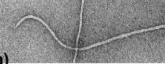
- Aphage fd
102virus?
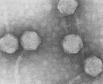
- Aphage lambda
103what is this virus?
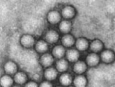
- Ahepititis A
104this is?
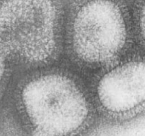
- Ainfluenza
Informações
- Descrição
- Quiz sobre Chapter 5, criado por Nina Butris em 07-02-2019.
- Autor
- Nina Butris
- Idioma
- English
- Visualizações
- 1
- Avaliação
- Ainda sem avaliações Avalie este quiz