
30988235
Descrição

Quiz por Hannah Eurell, atualizado more than 1 year ago

|
Criado por Hannah Eurell
mais de 5 anos atrás
|
|
Questão 1
Questão
When talking about the anatomical structure of bone, what is another name for compact bone.
Responda
-
Cancellous
-
Subchondral
-
Cortical
-
trabecular
Questão 2
Questão
The Cancellous part of bone is spongy or trabecular and is located in the middle of irregular bone.
Responda
- True
- False
Questão 3
Questão
Which are considered long bones?
Responda
-
Sternum
-
Humerus
-
Tibia
-
Ulna
Questão 4
Questão
Which part of the bone is not present in adults?
Responda
-
Diaphysis
-
Subchondral
-
Epiphysis
-
Metaphysis
Questão 5
Questão
What location on a long bone is the diaphysis ?
Responda
-
Distal end
-
Shaft
-
Proximal end
-
Is not present on long bones
Questão 6
Questão
A ligament is considered a fibrous connective tissue
Responda
- True
- False
Questão 7
Questão
A major fibrous insoluble protein in your body is called what?
Responda
-
Albumin
-
Collagen
-
Keratin
-
Myosin
Questão 8
Questão
Which types of collagen are mostly needed for musculoskeletal tissues?
Responda
-
Type 6
-
Type 1
-
Type 2
-
Type 9
-
Type 3
Questão 9
Questão
The various collagens and the structures they form all serve the same purpose, to help tissues withstand stretching.
Responda
- True
- False
Questão 10
Questão
A [blank_start]elastin[blank_end] protein functions in connective tissue with collagen. It is an important part in the function of [blank_start]ligaments[blank_end] and [blank_start]tendons[blank_end].
Responda
-
elastin
-
ligaments
-
tendons
Questão 11
Questão
Ligaments do not restrict joint motion or stabilizes the joint.
Responda
- True
- False
Questão 12
Questão
Which ligament connects the femur with the fibula?
Responda
-
Anterior cruciate ligament
-
Lateral collateral ligament
-
Posterior cruciate ligament
-
Medial collateral ligament
Questão 13
Questão
Which ligament is the lower attachment to the tibia?
Responda
-
Anterior cruciate ligament
-
Posterior cruciate ligament
-
Medial collateral ligament
-
Lateral collateral ligament
Questão 14
Questão
Ligaments have high cellularity but low vascularity.
Responda
- True
- False
Questão 15
Questão
Which collagen type makes up ligaments?
Responda
-
Type 2
-
Type 6
-
Type 3
-
Type 1
Questão 16
Questão
Tendons and Ligaments are weakest between days 5 - 21 of the healing process.
Responda
- True
- False
Questão 17
Questão
What would you classify as Grade 3 ?
Responda
-
Mild ligament sprain
-
Complete ligament tear
-
Moderate ligament sprain
-
Partial ligament tear
Questão 18
Questão
Which ligament stabilizes the meniscus?
Responda
-
Medial Collateral Ligament
-
Lateral Collateral Ligament
-
Posterior Cruciate Ligament
-
Anterior Cruciate Ligament
Questão 19
Questão
MCl and LCL provide stability to the knee in the [blank_start]coronal[blank_end] plane
Responda
-
coronal
Questão 20
Questão
Which is the largest and strongest ligament of the knee.
Responda
-
ACL
-
PCL
-
MCL
-
LCL
Questão 21
Questão
The lateral collateral ligament resists external rotation and restrains varus stress
Responda
- True
- False
Questão 22
Questão
Joint motion is produced by forces being transferred from muscle to bone via tendons.
Responda
- True
- False
Questão 23
Questão
Which types of collagen is found in tendons?
Responda
-
Type 1
-
Type 2
-
Type 3
-
Type 6
Questão 24
Questão
Tendons contain [blank_start]more[blank_end] collagen and [blank_start]less[blank_end] elastin than ligaments. Tendons are stronger but [blank_start]less[blank_end] elastic than ligaments.
Responda
-
more
-
less
-
less
Questão 25
Questão
Which is not a key function of articular cartilage
Responda
-
Increases mobility
-
decreases friction/ loads
-
interface of the bones that form joints
-
provides smooth articulation
Questão 26
Questão
Which collagen type makes up articular cartilage by 90%
Responda
-
Type 4
-
Type 3
-
Type 1
-
Type 2
Questão 27
Questão
What produces and maintains the cartilage matrix and is a mature cell.
Responda
-
chondroblasts
-
chondrocytes
-
fibroblasts
-
myocytes
Questão 28
Questão
Articular cartilage has a higher level of proteoglycans.
Responda
- True
- False
Questão 29
Questão
Articular cartilage has nervous and vascular tissue.
Responda
- True
- False
Questão 30
Questão
[blank_start]Snynovial[blank_end] fluid provides nutrition for articular cartilage.
Responda
-
Synovial
Questão 31
Questão
Does hyaline cartilage heal?
Responda
-
yes
-
no
Questão 32
Questão
Hyaline cartilage is only found on the articular surfaces of bones.
Responda
- True
- False
Questão 33
Questão
What are the functions of the menisci?
Responda
-
Reduce friction
-
Reduce tension
-
Provide stability
-
Disperse body weight
Questão 34
Questão
Which protein forms muscle
Responda
-
Keratin
-
Myosin
-
Collagen
-
Elastin
Questão 35
Questão
All nerves contain both myelinated and unmyelinated sensory/ motor fibers
Responda
- True
- False
Questão 36
Questão
What is the largest joint in the body?
Responda
-
Shoulder
-
Hip
-
Knee
-
Ankle
Questão 37
Questão
Which bone of the hip makes up for the larger portion of it?
Responda
-
Ischium
-
Pubis
-
Illium
-
Acetabulum
Questão 38
Questão
The femoral neck is angled at a certain degree. What degree is normal?
Responda
-
115
-
126
-
140
-
124
Questão 39
Questão
The [blank_start]labrum[blank_end] is a fibrous cartilage ring which lines the acetabular socket.
Responda
-
labrum
Questão 40
Questão
Which ligament connects the pelvis to the femoral head at the front of the joint?
Responda
-
iliofemoral
-
pubofemoral
-
ischiofemoral
-
ligamentum teres
Questão 41
Questão
The Iliofemoral Ligament limits over-flexion of the hip.
Responda
- True
- False
Questão 42
Questão
Which hip ligament is triangular shaped
Responda
-
iliofemoral
-
ischiofemoral
-
pubofemoral
-
ligamentum teres
Questão 43
Questão
[blank_start]Ligamentum[blank_end] [blank_start]Teres[blank_end] is the ligament that has a small artery within it that supplies blood to a part of the femoral head.
Responda
-
Ligamentum
-
Teres
Questão 44
Questão
The femoral nerve is in the posterior portion of the hip
Responda
- True
- False
Questão 45
Questão
The [blank_start]sciatic[blank_end] nerve is in the posterior portion and can radiate pain to the feet.
Responda
-
sciatic
Questão 46
Questão
Which arteries are in the gluteal & posterior thigh?
Responda
-
Superior gluteal artery
-
Inferior gluteal artery
-
Internal pudendal artery
-
All of the above
Questão 47
Questão
Which are the three basic muscle groups of the hip?
Responda
-
Medial
-
Lateral
-
Posterior
-
Anterior
-
Inferior
Questão 48
Questão
Which hip muscles connect to the patellofemoral Joint.
Responda
-
Sartorius
-
Glueteals
-
Tensor Fascia Latae
-
Quadriceps
Questão 49
Questão
The quadriceps are the longest muscle in the human body
Responda
- True
- False
Questão 50
Questão
Hamstrings are responsible for flexion of the knee and they are a posterior muscle group.
Responda
- True
- False
Questão 51
Questão
Where do the hamstrings originate?
Responda
-
ilium
-
ischium
-
pubis
-
femoral head
Questão 52
Questão
IT Band stands for [blank_start]iliotibial[blank_end] tract. It is an essential in stabilizing your [blank_start]knee[blank_end] while walking and running.
Responda
-
iliotibial
-
knee
Questão 53
Questão
A Fibrous, inelastic, sheath surrounding the thigh muscles is called a fascia lata. It does not limit the bulging of thigh muscles
Responda
- True
- False
Questão 54
Questão
Fluid filled sacs lined with synovial membrane which produce synovial fluid are called [blank_start]bursae[blank_end]
Responda
-
bursae
Questão 55
Questão
The lower leg deformity that exists when the bone at the knee joint is angled out and away from the body's midline.
Responda
-
Varus Knee
-
Valgus Knee
-
Patellofemoral Instability
-
Fixed Flexion deformity
Questão 56
Questão
Varus Knee is when your tibia turns inward instead of aligning with your femur which will cause your knees to turn outward.
Responda
- True
- False
Questão 57
Questão
What do you call the network of nerves in the shoulder that carries movement and sensory signals from the spinal cord to the arms and hands, neck trauma can cause injury to it.
Responda
-
Axillary nerve
-
Median nerve
-
Brachial plexus
-
Suprascapular nerve
Questão 58
Questão
Which term describes the hand down, with the back of the hand forward and radius crosses over the top of the ulna?
Responda
-
Supination
-
Pronation
Questão 59
Questão
What is the main artery of your shoulder?
Responda
-
Brachial artery
-
Suprascapular artery
-
Axillary artery
-
Thoracoacromial artery
Questão 60
Questão
Fracture repair is a healing process rather than a tissue regeneration process.
Responda
- True
- False
Questão 61
Questão
Hard cartilaginous starts to be replaced by woven bone (fibrous
bone) around which day?
Responda
-
day 20
-
day 7
-
day 35
-
day 14
Questão 62
Questão
AT 8 weeks (if proper stabilized and adequate blood supply), most long bone fractures achieve union
Responda
- True
- False
Questão 63
Questão
How many steps are there to bone repair?
Responda
-
4
-
3
-
5
-
7
Questão 64
Questão
In which step of bone repair does chemoattraction growth factors recruit undifferentiated
stem cells, and white blood cells clean damaged tissue?
Responda
-
Step 1
-
Step 4
-
Step 2
-
Step 3
Questão 65
Questão
All bones are constantly remodeled—for a long bone, like the femur, complete remodeling takes about 10 years
Responda
- True
- False
Questão 66
Questão
“Bone grows in response to mechanical stress to better accommodate that stress.” This is called [blank_start]Wolff's[blank_end] law.
Responda
-
Wolff's
Questão 67
Questão
A significant amount of scar tissue also forms where the muscle was injured.
Responda
- True
- False
Questão 68
Questão
What tissue is usually affected in a rotator cuff injury?
Responda
-
Ligament
-
Nerve
-
Tendon
-
Cartilage
Questão 69
Questão
Tendons can heal on their own.
Responda
- True
- False
Questão 70
Questão
When bones of the leg twist in opposite directions under your full body weight which tissue will be injured
Responda
-
LCL
-
MCL
-
ACL
-
PCL
Questão 71
Questão
What tissue provides the majority of support for the shoulder complex?
Responda
-
Bone
-
Ligament
-
Muscle
-
Cartilage
Questão 72
Questão
Which sets of motion can the shoulder preform?
Responda
-
Extension/ flexion
-
adduction/ abduction
-
internal rotation/ external rotation
Questão 73
Questão
Which long bone has the most motion compared to the others?
Responda
-
Ulna
-
Humerus
-
Femur
-
Tibia
Questão 74
Questão
Distal humerus is the anchor for important muscle, tendons and ligaments?
Responda
- True
- False
Questão 75
Questão
Thin pear shaped bone of the shoulder?
Responda
-
Acromion
-
Labrum
-
Coracoid Process
-
Glenoid
Questão 76
Questão
The humeral head articulates no more than [blank_start]30[blank_end]% of articular surface in any position with the glenoid.
Responda
-
30
Questão 77
Questão
Which muscles make up the anterior view of the rotator cuff?
Responda
-
Supraspinatus
-
Infraspinatus
-
Teres minor
-
Subscapularis
Questão 78
Questão
Which nerve is believed to be a source of Rotator cuff impingement pain?
Responda
-
Axillary Nerve
-
Suprascapular Nerve
-
Musculocutaneous Nerve
-
Lateral Pectoral Nerve
Questão 79
Questão
Which muscles make up the posterior view of the rotator cuff?
Responda
-
Infraspinatus
-
Supraspinatus
-
Teres Minor
-
Subscapularis
Questão 80
Questão
What are the four shoulder joints called?
Responda
-
Glenohumeral
-
Acromioclavicular
-
Sternoclavicular
-
Scapulothoracic
-
Acromiothoracic
Questão 81
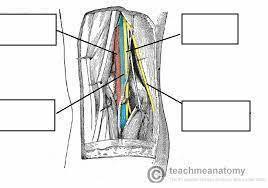
Responda
-
Peroneal nerve
-
Popliteal nerve
-
Tibial nerve
-
Peroneal nerve
-
Peroneal /common fibular nerve
-
Common fibular nerve
-
Tibial nerve
-
Axillary Vein
-
Cephalic Vein
-
Popliteal Vein
-
Femoral Vein
-
Popliteal Artery
-
Peroneal Artery
-
Axillary Artery
-
Colateral Artery
Questão 82
Questão
If I am naming these nerves and blood vessels, which part of the body am I referring to? [ Axillary vein/ artery, Brachial Plexus, Cephalic vein, Brachial vein/artery ]
Responda
-
Knee
-
Hip
-
Shoulder
Questão 83
Questão
What is it called when a bone is fractured into 2 or more parts and it has shifted so the ends are not lined up straight?
Responda
-
Comminuted
-
Segmental
-
Non Displaced
-
Displaced
Questão 84
Questão
When a bone is fractured in two places where there is a floating segment you would call this a segmental or multi fragmented fracture.
Responda
- True
- False
Questão 85
Questão
For a fracture to be considered Comminuted how many breaks or pieces does there need to be?
Responda
-
5 or more
-
2 or more
-
3 or more
-
4 or more
Quer criar seus próprios Quizzes gratuitos com a GoConqr? Saiba mais.