
Quiz
DSP
Crie uma conta grátis para terminar este quiz
Salve seu progresso e veja sua nota final.
Já tem uma conta? Inicie sessão
Perguntas do quiz (35)
1The equation below is refered to as ______
y[n] = x[n] + y[n-1]
- ARunning Sum
- BAssociativity
- CDiscrete Derivative
- DFirst Difference
2The property allows the output of a linear system to be expressed as a combination of input signals known as:
- ACausality
- BTime Invariance
- CLinearity
- DSuperposition
3In the equation shown below, what happens if k> 1?
x[n] * kδ[n] = kx[n]- AAttenuation
- BAmplification
- CDelay
- DAdvance
4The convolution of two discrete signals x[n[ and h[n] is defined as:
- Ay[n] = x[n] + h[n]
- By[n] = x[]n / h[n]
- Cy[n] = x[n] - h[n]
- Dy[n] = x[n] * h[n]
5In terms of signal processing, what does the term "kernel" refer to?
- AThe output respnoes
- BA filter used in convolution
- CThe main signal being processed
- DThe convolution operator
6What is the effect of convolving a signal with an impulse response?
- AIt reduces noise in the signal
- BIt changes the frequency of the signal
- CIt amplifies the signal
- DIt produces the output of the system
7Consider the image below, what type of connection does System A and System B has?
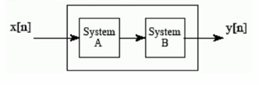
- ACommutative
- BSeries
- CCascade
- DParallel
8What happens to the convolved output if one of the signals is a zero signal?
- AThe output is undefined
- BThe output becomes infinite
- CThe output is also a zero signal
- DThe output retains the original signal
9____ breaks an N samples signal into N component signals, each containing N samples. Each of the component signals contains one point from the original signal, with the remainder of the values being zero
- AFourier Decomposition
- BImpulse Decomposition
- CEven/Odd Decomposition
- DStep Decomposition
10The figure shown below refers to ___
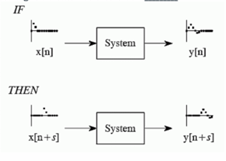
- AAdditivity
- BLinearity
- CHomogeneity
- DShift Invriance
11What is a characteristic of a causal system?
- AIt outputs depends on future inputs
- BIts outputs depend only on current and past inputs
- CIt requires feedback
- DIt has a non-linear response
12In which scenario is convolution particularly useful?
- AWhen performing spectral analysis
- BWhen compressing signals
- CWhen implementing linear filtering operations
- DWhen analyzing non-linear systems
13In the eqation below, if variable "s" is a negative integer, it means that the signal is ___.
x[n] * δ[n+s] = x[n +s]- AShifted to the left
- BUnchanged
- CDelayed
- DAdvanced
14In image processing, the impulse response is usually called ____.
- AConvolutional Kernel
- BFilter Kernel
- CPoint Spread Function
- DUnit Impulse
15When two causal signals are convolved, the resulting signal is also:
- ACasual
- BTime-shifted
- CCompressed
- DNon-causal
16The time reversal of signal x(n) is expressed as:
- Ax(-kn)
- Bx(1-n)
- Cx(-n)
- Dx(n-1)
17What is teh primary use of convolution in image processing?
- ATo compress image data
- BTo convert images to grayscale
- CTo enhance edges and features in images
- DTo change the color of an image
18_____ breaks an N sample signal into N component signals, each composed of N samples. Each component signal is a step, that is, the first samples have a value of zero, wile the last samples are some constant value
- AImpulse Decomposition
- BStep Decomposition
- CEven/Odd Decomposition
- DFourier Decomposition
19What is the result of convolving a signal with an impulse function?
- AThe signal itself
- BThe convolution is undefined
- CThe system becomes unstable
- DZero
20Any N point signal can be decomposed into N+2 signals, half of them sine waves and half of them cosine waves. This is called ____
- AImpulse Decomposition
- BEven/Odd Decomposition
- CFourier Decomposition
- DStep Decomposition
21What is the impulse response of a system?
- AThe output when the input is a unit step function
- BThe response to a sinusoidal input
- CThe frequency response of the system
- DThe output when the input is a delta function
22The figure below exhibits what property?
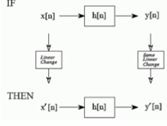
- ATransference
- BAssociative
- CDifference
- DCommutative
23The signal given by the equation x(n) = 1, for n >= 0; x(n) = 0, for n < 0 is a
- AUnit Step
- BImpulse Response
- CDelta function
- DUnit Impulse
24____ is the measure of the degree of similarity between 2 different signalss
- AConvolution kernel
- BComparative convolution
- CAuto-correlation
- DCross-correlation
25Which property of convolution allows it to be performed in any order?
- ADistributivity
- BLinearity
- CCommutativity
- DAmplifier/Attenuation
26Th equation below resembles ____ operation
y[n] = x[n] - x[n-1]- ATime Shifting
- BDifferentiation
- CIntegration
- DTime reversal
27_____ means that a change in the input signal's amplitude results in a corresponding change in the output signal's amplitude
- AAdditivity
- BLinearity
- CShift invariance
- DHomogeneity
28In convolution, what happens to the length of the output signal when convolving two finite-length signals of lengths M and N
- AThe output length is M + N - 1
- BThe output length is M x N
- CThe output length is M + N
- DThe output length is M x N - 1
29____ breaks the signal into two component signals, one having even symmetry and the other having odd symmetry
- AStep Decomposition
- BImpulse Decomposition
- CInterlaced DEcomposition
- DEven-Odd Decomposition
30Which of the following describes the concept of "convolution"?
- AThe multiplication of two frequency spectra
- BThe addition of two signals
- CThe process of combining two signals to form a third
- DThe filtering of noise from a signal
31If a signal is correlated with itself, the resulting signal is called
- ASelf-correlation
- BCross-correlation
- CAuto0correlation
- DKernel-correlation
32Which of the following is true about linear time-invariant (LTI) systems?
- ATheir output can be predicted from their input using convolution
- BThey always have a memory element
- CThey cannot be represented in the frequency domain
- DThy can be unstable
33In image processing, the kernel is referred to as _______
- ASinusoidal function
- BExponential function
- CPoint Spread Function
- DDelta function
34The system shown below is a _____
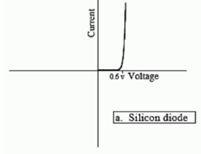
- AShift invariance
- BNon-linear
- CShift Invariance
- DLinear
35Which of the following best describes the convolution operation?
- AIt transforms a signal into the frequency domain
- BIt combines frequency components
- CIt mixes time-domain signals
- DIt evaluates the overlap of two signals as one is shifted over the other
Informações
- Descrição
- Quiz sobre DSP, criado por JON AVIV CLOYDD GAMUNDOY em 09-12-2024.
- Idioma
- English
- Visualizações
- 61
- Histórico
- Criado em 9 dez 2024 · atualizado em 9 dez 2024
- Etiquetas
- Avaliação
- Ainda sem avaliações Avalie este quiz