
Quiz
DSP
Create a free account to finish this quiz
Save your progress and see your final score.
Already have an account? Sign in
Questions in this quiz (35)
1The equation below is refered to as ______
y[n] = x[n] + y[n-1]
- ARunning Sum
- BAssociativity
- CDiscrete Derivative
- DFirst Difference
2The property allows the output of a linear system to be expressed as a combination of input signals known as:
- ACausality
- BTime Invariance
- CLinearity
- DSuperposition
3In the equation shown below, what happens if k> 1?
x[n] * kδ[n] = kx[n]- AAttenuation
- BAmplification
- CDelay
- DAdvance
4The convolution of two discrete signals x[n[ and h[n] is defined as:
- Ay[n] = x[n] + h[n]
- By[n] = x[]n / h[n]
- Cy[n] = x[n] - h[n]
- Dy[n] = x[n] * h[n]
5In terms of signal processing, what does the term "kernel" refer to?
- AThe output respnoes
- BA filter used in convolution
- CThe main signal being processed
- DThe convolution operator
6What is the effect of convolving a signal with an impulse response?
- AIt reduces noise in the signal
- BIt changes the frequency of the signal
- CIt amplifies the signal
- DIt produces the output of the system
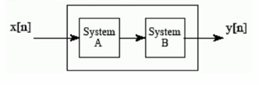
7Consider the image below, what type of connection does System A and System B has?
- ACommutative
- BSeries
- CCascade
- DParallel
8What happens to the convolved output if one of the signals is a zero signal?
- AThe output is undefined
- BThe output becomes infinite
- CThe output is also a zero signal
- DThe output retains the original signal
9____ breaks an N samples signal into N component signals, each containing N samples. Each of the component signals contains one point from the original signal, with the remainder of the values being zero
- AFourier Decomposition
- BImpulse Decomposition
- CEven/Odd Decomposition
- DStep Decomposition
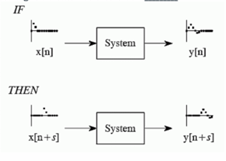
10The figure shown below refers to ___
- AAdditivity
- BLinearity
- CHomogeneity
- DShift Invriance
11What is a characteristic of a causal system?
- AIt outputs depends on future inputs
- BIts outputs depend only on current and past inputs
- CIt requires feedback
- DIt has a non-linear response
12In which scenario is convolution particularly useful?
- AWhen performing spectral analysis
- BWhen compressing signals
- CWhen implementing linear filtering operations
- DWhen analyzing non-linear systems
13In the eqation below, if variable "s" is a negative integer, it means that the signal is ___.
x[n] * δ[n+s] = x[n +s]- AShifted to the left
- BUnchanged
- CDelayed
- DAdvanced
14In image processing, the impulse response is usually called ____.
- AConvolutional Kernel
- BFilter Kernel
- CPoint Spread Function
- DUnit Impulse
15When two causal signals are convolved, the resulting signal is also:
- ACasual
- BTime-shifted
- CCompressed
- DNon-causal
16The time reversal of signal x(n) is expressed as:
- Ax(-kn)
- Bx(1-n)
- Cx(-n)
- Dx(n-1)
17What is teh primary use of convolution in image processing?
- ATo compress image data
- BTo convert images to grayscale
- CTo enhance edges and features in images
- DTo change the color of an image
18_____ breaks an N sample signal into N component signals, each composed of N samples. Each component signal is a step, that is, the first samples have a value of zero, wile the last samples are some constant value
- AImpulse Decomposition
- BStep Decomposition
- CEven/Odd Decomposition
- DFourier Decomposition
19What is the result of convolving a signal with an impulse function?
- AThe signal itself
- BThe convolution is undefined
- CThe system becomes unstable
- DZero
20Any N point signal can be decomposed into N+2 signals, half of them sine waves and half of them cosine waves. This is called ____
- AImpulse Decomposition
- BEven/Odd Decomposition
- CFourier Decomposition
- DStep Decomposition
21What is the impulse response of a system?
- AThe output when the input is a unit step function
- BThe response to a sinusoidal input
- CThe frequency response of the system
- DThe output when the input is a delta function
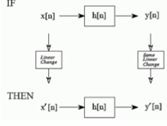
22The figure below exhibits what property?
- ATransference
- BAssociative
- CDifference
- DCommutative
23The signal given by the equation x(n) = 1, for n >= 0; x(n) = 0, for n < 0 is a
- AUnit Step
- BImpulse Response
- CDelta function
- DUnit Impulse
24____ is the measure of the degree of similarity between 2 different signalss
- AConvolution kernel
- BComparative convolution
- CAuto-correlation
- DCross-correlation
25Which property of convolution allows it to be performed in any order?
- ADistributivity
- BLinearity
- CCommutativity
- DAmplifier/Attenuation
26Th equation below resembles ____ operation
y[n] = x[n] - x[n-1]- ATime Shifting
- BDifferentiation
- CIntegration
- DTime reversal
27_____ means that a change in the input signal's amplitude results in a corresponding change in the output signal's amplitude
- AAdditivity
- BLinearity
- CShift invariance
- DHomogeneity
28In convolution, what happens to the length of the output signal when convolving two finite-length signals of lengths M and N
- AThe output length is M + N - 1
- BThe output length is M x N
- CThe output length is M + N
- DThe output length is M x N - 1
29____ breaks the signal into two component signals, one having even symmetry and the other having odd symmetry
- AStep Decomposition
- BImpulse Decomposition
- CInterlaced DEcomposition
- DEven-Odd Decomposition
30Which of the following describes the concept of "convolution"?
- AThe multiplication of two frequency spectra
- BThe addition of two signals
- CThe process of combining two signals to form a third
- DThe filtering of noise from a signal
31If a signal is correlated with itself, the resulting signal is called
- ASelf-correlation
- BCross-correlation
- CAuto0correlation
- DKernel-correlation
32Which of the following is true about linear time-invariant (LTI) systems?
- ATheir output can be predicted from their input using convolution
- BThey always have a memory element
- CThey cannot be represented in the frequency domain
- DThy can be unstable
33In image processing, the kernel is referred to as _______
- ASinusoidal function
- BExponential function
- CPoint Spread Function
- DDelta function
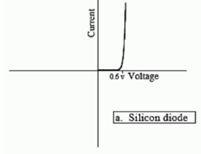
34The system shown below is a _____
- AShift invariance
- BNon-linear
- CShift Invariance
- DLinear
35Which of the following best describes the convolution operation?
- AIt transforms a signal into the frequency domain
- BIt combines frequency components
- CIt mixes time-domain signals
- DIt evaluates the overlap of two signals as one is shifted over the other
Information
- Description
- Quiz on DSP, created by JON AVIV CLOYDD GAMUNDOY on 09/12/2024.
- Author
- JON AVIV CLOYDD GAMUNDOY
- Language
- English
- Views
- 61
- History
- Created on 9 Dec 2024 · updated on 9 Dec 2024
- Tags
- Rating
- No ratings yet Rate this quiz