
Quiz
Matter, particles and properties
Este quiz tem tipos de pergunta que abrem no player de sempre.
Perguntas do quiz (13)
1Matter is anything that has mass and takes up space
- AVerdadeiro
- BFalso
2Matter is made up of elements, like fire, air and earth
- AVerdadeiro
- BFalso
3There are [blank_start]three[blank_end] states of matter. [blank_start]Solids[blank_end] are the state with the lowest energy. The [blank_start]particles[blank_end] in a solid are fixed in place. Liquids have more energy, and the particles can flow over each other to take the shape of the container. Gases have the most [blank_start]energy[blank_end]. The particles are spread far apart, moving fast, and will move to take up as much space as possible.
- Athree
- BSolids
- Cparticles
- Denergy
4Which of these are correct when talking about a solid, like a wooden block?
- AThe particles have low energy - they don't move easily, and just vibrate in place
- BThe particles spread out to take up as much space as possible
- CSolids can't easily be compressed or squashed, because there isn't much space between the particles
- DSolids spread out to take the shape of their container
- EParticles in a solid can be arranged in a regular pattern or jumbled up randomly
5Choose the correct labels for this picture
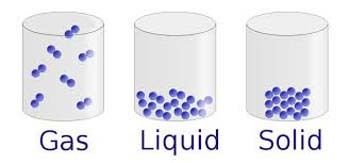
- AHigh energy
- BLow energy
- CParticles are fixed in place
- DParticles flow over and around each othe
- EParticles vibrate in fixed positions
- FParticles spread as far as possible
6To change the state of some matter, you should add or remove heat energy
- AVerdadeiro
- BFalso
7Material is the word used for a particular type of matter
- AVerdadeiro
- BFalso
8All materials have the same properties
- AVerdadeiro
- BFalso
9Matter can change [blank_start]state[blank_end] when you add or remove heat [blank_start]energy[blank_end] from it. Solids change into [blank_start]liquids[blank_end] by melting, while liquids change into [blank_start]solids[blank_end] by freezing or solidifying. Liquids change into gases by [blank_start]evaporating[blank_end], while gases change back into liquids by condensing. Though rare, solids can change directly into [blank_start]gases[blank_end] by sublimating. When they change back, it is reverse sublimation.
- Astate
- Bliquids
- Cenergy
- Dsolids
- Eevaporating
- Fgases
10If a material is springy or stretchy like elastic, we can assume that its particles are...
- AArranged in fixed positions
- BArranged in long strings that can flex easily
11If a material is heavy, dense and hard, like a lead sinker, we can assume its particles are arranged...
- AVery closely packed in a rigid formation
- BVery loosely packed and free to move easily
12If a material is volatile, like a perfume, we can assume that its particles...
- ACan flow over each other easily and escape into gas
- BFlow over each other very slowly
13If a material is easily split into sheets or planes, like wood can be split with an axe, we can assume its particles are...
- AArranged in loose, random structures that can be easily split
- BArranged in patterns that are stronger one way (the way you can split it) than the other
Informações
- Descrição
- A quiz for Y9 Science on basic matter, states of matter, and properties of matter
- Autor
- Gwyneth Cooper
- Idioma
- English
- Visualizações
- 280
- Histórico
- Criado em 4 fev 2019 · atualizado em 4 fev 2019
- Etiquetas
- Avaliação
- Ainda sem avaliações Avalie este quiz