
Quiz
Chapter 3 Practice: Interdependence and Gains from Trade
Perguntas do quiz (16)
1In an hour, David can wash 2 cars or mow 1 lawn, while Ron can wash 3 cars or mow 1 lawn. Who has the absolute advantage in car washing, and who has the absolute advantage in lawn mowing?
- ADavid in washing, Ron in mowing.
- BRon in washing, David in mowing.
- CDavid in washing, neither in mowing.
- DRon in washing, neither in mowing.
2 in an hour, David can wash 2 cars or mow 1 lawn, while Ron can wash 3 cars or mow 1 lawn. Who has the comparative advantage in car washing, and who has the comparative advantage in lawn mowing?
- ADavid in washing, Ron in mowing
- BRon in washing, David in mowing
- CDavid in washing, neither in mowing.
- DRon in washing, neither in mowing.
3When two individuals produce efficiently and then make a mutually beneficial trade based on comparative advantage,
- Athey both obtain consumption outside their production possibilities frontier.
- Bthey both obtain consumption inside their production possibilities frontier.
- Cone individual consumes inside his production possibilities frontier, while the other consumes outside his.
- Deach individual consumes a point on his own production possibilities frontier.
4Which goods will a nation typically import?
- Athose goods in which the nation has an absolute advantage
- Bthose goods in which the nation has a comparative advantage
- Cthose goods in which other nations have an absolute advantage
- Dthose goods in which other nations have a comparative advantage
5Suppose that in the United States, producing an aircraft takes 10,000 hours of labor and producing a shirt takes 2 hours of labor. In China, producing an aircraft takes 40,000 hours of labor, while producing a shirt takes 4 hours of labor.
What will these nations trade?- AChina will export aircraft, while the United States will export shirts.
- BChina will export shirts, while the United States will export aircraft.
- CBoth nations will export shirts.
- DThere are no gains from trade in this situation.
6Mark can cook dinner in 30 minutes and wash the laundry in 20 minutes. His roommate takes half as long to do each task. How should the roommates allocate the work?
- AMark should do more of the cooking based on his comparative advantage
- BMark should do more of the washing based on his comparative advantage.
- CMark should do more of the washing based on his absolute advantage.
- DThere are no gains from trade in this situation.
7Assume for the United States that the opportunity cost of each airplane is 50 cars. Which of these pairs of points could be on the United States' production possibilities frontier?
- A(300 airplanes, 15,000 cars) and (200 airplanes, 25,000 cars)
- B(200 airplanes, 5,000 cars) and (150 airplanes, 4,000 cars)
- C(200 airplanes, 12,500 cars) and (150 airplanes, 15,000 cars)
- D(300 airplanes, 25,000 cars) and (200 airplanes, 40,000 cars)
8Indonesia's opportunity cost of producing bananas is...
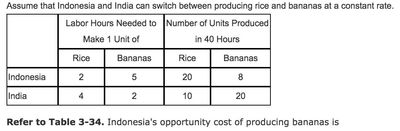
- A2.5 units of rice. This is lower than India's opportunity cost of producing bananas.
- B2.5 units of rice. This is higher than India's opportunity cost of producing bananas.
- C2/5 units of rice. This is lower than India's opportunity cost of producing bananas.
- D2/5 units of rice. This is higher than India's opportunity cost of producing bananas.
9India's opportunity cost of producing rice is
- A2 units of bananas. This is lower than Indonesia's opportunity cost of producing rice.
- B2 units of bananas. This is higher than Indonesia's opportunity cost of producing rice.
- C1/2 units of bananas. This is lower than Indonesia's opportunity cost of producing rice.
- D1/2 units of bananas. This is higher than Indonesia's opportunity cost of producing rice.
10When can two countries gain from trading two goods?
- Awhen the first country can only produce the first good and the second country can only produce the second good
- Bwhen the first country is better at producing both goods and the second country is worse at producing both goods
- Cwhen the first country can produce both goods, but can only produce the second good at great cost, and the second country can produce both goods, but can only produce the first good at great cost
- DTwo countries could gain from trading two goods under all of the above conditions
11for which good(s) does Indonesia have a comparative advantage
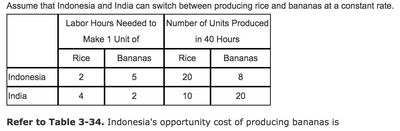
- Arice but not bananas.
- Brice and bananas.
- Cnether rice nor bananas.
- Dbananas but not rice.
12At which of the following prices, if any, can India and Indonesia both gain from trade?
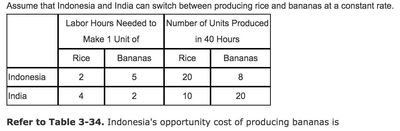
- A1/3 units of bananas per unit of rice
- B1/5 units of bananas per unit of rice.
- C3/5 units of bananas per unit of rice
- Dnone of the above.
13The opportunity cost of an item is
- Aalways less than the dollar value of the item.
- Bthe number of hours that one must work in order to buy one unit of the item.
- Cwhat you give up to get that item.
- Dalways greater than the cost of producing the item.
14Bob has...
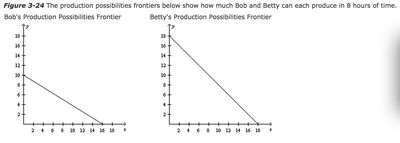
- Aan absolute and comparative advantage producing good x.
- Ba comparative but not an absolute advantage producing good x.
- Cneither a comparative nor an absolute advantage producing good x.
- Dan absolute but not a comparative advantage producing good x.
15The producer that requires a smaller quantity of inputs to produce a certain amount of a good, relative to the quantities of inputs required by other producers to produce the same amount of that good,
- Ahas a low opportunity cost of producing that good, relative to the opportunity costs of other producers.
- Bshould be the only producer of that good.
- Chas a comparative advantage in the production of that good.
- Dhas an absolute advantage in the production of that good.
16If the production possibilities frontier is a straight line, then "?" must be
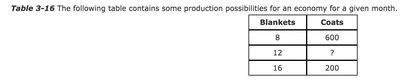
- A200
- B400
- C500
- D300
Informações
- Descrição
- Chapter 3
- Autor
- mfloyd6
- Idioma
- English
- Visualizações
- 2.402
- Etiquetas
- Avaliação
- Ainda sem avaliações Avalie este quiz