
Quiz
IBS Set 3 Quiz - Respiration
Crie uma conta grátis para terminar este quiz
Salve seu progresso e veja sua nota final.
Já tem uma conta? Inicie sessão
Perguntas do quiz (49)
1What enzyme partakes in the reversible reaction shown by the green question mark?
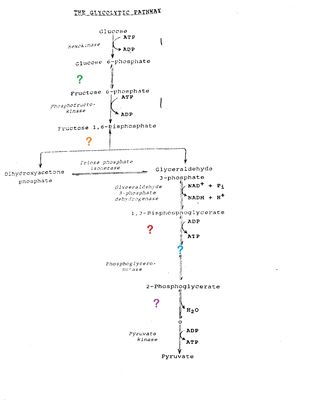
- APhosphoglucose isomerase
- BEnolase
- CAldolase
- DPhosphofructo kinase
2What enzyme partakes in the reversible reaction shown by the orange question mark?
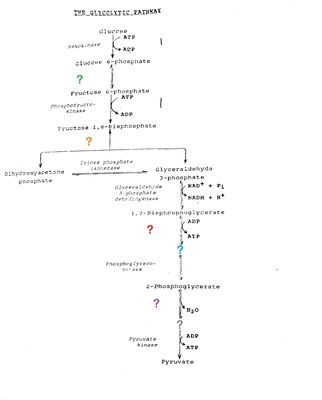
- AAldolase
- BPhosphoglucose isomerase
- CPhosphoglycerate kinase
- DEnolase
3What enzyme partakes in the reversible reaction shown by the red question mark?
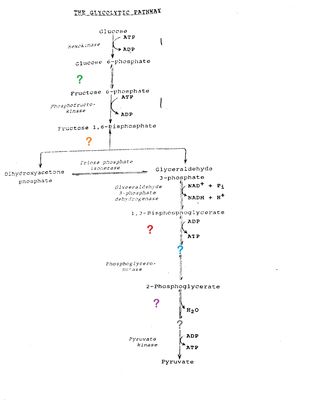
- APhosphoglycerate kinase
- BEnolase
- CAldolase
- DPhosphoglucose isomerase
4What enzyme partakes in the reversible reaction shown by the purple question mark?
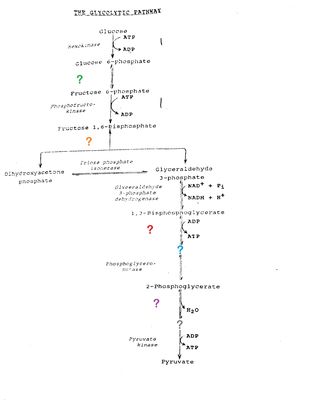
- AEnolase
- BAldolase
- CPhosphoglucose isomerase
- DPhosphoglycerate kinase
5What is the intermediate produced shown by the blue question mark?
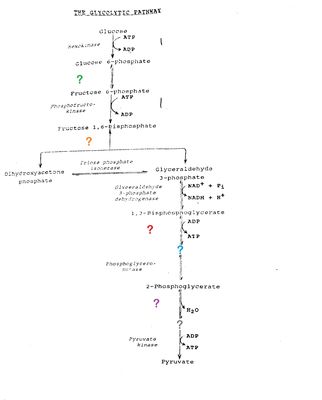
- A3-Phosphoglycerate
- B1-Phosphoglycerate
- C1,3-diphosphoglycerate
- DSuccinate
6What is the intermediate produced shown by the gray question mark?
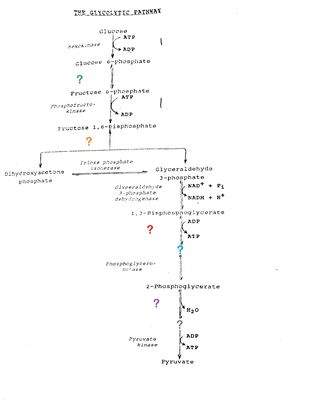
- APhosphoenol pyruvate
- B1-Phosphoglycerate
- C3-Phosphoglycerate
- DAcetyl CoA
7Define substrate level phosphorylation.
- AThe generation of an energy rich phosphate bond resulting from the breakdown of a more energy rich substrate.
- BThe synthesis of ATP driven by the electron transport chain.
- CThe potential of a substance to donate its electrons.
8Define oxidative phosphorylation
- AThe synthesis of ATP driven by the electron transport chain.
- BThe formation of an energy rich phosphate bond from the breakdown of a more energy rich substrate.
- CThe potential of a substance to donate its electrons.
9When is water produced in glycolysis?
- A2-Phosphoglycerate -> Phosphoenol pyruvate
- BGlucose -> Glucose-6-phosphate
- CGlyceraldehyde 3 phosphate -> 1,3-bisphosphoglycerate
- DFructose-6-phosphate -> Fructose-1,6-bisphosphate
10A kinase enzyme catalyses the removal of a phosphate group from a molecule.
- AVerdadeiro
- BFalso
11What molecule is shown by the red question mark?
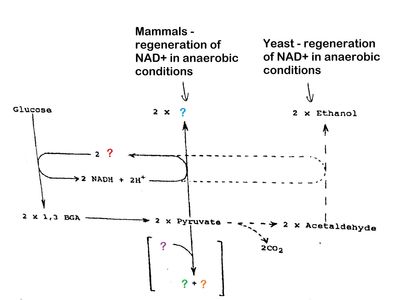
- ANAD+
- BO2
- CCO2
- DFADH
12What molecule is shown by the green question mark?
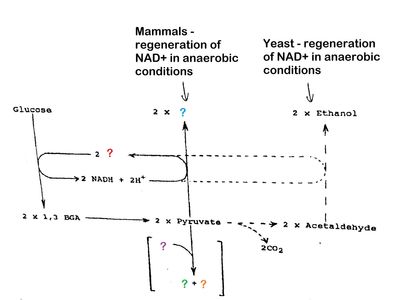
- ACO2
- BO2
- CPyruvate
- DFAD+
13What molecule is shown by the purple question mark?
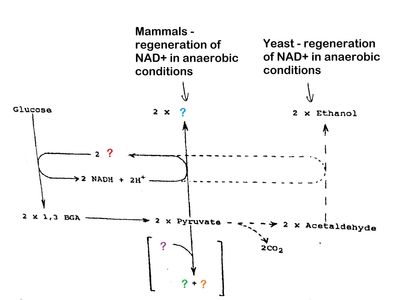
- AO2
- BNAD+
- CH2O
- DLactate
14What molecule is shown by the orange question mark?
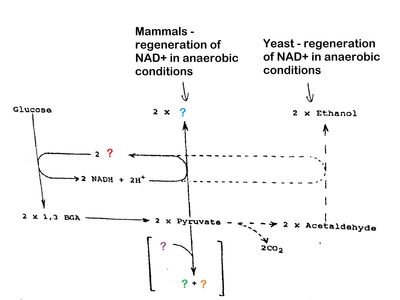
- ALactate
- BO2
- CH2O
- DNAD+
15What molecule is shown by the blue question mark?
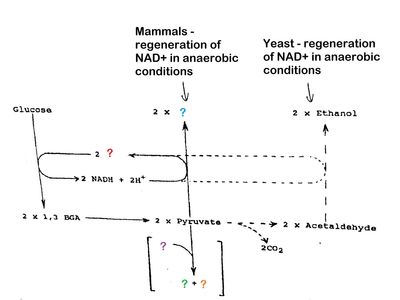
- ALactate
- BPyruvate
- CNADH
- DO2
16What intermediate does the red question mark show?
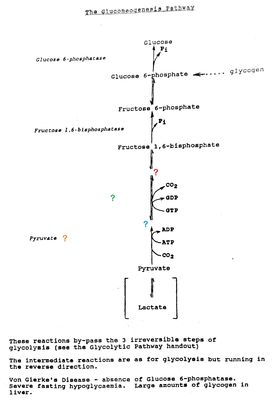
- APhosphoenolpyruvate
- BOxaloacetate
- CGlyceraldehyde-3-phosphate
- DDihydroxyacetone phosphate
17What intermediate does the blue question mark show?
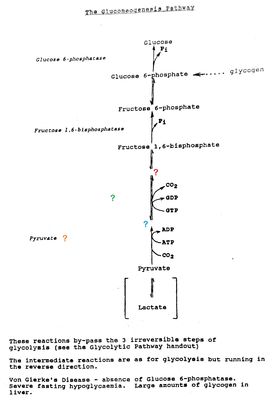
- APhosphoenolpyruvate
- BOxaloacetate
- CCitric acid
- DFumarate
18What enzyme does the green question mark show?
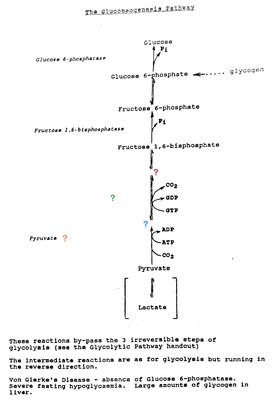
- APhosphoenolpyruvate carboxykinase
- BPyruvate dehydrogenase
- CPhosphoglucose isomerase
- DPhosphoglycerate mutase
19What enzyme does the orange question mark show?
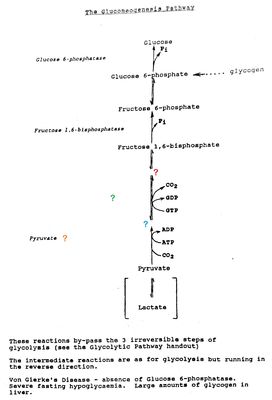
- APyruvate carboxylase
- BPyruvate dehydrogenase
- CPyruvate anhydrase
- DPyruvate carboxykinase
20What cycle does the diagram show?
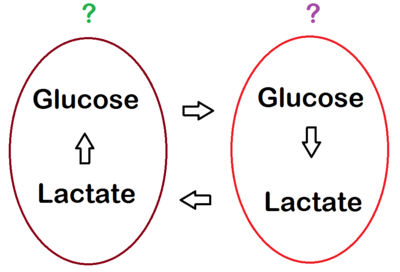
- ACori cycle
- BKrebs cycle
- CCalvin cycle
21Where is glucose converted to lactate in this cycle?
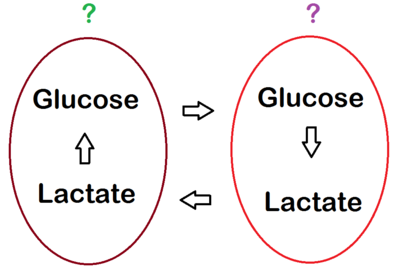
- ASkeletal muscle
- BLiver
- CKidneys
- DAdipose
22Where is lactate converted to glucose in this cycle?
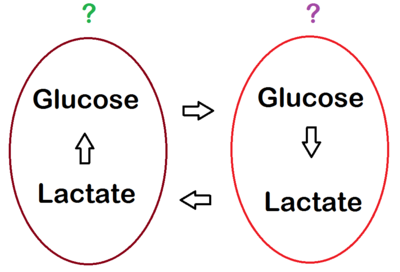
- ASkeletal muscle
- BLiver
- CKidneys
- DAdipose
23The cori cycle uses more ATP in conversion of lactate to glucose than vice versa.
- AVerdadeiro
- BFalso
24Von Gierke's disease leads to a deficiency in the enzyme glucose-6-phosphatase. How might this impact on glycogen levels in the liver?
- AGlycogen levels will increase
- BGlycogen levels will decrease
25Coenzyme A performs what function?
- AActivates acetyl groups so they can be transferred to other metabolites.
- BCatalyse gluconeogenesis in the liver as part of the cori cycle.
- CConverts Pyruvate into Acetyl CoA
26Pyruvate dehydrogenase complex is made up of what enzymes?
- APyruvate dehydrogenase
- BDihydrolipoyl transacetylase
- CDihydrolipoyl dehydrogenase
- DPyruvate carboxylase
- EPhosphoenolpyruvate carboxykinase
27Vitamin B1 deficiency, sometimes known as "beri-beri" causes fatigue due to lack of pyruvate conversion into Acetyl CoA.
- AVerdadeiro
- BFalso
28As well as pyruvate, fatty acids and amino acids can also be converted to Acetyl CoA
- AVerdadeiro
- BFalso
29Acetyl CoA can be converted to Amino acids, explaining why a high carbohydrate diet can lead to high protein levels.
- AVerdadeiro
- BFalso
30Electron loss during redox in the electron transport chain usually occurs when hydrogen is removed.
- AVerdadeiro
- BFalso
31The less negative a substances redox potential, the greater the tendency to donate electrons.
- AVerdadeiro
- BFalso
32Carriers of different redox potentials pass their electrons on to carriers with a less negative redox potential.
- AVerdadeiro
- BFalso
33Loss of hydrogen indicates oxidation.
- AVerdadeiro
- BFalso
34NADH has a less negative redox potential and therefore less ATP is generated from NADH's contribution to the ETC than FADH2.
- AVerdadeiro
- BFalso
35What is the chemiosmotic coupling hypothesis?
- AThe energy from electron transport drives the efflux of hydrogen ions from the matrix into the intermembrane space. This establishes a proton electrochemical gradient. ATP synthesis is driven by ATP synthase using this proton gradient (proton motor force).
- BThe energy from electron transport drives the efflux of hydrogen ions from the intermembrane space into the matrix. This establishes a proton electrochemical gradient. ATP synthesis is driven by ATP synthase using this proton gradient (proton motor force).
- CThe energy from electron transport drives the efflux of hydrogen ions from the matrix into the intermembrane space. This establishes a proton electrochemical gradient. ADP synthesis is driven by ADP synthase using this proton gradient (proton motor force).
36What is meant by an uncoupled system such as brown adipose?
- AThe H+ gradient generated by the energy that is released from the electron transport chain is dissipated as heat instead of being coupled to drive oxidative phosphorylation.
- BThe energy released from the electron transport chain is dissipated as heat instead of being coupled to drive oxidative phosphorylation.
37How does ATP synthase generate ATP?
- AIt allows the proton gradient, established from the energy generated by the electron transport chain, to pass through the membrane and uses this kinetic energy to phosphorylate ADP into ATP.
- BATP synthase phosphorylates ADP into ATP from the energy from the electron transport chain.
- CATP synthase phosphorylates cAMP into ATP using the proton gradient established from the energy from the electron transport chain.
38NADH has direct access to reduce the electron transport chain.
- AVerdadeiro
- BFalso
39Brown adipose is important in thermoregulation in neonats and for animals that hibernate.
- AVerdadeiro
- BFalso
40How does an uncoupler such as dinitrophenol work?
- AIt carrys the H+ back into the matrix therefore the proton gradient that is established is not used to make ATP via ATP synthase.
- BIt blocks the ATP synthase membrane bound enzyme, therefore stopping oxidative phosphorylation.
41What molecule is part of the glycerol phosphate shuttle and labelled by the red question mark?
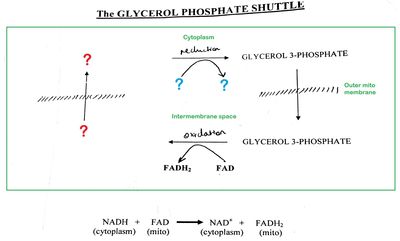
- ADihydroxyacetone phosphate
- B1,3-bisphosphoglycerate
- COxaloacetate
- DAspartate
42What reduces the red question mark molecule to glycerol-3-phosphate?
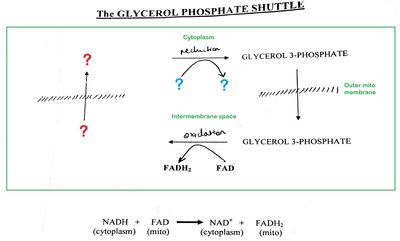
- ANADH -> NAD+
- BFADH2 -> FAD+
43What is the first membrane bound complex shown by the green question mark?
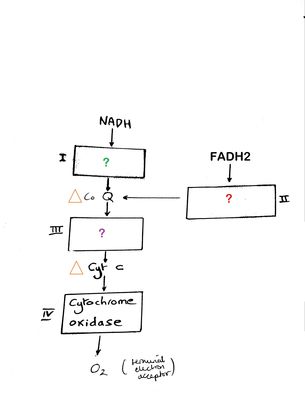
- ANADH-Q reductase
- BCytochrome C
- CSuccinate-Q reductase
- DCytochrome C reductase
44What is the second membrane bound complex shown by the red question mark?
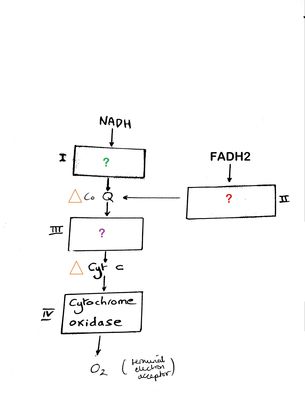
- ASuccinate-Q reductase
- BNADH-Q reductase
- CCytochrome C
- DCytochrome C reductase
45What is the third membrane bound complex shown by the purple question mark?
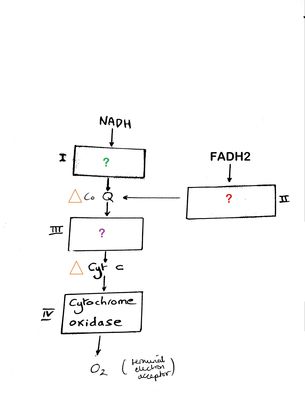
- ACytochrome reductase
- BSuccinate-Q reductase
- CNADH-Q reductase
- DCytochrome C
46What name is given to the electron carriers labelled by the orange triangles?
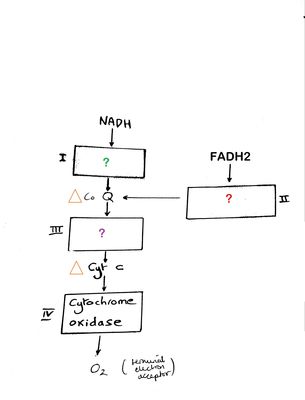
- AMembrane bound carriers
- BMobile carriers
- COxidising enzymes
- DFluid carriers
47ATP is produced during the krebs cycle.
- AVerdadeiro
- BFalso
48How many molecules of NADH are produced during the krebs cycle?
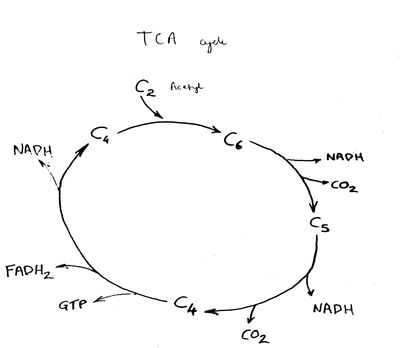
- A3
- B2
- C1
- D5
49Why can the krebs cycle not occur without O2?
- AAlthough the TCA/krebs cycle does not need O2 directly, regeneration of NAD+ and FAD depend upon O2 as a terminal electron acceptor at the end of the ETC. Without O2 as the terminal electron acceptor, the ETC cannot proceed as electrons are not being terminally accepted and thus FADH2 and NADH cannot reduce the ETC carriers as electrons are not passing through the system. Without NAD+ and FAD available, conversion of certain intermediates cannot occur in the TCA cycle but more importantly Glyceraldehyde-3-phosphate cannot be converted to 1,3-bisphosphoglycerate.
- BAlthough the TCA/krebs cycle does not need O2 directly, regeneration of NAD+ and FAD depend upon O2 as a terminal electron acceptor at the end of the ETC. Without O2 as the terminal electron acceptor, the ETC cannot proceed as electrons are not being terminally accepted and thus FADH2 and NADH cannot reduce the ETC carriers as electrons are not passing through the system. Without NAD+ and FAD available, conversion of certain intermediates cannot occur in the TCA cycle but more importantly 1,3-bisphosphoglycerate cannot be converted to Glyceraldehyde-3-phosphate.
Informações
- Descrição
- hgjgj
- Autor
- . .
- Idioma
- English
- Visualizações
- 76
- Etiquetas
- Avaliação
- Ainda sem avaliações Avalie este quiz