
Quiz
Contemporary Lab Skills - Exam 2
Este quiz tem tipos de pergunta que abrem no player de sempre.
Perguntas do quiz (100)
1What does PCR stand for?
- APolymerase Chain Reaction
- BPolyamorous Consensual Relationship
- CPolymorphic Chain Reaction
- DPolymorphic Contrasting Reaction
2PCR is typically the [blank_start]first[blank_end] step in DNA analysis.
- Afirst
- Bsecond
- Cthird
- Dlast
3What is the main significance of PCR vs other methods?
- APCR avoids the DNA cloning process
- BPCR promotes the DNA cloning process
- CPCR promotes the RNA cloning process
- DPCR avoids the RNA cloning process
4PCR amplifies all included DNA segments, which allows us to measure general information about the DNA, such as length and total composition.
- AVerdadeiro
- BFalso
5What determines the segment of DNA that is amplified by PCR?
- APrimers
- BTemplate DNA
- CBuffer
- DdNTPs
6DNA amplification after PCR is [blank_start]less[blank_end] than 10^[blank_start]6[blank_end]x
- Aless
- Bgreater
- C6
- D5
- E10
- F12
7PCR amplification requires [blank_start]little[blank_end] template DNA, but is highly [blank_start]susceptible[blank_end] to contamination.
- Alittle
- Ba large amount of
- Csusceptible
- Dresistant
8______________ is a thermostable DNA polymerase used to automate the repetitive steps in the polymerase chain reaction (PCR) technique.
- ATaq polymerase
- BQat polymerase
- CThermopolymerase
- DTherm polymerase
9Which of the following is a requirement of PCR?
- AThermocycler
- BTemplate DNA
- CPrimers
- DThermostable DNA polymerase
- EAgarose Gel
- FElectric Current
10What kind of primers are used in PCR?
- AForward
- BReverse
- COne-way
- DTwo-way
11 Using dNTP, or [blank_start]deoxynucleotide triphosphate[blank_end], during the [blank_start]extension[blank_end] phase of PCR provides single bases ready to go into DNA and double it, like building blocks.
- Adeoxynucleotide triphosphate
- Bdeoxynucleic triptophosphorous
- Cdeoxynucleotide triptophosphate
- Ddeoxynucleic triphosphate
- Eextension
- Freplication
- Gconditioning
12DNA polymerases (DNAPs)...
- Add dNTPs to [blank_start]elongate[blank_end] primer
- Require pre-existing [blank_start]oligonucleotide[blank_end] (primer) with free [blank_start]3' -OH[blank_end]
- Read DNA template strand & inserts complementary [blank_start]deoxyribonucleotide (dNTP)[blank_end] of the next unpaired nucleotide in the template
- Form [blank_start]phosphodiester[blank_end] bond between [blank_start]3' -OH[blank_end] of [blank_start]oligonucleotide[blank_end] & [blank_start]5' -PO4[blank_end] of [blank_start]deoxyribonucleotide (dNTP)[blank_end]
- DNA synthesis proceeds [blank_start]5'-->3'[blank_end]
- Template strand read [blank_start]3'-->5'[blank_end]- Aelongate
- Bcompress
- Coligonucleotide
- Dphosphodiester
- E3' -OH
- F5' -OH
- G3' -PO4
- H5' -PO4
- Ideoxyribonucleotide (dNTP)
- JDNA polymerase (DNAP)
- Kdeoxyribose (dRTP)
- L3' -OH
- M5' -PO4
- Noligonucleotide
- Ophosphodiester
- Pphosphodiester
- Qoligonucleotide
- Rdeoxyribonucleoide (dNTP)
- S5' -PO4
- T3' -OH
- U3' -PO4
- V5' -OH
- W5' -OH
- X3' -PO4
- Ydeoxyribonucleotide (dNTP)
- Zoligonucleotide
- AAphosphodiester
- AB5'-->3'
- AC3'-->5'
- AD3'-->5'
- AE5'-->3'
13Select all that apply to DNA polymerases for PCR
- AThermostability is essential
- BOptimum polymerase activity at 72 degrees C, but can withstand up to 95 degrees C
- CUse exonuclease deficient forms
- D3'-->5' exonuclease activity may modify/degrade primers under initial sub-optimal conditions
- EOptimum polymerase activity at 65 degrees C, but can withstand up to 82 degrees C
- FUse endonuclease deficient forms
- G5'-->3' exonuclease activity may modify/degrade primers under initial sub-optimal conditions
14Match the DNA polymerases with their description
[blank_start]Thermus aquatics[blank_end]
- Taq Polymerase
- In hot springs
[blank_start]Thermococcus litoralis[blank_end]
- deep ocean vents
...- extends templates >12kb
...- proofreading ability
- Manipulation of Vent -->Deep Vent
...- Greater thermostability
...-Lacks exonuclease (exo-) component
[blank_start]Thermus maritima (UITma)[blank_end]
- Extends long templates
- Proofreading ability
[blank_start]Thermus thermophilus (Tth)[blank_end]
- RT at 70 degrees C + Mn^2+
- similar to RNA-PCR without cDNA
[blank_start]Pfu DNA polymerase (marine bacterium)[blank_end]
- Proofreading activity
- Efficiently incorporates radiolabeled dNTPs
- Good for generating DNA probes- AThermus aquatics
- BThermococcus litoralis
- CThermus maritima (UITma)
- DThermus thermophilus (Tth)
- EPfu DNA polymerase (marine bacterium)
15How long are typical PCR primers?
- A20-30 bp
- B30-40 bp
- C10-20 bp
- D40-50 bp
16Select all that apply to a good PCR primer
- Acomplement flanking DNA
- Bnot self-complementary
- Cavoids potential secondary structure
- Dmatched GC content
- Esimilar melting temp
- Fhigher melting temp
- Gcomplements itself
- Hcannot complement flanking DNA
- Iavoids potential tertiary structure
17Using software such as Oligo and Primer to calculate precise times and temperatures for PCR primer is an option, but calculations made by the researcher should be accurate enough.
- AVerdadeiro
- BFalso
18Which of the following are major components in a PCR reaction mixture?
- ATarget DNA
- BPrimers
- CDNA Polymerase
- DdNTPs
- EBuffer appropriate for enzyme
- FdNADs
- Gdeoxyribonuclease
19Which of the following should be considered when choosing a buffer for PCR?
- Aenzyme activity
- Bprimer/template binding
- Ceffective incorporation of dNTPs
- Doptimization for Mg^2+
- Eoptimization for P^+
- FDNA length
20The PCR cycle has which three steps?
- ADenaturation
- BAnnealing
- CExtension
- DBuffering
- EContraction
21What is the significance of the denaturing phase of PCR?
- AIt allows the selected region for amplification to be accessible to enzymes
- BIt allows primers to anneal to the template DNA
- CIt extends the primers beyond the target DNA
22Denaturation of DNA occurs at what temperature?
- A90 degrees C
- B80 degrees C
- C85 degrees C
- D75 degrees C
23Which of the following occurs during the annealing phase of PCR?
- Areaction mixture cooled to 40-65 degrees C
- BPrimers anneal to template DNA
- Cprecise temperature is critical and must be defined to avoid synthesis of other products
- Dtemplate dsDNA denatured by heating above 90 degrees C
- Etemperature is raised to 72 degrees C
- Fprimers extended beyond target DNA
- GPrimers extended from 3' -OH by thermostable DNA polymerase
24Which of the following occurs during the extension phase of PCR
- ATemperature is raised to 72 degrees C
- BPrimers extended from 3' -OH by thermostable DNA polymerase
- CPrimers extended beyond target DNA
- DSequence at 3' end contains sequence complementary to other primer
- Ereaction mixture cooled to 40-50 degrees C
- FPrimers anneal to template DNA
- GTemplate dsDNA denatured by heating above 90 degrees C
25Successive PCR cycles yield fragments precisely delimited by the primer.
- AVerdadeiro
- BFalso
26Which of the following applies to Agarose Gel electrophoresis (AGE) PCR?
- ARun PCR products on gel alongside size standards
- BLook for band of predicted size
- COriginal method
- DSemi-quantitative at best
- EMonitor accumulation of PCR products
- FQuantitative
- GUse fluorescent-labeled primers, probes, or fluorochromes
- HBased on Fluorescent Resonance Energy Transfer (FRET)
27Which of the following applies to Real-time PCR
- AMonitor accumulation of PCR products during cycling
- BQuantitative
- CUse fluorescent-labeled primers, probes, or fluorochromes
- DBased on fluorescent Resonance Energy Transfer (FRET)
- ERun PCR products on gel alongside size standards
- FLook for band of predicted size
- GOrignal method
- HSemi-quantitative at best
28Label the types of Real-Time PCR
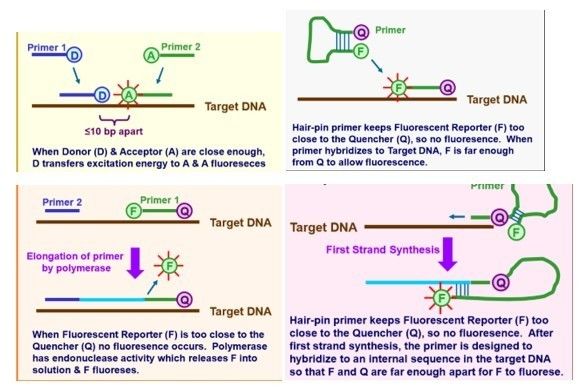
- ALight Cycler Primers
- BMolecular Beacons
- CUFO PCR
- DPhoton Cycler Primers
- ETaqman PCR Assay
- FReporter-Quencher Assay
- GScorpion Assay
- HInchworm Assay
29What is the main benefit of using PCR over cloning?
- APCR is faster
- BPCR produces more accurate results
- CPCR requires less preparation
- DPCR is generally cheaper
30In PCR, "RAPD" stands for...
[blank_start]Rapid[blank_end] [blank_start]Amplification[blank_end] of [blank_start]Polymorphic[blank_end] DNA- ARapid
- BRenentive
- CAmplification
- DAnnealing
- EPolymorphic
- FPhosphodiester
31Which of the following applies to RAPD PCR Analysis?
- AOne or both primers are random sequences
- BYields discrete bands on gel
- CAlteration in fragment length due to insertions/deletions between primer sites
- DReproducibly identify and organism/species
- EDifferentiate between various mutants
- FBased on insertions/deletions in gene sequence among individuals/genes
- GAmplification using 1 primer
32Which of the following applies to AFLP PCR analysis?
- ABased on insertions/deletions in gene sequence among individuals/species
- BPCR amplification of specific gene(s)
- CType of DNA fingerprint analysis
- DAmplification using 1 primer
- EOne or both primers are random sequences
- FYields discrete bands on gels
- GAlteration in fragment length due to insertions/deletions between primer sites
33PCR is an effective replacement for cloning
- AVerdadeiro
- BFalso
34Cloning PCR products involves which of the following?
- AIn vitro protein synthesis
- BIn vivo protein synthesis
- CIn vitro DNA synthesis
- DIn vivo DNA synthesis
35What are the initial problems associated with Direct PCR sequencing?
- Asequencing requires ssDNA
- BShort PCR products re-anneal rapidly
- CPrevent annealing of sequencing primers
- DBias amplification for 1 strand (primer ratio 100:1)
- EUse denaturants
- FSelectively remove 1 strand after sequencing
36What are the solutions for problems associated with direct PCR sequencing?
- ABias amplification for 1 strand (primer ratio 100:1)
- BUse denaturants
- CSelectively remove 1 strand after synthesis
- DSequencing requires ssDNA
- EShort PCR products reanneal rapidly
- FPrevent annealing of sequencing primers
37Select all the denaturants used for direct PCR sequencing
- AFormamide
- BDimethylsulfoxide
- CFormaldehyde
- DDihydrogen monoxide
38How is one strand selectively removed after synthesis during direct PCR sequencing?
(Select 2)- AIncorporate biotin into 1 primer
- BAffinity chromatography with bound streptavidin removes biotinylated strand
- CIncorporate formamide into 1 primer
- DHPLC chromatography with bound streptavidin removes biotinylated strand
- EHPLC chromatography with bound straptovitamin removes biotinylated strand
39This is a depiction of which kind of PCR sequencing?
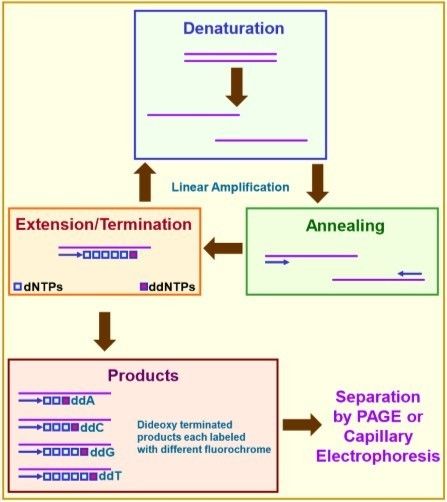
- ADirect PCR sequencing
- BPCR cycle sequencing
40This is a depiction of which type of PCR sequencing?
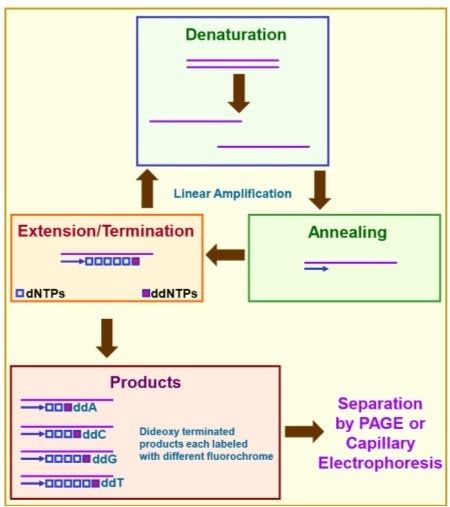
- APCR cycle sequencing
- BDirect PCR sequencing
41Which of the following applies to PCR cycling?
- AAmplification using 1 primer
- BUses about 20 PCR cycles to complete
- CDetected using Fluorescent ddNTPs
- DDetected using Radiolabeled ddNTPs
- EBIas amplification for 1 strand (primer ratio 100:1)
- FUse denaturants
42RT-PCR stands for...
- AReverse Transcriptase PCR
- BReverse Terminal PCR
- CRepeating Transcriptase PCR
- DRepeating Terminal PCR
43Reverse Transcriptase converts [blank_start]mRNA[blank_end] to [blank_start]cDNA[blank_end] during RT-PCR.
- AmRNA
- BcDNA
- CddDNA
- DrRNA
- EcDNA
- FmRNA
- GrRNA
- HddDNA
44What are the steps of RT-PCR in the correct order?
[blank_start]Isolate Poly(A)-mRNA[blank_end]
[blank_start]Anneal Poly(dT) Primer to mRNA[blank_end]
[blank_start]Reverse Transcriptase Synthesis of cDNA[blank_end]
[blank_start]Remove RNA[blank_end]--Use cDNA in PCR- AIsolate Poly(A)-mRNA
- BAnneal Poly(dT) Primer to mRNA
- CReverse Transcriptase Synthesis of cDNA
- DRemove RNA
45Electrophoresis is...
- Athe separation of molecules using an electric field
- Bthe separation of molecules using a magnetic field
- Cthe visualization of molecules using an electric field
- Dthe visualization of molecules using a magnetic field
46The migration distance is primarily determined by the ___________ ratio
- Acharge:mass
- Bcharge:size
- Cdensity:mass
- Ddensity:size
47What is the primary reason we use a matrix in electrophoresis?
- AIt increases resolution of molecules with a similar charge:mass ratio
- BIt decreases the time it takes to complete electrophoresis
- CIt allows the charges from the positive and negative ends to traverse the entire mechanism
- DIt gives the molecules something to adhere to
48A matrix imposes a size constraint on molecule movement during electrophoresis
- AVerdadeiro
- BFalso
49Select all that are common matrices for electrophoresis
- AAgarose (AGE)
- BPolyacrylamide (PAGE)
- CStarch
- DCellulose (TLE)
- ESilica (TLE)
- FPaper
- GSodium hydrogen carbonate (SHC)
50Drag the types of electrophoresis to their applications
[blank_start]Starch gel electrophoresis[blank_end]
- Proteins
Paper electrophoresis
- Small molecules
[blank_start]Thin-layer electrophoresis (TLE)[blank_end]
- Small Molecules
[blank_start]Free-flow electrophoresis[blank_end]
- Molecules dissolved in liquid
[blank_start]Agarose gel electrophoresis (AGE)[blank_end]
- DNA (>2 kb)
- RNA (>2 kb)
[blank_start]Capillary electrophoresis[blank_end]
- DNA
- RNA
-Proteins
- Small molecules
[blank_start]Polyacrylamide gel electrophoresis[blank_end] (PAGE)
- Small DNAs (<2 kb)
- Small RNAs (<2 kb)- AStarch gel electrophoresis
- BThin-layer electrophoresis (TLE)
- CFree-flow electrophoresis
- DAgarose gel electrophoresis (AGE)
- ECapillary electrophoresis
- FPolyacrylamide gel electrophoresis
51For nucleic acid gel electrophoresis (separation of DNA and RNA), an [blank_start]agarose[blank_end] matrix is used for general applications while [blank_start]polyacrylamide[blank_end] is used for sequencing and footprinting.
- Aagarose
- Bpolyacrylamide
- Cpolyacrylamide
- Dagarose
52The phosphate in a nucleic acid's backbone has a strong [blank_start]negative[blank_end] charge proportional to the [blank_start]number of base pairs (bp)[blank_end], so it runs towards the [blank_start]positive[blank_end] end of the electrophoresis matrix.
- Anegative
- Bpositive
- Cpositive
- Dnegative
- Enumber of base pairs (bp)
- Fsize of base pairs (bp)
- Gproportion of bases (A/G/T/C)
53Why is denaturing part of agarose electrophoresis?
- AUsed to prevent the formation of secondary structure
- BUsed to prevent the formation of tertiary structure
- CUsed to prevent re-annealing
- DUsed to prevent annealing
54Which of the following is used in denaturing agarose gels (DNA)
- Aalkaline buffers
- Bformamide
- Cformaldehyde
- Dmethylmercuric hydroxide
- EDetergents (e.g. SDS)
55Which of the following is used in denaturing agarose gels (RNA)
- Aformamide
- Bformaldehyde
- Cmethylmercuric hydroxide
- Dalkaline buffers
- EDetergents (e.g. SDS)
56Which of the following is used in denaturing acrylamide gels?
- ADetergents (e.g. SDS)
- Balkaline buffers
- Cformamide
- Dformaldehyde
- Emethylmercuric hydroxide
57Polyacrylamide gels permit the resolution of individual bases
- AVerdadeiro
- BFalso
58Pulsed-field electrophoresis (or orthogonal field electrophoresis) does not permit the separation of large DNAs.
- AVerdadeiro
- BFalso
59Which of the following applies to pulsed-field electrophoresis?
- Aeffectively separates small chromosomes >10^6 bp
- Buses electric field conducted through a stiff rod snaking through the gel
- Cone can alter the orientation of the field
- Deffectively separates large chromosomes <10^10 bp
- Euses electric field conducted through a liquid phase via two small rods on either end (one cathode, one anode)
- Fthe field is fixed and can only go in one direction
60Which of the following are general stains for nucleic acids?
- AEthidium bromide (EtBr)
- BSYBRgreen
- CPsorelen
- DMethylene blue
61During electrophoresis staining of nucleic acids, the stain intercalates between the ___________ of the nucleic acids.
- Abases
- Bphosphodiester bonds
- C-OH bonds
62Alignment of stain molecules to DNA after electrophoresis permits a strong fluorescent signal when stimulated with [blank_start]UV[blank_end].
- AUV
- Bgamma radiation
- Can electric field
63Proteins are typically separated by what kind of electrophoresis?
- APolyacrylamide gel electrophoresis (PAGE)
- BAgarose gel electrophoresis (AGE)
- CCapillary electrophoresis
- DFree-flow electrophoresis
64PAGE gels can come in what formats?
- ASlab gels
- BRod (tube) gels
- CBox gels
65PAGE buffer systems can either be [blank_start]continuous or discontinuous[blank_end].
- Acontinuous or discontinuous
- Bhigh or low charge
- Clong or short
- Dsimple or complex
66Which of the following are components of a polyacrylamide gel?
- AAcrylamide
- BBIs-acrylamide
- CBuffer
- DDenaturants (optional)
- EAgarose
67Which of the following are catalysts used for polymerization of PAGE preparation?
- AAmmonium persulfate (APS)
- BN,N,N'N'-Tetramethylenediamine (TEMED)
- CBis-acrylamide
- DAcrylamide
68What are the functions of the catalysts used during PAGE preparation?
- ATEMED forms free radicals from APS
- BAPS forms free radicals from TEMED
- CBis-acrylamide forms free radicals from acrylamide
- DAcrylamide forms free radicals from bis-acrylamide
69In PAGE gel preparation the free radicals made from the catalysts form form linkages from [blank_start]acylamide[blank_end] to acrylamide and [blank_start]acrylamide[blank_end] to [blank_start]bis-acrylamide[blank_end].
- Aacrylamide
- BTEMED
- CAPS
- Dacylamide
- ETEMED
- FAPS
- Gbis-acrylamide
- HTEMED
- IAPS
70Which of the following can inhibit APS/TEMED catalysts during PAGE gel preparation?
- Alow pH
- Boxygen
- Chigh pH
- Dwater
71Select all that apply to %T
- A= Total acrylamides in gel (w/v)
- B= % Acrylamide + % Bis-acrylamide
- CIncreased %T --> decreased pore size
- D= Cross-linkers in gel (w/v)
- E= % Bis-acrylamide
- FIncreased %T --> increased pore size
72Select all that apply to %C
- A= Cross-linkers in gel (w/v)
- B= % Bis-acrylamide
- CIncreased %C --> decreased pore size
- D= Total acrylamides in gel (w/v)
- E= % Acrylamide + % BIs-acrylamide
- FIncreased %C --> increased pore size
73In a discontinuous buffer system...
Velocity of Migration = [blank_start]Effective Mobility[blank_end] x [blank_start]Voltage[blank_end]
- Proportion of charged molecules determines effective mobility
Voltage = [blank_start]Current[blank_end] x [blank_start]Resistance[blank_end]
- V = I x R
Proteins accumulate in a [blank_start]narrow[blank_end] band (i.e. [blank_start]Stack[blank_end]) before entering the [blank_start]resolving[blank_end] gel
Stacking gels have [blank_start]large[blank_end] pores ([blank_start]low[blank_end] %T, [blank_start]no molecular sieving[blank_end]) and a pH of [blank_start]6.8[blank_end].
Glycine is [blank_start]protonated[blank_end], so it has a [blank_start]slow[blank_end] migration and is the [blank_start]trailing[blank_end] ion. Proteins are [blank_start]differentially deprotonated[blank_end], so they have an [blank_start]intermediate[blank_end] migration. Chloride (Cl-) has [blank_start]high[blank_end] mobility and is the [blank_start]leading[blank_end] ion.
Cl- moves [blank_start]away from[blank_end] the glycine, creating a [blank_start]low[blank_end] conductivity zone. The [blank_start]low[blank_end] conductivity zone attains a [blank_start]higher[blank_end] voltage gradient. At its steady-state, glycine and Cl- are moving at [blank_start]the same rate[blank_end] with a [blank_start]sharp[blank_end] boundary between them. As the glycine moves through the stacking gel, the [blank_start]Cl-[blank_end]overtakes the [blank_start]proteins[blank_end] [blank_start]in front of[blank_end] the boundary. Proteins have [blank_start]higher[blank_end] mobility than glycine in the trailing [blank_start]high-voltage[blank_end] gradient, so they move [blank_start]at[blank_end] the boundary.
Resolving gels have [blank_start]smaller[blank_end] pores ([blank_start]higher[blank_end] %T, [blank_start]molecular sieving[blank_end]) and a pH of [blank_start]8.8[blank_end]. At the resolving gel, glycine [blank_start]deprotonates[blank_end] and [blank_start]increases[blank_end] mobility. The [blank_start]glycine[blank_end] overtakes the [blank_start]proteins[blank_end] and moves just behind the Cl-. Then the Proteins separate based on their [blank_start]charge:mass ratio[blank_end] and molecular sieving due to gel composition (%T, %C).- AEffective Mobility
- BSize
- CVoltage
- DMass
- ECurrent
- FCharge
- GResistance
- HReactability
- Inarrow
- Jwide
- KStack
- LResolution
- Mresolving
- Nstacking
- Olarge
- Psmall
- Qlow
- Rhigh
- Sno molecular sieving
- Tmolecular sieving
- U6.8
- V8.8
- W8.6
- X6.6
- Y8.8
- Z6.8
- AA6.6
- AB8.6
- ACprotonated
- ADdeprotonated
- AEslow
- AFfast
- AGtrailing
- AHleading
- AIdifferentially deprotonated
- AJdifferentially deprotonated
- AKprotonated
- ALdeprotonated
- AMintermediate
- ANslow
- AOfast
- APintermediate
- AQhigh
- ARlow
- ASleading
- ATtrailing
- AUaway from
- AVtowards
- AWlow
- AXhigh
- AYlow
- AZhigh
- BAhigher
- BBlower
- BCthe same rate
- BDdifferent rates
- BEsharp
- BFundefined
- BGCl-
- BHproteins
- BIproteins
- BJCl-
- BKin front of
- BLbehind
- BMhigher
- BNlower
- BOhigh-voltage
- BPlow-voltage
- BQat
- BRbehind
- BSin front of
- BTsmaller
- BUlarger
- BVhigher
- BWlower
- BXmolecular sieving
- BYno molecular sieving
- BZdeprotonates
- CAprotonates
- CBincreases
- CCdecreases
- CDglycine
- CEproteins
- CFproteins
- CGglycine
- CHcharge:mass ratio
- CImass
74Denaturing protein electrophoresis is generally conducted using _________ to separate proteins.
- ASDS-PAGE
- BUrea gels
- CStarch gels
- DSucrose gels
75The "SDS" in SDS-PAGE stands for...
- Asodium dodecylsulfate
- Bsodium dioxycarbonate
- Csodium dioxysulfate
- Dsodium dodecylcarbonate
76Select all that apply to the SDS detergent used in SDS-PAGE
- ALinearizes protein
- BCoats protein with negative charges
- CCoats protein with positive charges
- DCompresses protein
77SDS-PAGE requires __________ for complete disruption of secondary structure
- Aa reducing agent
- Ba buffer
- Ca catalyst
78Which of the following are examples of reducing agents used during SDS-PAGE?
- Abeta-Mercaptoethanol (BME)
- BDithiothreitol (DTT)
- CDithioerythritol (DTE)
- DSodium dodecylsulfate
- EAmpholytes
79When using an SDS detergent for PAGE...
Separation is based on [blank_start]chain length[blank_end]
It has a slightly negative charge at pH 7, so the molecules run towards the positive pole- Achain length
- Bchain linearization
- Cchain charge
80Which of the following applies to Urea gels during denaturing protein electrophoresis?
- ADisrupts hydrogen bonds (H-bonds) to for primary structure
- BDoes not alter charges on protein for the given buffer system and pH
- CSeparation is based on the charge:mass ratio
- DAlters charges on protein for the given buffer system and pH
- ECreates hydrogen bonds (H-bonds) for secondary structure
- FSeparation is based on the chain length
- GSometimes used for 1st dimension of 2D-PAGE
81Which of the following are examples of gel matrices used for non-denaturing protein electrophoresis?
- Apolyacrylamide
- Bstarch
- CSucrose
- DGlucose
82Which of the following are examples of native gels used for non-denaturing protein electrophoresis?
- ASucrose
- BGlucose
- CPolyacrylamide
- DStarch
83Select all that apply to native gels
- ASeparation by charge:mass ratio
- BMaintain protein activity
- CHalt/dampen protein activity
- DSeparation by chain length
84Select all that apply to isoelectrofocussing (IEF) gels
- ASeparation based on pI of protein
- BAmpholytes generate pH gradient
- CProteins migrate to isoelectric point
- DUsed during non-denaturing protein electrophoresis
- EUsed during denaturing protein electrophoresis
- FSeparation based on charge:mass ratio
- GGlycine and Cl- generate charge gradient
85Which of the following are examples of protein stains? (Drag to correct spot)
Standard: [blank_start]Coomassie Brilliant Blue[blank_end]
[blank_start]Ruby Red[blank_end]
Most sensitive: [blank_start]Silver[blank_end]- ACoomassie Brilliant Blue
- BMethylene Blue
- CRuby Red
- DSybergreen
- ESilver
86[blank_start]Protein stains[blank_end] (is/are) used for total protein visualization in electrophoresis (steady-state).
[blank_start]Autoradiography[blank_end] (is/are) used for visualizing newly synthesized proteins after electrophoresis.- AProtein stains
- BAutoradiography
- CAutoradiography
- DProtein stains
87Select all that apply to Autoradiography
- AUsed for In vivo labeling
- BVisualizes bands with x-ray film
- CIntensifying screens
- Dincreased spot density means increased quantity in band
- EIncreased spot density means decreased quantity in band
- FVisualizes bands with UV light
88Rf = Distance of [blank_start]Migrated Band[blank_end] / Distance of [blank_start]Migrated Dye[blank_end]
- AMigrated Band
- BMigrated Dye
- CMigrated Dye
- DMigrated Band
89Migration in SDS-PAGE should be determined with a _________ function
- Alinear
- Blogarithmic
90Rf is typically used when molecular weight markers (MWM's) run on the gel with the sample.
- AVerdadeiro
- BFalso
912D enhanses esolution over 1D PAGE.
- AVerdadeiro
- BFalso
92Why do we use 2-Dimensional Gel Electrophoresis?
- AA 1D band may contain several proteins, so 2D resolves overlying proteins.
- B1D just seemed so boring that we had to add another dimension. It is the 21st century, after all.
- C1D band only transports the proteins halfway; 2D is needed for the proteins to travel the rest of the gel.
93Select all that apply to protein separation in the first dimension (electrophoresis).
- AIEF or native gel
- Bseparation based on charge:mass ratio
- Campholytes generate pH gradient
- Dproteins migrate to isoelectric point
- Eseparate on SDS-PAGE gels
- Fseparation based on size
- Gposttranslational modifications occur
94Select all that apply to protein separation in the second dimension (electrophoresis).
- Aseparate on SDS-PAGE gels
- Bseparation based on size
- CLook for reproducible results
- DPosttranslational modifications occur
- EIEF or native gel
- FSeparation based on charge:mass ratio
- GProteins migrate to isoelectric point
95Why do posttranslational modifications occur after separation in the second dimension (electrophoresis)>
- AARG & mature spot may not be the same
- Bproteins don't follow the laws of physics during electrophoresis
- Cproteins migrate to the isoelectric point, not based on size
96Select all components of In vitro translation systems (electrophoresis)
- Aribosomes
- Bprotein synthesis factors
- CtRNAs
- DmRNA
- EAmino acids (one radiolabeled)
- FrRNA
- GcDNA
- HAmpholytes
97What are the uses of In vitro translation of proteins?
- AAnalyze major mRNAs present
- BPro-protein production
- CResolves overlying proteins
98What is the basic procedure of In vitro translation of proteins?
1. [blank_start]Extract mRNAs[blank_end]
2. [blank_start]Translate mRNAs In vitro[blank_end]- AExtract mRNAs
- BCopy mRNAs
- CTranslate mRNAs In vitro
- DLabel mRNAs In vitro
99___________ is the transfer of macromolecules from gel to membrane filter following electrophoresis.
- ABlotting
- BTranslation
- CVisualization
- DStaining
100What are some of the advantages of analyzing macromolecules using probes instead of in gels?
- AMore sensitive detection
- BNeed less DNA/RNA/protein to complete
- CProbe detects only molecule of interest (not all molecules on gel visualized)
- DReduce volumes of expensive reagents
- EProbes make you feel like a cool alien
- FFaster visualization
Informações
- Descrição
- Covering Polymerase Chain Reaction, Electrophoresis, and more
- Autor
- Jo O'Bar
- Idioma
- English
- Visualizações
- 65
- Etiquetas
- Avaliação
- Ainda sem avaliações Avalie este quiz