
Quiz
ch 4
Crie uma conta grátis para terminar este quiz
Salve seu progresso e veja sua nota final.
Já tem uma conta? Inicie sessão
Perguntas do quiz (35)
1All of the following are considered “weak” interactions in proteins except:
- Ahydrogen bonds.
- Bhydrophobic interactions.
- Cionic bonds
- Dpeptide bonds
- Evan der Waals forces
2The most important contribution to the stability of a protein’s conformation appears to be the:
- Aentropy increase from the decrease in ordered water molecules forming a solvent shell around it.
- Bmaximum entropy increase from ionic interactions between the ionized amino acids in a protein.
- Csum of free energies of formation of many weak interactions among the hundreds of amino acids in a protein.
- Dsum of free energies of formation of many weak interactions between its polar amino acids and surrounding water.
- Estabilizing effect of hydrogen bonding between the carbonyl group of one peptide bond and the amino group of another.
3In an aqueous solution, protein conformation is determined by two major factors. One is the formation of the maximum number of hydrogen bonds. The other is the:
- Aformation of the maximum number of hydrophilic interactions.
- Bmaximization of ionic interactions.
- Cminimization of entropy by the formation of a water solvent shell around the protein.
- Dplacement of hydrophobic amino acid residues within the interior of the protein.
- Eplacement of polar amino acid residues around the exterior of the protein.
4Which of the following is not an appropriate description for van der Waals interactions?
- AThey involve dipole-dipole interactions.
- BTheir strength depends on the distance between the two interacting atoms.
- CThey are highly specific.
- DAn individual van der Waals interaction does not contribute significantly to the stability of a protein.
- EThey can involve hydrophobic amino acids.
5Which statement about intrinsically disordered proteins is true?
- AThey contain small hydrophobic cores.
- BThey represent misfolded conformations of cellular proteins.
- CThey have no stable three-dimensional structure and therefore have no cellular function.
- DThey are responsible for proteostasis.
- EThey can interact with multiple protein-binding partners and are central to protein interaction networks.
6Pauling and Corey’s studies of the peptide bond showed that:
- Aat pH 7, many different peptide bond conformations are equally probable.
- Bpeptide bonds are essentially planar, with no rotation about the C—N axis.
- Cpeptide bonds in proteins are unusual, and unlike those in small model compounds.
- Dpeptide bond structure is extraordinarily complex.
- Eprimary structure of all proteins is similar, although the secondary and tertiary structure may
differ greatly.
7In the diagram below, the plane drawn behind the peptide bond indicates the:
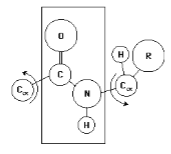
- Aabsence of rotation around the C—N bond because of its partial double-bond character.
- Bplane of rotation around the C—N bond.
- Cregion of steric hindrance determined by the large C=O group.
- Dregion of the peptide bond that contributes to a Ramachandran plot.
- Etheoretical space between –180 and +180 degrees that can be occupied by the and angles in
the peptide bond.
8Which of the following best represents the backbone arrangement of two peptide bonds?
- ACa—N—Ca—C—Ca—N—Ca—C
- BCa—N—C—C—N—Ca
- CC—N—Ca—Ca—C—N
- DCa—C—N—Ca—C—N
- ECa—Ca—C—N—Ca—Ca—C
9Which of the following pairs of bonds within a peptide backbone show free rotation around both bonds?
- ACa—C and N—Ca
- BC=O and N—C
- C C=O and N—Ca
- DN—C and Ca—C
- EN—Ca and N—C
10Roughly how many amino acids are there in one turn of an helix?
- A1
- B2.8
- C3.6
- D4.2
- E10
11In the a-helix the hydrogen bonds:
- Aare roughly parallel to the axis of the helix.
- Bare roughly perpendicular to the axis of the helix.
- Coccur mainly between electronegative atoms of the R groups.
- Doccur only between some of the amino acids of the helix.
- Eoccur only near the amino and carboxyl termini of the helix.
12In an a-helix, the R groups on the amino acid residues:
- Aalternate between the outside and the inside of the helix.
- Bare found on the outside of the helix spiral.
- Ccause only right-handed helices to form.
- Dgenerate the hydrogen bonds that form the helix.
- Estack within the interior of the helix.
13Thr and/or Leu residues tend to disrupt an a helix when they occur next to each other in a protein because:
- Aan amino acids like Thr is highly hydrophobic.
- Bcovalent interactions may occur between the Thr side chains.
- Celectrostatic repulsion occurs between the Thr side chains.
- Dsteric hindrance occurs between the bulky Thr side chains.
- Ethe R group of Thr can form a hydrogen bond.
14A D-amino acid would interrupt an a helix made of L-amino acids. Another naturally occurring
hindrance to the formation of an a helix is the presence of:- Aa negatively charged Arg residue.
- Ba nonpolar residue near the carboxyl terminus.
- Ca positively charged Lys residue.
- Da Pro residue.
- Etwo Ala residues side by side.
15An a helix would be destabilized most by:
- Aan electric dipole spanning several peptide bonds throughout the a helix.
- Binteractions between neighboring Asp and Arg residues.
- Cinteractions between two adjacent hydrophobic Val residues.
- Dthe presence of an Arg residue near the carboxyl terminus of the helix.
- Ethe presence of two Lys residues near the amino terminus of the helix.
16The major reason that antiparallel -stranded protein structures are more stable than parallel B-
stranded structures is that the latter:- Aare in a slightly less extended configuration than antiparallel strands.
- Bdo not have as many disulfide crosslinks between adjacent strands.
- Cdo not stack in sheets as well as antiparallel strands.
- Dhave fewer lateral hydrogen bonds than antiparallel strands.
- Ehave weaker hydrogen bonds laterally between adjacent strands.
17Amino acid residues commonly found in the middle of B turn are:
- AAla and Gly.
- Bhydrophobic.
- CPro and Gly.
- Dthose with ionized R-groups.
- Etwo Cys.
18A sequence of amino acids in a certain protein is found to be -Ser-Gly-Pro-Gly-. The sequence is
most probably part of a(n):- Aantiparallel B sheet.
- Bparallel B sheet.
- Ca helix.
- Da sheet.
- EB turn
19The three-dimensional conformation of a protein may be strongly influenced by amino acid residues
that are very far apart in sequence. This relationship is in contrast to secondary structure, where the
amino acid residues are:- Aalways side by side.
- Bgenerally near each other in sequence.
- Cinvariably restricted to about 7 of the 20 standard amino acids.
- Doften on different polypeptide strands.
- Eusually near the polypeptide chain’s amino terminus or carboxyl terminus.
20The a-keratin chains indicated by the diagram below have undergone one chemical step. To alter the
shape of the a-keratin chains—as in hair waving—what subsequent steps are required?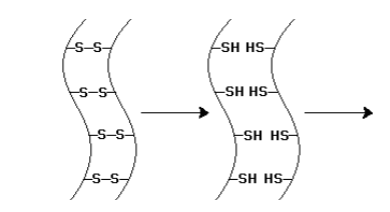
- AChemical oxidation and then shape remodeling
- BChemical reduction and then chemical oxidation
- CChemical reduction and then shape remodeling
- DShape remodeling and then chemical oxidation
- EShape remodeling and then chemical reduction
21Which of the following statements is false?
- ACollagen is a protein in which the polypeptides are mainly in the -helix conformation.
- BDisulfide linkages are important for keratin structure.
- CGly residues are particularly abundant in collagen.
- DSilk fibroin is a protein in which the polypeptide is almost entirely in the B conformation.
- Ea-keratin is a protein in which the polypeptides are mainly in the -helix conformation.
22Kendrew’s studies of the globular myoglobin structure demonstrated that:
- A“corners” between -helical regions invariably lacked proline residue.
- Bhighly polar or charged amino-acid residues tended to be located interiorally.
- Cmyoglobin was completely different from hemoglobin, as expected.
- Dthe structure was very compact, with virtually no internal space available for water.
- Ethe a helix predicted by Pauling and Corey was not found in myoglobin.
23Proteins often have regions that can fold and function as an independent entity from the whole
protein. These regions are called:- Adomains.
- Boligomers.
- Cpeptides.
- Dsites.
- Esubunits
24Which of the following statements concerning protein domains is true?
- AThey are a form of secondary structure.
- BThey are examples of structural motifs.
- CThey consist of separate polypeptide chains (subunits).
- DThey have been found only in prokaryotic proteins.
- EThey may retain their correct shape even when separated from the rest of the protein.
25The structural classification of proteins (based on motifs) is based primarily on their:
- Aamino-acid sequence.
- Bevolutionary relationships.
- Cfunction.
- Dsecondary structure content and arrangement.
- Esubunit content and arrangement.
26Proteins are classified within families or superfamilies based on similarities in:
- Aevolutionary origin.
- Bphysico-chemical properties.
- Cstructure and/or function.
- Dsubcellular location.
- Esubunit structure.
27Which of the following statements about oligomeric proteins is false?
- AA subunit may be similar to other proteins.
- BAll subunits must be identical.
- CMany have regulatory roles.
- DSome oligomeric proteins can further associate into large fibers.
- ESome subunits may have nonprotein prosthetic groups.
28A repeating structural unit in a multimeric protein is known as a(n):
- Adomain.
- Bmotif.
- Coligomer.
- Dprotomer.
- Esubunit.
29Proteostasis is the cellular process by which:
- Aproteins are synthesized.
- Bproteins are folder.
- Cproteins are modified.
- Dproteins are degraded.
- Eproteins are maintained.
30An average protein will not be denatured by:
- Aa detergent such as sodium dodecyl sulfate.
- Bheating to 90°C.
- Ciodoacetic acid.
- DpH 10.
- Eurea.
31Which of the following is least likely to result in protein denaturation?
- AAltering net charge by changing pH
- BChanging the salt concentration
- CDisruption of weak interactions by boiling
- DExposure to detergents
- EMixing with organic solvents such as acetone
32Experiments on denaturation and renaturation after the reduction and reoxidation of the —S—S—
bonds in the enzyme ribonuclease (RNase) have shown that:- Afolding of denatured RNase into the native, active conformation, requires the input of energy in the form of heat.
- Bnative ribonuclease does not have a unique secondary and tertiary structure.
- Cthe completely unfolded enzyme, with all —S—S— bonds broken, is still enzymatically active.
- Dthe enzyme, dissolved in water, is thermodynamically stable relative to the mixture of amino acids whose residues are contained in RNase.
- Ethe primary sequence of RNase is sufficient to determine its specific secondary and tertiary structure.
33Which of the following statements concerning the process of spontaneous folding of proteins is false?
- AIt may be an essentially random process.
- BIt may be defective in some human diseases.
- CIt may involve a gradually decreasing range of conformational species.
- DIt may involve initial formation of a highly compact state.
- EIt may involve initial formation of local secondary structure.
34Protein S will fold into its native conformation only when protein Q is also present in the solution. However, protein Q can fold into its native conformation without protein S. Protein Q, therefore, may function as a ____________ for protein S.
- Aproteasome
- Bmolecular chaperone
- Cprotein precursor
- Dstructural motif
- Esupersecondary structural unit
35Which of the following is not known to be involved in the process of assisted folding of proteins?
- AChaperonins
- BDisulfide interchange
- CHeat shock proteins
- DPeptide bond condensation
- EPeptide bond isomerization
Informações
- Descrição
- Quiz sobre ch 4, criado por skittlesdx em 08-07-2015.
- Autor
- skittlesdx
- Idioma
- English
- Visualizações
- 0
- Avaliação
- Ainda sem avaliações Avalie este quiz