
Quiz
ch 6
Crie uma conta grátis para terminar este quiz
Salve seu progresso e veja sua nota final.
Já tem uma conta? Inicie sessão
Perguntas do quiz (42)
1One of the enzymes involved in glycolysis, aldolase, requires Zn2+ for catalysis. Under conditions of
zinc deficiency, when the enzyme may lack zinc, it would be referred to as the:- Aapoenzyme
- Bcoenzyme
- Choloenzyme
- Dprosthetic group
- Esubstrate
2Which one of the following is not among the six internationally accepted classes of enzymes?
- AHydrolases
- BLigases
- COxidoreductases
- DPolymerases
- ETransferases
3Enzymes are potent catalysts because they:
- Aare consumed in the reactions they catalyze.
- Bare very specific and can prevent the conversion of products back to substrates.
- Cdrive reactions to completion while other catalysts drive reactions to equilibrium.
- Dincrease the equilibrium constants for the reactions they catalyze.
- Elower the activation energy for the reactions they catalyze.
4The role of an enzyme in an enzyme-catalyzed reaction is to:
- Abind a transition state intermediate, such that it cannot be converted back to substrate.
- Bensure that all of the substrate is converted to product.
- Censure that the product is more stable than the substrate.
- Dincrease the rate at which substrate is converted into product.
- Emake the free-energy change for the reaction more favorable.
5Which one of the following statements is true of enzyme catalysts?
- ATheir catalytic activity is independent of pH.
- BThey are generally equally active on D and L isomers of a given substrate.
- CThey can increase the equilibrium constant for a given reaction by a thousand fold or more.
- DThey can increase the reaction rate for a given reaction by a thousand-fold or more.
- ETo be effective, they must be present at the same concentration as their substrate.
6Which one of the following statements is true of enzyme catalysts?
- AThey bind to substrates but are never covalently attached to substrate or product.
- BThey increase the equilibrium constant for a reaction, thus favoring product formation.
- CThey increase the stability of the product of a desired reaction by allowing ionizations,
resonance, and isomerizations not normally available to substrates. - DThey lower the activation energy for the conversion of substrate to product.
- ETo be effective, they must be present at the same concentration as their substrates.
7Which of the following statements is false?
- AA reaction may not occur at a detectable rate even though it has a favorable equilibrium.
- BAfter a reaction, the enzyme involved becomes available to catalyze the reaction again.
- CFor S -> P, a catalyst shifts the reaction equilibrium to the right.
- DLowering the temperature of a reaction will lower the reaction rate.
- ESubstrate binds to an enzyme's active site.
8Enzymes differ from other catalysts in that only enzymes:
- Aare not consumed in the reaction.
- Bdisplay specificity toward a single reactant.
- Cfail to influence the equilibrium point of the reaction.
- Dform an activated complex with the reactants.
- Elower the activation energy of the reaction catalyzed.
9Compare the two reaction coordinate diagrams below and select the answer that correctly describes
their relationship. In each case, the single intermediate is the ES complex.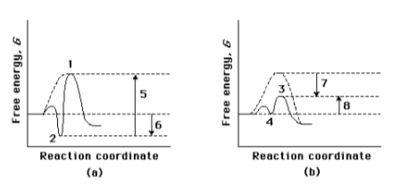
- A(a) describes a strict “lock and key” model, whereas (b) describes a transition-state
complementarity model. - BThe activation energy for the catalyzed reaction is 5 in (a) and is 7 in (b).
- CThe activation energy for the uncatalyzed reaction is given by 5 + 6 in (a) and by 7 + 4 in (b).
- DThe contribution of binding energy is given by 5 in (a) and by 7 in (b).
- EThe ES complex is given by 2 in (a) and 3 in (b).
- A(a) describes a strict “lock and key” model, whereas (b) describes a transition-state
10Which of the following is true of the binding energy derived from enzyme-substrate interactions?
- AIt is sometimes used to hold two substrates in the optimal orientation for reaction.
- BIt cannot provide enough energy to explain the large rate accelerations brought about by enzymes.
- CIt is the result of covalent bonds formed between enzyme and substrate.
- DMost of it is derived from covalent bonds between enzyme and substrate.
- EMost of it is used up simply binding the substrate to the enzyme.
11The concept of “induced fit” refers to the fact that:
- Aenzyme specificity is induced by enzyme-substrate binding.
- Benzyme-substrate binding induces an increase in the reaction entropy, thereby catalyzing the reaction.
- Cenzyme-substrate binding induces movement along the reaction coordinate to the transition state.
- Dsubstrate binding may induce a conformational change in the enzyme, which then brings catalytic
groups into proper orientation. - Ewhen a substrate binds to an enzyme, the enzyme induces a loss of water (desolvation) from the
substrate.
12In the following diagram of the first step in the reaction catalyzed by the protease chymotrypsin, the
process of general base catalysis is illustrated by the number ________, and the process of covalent
catalysis is illustrated by the number _________.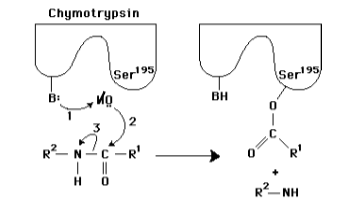
- A1; 2
- B1; 3
- C2; 2
- D2; 3
- E3; 2
13The benefit of measuring the initial rate of a reaction V0 is that at the beginning of a reaction:
- A[ES] can be measured accurately.
- Bchanges in [S] are negligible, so [S] can be treated as a constant.
- Cchanges in Km are negligible, so Km can be treated as a constant.
- DV0 = Vmax.
- Evarying [S] has no effect on V0.
14Which of the following statements about a plot of V0 vs. [S] for an enzyme that follows Michaelis-
Menten kinetics is false?- AAs [S] increases, the initial velocity of reaction V0 also increases.
- BAt very high [S], the velocity curve becomes a horizontal line that intersects the y-axis at Km.
- CKm is the [S] at which V0 = 1/2 Vmax.
- DThe shape of the curve is a hyperbola.
- EThe y-axis is a rate term with units of m/min.
15Michaelis and Menten assumed that the overall reaction for an enzyme-catalyzed reaction could be
written as
k1 k2
E + S <-> ES -> E + P
k-1- Ak1 ([Et] [ES]).
- Bk1 ([Et] [ES])[S].
- Ck2 [ES].
- Dk-1 [ES] + k2 [ES].
- Ek-1 [ES].
16The steady state assumption, as applied to enzyme kinetics, implies:
- AKm = Ks.
- Bthe enzyme is regulated.
- Cthe ES complex is formed and broken down at equivalent rates.
- Dthe Km is equivalent to the cellular substrate concentration.
- Ethe maximum velocity occurs when the enzyme is saturated.
17An enzyme-catalyzed reaction was carried out with the substrate concentration initially a thousand
times greater than the Km for that substrate. After 9 minutes, 1% of the substrate had been converted
to product, and the amount of product formed in the reaction mixture was 12 mol. If, in a separate
experiment, one-third as much enzyme and twice as much substrate had been combined, how long
would it take for the same amount (12 mol) of product to be formed?- A1.5 min
- B13.5 min
- C27 min
- D3 min
- E6 min
18Which of these statements about enzyme-catalyzed reactions is false?
- AAt saturating levels of substrate, the rate of an enzyme-catalyzed reaction is proportional to the
enzyme concentration. - BB) If enough substrate is added, the normal Vmax of a reaction can be attained even in the presence of
a competitive inhibitor. - CThe rate of a reaction decreases steadily with time as substrate is depleted.
- DThe activation energy for the catalyzed reaction is the same as for the uncatalyzed reaction, but
the equilibrium constant is more favorable in the enzyme-catalyzed reaction. - EThe Michaelis-Menten constant Km equals the [S] at which V = 1/2 Vmax.
- AAt saturating levels of substrate, the rate of an enzyme-catalyzed reaction is proportional to the
19The following data were obtained in a study of an enzyme known to follow Michaelis-Menten
kinetics:
(mol/min) (mmol/L)
V0 Substrate added
—————————————
217 0.8
325 2
433 4
488 6
647 1,000- A1 mM
- B1000 mM
- C2 mM
- D4 mM
- E6 mM
20For enzymes in which the slowest (rate-limiting) step is the reaction
k2
ES -> P
Km becomes equivalent to:- Akcat
- Bthe [S], where V0 = Vmax.
- Cthe dissociation constant, Kd, for the ES complex.
- Dthe maximal velocity.
- Ethe turnover number.
21For the simplified representation of an enzyme-catalyzed reaction shown below, the
statement “ES is in steady-state” means that:
k1 k2
E + S <-> ES <-> E + P
k-1 k-2- Ak2 is very slow.
- Bk1= k2.
- Ck1= k-1.
- Dk1[E][S] = k-1[ES] + k2[ES].
- Ek1[E][S] = k-1[ES].
22The Lineweaver-Burk plot is used to:
- Adetermine the equilibrium constant for an enzymatic reaction.
- Bextrapolate for the value of reaction rate at infinite enzyme concentration.
- Cillustrate the effect of temperature on an enzymatic reaction.
- Dsolve, graphically, for the rate of an enzymatic reaction at infinite substrate concentration.
- Esolve, graphically, for the ratio of products to reactants for any starting substrate concentration.
23The double-reciprocal transformation of the Michaelis-Menten equation, also called the Lineweaver-
Burk plot, is given by
1/V0 = Km /(Vmax[S]) + 1/Vmax
To determine Km from a double-reciprocal plot, you would:- Amultiply the reciprocal of the x-axis intercept by -1.
- Bmultiply the reciprocal of the y-axis intercept by -1.
- Ctake the reciprocal of the x-axis intercept.
- Dtake the reciprocal of the y-axis intercept.
- Etake the x-axis intercept, where V0 = 1/2 Vmax.
24To calculate the turnover number of an enzyme, you need to know:
- Athe enzyme concentration.
- Bthe initial velocity of the catalyzed reaction at [S] >> Km.
- Cthe initial velocity of the catalyzed reaction at low [S].
- Dthe Km for the substrate.
- Eboth A and B.
25The number of substrate molecules converted to product in a given unit of time by a single enzyme
molecule at saturation is referred to as the:- Adissociation constant.
- Bhalf-saturation constant.
- Cmaximum velocity.
- DMichaelis-Menten number.
- Eturnover number.
26In a plot of l/V against 1/[S] for an enzyme-catalyzed reaction, the presence of a competitive inhibitor
will alter the:- Acurvature of the plot.
- Bintercept on the l/[S] axis.
- Cintercept on the l/V axis.
- DpK of the plot.
- EVmax.
27In competitive inhibition, an inhibitor:
- Abinds at several different sites on an enzyme.
- Bbinds covalently to the enzyme.
- Cbinds only to the ES complex.
- Dbinds reversibly at the active site.
- EE) lowers the characteristic Vmax of the enzyme.
28Vmax for an enzyme-catalyzed reaction:
- Agenerally increases when pH increases.
- Bincreases in the presence of a competitive inhibitor.
- Cis limited only by the amount of substrate supplied.
- Dis twice the rate observed when the concentration of substrate is equal to the Km.
- Eis unchanged in the presence of a uncompetitive inhibitor.
29Enzyme X exhibits maximum activity at pH = 6.9. X shows a fairly sharp decrease in its activity
when the pH goes much lower than 6.4. One likely interpretation of this pH activity is that:- Aa Glu residue on the enzyme is involved in the reaction.
- Ba His residue on the enzyme is involved in the reaction.
- Cthe enzyme has a metallic cofactor.
- Dthe enzyme is found in gastric secretions.
- Ethe reaction relies on specific acid-base catalysis.
30Phenyl-methane-sulfonyl-fluoride (PMSF) inactivates serine proteases by binding covalently to the
catalytic serine residue at the active site; this enzyme-inhibitor bond is not cleaved by the enzyme.
This is an example of what kind of inhibition?- AIrreversible
- BCompetitive
- CNon-competitive
- DMixed
- EpH inhibition
31Both water and glucose share an —OH that can serve as a substrate for a reaction with the terminal
phosphate of ATP catalyzed by hexokinase. Glucose, however, is about a million times more reactive
as a substrate than water. The best explanation is that:- Aglucose has more —OH groups per molecule than does water.
- Bthe larger glucose binds better to the enzyme; it induces a conformational change in hexokinase
that brings active-site amino acids into position for catalysis. - Cthe —OH group of water is attached to an inhibitory H atom, while the glucose —OH group is
attached to C. - Dwater and the second substrate, ATP, compete for the active site resulting in a competitive
inhibition of the enzyme. - Ewater normally will not reach the active site because it is hydrophobic.
32A good transition-state analog:
- Abinds covalently to the enzyme.
- Bbinds to the enzyme more tightly than the substrate.
- Cbinds very weakly to the enzyme.
- Dis too unstable to isolate.
- Emust be almost identical to the substrate.
33A transition-state analog:
- Ais less stable when binding to an enzyme than the normal substrate.
- Bresembles the active site of general acid-base enzymes.
- Cresembles the transition-state structure of the normal enzyme-substrate complex.
- Dstabilizes the transition state for the normal enzyme-substrate complex.
- Etypically reacts more rapidly with an enzyme than the normal substrate.
34The role of the metal ion (Mg2+) in catalysis by enolase is to:
- Aact as a general acid catalyst.
- Bact as a general base catalyst.
- Cfacilitate general acid catalysis.
- Dfacilitate general base catalysis.
- Estabilize protein conformation.
35Penicillin and related drugs inhibit the enzyme ; this enzyme is produced by .
- A-lacamase; bacteria
- Btranspeptidase; human cells
- Ctranspeptidase; bacteria
- Dlysozyme; human cells
- Ealdolase; bacteria
36Which of the following statements about allosteric control of enzymatic activity is false?
- AA) Allosteric effectors give rise to sigmoidal V0 vs. [S] kinetic plots.
- BAllosteric proteins are generally composed of several subunits.
- CAn effector may either inhibit or activate an enzyme.
- DBinding of the effector changes the conformation of the enzyme molecule.
- EHeterotropic allosteric effectors compete with substrate for binding sites.
37A small molecule that decreases the activity of an enzyme by binding to a site other than the catalytic
site is termed a(n):- Aallosteric inhibitor.
- Balternative inhibitor.
- Ccompetitive inhibitor.
- Dstereospecific agent.
- Etransition-state analog.
38Allosteric enzymes:
- Aare regulated primarily by covalent modification.
- Busually catalyze several different reactions within a metabolic pathway.
- Cusually have more than one polypeptide chain.
- Dusually have only one active site.
- Eusually show strict Michaelis-Menten kinetics.
39Which of the following has not been shown to play a role in determining the specificity of protein
kinases?- ADisulfide bonds near the phosphorylation site
- BPrimary sequence at phosphorylation site
- CProtein quaternary structure
- DProtein tertiary structure
- EResidues near the phosphorylation site
40How is trypsinogen converted to trypsin?
- AA protein kinase-catalyzed phosphorylation converts trypsinogen to trypsin.
- BAn increase in Ca2+ concentration promotes the conversion.
- CProteolysis of trypsinogen forms trypsin.
- DTrypsinogen dimers bind an allosteric modulator, cAMP, causing dissociation into active trypsin
monomers. - ETwo inactive trypsinogen dimers pair to form an active trypsin tetramer.
41The allosteric enzyme ATCase is regulated by CTP, which binds to the T-state of ATCase.
CTP is a:- Apositive regulator.
- Bnegative regulator.
- Cco-factor.
- Dcompetitive inhibitor.
- Ecoenzyme.
42Blood coagulation involves:
- Aa kinase cascade.
- Bzymogen activation.
- Cserine proteases.
- DA and B.
- EB and C.
Informações
- Descrição
- Quiz sobre ch 6, criado por skittlesdx em 08-07-2015.
- Autor
- skittlesdx
- Idioma
- English
- Visualizações
- 0
- Avaliação
- Ainda sem avaliações Avalie este quiz