
Quiz
Connective tissue
Este quiz tem tipos de pergunta que abrem no player de sempre.
Perguntas do quiz (13)
1Connective tissue is made up of:
- ACells which are few in number and a matrix made up of ground substance and fibres
- BCells which are high in number and a matrix made up of ground substance and fibres
- CNo cells and a matrix made up of ground substance and fibres
2Concerning the types of fibres found in connective tissue:
[blank_start]Collagen[blank_end] fibres have high tensile strength. [blank_start]Elastin[blank_end] fibres give stretch and recoil. [blank_start]Reticular[blank_end] fibres form a mesh/network around organs.- ACollagen
- BElastin
- CReticular
3Complete the paragraph to correctly describe the functions of some of the main cells found in connective tissue. [blank_start]Fibroblasts[blank_end] produce fibres. [blank_start]Chondroblasts[blank_end] build cartilage, [blank_start]Osteoblasts[blank_end] build bone. [blank_start]Macrophages[blank_end] carry out phagocytosis. [blank_start]Plasma cells[blank_end] produce antibodies. [blank_start]Mast cells[blank_end] produce histamine,
- AFibroblasts
- BChondroblasts
- COsteoblasts
- DMacrophages
- EPlasma cells
- FMast cells
4Another name for articular cartilage is [blank_start]hyaline[blank_end] cartilage
- Ahyaline
5Match up the type of cartilage with the place in the body.
[blank_start]Articular[blank_end] carilage - Ends of bones and joints
[blank_start]Elastic[blank_end] cartilage - within blood vessel walls
[blank_start]Fibrocartilage[blank_end] - pubic symphysis- AArticular
- BElastic
- CFibrocartilage
6The process by which biomechanical forces regulate cell activity to control the orientation of fibres within connective tissue is known as
- AMechanotransduction
- BSynovial sweep
- COsmosis
- DWolf's law
7Identify any facts that are true about articular cartilage
- AIt lines synovial joints
- BIt is slippy - has a high co-efficient of friction
- CIt is spongy - can resist/conform to pressure
- DIt has a high number of collagen fibres
- EIt is aneural and avascular
- FIt has a low water content
- GIt contains osteoblasts
8The ground substance is made up of:
- ATissue fluid, proteoglycans, glycosaminoglycans and adhesion proteins
- BTissue fluid, phagocytes, proteoglycans, glycosaminoglycans
- CTissue fluid, fibres, proteoglycans and glycosaminoglycans
- DProteoglycans, glycosaminoglycans, adhesion proteins and collagen
9he cells in cartilage which produce collagen fibres are called chondroblasts - a type of fibroblast.
Within the ground substance there GAG chains. GAGS chains are [blank_start]negatively[blank_end] charged and therefore attract positively charged [blank_start]cations[blank_end]. This creates an [blank_start]osmotic[blank_end] gradient which draws water towards the GAG chains. This means that cartilage has a high [blank_start]water[blank_end] content. Due to the fact that the GAG chains are negatively charged, the chains repel each other which creates an internal [blank_start]pressure[blank_end]. When cartilage is put under tension, for example in the movement of a joint, the GAG chains are forced closer together. This forces water out of the cartilage tissue and into the [blank_start]synovial[blank_end] fluid. The water that leaves cartilage contains any waste products (e.g carbon dioxide). As the tension is reduced the GAG chains will spring back to their original position. This draws water back into the cartilage and brings with it dissolved oxygen and nutrients. This process is known as [blank_start]hydrokinetic transport[blank_end] or synovial sweep. This process is essential for supply of oxygen and nutrients due to the fact that cartilage does not have it's own [blank_start]blood[blank_end] supply.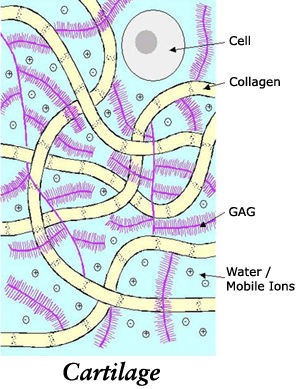
- Anegatively
- Bcations
- Cosmotic
- Dwater
- Epressure
- Fsynovial
- Ghydrokinetic transport
- Hblood
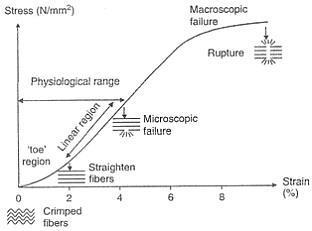
10The diagram shows the stress-strain curve. Rupture in a tendon happens at which stage of the stress-strain curve?
- AToe
- BElastic
- CPlastic
- DNecking
11Which diagrams shows the distribution of collagen fibres in tendons and ligaments
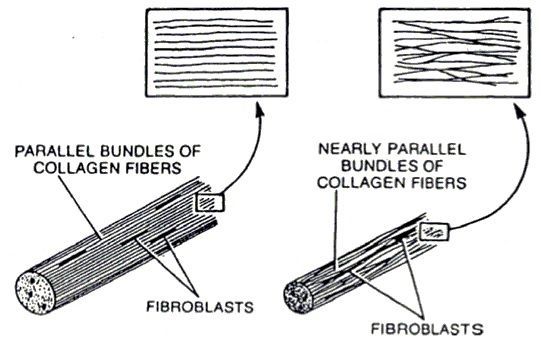
- ATendon
- Bligament
12Which are the following statements are true regarding the effects of movement on connective tissue?
- APromotes Fibre and GAG synthesis
- BEncourages optimum orientation of cells and fibres
- CSupports appropriate water content to control nutrition and metabolic clearance
13Connective tissue is visco-elastic. This means that it's pliability is dependent on temperature.
- AVerdadeiro
- BFalso
Informações
- Descrição
- Connective tissue
- Autor
- rachel_w
- Idioma
- English
- Visualizações
- 199
- Etiquetas
- Avaliação
- 3,0 de 5 · 1 avaliação Avalie este quiz