
Quiz
70-410 - MCSA: Windows Server 2012 - Installing and Configuring - Exam 1
Este quiz tem tempo limite, por isso abre no player de sempre.
Perguntas do quiz (50)
1You have a server named Server1 that runs Windows Server 2012 R2. Server1 has the Hyper-V server role installed. An iSCSI SAN is available on the network. Server1 hosts four virtual machines named VM1, VM2, VM3 and VM4. You create a LUN on the SAN to host the virtual hard drives for the virtual machines. You need to create a 3-TB virtual hard disk for VM1 on the LUN. The solution must prevent VM1 from being paused if the LUN runs out of disk space. What type of virtual hard disk should you create on the LUN?
- AFixed-size VHD
- BDynamically expanding VHD
- CFixed-size VHDX
- DDynamically expanding VHDX
2Your network contains an Active Directory domain named adatum.com. The domain contains a member server named Host1. Host1 runs Windows Server 2012 R2 and has the Hyper-V role installed. Host1 has two virtual machines named VM5 and VM6. Both virtual machines connect to a virtual switch named Virtual1. On VM5, you install a network monitoring application named Monitor1. You need to capture all of the inbound and outbound traffic to VM6 using Monitor1. Which two command should you run from Windows Powershell?
- AGet-VM "VM5" | Set-VMNetworkAdapter -PortMirroing Destination
- BGet-VM "VM6" | Set-VMNetworkAdapter -IovWeight 1
- CGet-VM "VM6" | Set-VMNetworkAdapter -AllowTeaming On
- DGet-VM "VM6" | Set-VMNetworkAdapter -PortMirroring Source
- EGet-VM "VM5" | Set-VMNetworkAdapter -IovWeight 0
3You have a Hyper-V host named Server1 that runs Windows Server 2012 R2. Server1 has two network cards named NIC1 and NIC2 and two vritual switches vSwitch1 and vSwitch2. Both switches are external virtual switches. vSwitch1 uses NIC1 as its physical network adapter and vSwitch2 uses NIC2 as its physical network adapter. You create a virtual machine named VM1. VM1 has two network adapters. One network adapter connects to vSwitch1 and the other connects to vSwitch2. You need to configure NIC teaming on VM1. You need to ensure that if a physical NIC fails on Server1, VM1 remains connected to the network. What should you do on Server1?
- AAdd a new network adapter to VM1
- BModify the properties of vSwitch1 and vSwitch2
- CCreate a new virtual switch on Server1
- DRun the Set-VMNetworkAdapter cmdlet
4Your router contains two Hyoer-V hosts that run Windows Server 2012 R2. They Hyper-V host contains several virtual machines running Server 2012 R2. You install the Network Load Balancing feature on the virtual machines. You need to configure the virtual machines to support Network Load Balancing (NLB). What should you configure?
- ADHCP Guard
- BRouter Guard
- CPort Mirroring
- DMAC Address
5You have a server named Server1 that runs Windows Server 2012 R2. Server1 has the Hyper-V server role installed. Server1 is connected to two Fibre Channel SANS (SAN1 and SAN2) with 4 Host bus adapters (HBA1, HBA2, HBA3, and HBA4). HBA1 and HBA3 connect to SAN1. HBA2 and HBA4 connect to SAN2. You have a virtual machine named VM1 hosted on Server1. You need to configure VM1 to connect to SAN1. What should you do first?
- ACreate a Hyper-V virtual switch.
- BAdd one HBA
- CCreate a Virtual Fibre Channel SAN
- DConfigure Network Adapter Teaming
6Your network contains an Active Directory domain named contoso.com. The domain contains a server named Server1. Server1 runs Windows Server 2012 R2 and has the Hyper-V server role instaled. On Server1, you create and start a virtual machine named VM1. VM1 is configured with a fixed size 100GB disk. VM1 has its minimum RAM set to 2048 MB and maximum RAM set to 4096 MB. You need to recommend a solution to minimize the amount of disk space used for the checkpoint of VM1. What should you do before you create the checkpoint?
- AShutdown VM1.
- BRun the Resize-VHD cmdlet.
- CRun the Convert-VHD cmdlet.
- DConvert Disk1.vhd to a dynamically expanding disk.
7You have a print server named Server1 that runs Windows Server 2012 R2. You discover that when there are many pending print jobs, the system drive occasionally runs out of free space. You add a new hard disk to Server1. You create an NTFS volume. You need to prevent the print jobs from consuming disk space on the system volume. What should you modify?
- AThe properties of each shared printer
- BThe properties of the new volume
- CThe Print Server Properties
- DThe properties of the Print Spooler service
8Your network contains an Active Directory domain named adatum.com. The domain contains a server named Server1. Server1 runs Windows Server 2012 R2. On a server named Core1, you perform a Server Core installation of Windows Server 2012 R2. You join Core1 to the adatum.com domain. You need to ensure that you can use Event Viewer on Server1 to view the event logs on Core1. What should you do on Core1?
- ARun the Enable-NetFirewallRule cmdlet
- BRun the Disable-NetFirewallRule cmdlet
- CInstall Remote Server Administration Tools (RSAT)
- DInstall Windows Management Framework
9Your network contains two servers named Server1 and Server2 that run Windows Server 2012 R2. Server1 and Server2 are part of a workgroup. On Server1 and Server2 you create a local user account named Admin1. You add the account to the local Administrators group. On both servers Admin1 has the same password. You log on to Server1 as Admin1. You open a Computer Management and connect to Server2. When you attempt to create a scheduled task, view the Event Logs, and manage the shared folders, you receive Access Denied messages. You need to ensure you can administer Server2 remotely from Server1 by using Computer Management. What should you configure on Server2?
- AFrom Server manager modify the Remote Management setting.
- BFrom Local Users and Groups, modify the membership of the Remote Management setting.
- CFrom Windows Firewall, modify the Windows Management Instrumentation (WMI) firewall rule.
- DFrom Registry Editor, configure the LocalAccountTokenFilterPolicy value.
10Your network contains a server named Server1 that runs WIndows Server 2012 R2. Server1 has the Hyper-V role installed. Server1 hosts four virtual machines named VM1, VM2, VM3, and VM4. Server1 is configured with eight network adapters. You install Windows Server 2012 R2 on VM2 by using Windows Deployment Services (WDS). You need to ensure that the next time VM2 restarts, you can connect to the WDS server using PXE. Which virtual machine setting should you configure on VM2?
- AVirtual Machine Chimney
- BProcessor Compatibility
- CStartup Order
- DNUMA Topology
- EAutomatic Start Action
11Your network contains a server named Server1 that runs Windows Server 2012 R2. Server1 has the Hyper-V role installed. Server1 hosts four virtual machines named VM1, VM2, VM3, and VM4. Server1 is configured with eight network adapters. You plan to schedule a complete backup of Server1 using Windows Server Backup. You need to ensure that the state of VM1 is saved before the backup starts. What should you configure?
- AResource Control
- BPort Mirroring
- CResource Metering
- DIntegration Services
- EThe VLAN ID
12Your network contains a server named Server1 that runs Windows Server 2012 R2. Server1 has the Hyper-V role installed. Server1 hosts four virtual machines named VM1, VM2, VM3, and VM4. Server1 is configured with eight network adapters that support VMQ and PCI-SIG. You need to ensure that the network traffic of VM2 bypasses the virtual switches of the parent partition. What should you configure?
- APort Mirroring
- BSingle-root I/O Virtualization
- CResource Control
- DIntegration Services
- ENUMA Topology
13Your network contains a server named Server1 that runs Windows Server 2012 R2. Server1 has the Hyper-V role installed. Server1 hosts four virtual machines named VM1, VM2, VM3, and VM4. Server1 has eight quad-core CPUs that have NUMA access. You need to ensure that VM1 can use more CPU time than other virtual machines when the CPUs on Server1 are under heavy load. What should you configure?
- ANUMA Topology
- BResource Control
- CResource Metering
- DIntegration Services
- EVirtual Machine Chimney
14Your network contains an Active Directory domain named contoso.com. You have a Group Policy Object (GPO) named GP1 that is linked to the domain. GP1 contains a software restriction policy that blocks an application named App1. You have a workgroup computer named Computer1 that runs Windows 8. A local Group Policy on Computer1 contains an application control policy that allows App1. You join Computer1 to the domain. You need to prevent App1 from running on Computer1. What should you do?
- AIn the local Group Policy of Computer1, configure a software restriction policy
- BFrom Computer1, run gpupdate /force.
- CFrom Group Policy Management, enable the Enforced option of GP1.
- DFrom the Group Policy Management, add an application control policy..
15Your network contains an Active Directory domain named contoso.com. All client computer accounts are in an OU named AllComputers. Client computers run Windows 7 and Windows 8. You create a GPO named GP1. You link G1 to the AllComputers OU. You need to ensure that GP1 applies only to computers who have more than 8GB of memory. What should you configure?
- AThe Block Inheritence option for AllComputers
- BThe Security Settings of GP1
- CThe Security Settings of AllComputers
- DThe WMI filter for GP1
16Your network contains an Active Directory domain named contoso.com. The domain contains an application server named Server1. Server1 runs Windows Server 2012 R2. Server1 is configured as an FTP server. Client computers use an FTP application named App1.exe. App1.exe uses TCP port 21. On Server1 you create a firewall rule to allow connections on TCP port 21. You need to configure Server1 to support the client connections from App1.exe. What should you do?
- ARun netsh firewall addportopening TCP 21 dynamic FTP
- BCreate an isolation connection security rule
- CCreate an inbound firewall rule to allow App1.exe
- DRun netsh advfirewall set global statefulftp disable
17Your network contains an Active Directory domain named contoso.com. All client computers run Windows 8. You deploy a server named Server1 that runs Windows Server 2012 R2. You install a new client-server application named App1 on Server1 and on the client computers. The client computers must use TCP port 6444 to connect to App1. Server1 publishes the information of App1 to an intranet server named Server2 by using TCP port 3080. You need to ensure that all of the client computers can connect to App1. The solution must ensure that the application can connect to Server2. Which Windows Firewall rule should you create on Server1?
- AAn outbound rule to allow a connection to TCP port 3080.
- BAn inbound rule to allow a connection to TCP port 6444.
- CAn inbound rule to allow a connection to TCP port 3080.
- DAn outbound rule to allow a connection to TCP port 6444.
18Your network contains an Active Directory domain named contoso.com. The domain contains two servers named Server1 and Server2 that run Windows Server 2012 R2. You create a security template named Template1 by using the Security Templates Snap-In. You need to apply Template1 to Server2. Which tool should you use?
- AAuthorization Manager
- BLocal Security Policy
- CSystem Configuration
- DCertificate Templates
19Your network contains multiple subnets. On one of the subnets, you deploy a server named Server1 that runs Windows Server 2012 R2. You install the DNS server role on Server1, and then create a standard primary zone named contoso.com. You need to ensure all client computers can resolve single-label name to IP Addresses. What should you do first?
- AConvert the contoso.com to an Active Directory Integrated zone
- BCreate a reverse lookup zone
- CCreate a GlobalNames zone
- DConfigure dynamic updates for contoso.com
20Your network contains an Active Directory domain named contoso.com. The DNS zone for contoso.com is an Active Directory integrated zone. The domain contains 500 client computers. There are an additional 20 computers in a workgroup. You discover that every client computer on the network can add its record to the contoso.com zone. You need to ensure only client computers in the active directory domain can register records in the contoso.com zone. What else should you do?
- AMove the contoso.com zone to a domain controller that is configured as a DNS server
- BConfigure the security settings of the contoso.com zone
- CSign the contoso.com zone by using DNSSEC
- DConfigure the dynamic update settings of the contoso.com zone
21Your network contains an Active Directory domain named contoso.com. The domain contains a domain controller named Server1 that has the DNS Server role installed. Server1 hosts a primary DNS zone for contoso.com. The domain contains a member server named Server2 that is configured to use Server1 as its primary DNS server. From Server2, you run nslookup.exe as shown in the exhibit. You need to ensure that when you run nslookup.exe the correct name of the default server is displayed. What should you do?
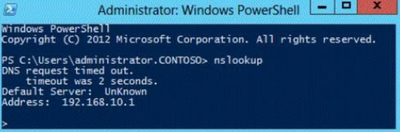
- AOn Server1, modify the security settings of the contoso.com zone.
- BFrom Advanced TCP/IP Settings of Server2, add contoso.com to the DNS suffix list.
- COn Server1, create a reverse lookup zone.
- DFrom Advanced TCP/IP Settings on Server1, add contoso.com to the DNS suffix list.
22Your network contains an Active Directory domain named contoso.com. The domain contains a DHCP server named Server1 that runs Windows Server 2012 R2. You create a DHCP scope named Scope1. The scope has a start address of 192.168.1.10 and an end address of 192.168.1.50 with a subnet mask of 255.255.255.192. You need to ensure that Scope1 has a subnet mask of 255.255.255.0. What should you do?
- AFrom the DHCP console, modify the scope options of Scope1
- BFrom the DHCP console, delete Scope1
- CFrom Windows Powershell, run the Set-DHCPServerv4Scope cmdlet
- DFrom the DHCP console, reconcile Scope1
23Your company has a main office and two branch offices. The offices connect to each other by using a WAN link. In the main office, you have a server named Server1 that runs Windows Server 2012 R2. Server1 is configured to use an IPv4 address only. You need to assign an IPv6 address to Server1. The IP address must be private and routable. Which IPv6 address should you assign to Server1?
- Afd00:ab32:14:ad88:ac:58:abc2:4
- Bfe80:ab32:145c::32cc:401b
- Cff00:3rff:65df:145c:dca8::82a4
- D2001:ab32:145c::32cc:401b
24In an isolated environment, you deploy a server named Server1 that runs a Server Core installation of Windows Server 2012 R2. The test environment does not have an Active Directory Domain Services (ADDS) installed. You install the ADDS role on Server1. You need to configure Server1 as a domain controller. What cmdlet should you run?
- AInstall-ADDSForest
- BInstall-WindowsFeature
- CInstall-ADDSDomain
- DInstall-ADDSDomainController
25You have a server named Server1 that runs Windows Server 2012 R2. You promote Server1 to a domain controller. You need to view the service location (SRV) records that Server1 registers in DNS. What should you do on Server1?
- ARun Get-DNSServerDiagnostics
- BRun ipconfig /displayDNS
- COpen the srv.sys file
- DOpen the netlogon.dns file
26Your network contains an Active Directory domain named adatum.com. The domain contains several thousand member servers that run Windows Server 2012 R2. All of the computer accounts for the members servers are in an Organizational Unit (OU) named ServerAccounts. Servers are only restarted occasionally. You need to identify which servers were restarted during the last two days. What should you do?
- ARun Get-Adcomputer and specify the lastlogon property
- BRun dsquery server and specify the -o parameter
- CRun the Get-Adcomputer and specfy the searchscope parameter
- DRun dsquery and specify the -stalepwd parameter
27Your network contains an Active Directory forest. The forest contains a single domain named contoso.com. The domain contains four domain controllers named DC1, DC2, DC3, and DC4.
DC1 is a Domain Naming Master, Schemda Master, and Global catalog server.
DC2 is a PDC emulator and Global catalog server
DC3 is the Infrastructure Master
DC4 is the RID Master, and Global catalog server
You plan to deploy a new domain controller named DC5 in the contoso.com domain. You need to identify which domain controllers must be online to ensure DC5 can be promoted successfully to a domain controller. Which domain controller should you identify?- ADC1
- BDC2
- CDC3
- DDC4
28Your network contains an Active Directory forest that contains three domains. A group named Group1 is configured as a domain local distribution group in the forest root domain. You plan to grant Group1 read-only access to a shared folder named Share1. Share1 is located in a child domain. You need to ensure Group1 can access Share1. What should you do first?
- AConvert Group1 to a global distribution group
- BConvert Group1 to a universal security group
- CConvert Group1 to a universal distribution group
- DConvert Group1 to a domain local security group
29Your network contains an Active Directory domain named contoso.com. The domain contains 100 servers. The servers are contained in an Organizational Unit (OU) named ServerOU. You need to create a group named Group1 on all Servers in the domain. You must ensure that Group1 is added only to the servers. What should you configure?
- AA Local Users and Groups preferences setting in a Group Policy linked to the ServerOU OU.
- BA Restricted Groups setting in a Group Policy linked to the domain
- CA Restricted Groups setting in a Group Policy linked to the ServerOU OU.
- DA Local Users and Groups preference setting in a Group Policy linked to the Domain Controllers OU.
30Your network contains an Active Directory forest named contoso.com. All domain controllers currently run Windows Server 2008 R2. You plan to install a new domain controller named DC4 that runs Windows Server 2012 R2. The new domain controller will be the Schema Master and the Global Catalog Server. It will also have the Active Directory Federation Services and Active Directory Certificate services roles installed. You need to identify which configuration can be fulfilled by using Active Directory Domain Services Configuration Wizard. What configuration should you identify?
- AInstall the DNS Server Role
- BInstall the Active Directory Certificate Services Role
- CEnable the global catalog server
- DTransfer the Schema Master
31Your network contains an Active Directory forest named contoso.com. The forest contains two domains named contoso.com and child.contoso.com and two additional sites named Site1 and Site2. The domains and the sites are configured as shown in the table shown:
When the link between Site1 and Site2 fails, users fail to login to Site2. You need to identify what prevents users in Site2 from logging on to the child.contoso.com domain. What should you identify?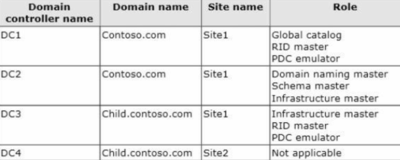
- AThe placement of the infrastructure master
- BThe placement of the PDC emulator
- CThe placement of the domain naming master
- DThe placement of the global catalog server
32You have a server named Server1 that runs Windows Server 2012 R2. You plan to create a storage pool that will contain a new volume. You need to create a 600GB volume by using thin provisioning. The new volume must use the pairity layout. What is the minimum number of 256GB disks required for the storage pool?
- A3
- B4
- C5
- D6
33You have a server named Server1 that runs Windows Server 2012 R2. You plan to use Windows Powershell Desired State Configuration (DSC) to confirm that the Application Identity service is running on all file servers. You define the following configuration in the Windows Powershell Integrated Scripting Environment (ISE). You need to use DSC to configure Server1 as defined in the configuration. What should you run first?
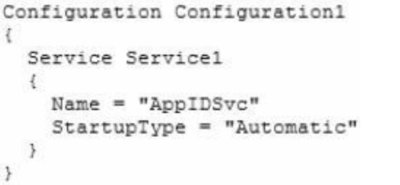
- ATest-DSCConfiguration
- BConfiguration1
- CStart-DSCConfiguration
- DService1
34Your network contains an Active Directory domain named contoso.com. The domain contains a server named Server1. Server1 runs Windows Server 2012 R2. You create a group managed service account named gservice1. You need to configure a service named Service1 to run as the gservice1 account. How should you configure Service1?
- AFrom a command prompt, run sc,exe and specify the privs parameter.
- BFrom the Services console, configure the General settings
- CFrom Windows Powershell, run Set-Service and specify the -StartupType parameter
- DFrom a command prompt, run sc.exe and specify the config parameter.
35Your network contains an Active Directory forst named contoso.com. The forest contains a single domain. The domain contains two domain controllers named DC1 and DC2 that run Windows Server 2012 R2. The domain contains a user named User1 and a global security group named Group1. You need to modify the SAM Account name of Group1. Which cmdlet should you run?
- ASet-AdGroup
- BRename-AdObject
- CSet-User
- DSet-ADAccountControl
- EAdd-AdPrincipalGroupMembership
36Your network contains an Active Directory forest named contoso.com. The forest contains a single domain. The domain contains two domain controllers named DC1 and DC2 that run Windows Server 2012 R2. The domain contains a user named User1 and a global security group named Group1. You need to add a new domain controller to the domain. You install Windows Server 2012 R2 on a new server named DC3. Which cmdlet should you run first?
- AInstall-ADDSDomain
- BInstall-ADDSDomainController
- CInstall-WindowsFeature
- DInstall-ADDSForest
- EAdd-ADPrincipalGroupMembership
37Your network contains an Active Directry forest named contoso.com. The forest contains a single domain. The domain contains two domain controllers named DC1 and DC2 that run Windows Server 2012 R2. The domain contains a user named User1 and a global security group named Group1. You need to prevent User1 from changing his password. The solution must minimize administrative effort. Which cmdlet should you run?
- ASet-User
- BSet-ADGroup
- CSet-ADAccountControl
- DRename-ADObject
- EAdd-ADPrincipalGroupMembership
38Your network contains an Active Directory forest named contoso.com. The forest contains a single domain,. The domain contains two domain controllers named DC1 and DC2 that run Windows Server 2012 R2. The domain contains a user named User1 and a global security group named Group1. You reconfigure DC2 as a member server in the domain. You need to add DC2 as the first domain controller in the new domain in the forest. Which cmdlet should you run?
- AInstall-WindowsFeature
- BInstall-ADDSDomain
- CInstall-ADDSDomainController
- DInstall-ADDSForest
- EAdd-ADPrincipalGroupMembership
39Your network contains a server named Server1 that runs Windows Server 2012 R2. Server1 has the Hyper-V role installed. Server1 has four virtual machines named VM1, VM2, VM3, and VM4. Server1 is configured a follows:
8 quad-core CPUs
32GB RAM
Two local 4-TB HDDs
Eight network adapters
VMQ-supported and PCI-SIG supported
You install a network monitoring application on VM2. You need to ensure all of the traffic sent to VM3 can be captured on VM2. What should you configure?- AVirtual Machine Chimney
- BResource Control
- CIntegration Services
- DSingle-Root I/O Virtualization (SR-IOV)
- EPort Mirroring
40Your have a Hyper-V host named Host1 that connects to SAN by using a Fibre Channel adapter. Host1 contains two virtual machines named VM1 and VM2. You need to provide VM1 with direct access to the SAN. VM2 must not require access to the SAN. Which two configurations should you perform? (Choose two)
- AOn Host1, modify the Hyper-V Settings.
- BOn VM1, add a network adapter.
- COn Host1, configure new Virtual Fibre Channel SAN
- DOn VM1, configure a Fibre Channel Adapter
- EOn Host1, configure new virtual switch
41You have a Hyper-V host named Server1 that runs Windows Server 2012 R2. Server1 hosts virtual machine named VM1 that runs Windows Server 2012 R2. VM1 has several snapshots. You need to modify the snapshot file location of VM1. What should you do?
- ADelete the existing snapshots and then modify the settings of VM1.
- BPause VM1, and then modify the settings of VM1
- CShut down VM1, and then modify the settings of VM1.
- DRight-click VM1, and then click Export.
42You have a virtual machine named VM1. VM1 uses a fixed size virtual hard disk (VHD) named Disk1.vhd. Disk1.vhd is 200GB. You shut down VM1. You need to reduce the size of Disk1.vhd. Which action should you select from the Edit Virtual Hard Disk Wizard?
- AMerge
- BCompact
- CConvert
- DShrink
43Your network contains an Active Directory domain controller named contoso.com. The domain contains a server named Server1 that runs Windows Server 2012 R2. You need to create a 3-TB virtual hard disk on Server1. Which tool should you use?
- ANew-VirtualDisk
- BShare and Storage Management
- CNew-StoragePool
- DDiskpart
44You have a server named Server1 that runs Windows Server 2012 R2. Server1 has the Hyper-V role installed. On Server1, you create a virtual machine named VM1. VM1 has a legacy network adapter. You need to assign a specific amount of available network bandwidth to VM1. What should you do first?
- ARemove the legacy network adapter, and then add a network adapter.
- BRemove the legacy network adapter, and then run the Set-VMNetworkAdapter cmdlet
- CAdd a second legacy network adapter, and then configure network adapter teaming.
- DAdd a second legacy network adapter, and then run the Set-VMNetworkAdapter cmdlet
45Your network contains an Active Directory domain named contoso.com. The domain contains a server named Server1 that runs Windows Server 2012 R2. You create a new inbound rule by using Windows Firewall with Advanced Security. You need to configure the rule to allow Server1 to accept unsolicited inbound packets that are received through a network address translation (NAT) device on your network. Which setting in the rule should you configure?
- AAuthorized computers.
- BEdge Traversal
- CInterface Types
- DRemote IP Address
46Your network contains an Active Directory domain named contoso.com. All servers run Windows Server 2012 R2. A server named Server1 is configured to encrypt all traffic by using IPSec. You need to ensure that Server1 can respond to ping requests from computers that do not support IPSec. What should you do?
- AFrom Windows Firewall with Advanced Security allow unicast responses for the domain profile.
- BFrom a command prompt, run netsh set global autotuninglevel = highlyrestrictedcongestionprovider = none
- CFrom a command prompt, run netsh set global autotuning level-restricted congestionprovider=ctcp
- DFrom Windows Firewall with Advanced Security, exempt ICMP from the IPSec.
47You have a server named Server1 that runs Windows Server 2012 R2. You need to create script that will create and mount a virtual hard disk. Which tool should you use?
- Avdsldr.exe
- Bfsutil.exe
- Cvds.exe
- Ddiskpart.exe
48You have a server named Server1 that runs Windows Server 2012 R2. Server1 has three physical network adapters named NIC1, NIC2, and NIC3. On Server1, you create a NIC team named Team1 by using NIC1 and NIC2. You configure Team1 to accept network traffic on VLAN10. You need to ensure that Server1 can accept network traffic on VLAN10 and VLAN11. The solution must ensure that the network traffic can be received on both VLANs if a network adapter fails. What should you do?
- AFrom Server Manager, add an interface to Team1.
- BRun the Add-NetLBFOTeamMember cmdlet
- CFrom Server Manager, change the load balancing mode of Team1.
- DRun the New-NetLBFOTeam cmdlet
49You have a server named Server1 that runs Windows Server 2012 R2. Server1 has six network adapters.
Two of the network adapters are connected to a network named LAN1.
Two of the network adapters are connected to a network named LAN2.
Two of the network adapters connect to a network named LAN3.
You create a network adapter team named Team1 from the two adapters connected to LAN1.
You create a a network adapter team named Team2 from the two network adapters connected to LAN2.
A company policy states that all server IP Addresses must be assigned by using a reservation on Server1 address in DHCP. You need to identify how many DHCP reservations you must create for Server1. How many reservations should you identify?- A6
- B3
- C8
- D4
50You have a server named Server1 that runs Windows Server 2012 R2. On Server1, you open COmputer Management s shown in the exhibit. You need to ensure that you can create a 3-TB volume on Disk1. What should you do?
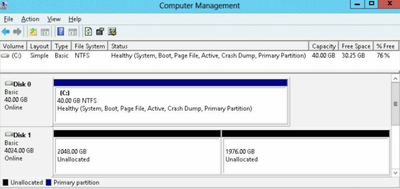
- ACreate storage pool
- BCreate a VHD and then attach the VHD.
- CConvert the disk to a dynamic disk.
- DConvert the disk to a GPT disk.
Informações
- Descrição
- This exam measures your ability to accomplish the technical tasks listed below: Install and configure Windows Server 2012 Describe AD DS Manage Active Directory objects Automate Active Directory administration Implement IPv4 Implement Dynamic Host Configuration Protocol (DHCP) Implement Domain Name System (DNS) Implement IPv6 Implement local storage Implement file and print services Implement Group Policy Secure Windows servers by using Group Policy Objects (GPOs) Configure Hyper-V
- Autor
- Mike M
- Idioma
- English
- Visualizações
- 482
- Histórico
- Criado em 2 out 2016 · atualizado em 7 mar 2018
- Etiquetas
- Avaliação
- Ainda sem avaliações Avalie este quiz