
Quiz
Immunity
Este quiz tem tipos de pergunta que abrem no player de sempre.
Perguntas do quiz (22)
1What are the two types of defence mechanisms?
- APhysical Barrier
- BNon-Specific
- CPhagocytosis
- DSpecific
2One type of defence mechanism is a non-specific response. This non-specific response is defined as a response which is [blank_start]immediate[blank_end] and the [blank_start]same[blank_end] for all pathogens. Example of this include a [blank_start]physical barrier[blank_end] e.g. skin or [blank_start]phagocytosis[blank_end]. Another type of defence mechanism is a specific response. This specific response is said to be a response that is [blank_start]slower[blank_end] and is [blank_start]specific[blank_end] to each pathogen. Some examples of a specific response is a [blank_start]cell mediated response[blank_end] (T lymphocytes) and a [blank_start]humoral response[blank_end] (B lymphocytes).
- Aimmediate
- Bsame
- Cphysical barrier
- Dphagocytosis
- Eslower
- Fspecific
- Gcell mediated response
- Hhumoral response
3To defend the body from invasion what do the lymphocytes have to recognise?
- APathogens and Cells
- BSelf and Non-Self Molecules
- CBacteria
4Each cell has [blank_start]specific molecules[blank_end] on its surface that identify it which vary depending on its [blank_start]proteins[blank_end]. This is because proteins have a highly specific [blank_start]tertiary structure[blank_end]. Therefore, this variety of a specific [blank_start]3D[blank_end] structure allows for them to be separately identified.
These protein molecules allow an organism to identify:
1) [blank_start]Pathogen[blank_end] e.g. HIV
2) [blank_start]Non-self[blank_end] material
3) [blank_start]Toxins[blank_end] produced by certain pathogens
4) [blank_start]Abnormal cells[blank_end] like cancer cells
Although this is helpful, it is a disadvantage for those who have [blank_start]organ transplants[blank_end] as they believe it is non-self material. To help minimise this problem, donor are matched as closely as possible.- Aspecific molecules
- Bproteins
- Camino acid sequence
- Dtertiary structure
- Eprimary structure
- Fquanternary structure
- G3D
- H2D
- IPathogen
- JNon-self
- KToxins
- LAbnormal cells
- Morgan transplants
5What are the two types of white blood cells?
- ARed Blood Cells
- BLymphocytes and Phagocytes
- CLysosomes
6Phagocytes
[blank_start]Chemical[blank_end] products of pathogens or dead, damaged or abnormal cells act as [blank_start]attractants[blank_end], causing [blank_start]phagocytes[blank_end] to move towards the pathogen.
Phagocytes have several [blank_start]receptors[blank_end] on their cell surface membrane that recognise chemicals on the pathogens.
They [blank_start]engulf[blank_end] the pathogen to form a vesicle which is known as a [blank_start]phagosome[blank_end].
[blank_start]Lysosomes[blank_end] move towards the vesicle and fuse with it. Enzymes called [blank_start]lysozymes[blank_end] are present and destroy ingested bacteria by [blank_start]hydrolysis[blank_end].
The soluble products from breakdown are absorbed into the [blank_start]cytoplasm[blank_end] of the lysosome.- AChemical
- Battractants
- Cphagocytes
- Dreceptors
- Eengulf
- Fphagosome
- GLysosomes
- Hlysozymes
- Ihydrolysis
- Jcytoplasm
7B lymphocytes (B cells)
B cells mature in the [blank_start]bone marrow[blank_end]. They are associated with [blank_start]humoral immunity[blank_end], that involve [blank_start]antibodies[blank_end] that are present in [blank_start]body fluid[blank_end] or humour such as blood plasma.
T lymphocytes (T cells)
T cells mature in the [blank_start]thymus gland[blank_end]. They are associated with [blank_start]cell-mediated[blank_end] immunity that involves the body cells.- Abone marrow
- Bhumoral immunity
- Cantibodies
- Dbody fluid
- Ethymus gland
- Fcell-mediated
8T lymphocytes can distinguish between their own cells and invader cells because:
1) [blank_start]Phagocytes[blank_end] have [blank_start]engulfed[blank_end] the pathogen and presented their antigens on their cell-surface membrane
2) Body cells are invaded by a virus and present their antigens on their cell-surface membrane
3) Transplanted cells from individuals have different antigens on their cell-surface membrane
4) Cancer cells are different from normal body cells and present them on the cell-surface membrane
Cells that display foreign antigens on their cell-surface membrane are called [blank_start]antigen-presenting cells[blank_end].- APhagocytes
- Bengulfed
- Cantigen-presenting cells
9Response of T Lymphocytes:
1) Pathogens invade body cells or are taken in by [blank_start]phagocytes[blank_end]
2) The phagocyte places antigens from the pathogen on its [blank_start]cell-surface membrane[blank_end]
3) Receptors on a specific [blank_start]helper T cell[blank_end] fit exactly onto these antigens
4) This attachment activates the [blank_start]T cell[blank_end] to divide rapidly by [blank_start]mitosis[blank_end] and form a clone of [blank_start]genetically identical[blank_end] cells
The cloned T cells:
a) Develop into [blank_start]memory cells[blank_end] that enable a [blank_start]rapid response[blank_end] to future infections
b) Stimulate [blank_start]phagocytes[blank_end] to engulf pathogens by [blank_start]phagocytosis[blank_end]
c) Stimulate [blank_start]B cells[blank_end] to divide and secrete their [blank_start]antibodies[blank_end]
d) Activate [blank_start]cytotoxic T[blank_end] cells- Aphagocytes
- Bcell-surface membrane
- Chelper T cell
- DT cell
- Emitosis
- Fgenetically identical
- Gmemory cells
- Hrapid response
- Iphagocytes
- Jphagocytosis
- KB cells
- Lantibodies
- Mcytotoxic T
10What type of cells does humoral immunity produce?
- APlasma and Memory Cells
- BMonoclonal Antibodies
11Plasma cells secrete antibodies into the blood plasma and can make antibodies that lead to the destruction of the antigen.
- AVerdadeiro
- BFalso
12Memory cells are responsible for a primary response and live for a brief duration.
- AVerdadeiro
- BFalso
13B Lymphocytes
1) The [blank_start]surface antigens[blank_end] of an invading pathogen are taken up by a B cell
2) The B cell processes the antigens and presents them on its [blank_start]surface[blank_end]
3) [blank_start]Helper T cells[blank_end] attach to the processed antigens on the B cell activating them
4) The B cells is now activated to divide by [blank_start]mitosis[blank_end] to give a clone of plasma cells
5) The cloned plasma cells produce and secrete the [blank_start]specific antibody[blank_end] that exactly fits the antigen
6) The antibody attached to antigens on the pathogen and destroys them
7) Some B cells develop into [blank_start]memory cells[blank_end] that can respond to further infections- Asurface antigens
- Bsurface
- CHelper T cells
- Dmitosis
- Especific antibody
- Fmemory cells
14Antibodies are proteins with a specific binding site that have been synthesised by B cells.
- AVerdadeiro
- BFalso
15Label the image of an antibody
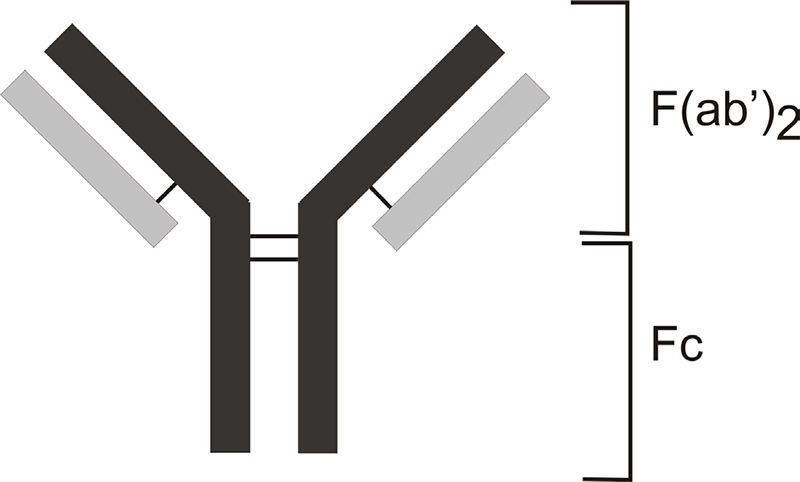
- ALight Chain
- BHeavy Chain
- CVariable Region
- DConstant Region
16Destruction of Antigens by Antibodies
[blank_start]Agglutination[blank_end] of bacterial cells make it easier for phagocytes to locate the antigen as they are less spread out within the body.
[blank_start]Neutralisation[blank_end] is when antibodies bind to the antigen to for a [blank_start]antigen-antibody complex[blank_end] which prevents them from infecting cells. Therefore they serve as [blank_start]markers[blank_end] to stimulate phagocytes to [blank_start]engulf[blank_end] the bacteria cells attached.- AAgglutination
- BNeutralisation
- Cantigen-antibody complex
- Dmarkers
- Eengulf
- Fmonoclonal antibodies
- Gantibodies
17When using monoclonal antibodies an antigen is added to a well of the patients blood plasma which binds to the antibodies in their blood. A secondary antigen is added which attaches to the antigen and is then washed to get rid of unattached antibodies. A solution is added which changes colour with the enzymes that is present on the secondary antibody.
- AVerdadeiro
- BFalso
18Which of these statements apply to passive immunity?
- AThe ability of an organism to resist infection
- BProduced by the introduction of antibodies into the individual
- CProduced by stimulating the production of antibodies by the individuals' own immune system
- DNo direct contact is needed with the pathogen or antigen
- EDirect contact with the pathogen or antigen
- FAntibodies are not produced so no memory cells are made so there is no long lasting immunity
- GIncludes the body forming its own antibodies naturally or inducing the immune response
19Which of these statements apply to active immunity?
- AThe ability of an organism to resist infection
- BProduced by the introduction of antibodies into the individuals
- CProduced by stimulating the production of antibodies by the individuals' own immune system
- DNo direct contact is needed with the pathogen or antigen
- EDirect contact with the pathogen
- FAntibodies are not produced so no memory cells are made so there is no long lasting immunity
- GCan include the body forming its own antibodies naturally or inducing the immune response
20Successful Vaccination
For vaccination to be successful it must be [blank_start]economically available[blank_end] to immunise the most [blank_start]vulnerable[blank_end] population, have very few [blank_start]side effects[blank_end], have a means of [blank_start]storing[blank_end] and [blank_start]transporting[blank_end], have a means of [blank_start]administrating[blank_end] the vaccine and must be able to produce a [blank_start]herd immunity[blank_end] effect.
However, vaccines don't eliminate disease as they may fail to [blank_start]induce immunity[blank_end] is certain individuals, may develop the disease immediately after a vaccination, the pathogen may mutate frequently ([blank_start]antigenic variability[blank_end]) or certain pathogens may hide from the immune system.- Aeconomically available
- Bvulnerable
- Cpoor
- Dside effects
- Estoring
- Ftransporting
- Gadministrating
- Hherd immunity
- Iinduce immunity
- Jantigenic variability
21Label this diagram of HIV
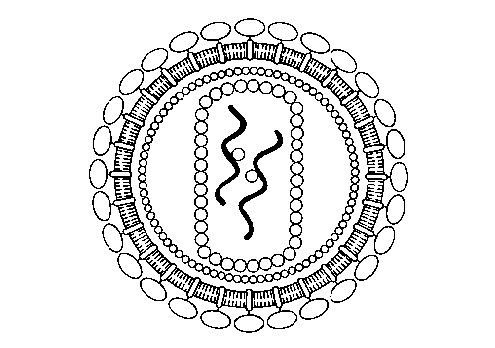
- AViral Proteins
- BViral Envelope
- COuter Capsid
- DInner Capsid
- ERNA
- FEnzyme
22Replication of HIV
1) HIV enters the [blank_start]bloodstream[blank_end] and circulates around the body
2) Proteins on the HIV readily bind to a protein found on [blank_start]helper T cells[blank_end]
3) The protein [blank_start]capsid[blank_end] fuses with the cell surface membrane and RNA and the [blank_start]enzymes[blank_end] enter the [blank_start]helper T cells[blank_end]
4) The HIV [blank_start]reverse transcriptase[blank_end] conversts the virus's RNA into [blank_start]DNA[blank_end] which is inserted into the [blank_start]nucleus[blank_end]
5) The nucleus creates [blank_start]mRNA[blank_end] containing the new instructions for [blank_start]viral proteins[blank_end] and [blank_start]RNA[blank_end]
6) The HIV particles break away with a piece of its cell surface membrane surrounding them which forms their [blank_start]lipid envelope[blank_end]- Abloodstream
- Bhelper T cells
- Ccapsid
- Denzymes
- Ehelper T cells
- Freverse transcriptase
- GDNA
- Hnucleus
- ImRNA
- Jviral proteins
- KRNA
- Llipid envelope
Informações
- Descrição
- Immunity Questionn
- Autor
- Joanne North
- Idioma
- English
- Visualizações
- 47
- Etiquetas
- Avaliação
- Ainda sem avaliações Avalie este quiz