
Quiz
CCNA5 Chapter 5 Exam
Este quiz tem tempo limite, por isso abre no player de sempre.
Perguntas do quiz (21)
1What happens to runt frames received by a Cisco Ethernet switch?
- AThe frame is dropped.
- BThe frame is returned to the originating network device.
- CThe frame is broadcast to all other devices on the same network.
- DThe frame is sent to the default gateway.
2What are the two sizes (minimum and maximum) of an Ethernet frame (Choose two.)
- A56 bytes
- B64 bytes
- C128 bytes
- D1024 bytes
- E1518 bytes
3What statement describes Ethernet?
- AIt defines the most common LAN type in the world.
- BIt is the required Layer 1 and 2 standard for Internet communication.
- CIt defines a standard model used to describe how networking works.
- DIt connects multiple sites such as routers located in different countries.
4Which two statements describe features or functions of the logical link control sublayer in Ethernet standards? (Choose two.)
- ALogical link control is implemented in software
- BLogical link control is specified in the IEEE 802.3 standard.
- CThe LLC sublayer adds a header and a trailer to the data.
- DThe data link layer uses LLC to communicate with the upper layers of the protocol suite.
- EThe LLC sublayer is responsible for the placement and retrieval of frames on and off the media.
5What statement describes a characteristic of MAC addresses?
- AThey must be globally unique.
- BThey are only routable within the private network.
- CThey are added as part of a Layer 3 PDU.
- DThey have a 32-bit binary value.
6What statement is true about MAC addresses?
- AMAC addresses are implemented by software.
- BA NIC only needs a MAC address if connected to a WAN.
- CThe first three bytes are used by the vendor assigned OUI.
- DThe ISO is responsible for MAC addresses regulations.
7What destination address is used in an ARP request frame?
- A0.0.0.0
- B255.255.255.255
- CFFFF.FFFF.FFFF.FFFF
- D127.0.0.1
- E01-00-5E-00-AA-23
8What addressing information is recorded by a switch to build its MAC address table?
- Athe destination Layer 3 address of incoming packets
- Bthe destination Layer 2 address of outgoing frames
- Cthe source Layer 3 address of outgoing packets
- Dthe source Layer 2 address of incoming frames.
9Refer to the exhibit. The exhibit shows a small switched network and the contents of the MAC address table of the switch. PC1 has sent a frame addressed to PC3. What will the switch do with the frame?
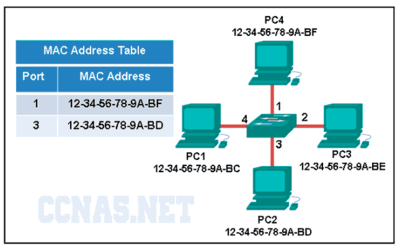
- AThe switch will discard the frame.
- BThe switch will forward the frame only to port 2.
- CThe switch will forward the frame to all ports except port 4.
- DThe switch will forward the frame to all ports.
- EThe switch will forward the frame only to ports 1 and 3.
10Which switching method uses the CRC value in a frame?
- Acut-through
- Bfast-forward
- Cfragment-free
- Dstore-and-forward
11What is auto-MDIX?
- Aa type of Cisco switch
- Ban Ethernet connector type
- Ca type of port on a Cisco switch
- Da feature that detects Ethernet cable type
12True or false
When a device is sending data to another device on a remote network, the Ethernet frame is sent to the MAC address of the default gateway.- Atrue
- Bfalse
13The ARP table in a switch maps which two types of address together?
- ALayer 3 address to a Layer 2 address
- BLayer 3 address to a Layer 4 address
- CLayer 4 address to a Layer 2 address
- DLayer 2 address to a Layer 4 address
1414. Refer to the exhibit. PC1 issues an ARP request because it needs to send a packet to PC2. In this scenario, what will happen next?
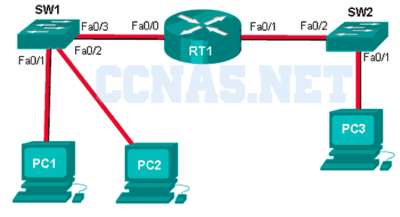
- APC2 will send an ARP reply with its MAC address.
- BRT1 will send an ARP reply with its Fa0/0 MAC address.
- CRT1 will send an ARP reply with the PC2 MAC address.
- DSW1 will send an ARP reply with the PC2 MAC address.
- ESW1 will send an ARP reply with its Fa0/1 MAC address.
1515. Refer to the exhibit. A switch with a default configuration connects four hosts. The ARP table for host A is shown. What happens when host A wants to send an IP packet to host D?
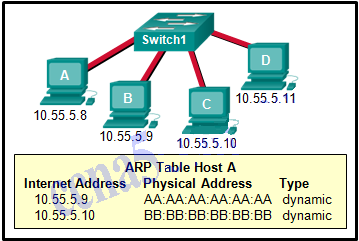
- AHost A sends an ARP request to the MAC address of host D.
- BHost D sends an ARP request to host A.
- CHost A sends out the packet to the switch. The switch sends the packet only to the host D, which in turn responds.
- DHost A sends out a broadcast of FF:FF:FF:FF:FF:FF. Every other host connected to the switch receives the broadcast and host D responds with its MAC address.
16Refer to the exhibit. The switches are in their default configuration. Host A needs to communicate with host D, but host A does not have the MAC address for its default gateway. Which network hosts will receive the ARP request sent by host A?
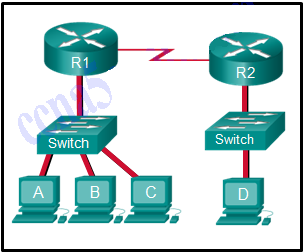
- Aonly host D
- Bonly router R1
- Conly hosts A, B, and C
- Donly hosts A, B, C, and D
- Eonly hosts B and C
- Fonly hosts B, C, and router R1
17What statement describes the treatment of ARP request on the local link?
- AThey must be forwarded by all routers on the local network.
- BThey are received and processed by every device on the local network.
- CThey are dropped by all switches on the local network.
- DThey are received and processed only by the target device.
18What are two potential network problems that can result from ARP operation? (Choose two.)
- AManually configuring static ARP associations could facilitate ARP poisoning or MAC address spoofing.
- BOn large networks with low bandwidth, multiple ARP broadcasts could cause data communication delays.
- CNetwork attackers could manipulate MAC address and IP address mappings in ARP messages with the intent of intercepting network traffic.
- DLarge numbers of ARP request broadcasts could cause the host MAC address table to overflow and prevent the host from communicating on the network.
- EMultiple ARP replies result in the switch MAC address table containing entries that match the MAC addresses of hosts that are connected to the relevant switch port.
19Fill in the blank. A collision fragment, also known as a [blank_start]runt[blank_end] frame, is a frame of fewer than 64 bytes in length.
- Arunt
20Fill in the blank. On a Cisco switch, [blank_start]port-based[blank_end] memory buffering is used to buffer frames in queues linked to specific incoming and outgoing ports.
- Aport-based
21Fill in the blank. ARP [blank_start]spoofing[blank_end] is a technique that is used to send fake ARP messages to other hosts in the LAN. The aim is to associate IP addresses to the wrong MAC addresses.
- Aspoofing
Informações
- Descrição
- CCNA5
- Autor
- Matthew M
- Idioma
- English
- Visualizações
- 216
- Histórico
- Criado em 1 nov 2016 · atualizado em 2 nov 2016
- Etiquetas
- Avaliação
- Ainda sem avaliações Avalie este quiz