
Quiz
Chapter 8
Crie uma conta grátis para terminar este quiz
Salve seu progresso e veja sua nota final.
Já tem uma conta? Inicie sessão
Perguntas do quiz (30)
1As a star exhausts the hydrogen in its core, what happens?
- AIt becomes hotter and more luminous
- BIt becomes hotter and less luminous
- CIt becomes cooler and less luminous
- DIt becomes cooler and more luminous
2When does a star experience helium fusion?
- Ajust before it enters the main sequence
- Bafter it has become a red giant star
- Cwhen it is on the horizontal branch
- Dbefore it leaves the main sequence
3Why are giant and supergiant stars rare?
- AThe giant and supergiant stages are very short
- BThe star blows up before the giant or supergiant stage is reached
- CThey do not form as often as main sequence stars
- DThe giant or supergiant stage is very long
4Which of the following statements best describes why stars eventually die?
- ATheir lifespan is limited
- BThey exhaust all their fuel
- CTheir cores become hotter
- DThey become less luminous
5Which of the following occurs during the giant stage?
- Ahelium fusion in the core and hydrogen fusion in the surrounding shell
- Bhydrogen fusion in the core and helium fusion in the surrounding shell
- Chydrogen and helium fusion in the core
- Dhydrogen flash
6In what way are giants and supergiants similar?
- AThey are the main sequence stars
- BThey undergo a helium flash stage as they enter the main sequence
- CThey are very luminous
- DTheir cores expand rapidly to reach giant sizes
7What is the term for a collection of 105 to 106 old stars in a region 30 to 100 light-years in diameter?
- AHerbig-Haro object
- Bglobular cluster
- Copen cluster
- Dgiant cluster
8What is the defining characteristic of stars within a cluster that are at the turnoff point?
- AThey are just leaving the main sequence
- BThey are just becoming white dwarfs
- CThey are just entering the main sequence
- DThey are about to explode in supernovae
9What is the approximate age of the star cluster in the H-R diagram? (Hint: Main sequence stars of spectral types O and B have a core supply of hydrogen that is sufficient to last about 250 million years; types A and F, about 2 billion years; type G about 10 billion years; types K and M about 30 billion years. The apparent magnitude scale means that larger numbers are toward the bottom of the vertical axis.)
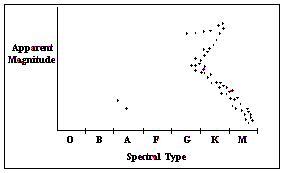
- A200 million years
- B2 billion years
- C10 billion years
- D30 billion years
10Refer to the H-R diagram. What type of star do the two data points above spectral type “A” represent?
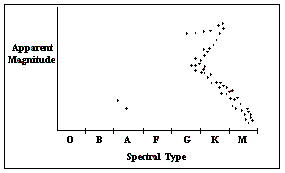
- Amassive main sequence stars
- Bmassive supergiant stars
- Cwhite dwarfs with mass less than the sun’s mass
- Dwhite dwarfs with mass greater than twice the sun’s mass
11Refer to the H-R diagram. What type of star do the data points above spectral type “M” represent?
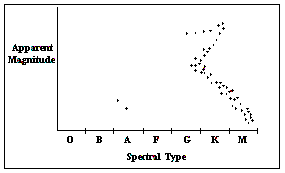
- Amassive main sequence stars
- Bmassive main sequence stars with mass less than the sun’s mass
- Cmain sequence stars with luminosities higher than the sun’s luminosity
- Dpre-main sequence stars
12Refer to the H-R diagram. How would the H-R diagram of an older star cluster look different

- AThe points would shift to the right, because all of the stars would have lower temperatures
- BThe lower main sequence would look the same, but the turnoff would be at spectral type K or M
- CThe points would shift down, because all of the stars would have lower luminosities
- DThe lower main sequence would look the same, but the turnoff would be at spectral type F or A
13Refer to the H-R diagram. How would the H-R diagram of a more distant star cluster look different?
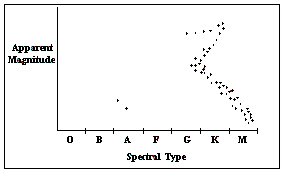
- AThe points would shift down, because all of the stars would have larger apparent magnitudes
- BThe points would shift to the right, because all of the stars would appear to be cooler
- CThe points would shift up, because all of the stars would have smaller apparent magnitudes
- DThe points would shift to the left, because all of the stars would appear to be hotter
14Which nuclear fuels does a one solar mass star use over the course of its entire lifespan?
- Ahydrogen
- Bhydrogen and helium
- Chydrogen, helium, and carbon
- Dhydrogen, helium, carbon, and oxygen
15Star A is a 1 solar mass white dwarf, and star B is a 1.3 solar mass white dwarf. How would they differ?
- AStar A has a smaller radius
- BStar B has a smaller radius
- CStar B is supported by neutron degeneracy pressure
- DStar A is hotter
16What is the source of the energy radiated by a white dwarf?
- Athe proton-proton chain
- Bthe CNO cycle
- Cgravitational contraction after becoming a white dwarf
- Dgravitational contraction during the white dwarf formation phase
17What does the Chandrasekhar-Landau limit tell us?
- AAccretion disks can grow hot through friction
- BNeutron stars of more than 3 solar masses are not stable
- CWhite dwarfs more massive than 1.4 solar masses are not stable
- DStars with a mass less than 0.5 solar masses will not go through helium flash
18What is the ultimate fate of our Sun?
- AIt will become a neutron star
- BIt will explode in a supernova
- CIt will become a white dwarf
- DIt will explode in a nova
19Which scenario is most likely to happen when the Sun enters the red giant stage?
- AMercury, Venus, and Earth will be destroyed by the expanding Sun
- BMercury will be destroyed by the expanding Sun, but Venus and Earth will remain intact
- CThe Sun will engulf and destroy all planets in the Solar System
- DThe Sun will never expand far enough to reach Mercury or any other planets in the Soar System
20If the stars at the turnoff point of a cluster have a mass of 3 times the mass of the Sun, what is the age of the cluster?
- A6.4×10^8 years
- B3.3×10^9 years
- C3.0×10^10 years
- D1.6×10^11 years
21Which of the following correctly describes a relationship between pressure, temperature, and density in degenerate matter?
- APressure depends only on the temperature
- BPressure does not depend on temperature
- CTemperature depends only on density
- DPressure does not depend on density
22What is a white dwarf composed of?
- Ahydrogen nuclei and degenerate electrons
- Bhelium nuclei and normal electrons
- Ccarbon and oxygen nuclei and degenerate electrons
- Ddegenerate iron nuclei
23As a white dwarf cools, its radius remains the same. Why is this?
- Abecause pressure due to nuclear reactions in a shell just below the surface keeps it from collapsing
- Bbecause pressure does not depend on temperature for a white dwarf, since the electrons are degenerate
- Cbecause pressure does not depend on temperature, since the star has exhausted all its nuclear fuels
- Dbecause material accreting onto it from a companion maintains a constant radius
24What are the two longest stages in the life of a one solar mass star?
- Aprotostar, pre–main sequence
- Bprotostar, white dwarf
- Cprotostar, main sequence
- Dmain sequence, white dwarf
25Which of the following is the most important factor that determines a life cycle of a star (for example, why some stars have a short life span)?
- Amass
- Btemperature
- Cluminosity
- Dradius
26What principle explains why matter flowing from one star in a binary system to its companion forms an accretion disk?
- Aconservation of tidal forces
- Bconservation of temperature
- Cconservation of angular momentum
- Dconservation of energy
27Suppose you discover a binary star system with a 0.7 solar mass giant star and a 2 solar mass main sequence star. Why is this surprising?
- A0.7 solar mass stars are not expected to become giants
- BAll 2 solar mass stars should have left the main sequence
- CGiant stars are expected to destroy their companions, so the 2 solar mass star shouldn’t exist
- DThe 2 solar mass star should have become a giant before the 0.7 solar mass star
28When material expanding away from a star in a binary system reaches the edge of its Roche lobe, what happens?
- AThe material will start to fall back toward the star
- BAll of the material will accrete on to the companion
- CThe material will no longer be gravitationally bound to the star
- DThe material will increase in temperature and eventually undergo thermonuclear fusion
29When mass is transferred toward a white dwarf in a binary system, the material forms a rapidly growing whirlpool of material. What is that whirlpool called?
- Aan accretion disk
- Ban Algol paradox
- Ca planetary nebula
- Da supernova remnant
30Under what conditions are Type Ia supernovae believed to occur?
- Awhen the core of a massive star collapses
- Bwhen a white dwarf exceeds the Chandrasekhar-Landau limit
- Cwhen hydrogen detonation occurs
- Dwhen neutrinos in a massive star form a shock wave that explodes the star
Informações
- Descrição
- Astronomy
- Autor
- Ryan Tram
- Idioma
- English
- Visualizações
- 835
- Etiquetas
- Avaliação
- 5,0 de 5 · 2 avaliações Avalie este quiz