
Quiz
Chapter 17 - Electrochemistry
Crie uma conta grátis para terminar este quiz
Salve seu progresso e veja sua nota final.
Já tem uma conta? Inicie sessão
Perguntas do quiz (38)
1What is the oxidation number of bromine in the BrO3- ion?
- AA) -1
- BB) +1
- CC) +3
- DD) +5
- EE) +7
2What is the oxidation number of sulfur in the HSO4- ion?
- AA) -2
- BB) +1
- CC) +2
- DD) +4
- EE) +6
3Which element is oxidized in the reaction below?
Fe(CO)5 (l) + 2HI (g) → Fe(CO)4I2 (s) + CO (g) + H2 (g)- AA) Fe
- BB) C
- CC) O
- DD) H
- EE) I
4Which element is reduced in the reaction below?
Fe(CO)5 (l) + 2HI (g) → Fe(CO)4I2 (s) + CO (g) + H2 (g)- AA) Fe
- BB) C
- CC) O
- DD) H
- EE) I
5Which of the following reactions is a redox reaction?
(a) K2CrO4 + BaCl2 → BaCrO4 + 2KCl
(b) Pb22+ + 2Br- → PbBr
(c) Cu + S → CuS- AA) (a) only
- BB) (b) only
- CC) (c) only
- DD) (a) and (c)
- EE) (b) and (c)
6Which one of the following reactions is a redox reaction?
- AA) NaOH + HCl → NaCl + H2O
- BB) Pb2+ + 2Cl- → PbCl2
- CC) AgNO3 + HCl → HNO3 + AgCl
- DD) None of the above is a redox reaction.
7Which substance is the reducing agent in the following reaction?
Fe2S3 + 12HNO3 → 2Fe(NO3)3 + 3S + 6NO2 + 6H2O- AA) HNO3
- BB) S
- CC) NO2
- DD) Fe2S3
- EE) H2O
8What is the coefficient of the permanganate ion when the following equation is balanced?
MnO4- + Br- → Mn2+ + Br2 (acidic solution)- AA) 1
- BB) 2
- CC) 3
- DD) 5
- EE) 4
9What is the coefficient of Fe3+ when the following equation is balanced?
CN- + Fe3+ → CNO- + Fe2+ (basic solution)- AA) 1
- BB) 2
- CC) 3
- DD) 4
- EE) 5
10The purpose of the salt bridge in an electrochemical cell is to __________.
- AA) maintain electrical neutrality in the half-cells via migration of ions.
- BB) provide a source of ions to react at the anode and cathode.
- CC) provide oxygen to facilitate oxidation at the anode.
- DD) provide a means for electrons to travel from the anode to the cathode.
- EE) provide a means for electrons to travel from the cathode to the anode.
11Which transformation could take place at the anode of an electrochemical cell?
- AA) NO → NO3-
- BB) CO2 → Cr2O42-
- CC) VO2+ → VO2+
- DD) H2AsO4 → H3AsO3
- EE) O2 → H2O2
12Which transformation could take place at the cathode of an electrochemical cell?
- AA) MnO2 → MnO4-
- BB) Br2 → BrO3-
- CC) NO → HNO2
- DD) HSO4- → H2SO3
- EE) Mn2+ → MnO4-
13Which of the halogens in Table 20.1 is the strongest oxidizing agent?
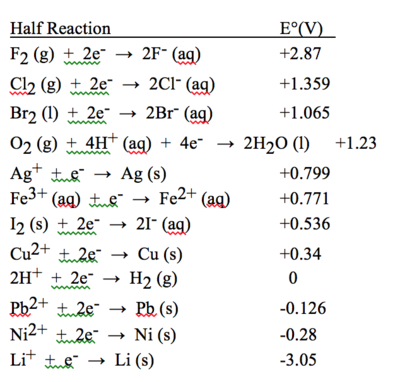
- AA) Cl2
- BB) Br2
- CC) F2
- DD) I2
- EE) All of the halogens have equal strength as oxidizing agents.
14Which one of the following types of elements is most likely to be a good oxidizing agent?
- AA) alkali metals
- BB) lanthanides
- CC) alkaline earth elements
- DD) transition elements
- EE) halogens
15Which one of the following is the best oxidizing agent?
- AA) H2
- BB) Na
- CC) O2
- DD) Li
- EE) Ca
16Which of the following reactions will occur spontaneously as written?
- AA) Sn4+ (aq) + Fe3+ (aq) → Sn2+ (aq) + Fe2+ (aq)
- BB) 3Fe (s) + 2Cr3+ (aq) → 2Cr (s) + 3Fe2+ (aq)
- CC) Sn4+ (aq) + Fe2+ (aq) → Sn2+ (aq) + Fe (s) ← I chose this one
- DD) 3Sn4+ (aq) + 2Cr (s) → 2Cr3+ (aq) + 3Sn2+ (aq)
- EE) 3Fe2+ (aq) → Fe (s) + 2Fe3+ (aq)
17Consider an electrochemical cell based on the reaction:
2H+ (aq) + Sn (s) → Sn2+ (aq) + H2 (g)
Which of the following actions would change the measured cell potential?- AA) increasing the pH in the cathode compartment
- BB) lowering the pH in the cathode compartment
- CC) increasing the [Sn2+] in the anode compartment
- DD) increasing the pressure of hydrogen gas in the cathode compartment
- EE) Any of the above will change the measure cell potential.
18Consider an electrochemical cell based on the reaction:
2H+ (aq) + Sn (s) → Sn2+ (aq) + H2 (g)
Which of the following actions would not change the measured cell potential?- AA) lowering the pH in the cathode compartment
- BB) addition of more tin metal to the anode compartment
- CC) increasing the tin (II) ion concentration in the anode compartment
- DD) increasing the pressure of hydrogen gas in the cathode compartment
- EE) Any of the above will change the measured cell potential.
19Cathodic protection of a metal pipe against corrosion usually entails
- AA) attaching an active metal to make the pipe the anode in an electrochemical cell.
- BB) coating the pipe with another metal whose standard reduction potential is less negative than that of the pipe.
- CC) attaching an active metal to make the pipe the cathode in an electrochemical cell.
- DD) attaching a dry cell to reduce any metal ions which might be formed.
- EE) coating the pipe with a fluoropolymer to act as a source of fluoride ion (since the latter is so hard to oxidize).
20One of the differences between a voltaic cell and an electrolytic cell is that in an electrolytic cell __________.
- AA) an electric current is produced by a chemical reaction
- BB) electrons flow toward the anode
- CC) a nonspontaneous reaction is forced to occur
- DD) O2 gas is produced at the cathode
- EE) oxidation occurs at the cathode
21__________ is reduced in the following reaction:
Cr2O72- + 6S2O32- + 14H+ → 2Cr3+ + 3S4O62- + 7H2O- AA) Cr6+
- BB) S2+
- CC) H+
- DD) O2-
- EE) S4O62-
22Which substance is serving as the oxidizing agent in the following reaction?
14H+ + Cr2O72- + 3Ni → 3Ni2+ + 2Cr3+ + 7H2O- AA) Ni
- BB) H+
- CC) Cr2O72-
- DD) H2O
- EE) Ni2+
23__________ electrons appear in the following half-reaction when it is balanced.
S4O62- → S2O32-- AA) 6
- BB) 2
- CC) 4
- DD) 1
- EE) 3
24The balanced half-reaction in which dichromate ion is reduced to chromium metal is a __________ process.
- AA) two-electron
- BB) six-electron
- CC) three-electron
- DD) four-electron
- EE) twelve-electron
25The electrode at which oxidation occurs is called the __________.
- AA) oxidizing agent
- BB) cathode
- CC) reducing agent
- DD) anode
- EE) voltaic cell
26In a voltaic cell, electrons flow from the __________ to the __________.
- AA) salt bride, anode
- BB) anode, salt bridge
- CC) cathode, anode
- DD) salt bridge, cathode
- EE) anode, cathode
27The standard cell potential (E°cell) for the voltaic cell based on the reaction below is __________ V.
Sn2+ (aq) + 2Fe3+ (aq) → 2Fe2+ (aq) + Sn4+ (aq)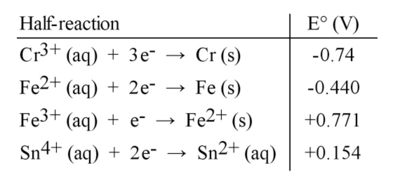
- AA) +0.46
- BB) +0.617
- CC) +1.39
- DD) -0.46
- EE) +1.21
28The standard cell potential (E°cell) for the voltaic cell based on the reaction below is __________ V.
Cr (s) + 3Fe3+ (aq) → 3Fe2+ (aq) + Cr3+ (aq)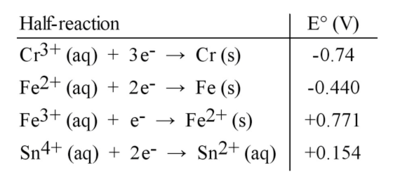
- AA) -1.45
- BB) +2.99
- CC) +1.51
- DD) +3.05
- EE) +1.57
29The standard cell potential (E°cell) of the reaction below is +0.126 V. The value of ΔG° for the reaction is __________ kJ/mol.
Pb (s) + 2H+ (aq) → Pb2+ (aq) + H2 (g)- AA) -24.3
- BB) +24.3
- CC) -12.6
- DD) +12.6
- EE) -50.8
30The standard cell potential (E°cell) of the reaction below is -0.34 V. The value of ΔG° for the reaction is __________ kJ/mol.
Cu (s) + 2H+ (aq) → Cu2+ (aq) + H2 (g)- AA) -0.34
- BB) +66
- CC) -130
- DD) +130
- EE) none of the above
31The standard cell potential (E°cell) of the reaction below is +1.34 V. The value of ΔG° for the reaction is __________ kJ/mol.
3Cu (s) + 2MnO4- (aq) + 8H+ (aq) → 3Cu2+ (aq) + 2MnO2 (s) + 4H2O (l)- AA) -24.3
- BB) +259
- CC) -259
- DD) +776
- EE) none of the above
32Galvanized iron is iron coated with __________.
- AA) magnesium.
- BB) zinc.
- CC) chromium.
- DD) phosphate.
- EE) iron oxide.
33The standard cell potential (E°) of a voltaic cell constructed using the cell reaction below is 0.76 V:
Zn (s) + 2H+ (aq) → Zn2+ (aq) + H2 (g)
With PH2 = 1.0 atm and [Zn2+] = 1.0 M, the cell potential is 0.66 V. The concentration of H+ in the cathode compartment is __________ M.- AA) 2.0 × 10⁻²
- BB) 4.2 × 10⁻⁴
- CC) 1.4 × 10⁻¹
- DD) 4.9 × 101
- EE) 1.0 × 10⁻¹²
34A voltaic cell is constructed with two silver-silver chloride electrodes, where the half-reaction is
AgCl (s) + e- → Ag (s) + Cl- (aq) E° = +0.222 V
The concentrations of chloride ion in the two compartments are 0.0222 M and 2.22 M, respectively. The cell emf is __________ V.- AA) 0.212
- BB) 0.118
- CC) 0.00222
- DD) 22.2
- EE) 0.232
35The standard cell potential (E°cell) for the reaction below is +0.63 V. The cell potential for this reaction is __________ V when [Zn2+] = 3.5 M and [Pb2+] = 2.0 × 10⁻⁴ M.
Pb2+ (aq) + Zn (s) → Zn2+ (aq) + Pb (s)- AA) 0.50
- BB) 0.84
- CC) 0.39
- DD) 0.76
- EE) 0.63
36The standard emf for the cell using the overall cell reaction below is +2.20 V:
2Al (s) + 3I2 (s) → 2Al3+ (aq) + 6I- (aq)
The emf generated by the cell when [Al3+] = 4.5 × 10⁻³ M and [I-] = 0.15 M is ________ V.- AA) 2.20
- BB) 2.32
- CC) 2.10
- DD) 2.39
- EE) 2.23
37The most difficult species to reduce and the poorest oxidizing agent is __________.
- AA) Fr+
- BB) F-
- CC) Li+
- DD) He
38 In a half reaction the amount of a substance that is reduced or oxidized is directly proportional to the number of electrons generated in the cell.
- ATrue
- BFalse
Informações
- Descrição
- Originally chapter 20
- Autor
- Dawn G
- Idioma
- English
- Visualizações
- 1.283
- Etiquetas
- Avaliação
- Ainda sem avaliações Avalie este quiz