
Quiz
Chapter 12- Kinetics
Crie uma conta grátis para terminar este quiz
Salve seu progresso e veja sua nota final.
Já tem uma conta? Inicie sessão
Perguntas do quiz (36)
1At elevated temperatures, dinitrogen pentoxide decomposes to nitrogen dioxide and oxygen:
2N2O5(g) → 4NO2 (g) + O2 (g)
When the rate of formation of O2 is 2.2 × 10⁻⁴ M/s, the rate of decomposition of N2O5 is __________ M/s.- AA) 1.1 × 10⁻⁴
- BB) 2.2 × 10⁻⁴
- CC) 2.8 × 10⁻⁴
- DD) 4.4 × 10⁻⁴
- EE) 5.5 × 10⁻⁴
2Which one of the following is not a valid expression for the rate of the reaction below?
4NH3 + 7O2 → 4NO2 + 6H2O- AA)
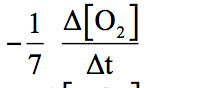
- BB)
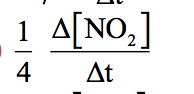
- CC)
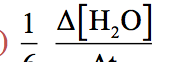
- DD)
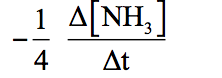
- EE) All of the above are valid expressions of the reaction rate.
- AA)
3The rate law of a reaction is rate = k[D][X]. The units of the rate constant are __________.
- AA) mol L-1s-1
- BB) L mol-1s-1
- CC) mol2 L-2s-1
- DD) mol L-1s-2
- EE) L2 mol -2s-1
4The rate law for this reaction is rate = __________.
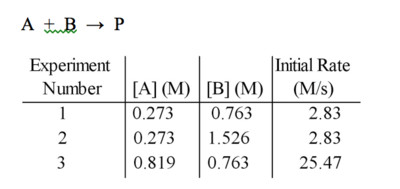
- AA) k[A][B]
- BB) k[P]
- CC) k[A]2[B]
- DD) k[A]2[B]2
- EE) k[A]2
5Under constant conditions, the half-life of a first-order reaction __________.
- AA) is the time necessary for the reactant concentration to drop to half its original value
- BB) is constant
- CC) can be calculated from the reaction rate constant
- DD) does not depend on the initial reactant concentration
- EE) All of the above are correct.
6The reaction
2NO2 → 2NO + O2
follows second-order kinetics. At 300°C, [NO2] drops from 0.0100 M to 0.00650 M in 100.0 s. The rate constant for the reaction is __________ M-1s-1.- AA) 0.096
- BB) 0.65
- CC) 0.81
- DD) 1.2
- EE) 0.54
7A compound decomposes by a first-order process. If 25.0% of the compound decomposes in 60.0 minutes, the half-life of the compound is __________.
- AA) 65 minutes
- BB) 120 minutes
- CC) 145 minutes
- DD) 180 minutes
- EE) 198 minutes
8The following reaction is second order in [A] and the rate constant is 0.025 M-1s-1:
A → B
The concentration of A was 0.65 M at 33 s. The initial concentration of A was __________ M.- AA) 2.4
- BB) 0.27
- CC) 0.24
- DD) 1.4
- EE) 1.2 × 10⁻²
9The rate constant for this reaction is __________ s-1.
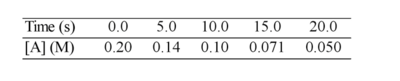
- AA) 6.9 × 10⁻²
- BB) 3.0 × 10⁻²
- CC) 14
- DD) 0.46
- EE) 4.0 × 10²
10The concentration of A is __________ M after 40.0 s.
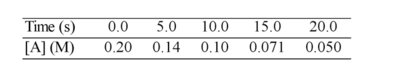
- AA) 1.3 × 10⁻²
- BB) 1.2
- CC) 0.17
- DD) 3.5 × 10⁻⁴
- EE) 0.025
11The rate constant of a first-order process that has a half-life of 225 s is __________s-1.
- AA) 0.693
- BB) 3.08 × 10⁻³
- CC) 1.25
- DD) 12.5
- EE) 4.44 × 10⁻³
12One difference between first- and second-order reactions is that __________.
- AA) the half-life of a first-order reaction does not depend on [A]0; the half-life of a second-order reaction does depend on [A]0
- BB) the rate of both first-order and second-order reactions do not depend on reactant concentrations
- CC) the rate of a first-order reaction depends on reactant concentrations; the rate of a second-order reaction does not depend on reactant concentrations
- DD) a first-order reaction can be catalyzed; a second-order reaction cannot be catalyzed
- EE) None of the above are true.
13At elevated temperatures, methylisonitrile (CH3NC) isomerizes to acetonitrile (CH3CN):
CH3NC (g) → CH3CN (g)
The reaction is first order in methylisonitrile. The attached graph shows data for the reaction obtained at 198.9°C.
The rate constant for the reaction is __________ s-1.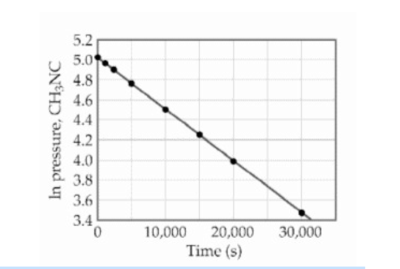
- AA) -1.9 × 10⁴
- BB) +1.9 × 10⁴
- CC) -5.2 × 10⁻⁵
- DD) +5.2 × 10⁻⁵
- EE) +6.2
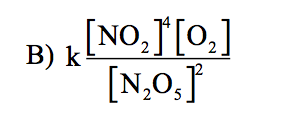
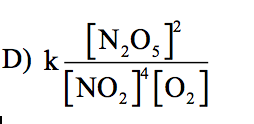
14The decomposition of N2O5 in solution in carbon tetrachloride proceeds via the reaction
2N2O5 (soln) → 4NO2 (soln) + O2 (soln)
The reaction is first order and has a rate constant of 4.82 × 10⁻³ s-1 at 64°C. The rate law for the reaction is rate = __________.- AA) k[N2O5]2
- BB)
- CC) k[N2O5]
- DD)
- EE)2k[N2O5]
15As the temperature of a reaction is increased, the rate of the reaction increases because the __________.
- AA) reactant molecules collide less frequently
- BB) reactant molecules collide more frequently and with greater energy per collision
- CC) activation energy is lowered
- DD) reactant molecules collide less frequently and with greater energy per collision
- EE) reactant molecules collide more frequently with less energy per collision
16The rate of a reaction depends on __________.
- AA) collision frequency
- BB) collision energy
- CC) collision orientation
- DD) all of the above
- EE) none of the above
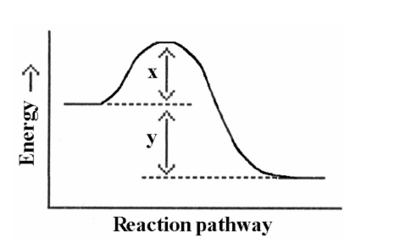
17Which energy difference in the energy profile below corresponds to the activation energy for the forward reaction?
- AA) x
- BB) y
- CC) x + y
- DD) x - y
- EE) y – x
18In the energy profile of a reaction, the species that exists at the maximum on the curve is called the __________.
- AA) product
- BB) activated complex
- CC) activation energy
- DD) enthalpy of reaction
- EE) atomic state
19In general, as temperature goes up, reaction rate __________.
- AA) goes up if the reaction is exothermic
- BB) goes up if the reaction is endothermic
- CC) goes up regardless of whether the reaction is exothermic or endothermic
- DD) stays the same regardless of whether the reaction is exothermic or endothermic
- EE) stays the same if the reaction is first order
20At elevated temperatures, methylisonitrile (CH3NC) isomerizes to acetonitrile (CH3CN):
CH3NC (g) → CH3CN (g)
The dependence of the rate constant on temperature is studied and the graph below is prepared from the results.
The energy of activation of this reaction is __________ kJ/mol.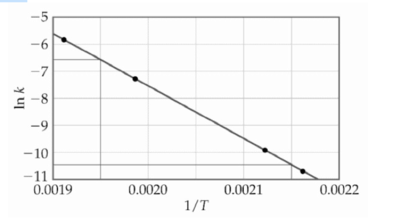
- AA) 160
- BB) 1.6 × 10⁵
- CC) 4.4 × 10⁻⁷
- DD) 4.4 × 10⁻⁴
- EE) 1.9 × 10⁴
21The mechanism for formation of the product X is:
A + B → C + D (slow)
B + D → X (fast)
The intermediate reactant in the reaction is __________.- AA) A
- BB) B
- CC) C
- DD) D
- EE) X
22Which of the following is true?
- AA) If we know that a reaction is an elementary reaction, then we know its rate law.
- BB) The rate-determining step of a reaction is the rate of the fastest elementary step of its mechanism.
- CC) Since intermediate compounds can be formed, the chemical equations for the elementary reactions in a multistep mechanism do not always have to add to give the chemical equation of the overall process.
- DD) In a reaction mechanism, an intermediate is identical to an activated complex.
- EE) All of the above statements are true.
23Of the following, __________ will lower the activation energy for a reaction.
- AA) increasing the concentrations of reactants
- BB) raising the temperature of the reaction
- CC) adding a catalyst for the reaction
- DD) removing products as the reaction proceeds
- EE) increasing the pressure
24A catalyst can increase the rate of a reaction __________.
- AA) by changing the value of the frequency factor (A)
- BB) by increasing the overall activation energy (Ea) of the reaction
- CC) by lowering the activation energy of the reverse reaction
- DD) by providing an alternative pathway with a lower activation energy
- EE) All of these are ways that a catalyst might act to increase the rate of reaction.
25Nitrogen fixation is a difficult process because __________.
- AA) there is so little nitrogen in the atmosphere
- BB) nitrogen exists in the atmosphere primarily as its oxides which are very unreactive
- CC) nitrogen is very unreactive, largely due to its triple bond
- DD) of the extreme toxicity of nitrogen
- EE) of the high polarity of nitrogen molecules preventing them from dissolving in biological fluids, such as those inside cells
26Consider the following reaction:
3A → 2B
The average rate of appearance of B is given by Δ[B]/Δt. Comparing the rate of appearance of B and the rate of disappearance of A, we get Δ[B]/Δt = __________ × (-Δ[A]/Δt).- AA) -2/3
- BB) +2/3
- CC) -3/2
- DD) +1
- EE) +3/2
27Which substance in the reaction below either appears or disappears the fastest?
4NH3 + 7O2 → 4NO2 + 6H2O- AA) NH3
- BB) O2
- CC) NO2
- DD) H2O
- EE) The rates of appearance/disappearance are the same for all of these.
28A flask is charged with 0.124 mol of A and allowed to react to form B according to the reaction A(g) →B(g). The following data are obtained for [A] as the reaction proceeds:
The average rate of disappearance of A between 10 s and 20 s is __________ mol/s.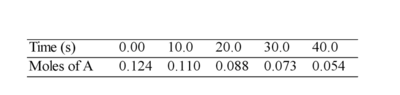
- AA) 2.2 × 10⁻³
- BB) 1.1 × 10⁻³
- CC) 4.4 × 10⁻³
- DD) 454
- EE) 9.90 × 10⁻³
29A flask is charged with 0.124 mol of A and allowed to react to form B according to the reaction A(g) →B(g). The following data are obtained for [A] as the reaction proceeds:
The average rate of appearance of B between 20 s and 30 s is __________ mol/s.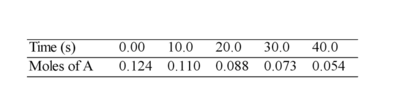
- AA) +1.5 × 10⁻³
- BB) +5.0 × 10⁻⁴
- CC) -1.5 × 10⁻³
- DD) +7.3 × 10⁻³
- EE) -7.3 × 10⁻³
30A reaction was found to be second order in carbon monoxide concentration. The rate of the reaction __________ if the [CO] is doubled, with everything else kept the same.
- AA) doubles
- BB) remains unchanged
- CC) triples
- DD) increases by a factor of 4
- EE) is reduced by a factor of 2
31The half-life of a first-order reaction is 13 min. If the initial concentration of reactant is 0.085 M, it takes __________ min for it to decrease to 0.055 M.
- AA) 8.2
- BB) 11
- CC) 3.6
- DD) 0.048
- EE) 8.4
32A second-order reaction has a half-life of 18 s when the initial concentration of reactant is 0.71 M. The rate constant for this reaction is __________ M-1s-1.
- AA) 7.8 × 10⁻²
- BB) 3.8 × 10⁻²
- CC) 2.0 × 10⁻²
- DD) 1.3
- EE) 18
33The rate of disappearance of HBr in the gas phase reaction
2HBr (g) → H2 (g) + Br2 (g)
is 0.130 Ms-1 at 150°C. The rate of reaction is __________ Ms-1.- AA) 3.85
- BB) 0.0650
- CC) 0.0169
- DD) 0.260
- EE) 0.0860
34Nitrogen dioxide decomposes to nitric oxide and oxygen via the reaction:
2NO2 → 2NO + O2
In a particular experiment at 300 °C, [NO2] drops from 0.0100 to 0.00550 M in 100 s. The rate of appearance of O2 for this period is __________ M/s.- AA) 2.3 × 10⁻⁵
- BB) 4.5 × 10⁻⁵
- CC) 9.0 × 10⁻⁵
- DD) 4.5 × 10⁻³
- EE) 9.0 × 10⁻³
35The reaction
2NOBr (g) → 2 NO (g) + Br2 (g)
is a second-order reaction with a rate constant of 0.80 M-1s-1 at 11°C. If the initial concentration of NOBr is 0.0440 M, the concentration of NOBr after 7.0 seconds is __________.- AA) 0.0276 M
- BB) 0.0324 M
- CC) 0.0353 M
- DD) 0.0480 M
- EE) 0.0402 M
36A particular first-order reaction has a rate constant of 1.35 × 10²s-1 at 25.0°C. What is the magnitude of k at 95.0°C if Ea = 55.5 kJ/mol?
- AA) 9.56 × 10³
- BB) 2.85 × 10⁴
- CC) 576
- DD) 4.33 × 1087
- EE) 1.36 × 10²
Informações
- Descrição
- Originally chapter 14
- Autor
- Dawn G
- Idioma
- English
- Visualizações
- 841
- Etiquetas
- Avaliação
- Ainda sem avaliações Avalie este quiz