
Quiz
P2.1 - Everything in the Specification
Este quiz tem tipos de pergunta que abrem no player de sempre.
Perguntas do quiz (24)
1Label the distance-time graph with the correct descriptions of movement.
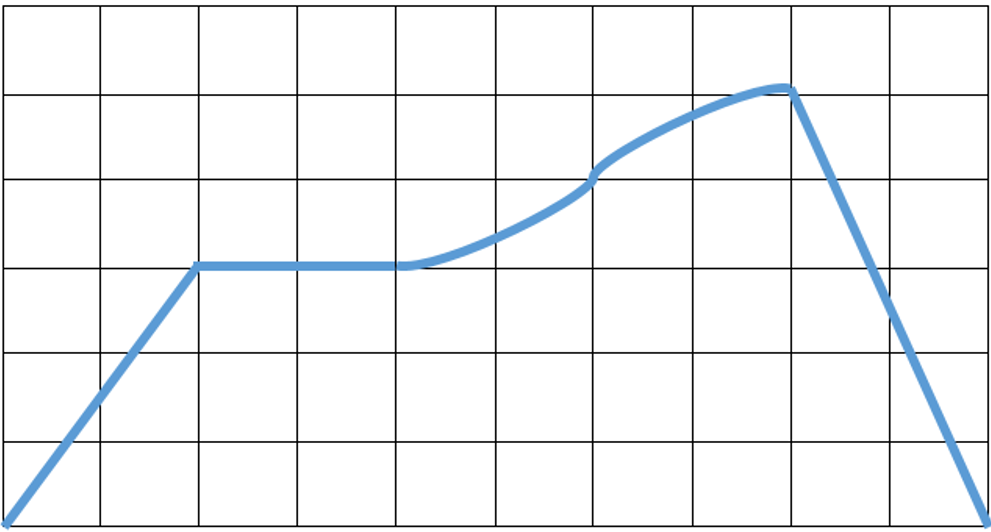
- ASteady speed
- BStopped
- CAcceleration
- DDeceleration
- ESteady speed
2Label the velocity-time graph with the correct descriptions of movement.
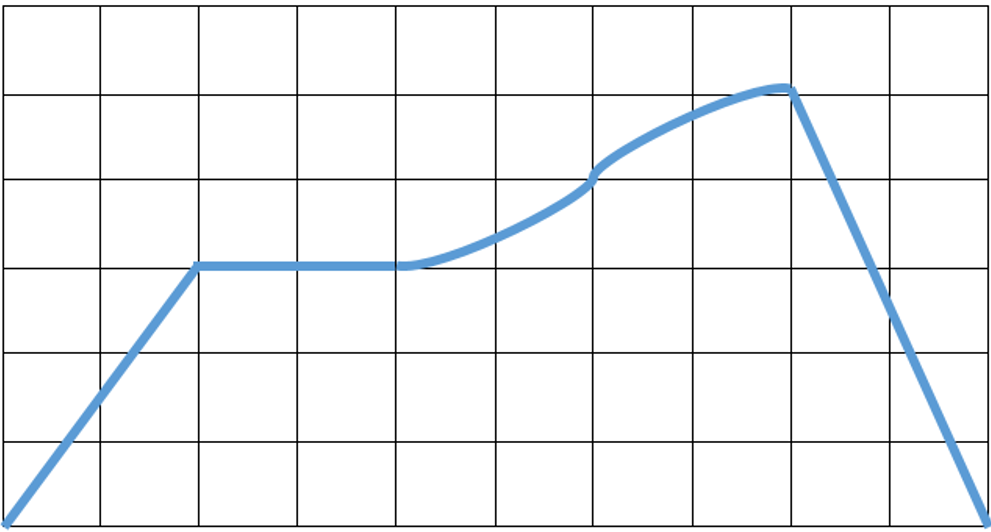
- AAcceleration
- BSteady speed
- CIncreasing acceleration
- DIncreasing deceleration
- EDeceleration
3How is speed calculated from a distance-time graph?
By using the [blank_start]gradient[blank_end].
How is acceleration calculated from a velocity-time graph?
By using the [blank_start]gradient[blank_end].
How is velocity calculated from a velocity-time graph?
By [blank_start]reading[blank_end] the value off of the [blank_start]y-axis[blank_end].
How is distance calculated from a velocity-time graph?
By using the [blank_start]area[blank_end] under the [blank_start]graph[blank_end].- Agradient
- Bgradient
- Creading
- Dy-axis
- Earea
- Fgraph
4Speed is a scalar, velocity is a vector.
- AVerdadeiro
- BFalso
5[blank_start]RESULTANT[blank_end] [blank_start]FORCE[blank_end] - The overall [blank_start]force[blank_end] acting on an [blank_start]object[blank_end].
- ARESULTANT
- BFORCE
- Cforce
- Dobject
6If the [blank_start]resultant force[blank_end] acting on a [blank_start]stationary[blank_end] object is:
- [blank_start]zero[blank_end], the object will remain [blank_start]stationary[blank_end]
- non-zero, the object will [blank_start]accelerate[blank_end] in the [blank_start]direction[blank_end] of the [blank_start]resultant force[blank_end]
If the resultant force acting on a moving object is:
- [blank_start]zero[blank_end], the object will continue to move at a [blank_start]constant[blank_end] [blank_start]velocity[blank_end]
- [blank_start]non-zero[blank_end], the object will [blank_start]accelerate[blank_end] in the [blank_start]direction[blank_end] of the [blank_start]resultant force[blank_end]- Aresultant force
- Bstationary
- Czero
- Dstationary
- Eaccelerate
- Fdirection
- Gresultant force
- Hresultant force
- Idirection
- Jaccelerate
- Kzero
- Lnon-zero
- Mconstant
- Nvelocity
7What happens (in terms of forces) when two objects interact?
- AThey exert equal and opposite forces on each other.
- BThey exert equal and opposite forces on themselves.
- CThe bigger object exerts a greater force on the smaller object.
- DThey exert equal forces on each other.
- EThey exert forces in the opposite direction on each other.
8What are the four factors that affect thinking distance?
- ATiredness, drugs, alcohol, speed of car
- BTiredness, drugs, brake quality, speed of car
- CAlcohol, drugs, speed of car, grip
- DFriction, tiredness, alcohol, drugs
- ESpeed of car, alcohol, tyre quality, tiredness
- FGrip, tiredness, alcohol, brake quality
- GTiredness, grip, brake quality, drugs
9What are the four factors that affect braking distance?
- ASpeed of car, grip, tyre quality, brake quality
- BSpeed of car, tyre quality, brake quality, tiredness
- CTyre quality, grip, alcohol, drugs
- DGrip, tiredness, speed of car, brake quality
- EGrip, speed of car, tyre quality, alcohol
- FBrake quality, tyre quality, drugs, tiredness
- GTiredness, drugs, speed of car, grip
10[blank_start]STOPPING[blank_end] DISTANCE - The [blank_start]distance[blank_end] covered in the [blank_start]time[blank_end] between the driver first spotting a [blank_start]hazard[blank_end] and the vehicle coming to a complete [blank_start]stop[blank_end]. It is the [blank_start]sum[blank_end] of the [blank_start]thinking[blank_end] distance and the braking distance.
- ASTOPPING
- Bhazard
- Cdistance
- Dtime
- Estop
- Fsum
- Gthinking
11[blank_start]THINKING[blank_end] DISTANCE - The [blank_start]distance[blank_end] the vehicle travels during the driver's [blank_start]reaction[blank_end] time.
- ATHINKING
- Bdistance
- Creaction
12[blank_start]BRAKING[blank_end] DISTANCE - The [blank_start]distance[blank_end] the car travels under the [blank_start]braking[blank_end] force.
- ABRAKING
- Bdistance
- Cbraking
13Complete the passage about the role of brakes in a car.
When the [blank_start]brakes[blank_end] of a vehicle are applied to slow the car down, work is done by the [blank_start]frictional[blank_end] force between the [blank_start]brakes[blank_end] and the [blank_start]wheel[blank_end]. This force reduces the [blank_start]kinetic[blank_end] energy of the vehicle, as energy is [blank_start]transferred[blank_end] into [blank_start]heat[blank_end] (and sound) energy. Therefore, the [blank_start]temperature[blank_end] of the brakes [blank_start]increase[blank_end].- Abrakes
- Btemperature
- Cincrease
- Dfrictional
- Ebrakes
- Fwheel
- Gkinetic
- Htransferred
- Iheat
14When a vehicle travels at a constant speed, the resistive forces are balanced with the car's weight.
- AVerdadeiro
- BFalso
15The [blank_start]faster[blank_end] an object moves through a [blank_start]fluid[blank_end], the [blank_start]greater[blank_end] the [blank_start]frictional[blank_end] force that acts on it.
- Afaster
- Bslower
- Cfluid
- Dgas
- Eliquid
- Fair
- Gsolid
- Hgreater
- Ismaller
- Jfrictional
- Kkinetic
- Lbraking
- Mresistant
- Nresultant
16Which of the following statements is false?
1. 'Drag' is another name for air resistance.
2. Friction always opposes movement, even in space.
3. To travel at a steady speed, the driving force and frictional force must be balanced.
4. Friction occurs between two surfaces in contact.
5. Speed is directly proportional to friction.- A1
- B2
- C3
- D4
- E5
17Fill in the blanks to complete the table showing the movement of an object falling through a fluid.
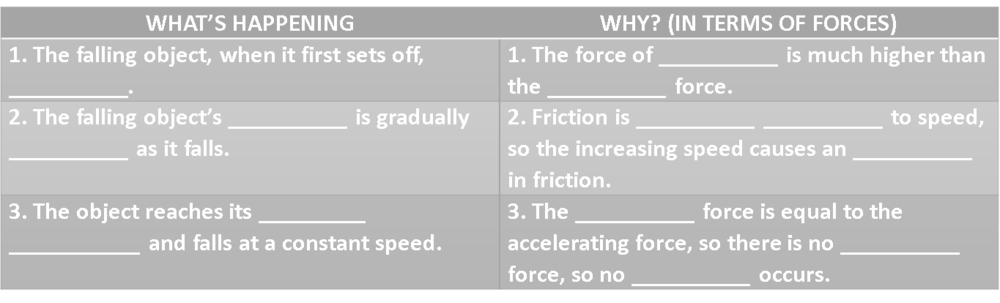
- Aaccelerates
- Bacceleration
- Creduced
- Dterminal
- Evelocity
- Facceleration
- Gfrictional
- Hresultant
- Igravity
- Jfrictional
- Kdirectly
- Lproportional
- Mincrease
18What are the two factors that impact the terminal velocity of a falling object?
- AShape and area.
- BSpeed and area.
- CWeight and speed.
- DWeight and shape.
- EShape and speed.
- FArea and weight.
19Select the correct answers to explain the movement, in terms of forces, of the parachutist at each stage.
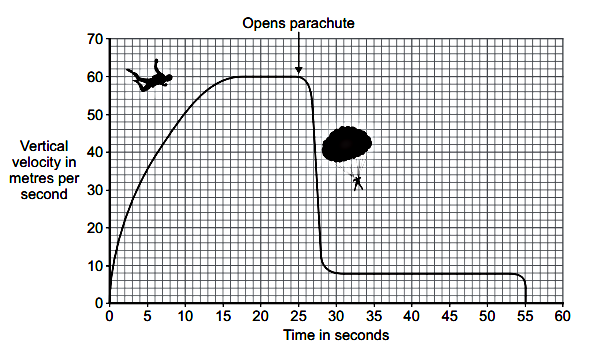
- AGravity is greater than friction.
- BGravity is less than friction.
- CGravity is the same as friction.
- DForces are directly proportional.
- EForces are inversely proportional.
- FForces are balanced.
- GFriction and gravity are balanced.
- HFriction and gravity are not balanced.
- IFriction and drag are balanced.
- JAir resistance is greater than gravity.
- KAir resistance is less than gravity.
- LAir resistance is the same as gravity.
- MFriction and gravity are balanced.
- NFriction and gravity are not balanced.
- OFriction and drag are balanced.
20[blank_start]ELASTIC[blank_end] [blank_start]OBJECT[blank_end] - An object that can return to its [blank_start]original[blank_end] [blank_start]shape[blank_end] after having its [blank_start]shape[blank_end] changed by a [blank_start]force[blank_end].
- AELASTIC
- BOBJECT
- Coriginal
- Dshape
- Eshape
- Fforce
21When you apply a [blank_start]force[blank_end] to an object, you may cause it to change its [blank_start]shape[blank_end]. A [blank_start]force[blank_end] applied to an [blank_start]elastic[blank_end] object in order to change its [blank_start]shape[blank_end] is stored by the object as [blank_start]elastic[blank_end] potential energy. The [blank_start]elastic[blank_end] potential energy is then converted to [blank_start]kinetic[blank_end] energy when the [blank_start]force[blank_end] is removed, and the object returns to its original [blank_start]shape[blank_end].
- Ashape
- Bforce
- Cforce
- Delastic
- Eshape
- Felastic
- Gelastic
- Hkinetic
- Iforce
- Jshape
22The extension of an elastic object is inversely proportional to the force applied to it.
- AVerdadeiro
- BFalso
23[blank_start]LIMIT[blank_end] OF [blank_start]PROPORTIONALITY[blank_end] - The [blank_start]maximum[blank_end] force that an [blank_start]elastic[blank_end] object can take and still extend [blank_start]proportionally[blank_end].
- ALIMIT
- BPROPORTIONALITY
- Cmaximum
- Delastic
- Eproportionally
24When a car is [blank_start]aerodynamic[blank_end], it means that it is shaped so that [blank_start]air[blank_end] flows very easily and smoothly past it, so [blank_start]air[blank_end] [blank_start]resistance[blank_end] is minimised.
- Aaerodynamic
- Bair
- Cresistance
- Dair
Informações
- Descrição
- A quick quiz on everything outlined in the AQA specification for P3.1.
- Autor
- Harry Woodhall
- Idioma
- English
- Visualizações
- 24
- Etiquetas
- Avaliação
- Ainda sem avaliações Avalie este quiz