
Planes
Slides do conjunto (4)
-
- - In order to find a plane parallel to another plane (e.g. 2x+3y-4z=1) , we can change the right hand side (e.g. 2x+3y-4z=3) . We can also multiply through by a number (e.g. 3x+6y-8z = 2)
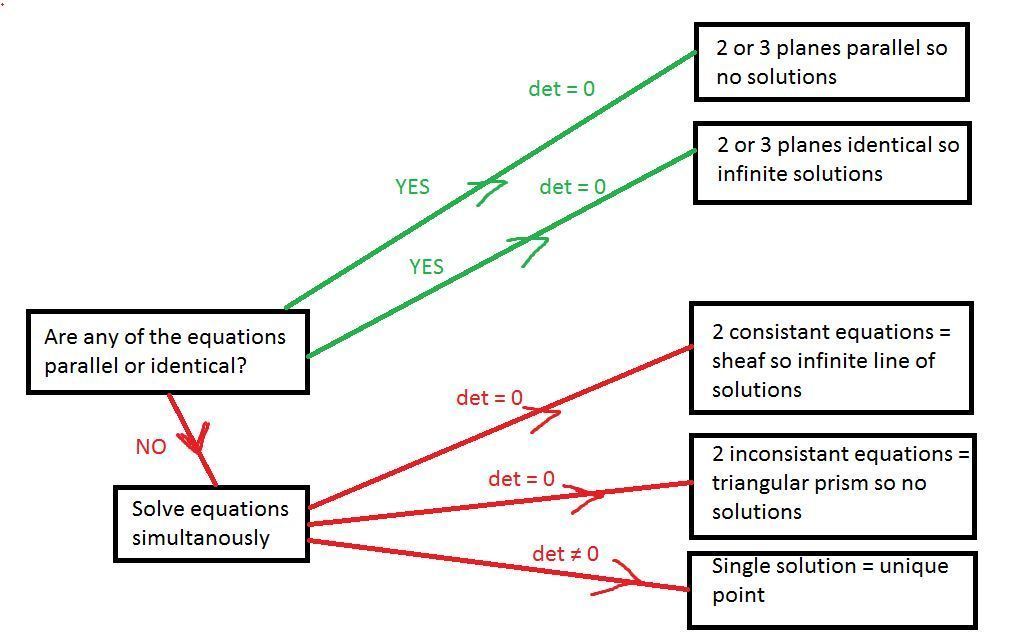
- - Geometrically, 2 planes can be formed in 3 different ways: 1. The 2 planes are parallel , equations have no solutions , so is inconsistent. 2. The 2 planes are identical, the equations have infinite solutions, so is consistent. 3. The 2 planes intersect along a line , the equations have infinite solutions , so is consistent.
- - When : 1. 3 planes are identical , they have infinite solutions and are consistent. 2. 2 planes are identical and 1 parallel , there are no solutions and are inconsistent 3. 3 planes are parallel , there are no solutions and are inconsistent
- - When : 1. 2 planes are parallel and 1 is in a different direction , equations have no solutions and are inconsistent 2. 2 planes are identical and 1 is in a different direction , there are infinite solutions and are consistent
- - If no planes are parallel there are 3 different geometrical solutions : 1. Forms a triangular prism (no point lies on all 3 planes , so no solutions and consistent) 2. Forms sheaf (line of points that lie on all 3 planes , infinite line of solutions , consistent) 3. All intersect at a single point (unique point that lies on all 3 planes , single solution , consistent , determinant ≠ 0 )
- - Note consistent / inconsistent is NOT the same as solutions / no solutions !!
- - An equation parallel to 5x+3y=8 is 5x+3y = c , where c≠8 . If c=8 , the equations are identical
- -Cartesian equation of a plane is defined by: ax + by +cz = d
- - 2 planes are parallel if the coefficients of x,y and z are the same, but the RHS is not
-
- Determine the geometrical solutions of:
- 1. 2y+z+3x-8 = 0 , 6x+4y = 16+2z , 3x+z = 8-2y : 3x+2y+z = 0 , 6x+4y-2z = 16 (same as 3x+2y-z = 8) , 3x+2y+z = 8 . As we can see, 2 of these planes are identical , and if we put these equations into our simultaneous equation mode on the calculator, we get infinite solutions , so we now know 2 planes are identical and 1 is in a different direction
- Use elimination to determine the geometrical solutions to:
- 1. x+3y+5z = 8 , x+y+2z = 3 , 2x+4y+2z = 0 : det=0 , R1 - R2 ; 2y+3y = 5 , R3 - 2R2 ; 2y+3z = 3 , these have no solutions are are inconsistent , therefore it's a triangular prism
- 2. 4x+y-z = 8 , 7x+3y = 9 , 3x+y+z = 1 : det = 0 , R1+R3 ; 7x+2y = 9 , which is identical to R2 , line of infinite solutions , consistent and therefore it's a sheaf
- 3. x-y+5z = 4 , x+y+2z = 17 , 2x+4y+z = 53 : det ≠ 0 , therefore all intersect at a point. To find this point , we find the inverse (matrix), multiply it by [4][17][53] and get (7,8,1) .
-
Finding equation of line via parameterising
- Find geometrical solutions of : x-3y+4z = 4 , 2x-y+3z = 8 , 3x+y+2z = 12
- R2 + R3 = 5x+5z=20 = x+z = 4 , 3R3 + R1 = 10x+10z=40 , x+z = 4 ; these are consistent so therefore it's a sheaf
- We can say the line of the sheaf: r = a + λb , and we parameterise and let x =λ
- Now x+z=4 is the same as λ+z = 4 , so z = 4-λ .
- For simplicity, choose R3 (as no negatives) , 3x+y+2z = 12 becomes: 3(λ) + y + 2(4-λ) = 12 which can be rearranged for y=4-λ
- We know : x=λ , in longer terms , x = 0 + (1)λ , y=4-λ , in longer terms , y = 4 + (-1)λ , z=4-λ which is also y = 4 + (-1)λ
- We can finally put this into the vector equation: r = [0][4][4] + λ [1][-1][-1]
-
How to find geometrical solutions (flow ch.)
Informações
- Descrição
- Planes
- Criado por
- Doc Boff · ago 2019
- Atualizado
- 6 out 2019
- Visualizações
- 2
- Avaliação