
Ionisation
Slides do conjunto (3)
-
How some EM Radiation causes Ionisation
- All substances are made of atoms and molecules
- All atoms have electrons orbiting them
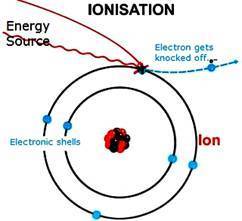
- When a photon hits an atom or molecule, if it has enough energy, it can remove an electron
- This changes the atom or molecule
- This process is called Ionisation...
- The changed atoms or molecules go on to initiate other chemical reactions
- It takes a lot of energy to remove an electron
- So only the EM Radiations that at have high enough photon energy can cause ionisation.
- These are ultraviolet, X-rays and gamma rays
- These types of electromagnetic radiation are called ionising radiation
- Some substance (radioactive materials) emit ionising gamma radiation all the time
- Hence why radioactive materials are so dangerous!!
- Legenda: Ionisation: the energy source (photons) hit into the orbiting shells where the electrons are and knock one off
-
- If it happens in your cells, it is very dangerous
- The cells contain very important molecules, such as DNA molecules
- DNA contain the instructions for the cell and are important in cell division - when new cells are made
- If your cells are exposed to ionising radiation, DNA molecules can become damaged. This can cause mutations.
- So, the cells may start to divide over and over again, without stopping....this is CANCER.
- Very high doses of radiation can kill your cells....this is radiation sickness
- We're all exposed to ultraviolet light from the sun. UV radiation is ionising so if you stay in it long enough, it can damage living cells in the skin.
- This can lead to sunburn or even skin cancer.
- Increased exposure means more damage.
- So, the longer you're exposed the more damage it will cause.
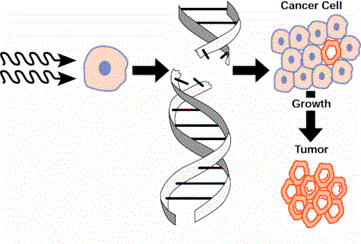
- Legenda: The damaged cell has had its DNA damage too, and it is now a mutated cell. It then divides and makes more mutated cells, causing a larger amount of mutated cells, which is basically cancer.
-
Protection against dangerous radiation...
- UV Radiation
- Easily protect
- Using physical barriers - such as clothes or sunscreen or sunblock
- X-Rays
- When having an X-ray, the radiographer puts lead shields over parts of the body that aren't being investigated
- Lead absorbs the X-ray, protecting you from any unnecessary exposure
- Radiographers also where lead aprons or stand behind concrete to protect themselves
- X-Rays - what do they do?
- Radiographers take X-ray pictures to see if you have broken bones
- X-rays pass easily through flesh
- BUT are absorbed by denser materials like bone and metal
- So it's the varying amount of radiation absorbed that makes an X-ray image.
- X-ray imaging also used in airports
- Checks the contents of passengers bags
Informações
- Descrição
- GCSE Physics (P2) Slides sobre Ionisation, criado por Elizabeth Kelly em 30-04-2016.
- Criado por
- Elizabeth Kelly
- Visualizações
- 0
- Avaliação